



| Contents |
|---|

Introduction
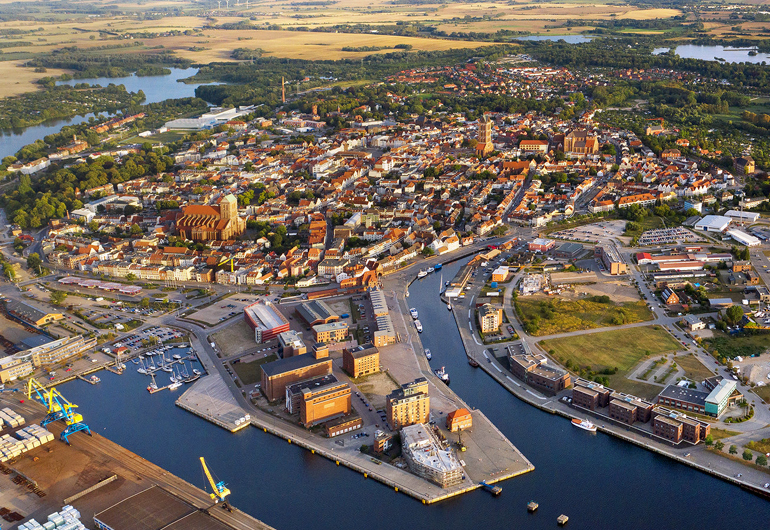
Strategically sited on a promontory on the Bay of Wismar, facing Poel Island, Wismar (pop. 44,000) started life in the 13th century as a Hanseatic town. In 1648, at the closing of the Thirty Years' War, it became Swedish and remained it until 1903.
The city's architectural character is defined by its distinctive Brick Gothic style, showcased by the three great churches of St. George, St. Nicholas, and the remaining tower of St. Mary's. The vast market square, one of Germany's largest, and the historic old harbour further testify to its past importance as a trading centre. Wismar's Brick Gothic historic centre is now protected by the UNESCO as a World Heritage Site.
Interesting Facts about Wismar
- Wismar is a Baltic Sea Hanseatic city founded in 1226 and renowned for its well-preserved medieval layout and Brick Gothic architecture.
- The Historic Centres of Stralsund and Wismar were inscribed together as a UNESCO World Heritage Site in 2002 for their Hanseatic urban fabric and Gothic brick churches.
- From the Peace of Westphalia in 1648, Wismar came under Swedish rule for over two centuries, leaving a distinct Swedish architectural and cultural imprint.
- Wismar’s vast Market Place is among the largest in northern Germany and features the ornate Renaissance Wasserkunst fountain, once a vital water source for the town.
- The harbour shaped Wismar’s prosperity in the Hanseatic era, with the old port area still showcasing historic warehouses and maritime character.
- The soaring churches of St Nicholas and the surviving tower of St Mary exemplify North German Brick Gothic and testify to the city’s medieval prominence.
- Many historic buildings survived the Second World War with comparatively limited damage, helping preserve the Altstadt’s authentic streetscapes.
- Wismar’s World Heritage House offers free exhibitions that trace the city’s evolution, including a restored early 19th-century panoramic wallpaper room by Dufour & Leroy.
- The Alter Schwede townhouse on the Market Place, dating to around 1380, is one of Wismar’s most photographed medieval brick façades.
- Wismar’s population is about 44,000, reflecting its role as a compact regional centre with a university and active port on the Baltic.
History
Whilst Wismar's exact founding date remains uncertain, the settlement was first documented in 1229, by which time it had already established civic rights. Founded under Henry Borwin I, Lord of Mecklenburg from the House of Mecklenburg—a German dynasty of Slavic origin also known as the Obotrites—the city developed from Slavic territory that had previously belonged to the Western Slavic Obotrites. By 1259, Wismar had joined the powerful Hanseatic League, entering into a defensive agreement with Lübeck and Rostock to counter Baltic piracy. The city flourished as a major trading hub specialising in herring and beer, and by the 13th and 14th centuries had grown into one of the most prosperous Hanseatic centres, with wool processing becoming another significant industry.
The most distinctive chapter in Wismar's history began following the Thirty Years' War, when the Peace of Westphalia in 1648 transferred the city to Swedish control. Under Swedish rule, Wismar became the administrative centre for Swedish dominions in the Holy Roman Empire, with the Fürstenhof (prince's court) serving as the supreme court seat after 1653. The Swedes significantly expanded the city's fortifications under Field Marshal Erik Dahlbergh, creating an impressive all-round defence system, remnants of which can still be seen today in locations such as the Lindengarten. During the Scanian War, Danish forces briefly captured the city in 1675, but Swedish control was restored. This Scandinavian influence lasted remarkably long—whilst Sweden ceded administrative control to the Grand Duchy of Mecklenburg-Schwerin in 1803 for 1,258,000 Riksdalers, Sweden retained the right of redemption for 100 years. It wasn't until 1903 that Sweden finally renounced all claims to the city, making it fully German once more.
Throughout its turbulent history, Wismar developed into a masterpiece of Baltic brick Gothic architecture that would eventually earn it UNESCO World Heritage status in 2002. The city's three magnificent churches—St. George's, St. Nicholas', and St. Mary's (of which only the tower remains standing)—dominated the skyline and exemplified the characteristic building techniques of the region. Despite suffering significant damage during World War II, Wismar's medieval town centre survived, showcasing the distinctive gabled patrician houses and Hanseatic building types such as the Dielenhaus and Kemläden that were developed in the 14th century. The city has preserved its medieval harbour basin and continues to celebrate its Swedish heritage with an annual "Sweden Celebration". Today, Wismar represents one of the finest examples of Hanseatic architecture and urban planning, serving as a living testament to centuries of Baltic trade, Swedish administration, and Germanic cultural heritage.
Main Attractions
Market Square (Marktplatz)
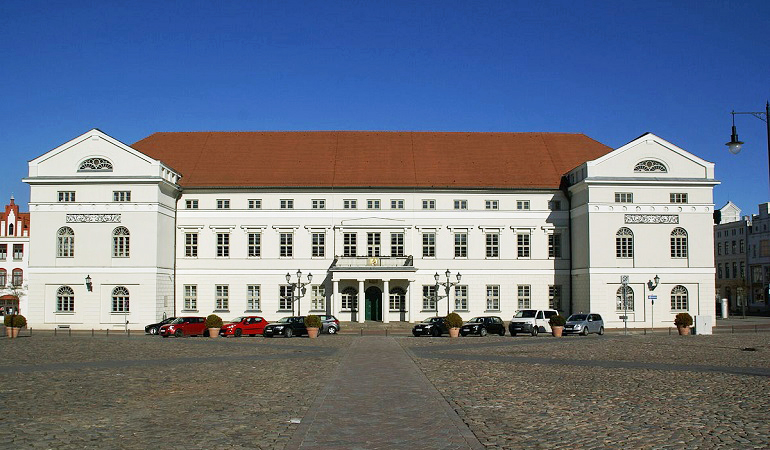
Wismar’s Market Square is among the largest in northern Germany and functions as the principal civic space, edged by the neoclassical town hall, gabled merchant houses and the landmark Wasserkunst. Regular markets and events use the open expanse, while the square’s rectangular plan reflects medieval urban planning principles tied to trade and administration. From here, the main axes lead towards the churches and to the harbour, making it the most efficient starting point for a self-guided walking tour. The uniform paving and open sightlines also help visitors understand the city’s protected Old Town ensemble status.

Wasserkunst am Markt
The Wasserkunst on the Market Square is an ornate, domed waterworks structure that formed part of Wismar’s historic public water supply, originally channelling and distributing drinking water to the town. Built in the late Renaissance tradition with later alterations, it combines decorative metalwork, stone basins and a polygonal plan, standing at the centre of one of northern Germany’s largest medieval market squares. Its placement underscores the civic importance of reliable water provision in a Hanseatic trading city, and it serves as a convenient reference point for navigating the Old Town. The surrounding gabled merchant houses, town hall, and regular markets make it a logical stop on a walking route.

Town Hall (Rathaus)
Wismar’s Town Hall stands on the north side of the Market Square and is distinguished by its neoclassical façade, which dates from reconstruction in the early 19th century following earlier designs. While the exterior conveys a sense of official civic order, the building incorporates older structural elements, reflecting the site’s long administrative history. The town hall has continuously housed the municipal government and remains a hub for local political life and public ceremonies. Publicly accessible areas often include representative rooms and historic council chambers, illustrating the evolution of urban governance in this Hanseatic city.
Gewölbe (The Vault)
The Gewölbe, or The Vault, is a historic Gothic vaulted cellar situated beneath the Market Square in Wismar. Originally used for storage and as a secure trading facility by local merchants, it exemplifies medieval brick construction and the city’s longstanding commercial traditions. The extensive ribbed vaults and sturdy pillars are characteristic of Hanseatic urban architecture. Today, the Gewölbe often serves as an atmospheric venue for exhibitions, events, or guided tours, offering visitors a tangible sense of Wismar’s mercantile past and the practical measures taken to support and protect valuable goods within the bustling market district.
Grube Canal and Bridge Ensemble
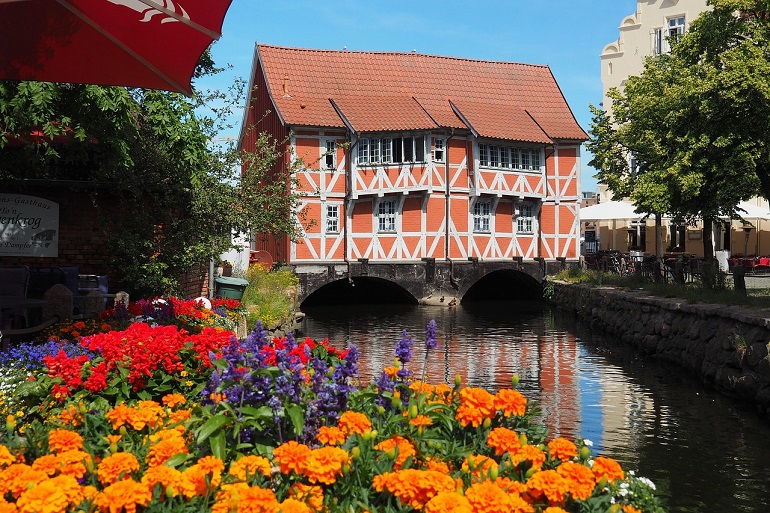
The Grube is a medieval watercourse running through the Old Town with small bridges and adjacent brick façades that demonstrate the integration of drainage, milling and urban planning in a Hanseatic context. Short sections along Schweinsbrücke and related streets provide intact views of the canal’s course and its role in servicing crafts and households. The ensemble is best appreciated during a slow walk between the market area and the harbour, where it links civic, commercial and domestic urban layers.

St Mary’s Church Tower (St.-Marien-Kirchturm)
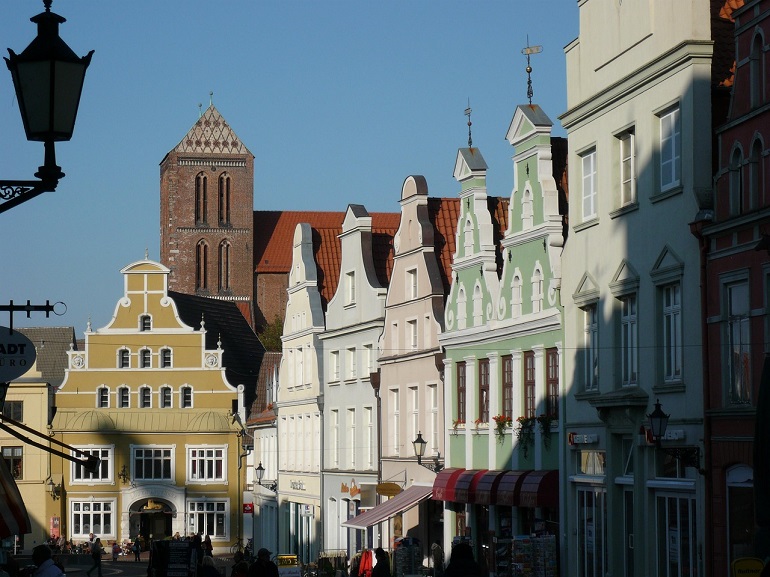
St.-Marien-Kirchturm is the surviving tower of Wismar’s former main parish church, a monumental Brick Gothic structure largely destroyed in the Second World War and later demolished, leaving the tower as a landmark and memorial. The tower illustrates the scale and style of Hanseatic ecclesiastical architecture, with characteristic red brick, tall lancet openings, and buttressing typical of the Baltic region. Inside, exhibitions often explain the church’s history, wartime damage, and post-war urban development decisions that led to the preservation of the tower alone. The surrounding Marienkirchhof offers a clear footprint of the former nave, helping visitors visualise the original plan and the relationship between the great parish churches that once dominated Wismar’s skyline.
St.-Georgen-Kirche with Observation Platform
St.-Georgen-Kirche is a major Brick Gothic hall church restored after extensive wartime damage, now used for cultural events and as a vantage point over the city. The observation platform, reached by lift and stairs depending on current arrangements, offers an unobstructed view of Wismar’s street grid, Marienkirchturm, Nikolaikirche, and the harbour basin. Inside, the church’s spacious nave highlights the engineering of late medieval brick vaulting and the scale typical of Hanseatic parish churches. Because of its central position, the platform is one of the most efficient ways to grasp the Old Town’s layout before continuing on foot.
Nikolaikirche (St Nicholas’ Church)
Nikolaikirche, dedicated to the patron saint of sailors and merchants, is one of the tallest Brick Gothic churches on the Baltic and an essential component of Wismar’s medieval skyline. Its vast hall interior and soaring choir convey the prosperity of a trading city that invested heavily in ecclesiastical architecture. Surviving medieval elements, later restorations, and the church’s maritime associations make it a logical stop on a thematic route connecting commerce, shipbuilding and religion. The approach streets around the church also preserve segments of historic urban fabric, offering context for the church’s relationship to the old harbour.
Alter Hafen (Old Harbour)
The Old Harbour remains the most tangible expression of Wismar’s Hanseatic maritime identity, with historic quays, warehouses and basins still framing fishing boats and excursion craft. The quaysides provide level promenades for viewing the basin, ship movements and the silhouettes of the Old Town churches. Seasonal kiosks and fish stands underline the working character of the harbour, while adjacent piers are common departure points for short boat trips in the bay. The area links directly to the Wassertor and to industrial heritage remains further along the waterfront, making it suitable for a linear walk that combines history and contemporary port activity.
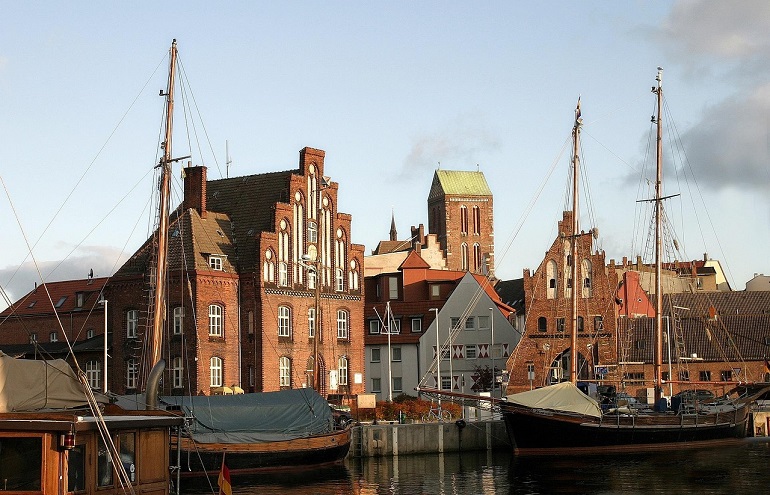
Wassertor
Wassertor is Wismar’s surviving waterside city gate, a 15th-century Brick Gothic portal that once connected the fortified town directly to the harbour. Its robust brickwork, crow-stepped gables and pointed arch illustrate the town’s medieval defensive system and the strategic value of its port. Standing at the interface of Old Town and waterfront, the gate introduces the maritime quarter and works well as a staging point for a harbour circuit. Interpretive panels in the vicinity typically outline the gate’s historical role, and the open setting allows clear views for photography and orientation.
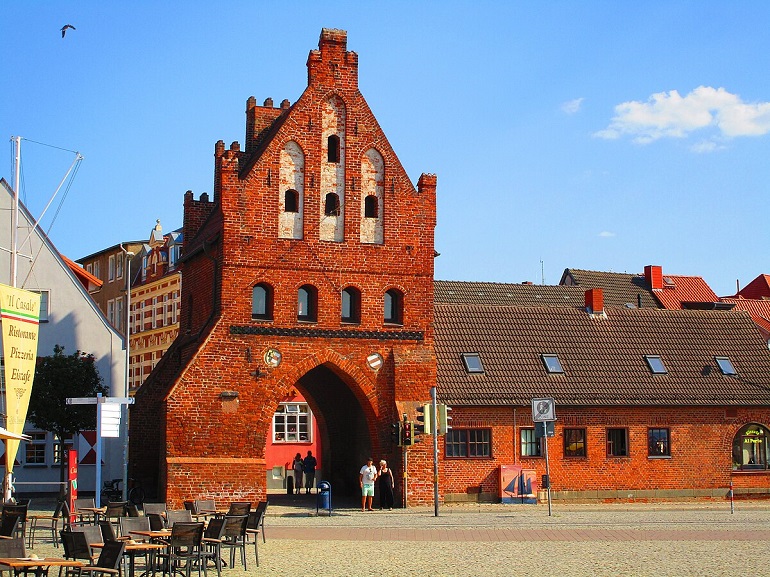
Poeler Tor Bastion Remains and City Fortifications
Although most of Wismar’s medieval walls and gates have disappeared, sections of bastions and earthworks near the former Poeler Tor outline the extent of the early modern fortifications. These remains help interpret how Wismar transitioned from medieval walls to more complex bastioned systems capable of resisting artillery, particularly relevant during Swedish rule when Wismar served as a fortified base. Walking paths and signage in this area typically allow a brief but informative stop that complements visits to the Wassertor and the harbour.
Baumhaus (Boathouse/Waterfront Building)
The Baumhaus is an 18th-century harbour structure historically associated with controlling access to the port and handling naval stores, illustrating the regulatory framework of a Hanseatic harbour. Positioned on the Old Harbour, it complements the Wassertor by showing the civilian and logistical side of waterfront management rather than purely defensive elements. Its sturdy brick construction and proximity to moorings help explain how goods and vessels were processed. Together with other quayside buildings, it supports a coherent reading of Wismar’s maritime infrastructure.
Am Ziegenmarkt and Old Town Streetscape
Am Ziegenmarkt and surrounding streets present a compact urban square framed by restored gabled houses that typify Wismar’s merchant architecture. The area connects to a network of narrow lanes with brick and plaster façades, stepped or curved gables, and traditional plot widths. This streetscape is useful for understanding how trade wealth translated into domestic architecture and how plots were subdivided or rebuilt after wartime damage. It is also a practical waypoint en route between Nikolaikirche and the harbour.
Fürstenhof (Former Ducal Residence)
The Fürstenhof is a Renaissance complex that served as the residence of the Mecklenburg dukes following Wismar’s period under Lübeck’s and later Swedish influence. Its façades exhibit early Renaissance ornament translated into brick and stone typical of the region, with round-arched portals and decorative friezes. The building complex sits near St Mary’s and forms part of a cluster of high-value monuments within easy walking distance. Although primarily used by administrative functions today, its courtyard and exterior can be viewed from the street, making it a concise architectural stop on an Old Town circuit.
Seebad Wendorf (Wendorf Beach)
Seebad Wendorf is Wismar’s local seaside area on Wismar Bay, offering a small sandy beach, a pier and direct access to sheltered waters suitable for bathing in season. Facilities are straightforward, with paths, seating and access points supporting short visits or an extended break from an Old Town itinerary. The location provides a different perspective on the city, linking the urban core with the broader coastal geography and the shipping routes that underpin Wismar’s maritime economy.
Tierpark Wismar (Wismar Zoo)
Tierpark Wismar is a compact, family-oriented zoo and animal park that focuses on accessible encounters with species such as bison, lemurs and fallow deer alongside domestic breeds in a petting area. Flat, well-maintained paths and on-site facilities support an easy visit, with feeding times and children’s play spaces adding structure for those planning a half-day stop. As it sits next to Bürgerpark, both can be combined in a single outing, with the zoo providing the more structured activity and the park offering unprogrammed time outdoors. Parking is straightforward, and the site is manageable for those seeking lighter walking.
Bürgerpark Wismar
Bürgerpark is Wismar’s largest landscaped park, created on former fairgrounds to provide open green space with ponds, meadows, and mixed woodland suitable for walking and cycling. A 37-metre lookout tower provides a straightforward vantage point over the park and towards the city, useful for orienting a visit. The grounds include children’s play areas, picnic tables, and broad paths suitable for prams and wheelchairs, making it a practical stop for families and multi-generational groups. Adjoining leisure facilities and seasonal events mean the park functions both as a relaxation area and as an activity zone, with waymarked loops enabling short or longer circuits.
Top Museums
City History Museum of Wismar (Schabbell)
Housed within authentic 16th-century townhouses, the City History Museum of Wismar presents the fascinating story of this Hanseatic city through engaging exhibits and multimedia presentations. The museum's setting itself is remarkable, occupying historic merchant houses that exemplify the architectural grandeur of Wismar's prosperous past. Visitors can explore comprehensive displays chronicling the city's development from its medieval origins through its role in the powerful Hanseatic League to its modern evolution. The museum features audio and video presentations that bring the city's rich heritage to life, making it an ideal starting point for understanding Wismar's cultural significance.
phanTECHNIKUM - Technical State Museum of Mecklenburg-Vorpommern
The phanTECHNIKUM stands as the largest technical museum in the region, offering an interactive journey through the history of technology and inventions. This substantial museum houses a collection of approximately 6,500 objects that span centuries of technological development. The museum's approach emphasises hands-on learning, with numerous interactive exhibits that allow visitors to engage directly with historical machinery and scientific principles.
The museum regularly hosts explosive laboratory demonstrations and offers specialised workshops in its technikSCHULE, where visitors can develop skills such as welding under supervision. Recent additions include the innovative FOKUS:INNOVATION exhibition area, which showcases contemporary regional technological developments, including sustainable building materials made from seagrass by the local company Build Blue.
The phanTECHNIKUM also maintains an impressive outdoor display, featuring massive propeller casting models donated by Mecklenburger Metallguss GmbH. These imposing pieces, including one nearly five metres tall weighing 1.8 tonnes, demonstrate the region's continued excellence in maritime engineering and metallurgy.
St. Marien Church Tower (St.-Marien-Kirchturm)
The towering remnant of what was once Wismar's most magnificent church now serves as both a historical landmark and exhibition space. The 80-metre-high tower is all that remains of the original Backstein basilica, which was destroyed during World War II bombing and subsequently demolished in 1960.
The tower houses rotating exhibitions in its North Chapel, whilst the South Chapel features the "Dialog des Geistes" (Dialogue of the Spirit), an evocative installation combining terracotta figures with lighting effects. This multimedia presentation features six historical figures representing different cultures and religions, brought to life through original quotations spoken by acclaimed actor Bruno Ganz. The installation explores themes of faith, creation, and cross-cultural dialogue.
At the tower's base, visitors can explore a demonstration brick-making facility that illustrates the traditional techniques used to create the distinctive red bricks that define Wismar's architectural character. The tower's remarkable clock faces, measuring 5 metres in diameter, and its twelve bells that chime every 15 minutes continue to serve as important civic timepieces.
Welt-Erbe-Haus (World Heritage House)
This specialised visitor centre, opened in 2014, serves as Germany's third UNESCO World Heritage interpretation centre after Regensburg and Stralsund. The museum occupies a beautifully preserved historic hall house that itself exemplifies the architectural heritage it seeks to explain.
The museum's concept treats the building itself as the primary exhibit, with specially created "windows into the past" that reveal original structural elements and decorative features normally hidden from public view. The ground floor features a comprehensive World Heritage Room where visitors can study an intricate floor inlay depicting Wismar's medieval street plan whilst learning about UNESCO's global heritage preservation efforts.
The museum's crown jewel is the meticulously restored Tapestry Room on the upper floor, featuring 64 square metres of rare Parisian wallpaper from 1823. These elaborate paper prints, mounted on sackcloth, depict scenes from Greek mythology, specifically "The Travels of Telemachus on Calypso's Island". Remarkably, fragments of this same wallpaper cycle are held by the Museum of Modern Art in New York.
Rather than presenting history chronologically, the museum explores thematic aspects of Wismar's development, including trade prosperity, architectural evolution, and civic governance, connecting medieval heritage with contemporary conservation challenges.
Atelier-Galerie Manfred W. Jürgens
Located in Wismar's villa district, just ten minutes' walk from the market square, this intimate gallery showcases the work of Manfred W. Jürgens, a prominent representative of New Realism. The artist, who relocated to Wismar in 2017 and opened the gallery in 2018, presents his distinctive photographic-quality paintings in bright, welcoming rooms.
Jürgens' work encompasses portraits of people and animals, still lifes, and seascapes, all rendered with remarkable precision whilst maintaining sensitive character studies. His approach seeks concrete precision and clarity in an age of over-staging. The gallery offers visitors the unique opportunity to observe works in progress, providing insight into the artist's meticulous creative process.
The artist is known for his innovative "Ein-Bild-Ausstellung" (One-Painting Exhibition) concept, where single artworks are displayed alongside both the subject and the artist, creating an immersive dialogue between art, subject, and viewer. His notable portraits include works of prominent figures such as former German Chancellor Helmut Schmidt and actor Till Lindemann.
Regional Museums in the Wismar Area
Kreisagrarmuseum Dorf Mecklenburg
This agricultural heritage museum in nearby Dorf Mecklenburg focuses on the region's rural technological development and farming traditions. The museum emphasises family-friendly interactive experiences and regularly hosts live demonstrations that bring historical agricultural practices to life.
Inselmuseum Poel
Situated on the nearby Island of Poel, this museum provides insights into local maritime culture and island life, complementing Wismar's urban historical narrative with perspectives on coastal and island communities.
Buddelschiffmuseum
Located in Ostseebad Boltenhagen, this unique ship-in-bottle museum celebrates the distinctive maritime craftsmanship tradition of creating miniature vessels within glass bottles, reflecting the region's deep connection to seafaring culture.
Local Cuisine
Local menus highlight freshly caught fish such as Bückling (smoked herring) and Dorsch (cod), often served with tangy potato salad or hearty rye bread. Traditional dishes like Mecklenburger Rippenbraten (pork rib roast with caramelised onions) and Tüffels un Plum (a rustic potato and plum combination) reflect the region’s love of hearty, comforting fare. For those with a sweet tooth, the area is also known for Rote Grütze, a red berry compote typically enjoyed with fresh cream or vanilla sauce, providing a light and fruity finish to a meal by the harbour.
Getting There
By train, visitors can reach Wismar via Deutsche Bahn services, typically requiring a connection through Hamburg or Schwerin, with the journey from major German cities taking approximately 3-4 hours depending on your departure point. The town's railway station is conveniently located within walking distance of the historic centre.
By coach, FlixBus and other operators provide regular services to Wismar from major German cities, offering a comfortable and scenic route through the northern German countryside, though journey times are generally longer than by rail.
By car, Wismar is well-connected via the A20 motorway (Autobahn), which links the town to the broader German road network. The drive offers pleasant views of the Mecklenburg landscape, and the town centre provides adequate parking facilities for visitors exploring the UNESCO World Heritage historic quarter.


