| Contents |
|---|
Introduction
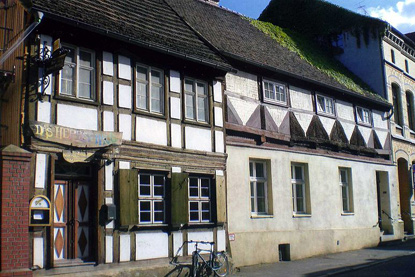
Lined with half-timbered houses, Stendal (pop. 40,000) is a pleasant historic town and the unofficial capital of the rural Altmark region. Once a prominent member of the Hanseatic League, until the plague and the Thirty Years' War put and end to its prosperity in the 17th century. Stendal is noted for its brick Gothic architecture and well-preserved medieval core. The compact old town centres on the Marktplatz with its town hall and the Roland statue, while major landmarks include St Mary’s Church with twin spires, the cathedral of St Nicholas with notable stained glass, and surviving city gates such as the Uenglinger Tor. The town is associated with the art historian Johann Joachim Winckelmann, commemorated by a monument and museum, and offers additional sights including the Tangermünder Tor, local museums, and a small zoological garden.
Interesting Facts about Stendal
- Stendal is an officially styled Hanseatic city and the largest town in the Altmark region of northern Saxony-Anhalt.
- It was founded and granted Magdeburg rights by Margrave Albert I “the Bear” around 1160, becoming an important medieval trading centre.
- The town joined the Hanseatic League in 1358 and even maintained its own seafarers’ guild despite being far from the sea.
- Stendal served as the capital of the Altmark division of Brandenburg in earlier centuries.
- Johann Joachim Winckelmann, a pioneering 18th-century archaeologist and art historian linked to the rise of Neoclassicism, was born in Stendal in 1717.
- The French novelist Marie-Henri Beyle chose "Stendhal" as his pen name in homage to J.J. Winckelmann, the founder of modern archaeology, who was from Stendal.
- Stendal’s skyline is marked by Brick Gothic landmarks, including St Mary’s Church (inaugurated 1447) and the cathedral with notable medieval features.
- The Uenglinger Gate and Tangermünde Gate are impressive surviving medieval city gates that showcase the town’s defensive past.
- The Roland statue in front of the town hall stands about 7.8m tall, ranking among the largest Roland figures in Germany.
- Stendal became a key rail junction with high-speed passenger service, reinforcing its role as a regional hub.
- During the Second World War, Stendal hosted a Luftwaffe airfield; parts of the historic centre were damaged by bombing, and the town surrendered in May 1945.
- The city hall’s market square ensemble reflects medieval prosperity, with a preserved old town designated as a large conservation area.
- St Nicholas Church (built 1423–1467) suffered wartime damage and underwent long reconstruction, completed in 2013.
- Stendal is home to a University of Applied Sciences and functions as the administrative centre of the surrounding district.
- Industries in and around Stendal range from food processing to precision instruments and motor-vehicle parts, alongside its administrative and retail roles.

History
Stendal's origins trace back to the medieval period, though archaeological evidence suggests settlements in the area as early as the 9th century. The town was officially founded and granted market rights by Brandenburg Margrave Albert the Bear around 1160, making it one of the oldest cities in the old Mark Brandenburg. A settlement called Steinedal in the Eastphalian Balsamgau was allegedly mentioned in a document from 1022 attributed to Emperor Henry II, though this has been proven to be a 12th-century forgery. The fortified town developed near the important Elbe crossing at Tangermünde, establishing its strategic importance from its earliest days.
During the medieval period, Stendal flourished as a prosperous commercial centre and became an active member of the Hanseatic League in 1358, maintaining this prestigious membership until 1518. Despite being located more than 150 kilometres from the nearest seashore, the wealthy merchant city even maintained its own seafarers' guild. The town's prosperity was evident in its impressive medieval architecture - it received defensive city walls around 1300, with a complex fortification system including two moats, two earth ramparts, and four town gates. Citizens purchased the privilege of minting coins from the Brandenburg margraves in 1369, and several magnificent Gothic churches were constructed, including the parish church of St Mary's first mentioned in 1283 and completed in 1447 with its distinctive twin towers measuring 84 metres in height. A Latin school was documented from 1338, and in 1456, Elector Frederick II Irontooth founded a convent of Augustinian nuns.
From the 17th century onwards, Stendal served as a Prussian garrison town and became part of the Prussian Province of Saxony following the Napoleonic Wars. The town embraced Protestantism in 1539 under the reformer Konrad Cordatus, and during the 1680s and 1690s welcomed religious refugees including Waldensians, Palatines, and Swiss settlers. Stendal's strategic military importance continued through both world wars - it housed a Luftwaffe airfield in World War II and was the site of Germany's first paratrooper training school from 1936, where notably the boxer Max Schmeling trained in 1940-41. The town suffered significant damage from Allied bombing raids, with over 300 civilians killed when the residential area of Röxe was devastated, and the cathedral and various historical buildings were heavily damaged. On 13 April 1945, Mayor Karl Wernecke surrendered the city to American forces without resistance, preventing its complete destruction, though this act led to his imprisonment and death in Sachsenhausen concentration camp after Soviet occupation began in July 1945.
Main Attractions
Marktplatz and Rathaus
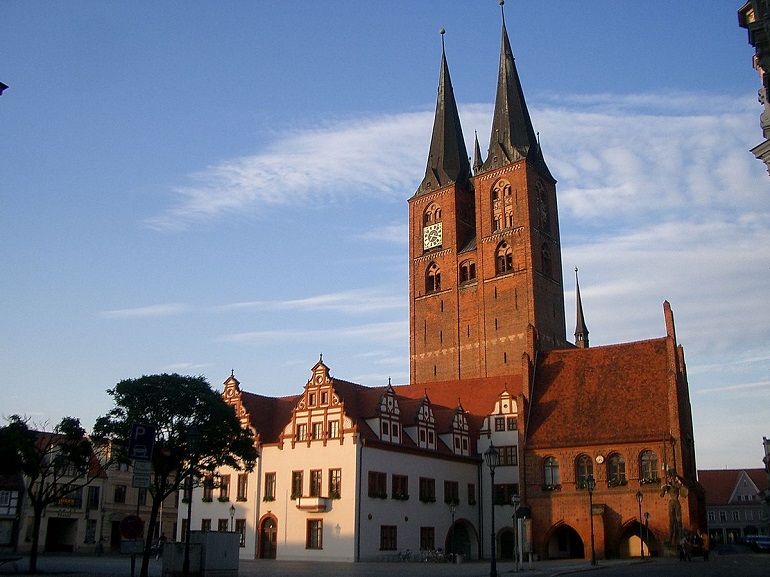
The Marktplatz is the civic centre of Stendal, featuring the historic town hall and the Roland statue. It acts as the focal point for urban life and provides a setting to view the surrounding ensemble of Hanseatic and Brandenburg architecture that outlines the square.
Stendal Roland Statue
Standing on the market square, the Roland statue was erected in 1525 as a symbol of municipal rights and freedoms. The sandstone figure, 7.8 m in total height, depicts Roland in plate armour with a sword and a buckler bearing the Brandenburg eagle. The present version is a 1974 remake after storm damage to the original; surviving fragments are preserved locally.
City Walls & Gates

Uenglinger Tor
The Uenglinger Tor is a late-medieval brick-Gothic town gate built around 1450–1460 and attributed to the North German master builder Steffen Boxthude. Its square tower with crenellated platform and corner turrets is topped by a round section richly decorated with blind arcades and friezes, reaching about 27.5 m. Pedestrians can pass through the Gothic arch beneath, and seasonal access is offered to viewing levels for vistas over Stendal’s skyline.
Tangermünder Tor
The Tangermünder Tor is the other surviving medieval gate of Stendal, distinguished by an early 13th-century Romanesque base that makes it older than the Uenglinger Tor. It formed part of the city’s fortifications and, like its counterpart, can be climbed during busier holiday periods for panoramic views of the old town and its many Gothic churches.
Wiekhaus and Town Wall on Wendestraße
Near the Uenglinger Tor, visitors can see a Wiekhaus—housing integrated into the medieval town wall—along with small surviving wall sections on Wendestraße, illustrating how residential and defensive structures once coexisted in Stendal’s fortification system.
Pulverturm and Town Wall Remains
The Powder Tower, dating to about 1450, is a surviving element of Stendal’s medieval fortifications. It was used for powder storage around 1722 and later for beer storage by local brewers. Short stretches of the adjacent town wall can still be seen nearby.
Churches
Dom St. Nikolaus (Cathedral of St Nicholas)
The Cathedral of St Nicholas dominates the old-town skyline with its prominent brick stepped gable, often linked to Steffen Boxthude’s workshop. The building reflects Stendal’s medieval ecclesiastical significance and can be clearly seen from the viewing platforms of the town gates.
Pfarrkirche Sankt Marien (St Mary’s Church)
St Mary’s Church is one of the city’s principal parish churches, noted for its clock chimes and listed status. Located close to the market area, it forms part of the cluster of Gothic religious buildings that characterise the historic core.
Jakobikirche (St James’s Church)
The Jakobikirche is a Gothic hall church built of fieldstone and brick. It houses stained glass from the 14th–15th centuries and a painted sandstone pulpit depicting St James the Elder, connecting the site to the St James pilgrimage route through Saxony-Anhalt.
Other Attractions
Winckelmann Monument
This monument commemorates Johann Joachim Winckelmann, the Stendal-born pioneer of archaeology and art history. It marks the legacy of a scholar who influenced classical studies across Europe.
Tiergarten Stendal
The Tiergarten is a longstanding zoological park within the city boundaries, offering a compact green setting for recreation and animal viewing. It is a family-friendly amenity away from the historic core.
Sperlingsberg
Sperlingsberg is a local viewpoint and civic landmark included among Stendal’s points of interest. It complements the architectural sights of the old town with an outdoor stop.
Bismarck-Schloss Döbbelin
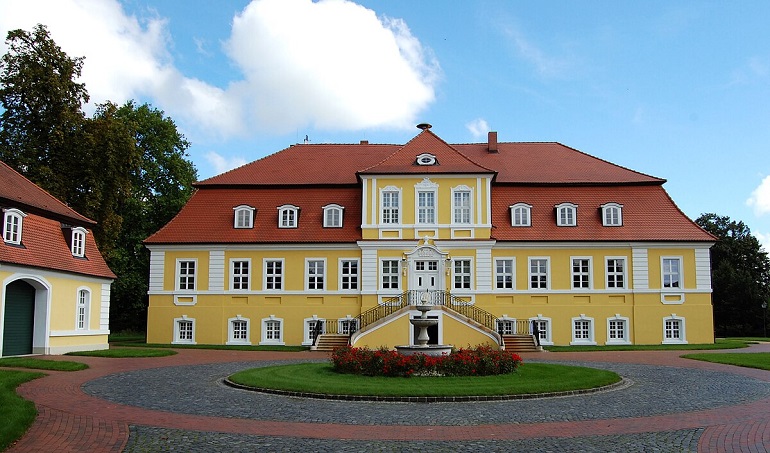
Bismarck-Schloss Döbbelin, a manor associated with the Bismarck family just outside Stendal, represents aristocratic estate architecture in the Altmark and is often visited as part of excursions into the surrounding region.
Top Museums
Classical Art and Cultural History
Winckelmann Museum
The Winckelmann Museum stands as Stendal's crown jewel, located on the site of Johann Joachim Winckelmann’s birthplace. Winckelmann, born in 1717, revolutionised the study of ancient Greek and Roman art, and the museum explores his life, scholarship, and enduring influence.
Following a major renovation, the museum presents a modern and interactive narrative. Exhibitions trace his childhood and education, his roles as school principal and librarian, and his transformative years in Rome, culminating in his pioneering studies of classical antiquity.
Highlights include his writings on the excavations at Pompeii and Herculaneum and a striking collection of engraved gems and imprints that reveal the finesse of ancient craftsmanship. A dedicated children’s area introduces everyday life in ancient Greece and Rome with engaging, hands-on displays.
Outside, a walk-in replica of the Trojan Horse adds a playful yet instructive dimension, echoing Winckelmann’s passion for the ancient world and its literature.
Regional and City History
Altmärkisches Museum
Housed in the evocative former St Catherine’s Monastery, the Altmärkisches Museum is the region’s principal local history museum. Its collections illuminate the cultural and historical development of the Altmark, with an emphasis on Romanesque and Gothic sacred art.
Among its notable exhibits is the Johannes Altar of the Clothmakers’ Guild from 1530, a remarkable work from the Reformation era that showcases the artistry and devotional life of Stendal’s guilds. The museum’s core exhibition, “The old Hanseatic city of Stendal – City of Brick Gothic,” traces the city’s evolution from early settlement to thriving trading centre.
The displays spotlight influential local figures, the city’s garrison tradition, and the onset of industrialisation, offering a nuanced portrait of how Stendal bridged medieval heritage and modern transformation. The monastic setting adds an atmospheric backdrop that deepens the experience of the sacred and historical collections.
Special Interest Museums
Fire Museum (Feuerwehrmuseum)
This speciality museum explores the history of firefighting in the region, from early hand-operated pumps to contemporary motorised engines. Its exhibits document changing technologies, tools, and techniques, illustrating how civic safety and public services evolved over time.
Heimatmuseum
Offering additional perspectives on local history and everyday culture, the Heimatmuseum complements the city’s larger institutions with focused displays on regional traditions, artefacts, and community life.
Local Cuisine
Stendal sits in the fertile Altmark, where hearty, rural cooking meets refined Hanseatic tastes, and menus lean on rye bread, potatoes, onions and excellent local asparagus in season. A must-try is the celebratory soup of the region, Altmärker Hochzeitssuppe, traditionally served at weddings and built on a clear broth with delicate garnishes. For something sweet, cafés often showcase the Altmark’s emblematic Salzwedeler Baumkuchen (tree cake), baked in rings on a spit to form its signature layers and enjoyed with coffee across the region. Cheese lovers can seek out distinctive Saxony-Anhalt curiosities such as Milbenkäse (mite cheese) or the semi-soft Börde Speck cheese specialty, which reflect the area’s deep dairy traditions. Contemporary kitchens in town blend this heritage with modern touches, but the soul of Stendal’s food remains rooted in local produce and time-honoured recipes from the surrounding Altmark countryside.
Getting There
By train Stendal is well connected on Deutsche Bahn routes, with frequent regional and long-distance services linking it to Magdeburg in around 35–50 minutes and direct options available, while routes also run to Berlin via ICE and regional trains, making rail the most straightforward choice for many travellers.
By coach or bus Long-distance coaches operate to and from Stendal on major networks, including direct links with Berlin and other regional hubs; services also connect from Hanover and additional cities depending on the timetable, offering a practical alternative if rail schedules don’t suit.
By car Stendal can be reached via the A14 corridor from Magdeburg, with typical driving times under an hour for the 64km stretch, and broader access from the A2/A14 network across Saxony-Anhalt and beyond, providing a convenient approach for those touring by road.
| Travel destinations in Saxony-Anhalt | ||||||||||||||
|---|---|---|---|---|---|---|---|---|---|---|---|---|---|---|
|
|
|
|
| ||||||||||
|
|
|
|
| ||||||||||
|
|
|
| |||||||||||