



| Contents |
|---|
Introduction
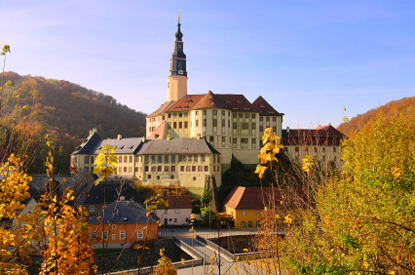
Nestled in the picturesque Müglitz Valley near Dresden, Weesenstein Castle stands as one of Saxony's most remarkable architectural treasures, offering visitors a captivating journey through nearly a millennium of German history. This extraordinary fortress, with its distinctive inverted layout where the kitchen sits at the top and the chapel at the bottom, represents a unique fusion of medieval fortification and baroque elegance that evolved organically over centuries of continuous habitation. Built upon a rocky outcrop and seamlessly integrated into the landscape, the castle has served as both a defensive stronghold and an aristocratic residence, witnessing the rise and fall of noble families whilst adapting to changing architectural fashions from Gothic to Renaissance to Baroque. Today, Weesenstein enchants visitors with its meticulously preserved interiors, extensive collections of period furniture and artwork, and its remarkable state of conservation that allows one to truly experience the atmosphere of centuries past, making it an essential destination for anyone seeking to understand the rich cultural heritage of Saxony and the broader Holy Roman Empire.
Interesting Facts about Weesenstein Castle
- Weesenstein Castle began as a medieval fortification over 800 years ago and was first documented in 1318 as “Weysinberg, dem huse.”
- The oldest visible element is the central round tower from around 1300, anchoring a complex that grew across centuries.
- After the Dohna Feud, the castle passed from the burgraves of Dohna to the Margraviate of Meissen and then, in 1406, to the von Bünau family.
- The von Bünau family transformed the fortress into a residential Schloss between 1526 and 1575, ruling here across 12 generations.
- Its architecture is a striking blend of Gothic, Renaissance, Baroque and Classicist layers, reshaped repeatedly to suit changing tastes.
- The 1575 main portal is regarded as one of Saxony’s most valuable Renaissance portals.
- The castle’s quirky layout famously places stables on the fifth floor, grand halls near the roof, and living quarters beneath the cellar.
- King Anton bought the estate in 1830, and it became a discreet royal residence associated especially with his nephew, King John of Saxony.
- King John (Johann) of Saxony, under the alias “Philalethes,” produced a renowned German translation of Dante’s Divine Comedy while linked to Weesenstein.
- During the Second World War, Weesenstein safeguarded major Dresden art collections, contributing to their survival amid the city’s destruction.
- The castle houses a late Baroque chapel, considered an architectural highlight, likely by Johann George Schmidt.
- Set above the Müglitz Valley, the ensemble includes a formal park and traces of one of Saxony’s earliest English landscape gardens from around 1780.
- Today the site belongs to the State Palaces, Castles and Gardens of Saxony and functions as a museum with dozens of rooms open to visitors.
- Every fifth window on the façade is a trompe-l’œil, painted rather than real, enhancing the castle’s eccentric character.
- Visitors can explore a reverse-chronology exhibition through richly furnished rooms, mirroring the castle’s topsy-turvy architecture.

History
First mentioned in historical documents in 1318 as "Weysinberg, dem huse," the castle originally served to defend the border with the Kingdom of Bohemia. The castle initially belonged to the burgraves of Dohna, but following the notorious Dohna Feud—sparked by a scandalous incident at a Dresden ball in 1385 when young Jeschke von Dohna flirted with another nobleman's wife—the property was incorporated into the Margraviate of Meissen in 1400. In 1406, Margrave William I of Meissen granted the castle to Günther von Bünau as a reward for his support during the feud, beginning the Bünau family's remarkable 366-year reign over Weesenstein.
The von Bünau family transformed Weesenstein from a defensive fortress into a magnificent residential Schloss between 1526 and 1575, with successive generations continuously expanding and reconfiguring the structure for over twelve generations until 1772. During the 15th and 16th centuries, the Weesenstein lineage ranked among the most influential and wealthiest aristocratic houses in Saxony. The family's fortunes dramatically declined during the Seven Years' War (1756-1763) when they sided with the Saxon rulers against Prussia, ultimately suffering severe losses that forced them to sell the castle. The property passed to the von Uckermann family, remarkably acquired in 1772 by Johanna Christiana von Uckermann, a woman whose purchase defied the conventions of her time. The Uckermanns owned the castle for two generations and continued to embellish the estate, particularly developing the gardens during their tenure.
In 1830, King Anton of Saxony purchased Weesenstein Castle, elevating it to the rank of a royal house and beginning its most illustrious chapter as the "secret residence" of the Saxon royals. The castle's most celebrated owner was King Anton's nephew, King John of Saxony, who famously declared Weesenstein to be "the most beautiful valley of Saxony" and spent considerable time there working on his scholarly pursuits. Under the pseudonym Philalethes, meaning "friend of the truth," King John created his renowned German translation of Dante's "The Divine Comedy" at Weesenstein, a scholarly achievement still regarded as unrivalled today. Three Saxon kings—Anton, John, and George—lived in the castle during the royal period. The Saxon royal family sold Weesenstein to industrial magnate Alwin Bauer in 1917 during World War I, but by 1933, the National Association of Saxon Homeland Protection acquired the property through public donations and established the museum that continues to operate today. During World War II, the castle served as a repository for Dresden's art treasures, ironically saving them from destruction during the bombing of Dresden, and today the castle belongs to the Free State of Saxony.
Description
Weesenstein Castle presents itself as a true masterpiece of architectural harmony and scenic grandeur, nestled picturesquely amid the undulating hills and dense woodlands of Saxon Switzerland. Rising above the banks of the tranquil River Wesenitz, the castle commands awe from near and far, its silhouette marked by soaring turrets, crenellated walls, and delicately arched windows. Approaching the castle, one is immediately struck by the way each segment appears to be sculpted directly from the towering rock, blending nature and craftsmanship in a seamless embrace.
The Setting and Approach
The pathway to the entrance gently climbs through formal terraces, bordered by intricately clipped box hedges, fragrant herbs, and seasonal blooms. Occasional old oaks and lime trees afford pockets of shade, while ornate statues of mythological figures punctuate secluded corners, offering places for quiet contemplation. The steady sound of the river, coupled with the chorus of woodland birds, creates an atmosphere of peaceful seclusion before one even crosses the threshold.

Arrival and Courtyards
Upon arrival at the fortified gatehouse, visitors are greeted by robust wooden doors, studded with ironwork and framed beneath a robust arch. Beyond, the outer courtyard opens expansively, its uneven cobbles bearing the marks of countless carriages and footsteps through the centuries. Here, the fabric of the castle reveals its layered evolution, with striking transitions from imposing Gothic buttresses and pointed arches to the refined lines of Renaissance balustrades and the exuberant flourishes of Baroque façades. Every façade tells a different story: medallions bearing noble crests, stone reliefs depicting hunt scenes, and distinctive sgraffito ornamentation revealing a meticulous attention to decorative detail.
Wandering into the heart of the castle, the inner courtyard strikes a gentler note. Pastel-yellow walls, punctuated by rows of mullioned windows, turn golden in the afternoon sun, while ivy tendrils scatter soft green shadows across the flagstones. A medieval well stands sentinel in the courtyard’s centre, its shingled roof supported by stout, hand-hewn beams. In one cosy corner, a small garden spills over with summer roses and aromatic herbs, their scents mingling delicately with the fresh, clean air.
The Castle Interior
Within the castle’s labyrinthine interior, vaulted corridors, some set with original hand-fired tiles, meander between grand halls and intimate chambers. The ceilings—some painted with fading Renaissance frescoes, others adorned with elaborate Baroque stucco—draw the eye upward at every turn. Tall lancet windows bathe the main passageways in a gentle glow, illuminating time-worn tapestries that depict scenes of courtly life, epic battles, and rural festivals. Antique chests, elegantly carved with motifs of flora and fauna, line the passageways, hinting at the wealth and tastes of former residents.

The Knight’s Hall
Among the most impressive chambers, the Knight’s Hall stands out for its soaring timbered ceiling and vast, polished flagstones. The hall is flanked by a grand fireplace of monumental stone—a once-roaring hearth that would have warmed banquets and noble assemblies. The walls, adorned with ancestral portraits in gilded frames, transport visitors to an era when Weesenstein was the centrepoint of courtly intrigue and hospitality. On certain days, sunlight filtered through high windows casts a golden haze, imbuing the space with a cinematic grandeur.
The Chapel
The castle’s private Chapel, tucked away behind a discreet wooden door, offers a contrasting sense of calm and introspection. This sacred space, with its slender columns and intricate stucco reliefs, is filled with light filtered through ornate stained-glass panels. The altar, simply adorned but beautifully proportioned, exudes a subtle elegance. On quiet days, the soft echo of footsteps is often the only sound—an atmosphere conducive to contemplation.
The Armoury
Elsewhere, the Armoury houses an impressive collection of medieval breastplates, helmets, and ceremonial swords, all meticulously displayed upon sturdy wooden racks. The displays are artfully arranged, allowing visitors to appreciate both the craftsmanship and the practical ingenuity of these artefacts. Each piece whispers of tournaments, military campaigns, and rites of passage.
The Residence Wing and Stucco Parlour
A stroll through the residence wing uncovers a different facet of Weesenstein’s charm. Here, the rooms adopt a lighter, more elegant feeling. The celebrated Stucco Parlour shines as a gem of Rococo decoration, replete with pearly-white plasterwork, gilded mirrors, and pastel ceiling panels rendered with delicate floral scenes. Sunlight reflected from the river flickers on parquet floors, and period furnishings invite the imagination to conjure scenes of literary salons and musical soirées.
Views from the Tower and Gardens
Ascending the historic clock tower, you are rewarded with breathtaking panoramas. The roofscape below presents a captivating maze of red tiles, slender chimneys, and dormer windows, while beyond, the forested valleys and gentle hills recede into the pale afternoon haze. The terraced gardens, when viewed from above, reveal intricate parterres and manicured lawns, often populated by peacocks that parade languidly amid the greenery.
Getting There
By train From Dresden Hauptbahnhof, take an S-Bahn to Heidenau and change to the regional train up the Müglitz Valley towards Altenberg, alighting at Weesenstein; from the station it’s a signposted 10–15 minute uphill walk to the castle.
By bus/coach Regional VVO buses from Dresden, Heidenau or Pirna run through the Müglitz Valley and stop at Weesenstein (often marked Weesenstein or Weesenstein Schloss); from the stop, follow the signs for a short uphill walk to the entrance—check current timetables, as weekend and holiday services may be less frequent.
By car From Dresden, take the A17 (exit Heidenau) or the B172 to Heidenau, then follow the brown tourist signs for Müglitztal/Weesenstein; there is a visitor car park below the castle, with a brief but steep walk to the gate, and the access roads are narrow and winding.
Best Time to Visit
The best time to visit Weesenstein Castle is from late spring through to early autumn, typically from May to October, when the weather is pleasant and the castle's surrounding gardens are in full bloom. During these warmer months, the castle is open from 10am to 6pm (Tuesday through Sunday), offering extended visiting hours that allow you to explore the castle's 200 rooms, admire its eclectic architectural styles ranging from Gothic to Baroque, and stroll through the picturesque park grounds. The mild weather makes it ideal for enjoying the castle's outdoor spaces, including the beautiful French garden and the scenic pathways along the Müglitz River valley. For a more tranquil experience, weekday visits are recommended to avoid weekend crowds, whilst an early morning arrival shortly after opening allows you to appreciate the castle's grandeur in a more serene atmosphere before the afternoon bustle begins.