



| Contents |
|---|
Introduction
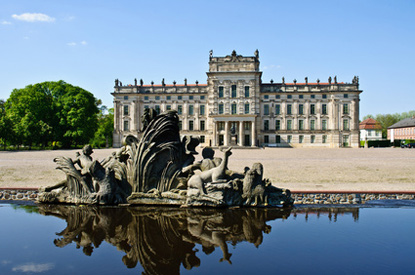
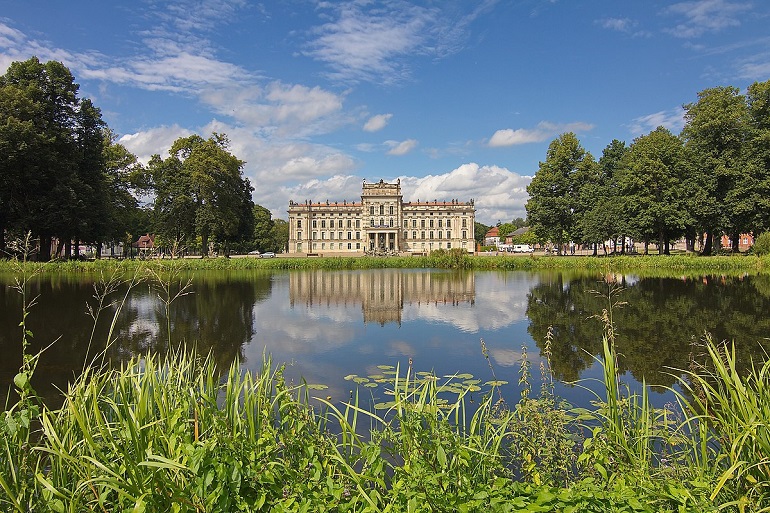
Ludwigslust Palace stands at the heart of the town of Ludwigslust in Mecklenburg-Vorpommern, roughly 40 km south of Schwerin. Originally erected a modest hunting lodge by Prince Christian Ludwig in 1724 near the hamlet of Klenow, it gained its name—meaning “Ludwig’s joy”—when he became duke in 1747. In 1765, Duke Friedrich II elevated Ludwigslust to the ducal capital, prompting a grand reconstruction between 1772 and 1776 under architect Johann Joachim Busch. The late Baroque château, built on an E-shaped plan of brick clad in local sandstone, features a Corinthian-columned central block contrasting with Ionic wings, and its interiors combine Neoclassical reception rooms with elaborate ornamentation—including the two-storey Golden Hall adorned with stucco and innovative papier-mâché decoration. Surrounding the palace is a 120-hectare formal park of canals, fountains and cascades, reflecting its role as both a seat of government and a leisure retreat.
Interesting Facts about Ludwigslust Palace
- Ludwigslust Palace was originally built as a hunting lodge for Prince Christian Ludwig before evolving into the ducal residence of Mecklenburg-Schwerin.
- The palace is often referred to as the "Versailles of the North" due to its baroque grandeur and vast landscaped park.
- Its spectacular Golden Hall features monumental columns, large mirrors, and ornate gilded décor, creating an atmosphere of courtly splendour.
- Many decorative elements inside the palace, including wall panels and even the Venus de' Medici statue, are crafted from papier-mâché known locally as "Ludwigslust board".
- The building blends late Baroque and Neoclassical styles and is notable for its unique E-shaped layout designed by architect Johann Joachim Busch.
- The surrounding palace park boasts elegant avenues, cascades, canals, water jumps, mausoleums, and the Swiss House, making it an artistic landscape in its own right.
- Ludwigslust Palace served as the government seat of the Duchy of Mecklenburg-Schwerin from 1765 to 1837.
- Remarkably, the palace survived the First and Second World Wars with almost no damage and is now open to the public as a branch of the State Museum Schwerin.
- The interior houses not only paintings by celebrated court artists but also fine furnishings, antique clocks, sculptures by Jean-Antoine Houdon, Meissen porcelain, and even a menagerie series by French artist Jean-Baptiste Oudry.
- Restoration of the historic east wing was completed and ceremoniously reopened in March 2016, allowing visitors to experience the rooms as they once were.
History
Originally conceived in 1724 as a humble hunting lodge by Prince Christian Ludwig, heir to the Duchy of Mecklenburg-Schwerin, Ludwigslust Palace began life amid the elm and beech woods near the hamlet of Klenow. The prince, enchanted by the locale and its rich game, named his retreat “Ludwigslust” (literally “Ludwig’s joy”). Even after acceding to the ducal throne in 1747, he preferred this rustic residence to the capital at Schwerin, laying the foundations for its evolution from modest lodge to grand rural retreat.
In 1765 Duke Frederick II elevated Ludwigslust to the duchy’s capital, triggering an ambitious rebuilding programme. Between 1772 and 1776, court architect Johann Joachim Busch replaced the original timber hunting house with the imposing Late Baroque palace we see today. Built on an E-plan and faced with local sandstone, the central corps de logis rises in a bold Corinthian order, contrasting with the flanking wings’ Ionic columns. Decorative allegorical figures by sculptor Rudolf Kaplunger crown the attic, while the flat urban façade and Doric portico hint at the emerging neoclassical taste.
The palace’s interiors reflect this stylistic transition. The piano nobile houses the two-storey “Gilded Hall” with its Corinthian columns, stucco work and innovative papier-mâché ornament known locally as “Ludwigsluster Carton,” still in use for summer concerts. One wing accommodated semi-public state rooms—antechamber, salon, audience chamber and gallery—while the opposite side contained the duke’s private apartments, crowned by a porcelain chimneypiece. From 1765 until 1837, Ludwigslust served as the administrative heart of Mecklenburg-Schwerin; thereafter the court returned to Schwerin, leaving the palace to a quieter life as a museum and cultural venue.
Description
Nestled at the heart of the Baroque town, Ludwigslust Palace presents an arresting facade of pale sandstone, its elegant E-shaped layout punctuated by central corps de logis that projects proudly between two symmetrical wings. Corinthian columns grace the central block, their ornate capitals supporting a gently undulating entablature, while the wings display the refined restraint of the Ionic order. Above the portals, forty larger-than-life allegorical figures stand sentinel, their stone forms seeming to stride across the roofline.
Stepping through the grand entrance leads into a sequence of opulent chambers, but it is the Golden Hall that truly captivates. Spanning two storeys, the hall glitters with gilded papier-mâché ornamentation applied to its capitals, wall panels and moldings, creating the illusion of solid gold relief. Huge mirrors flank each Corinthian column, reflecting the sparkle of crystal chandeliers and amplifying the vaulted ceiling’s Rococo flourishes. Beneath one’s feet lies the original parquetry, its herringbone patterns still bearing the faint wear of courtly balls.
Beyond the Golden Hall, the Picture Gallery unfolds along pale grey-green walls hung with portraits and panoramic cork models of ancient edifices. Here, works by court painters mingle with Meissen porcelain, ivory carvings and silver treasures, each displayed in its historic setting. Adjacent salons—once the private apartments of dukes and duchesses—feature sumptuous damask wallcoverings in ruby reds, turquoise and ochre, all complemented by delicate gilding and finely inlaid marquetry floors.
French windows open from the palace’s lower level onto the vast palace park, a harmonious blend of formal Baroque parterre and naturalistic English landscape. Geometric lawns radiate from the palace in sweeping vistas, punctuated by cascades, canals and an elegant stone bridge that spans the main waterway. Paths meander beneath mature lime and beech trees to unexpected delights: a Swiss Cottage furnished in rustic style, two ornate mausoleums with Neoclassical façades, and a Gothic revival chapel whose slender spire gazes across the lawns.
To the south, a gently sloping cascade tumbles in sandstone steps, its trickling water framed by sculpted balustrades. Beyond lies the Great Garden, where avenues of lime trees lead the eye towards distant glades, and secluded groves offer quiet respites among beds of seasonal blooms. Throughout the park, the interplay of open vistas and intimate corners invites leisurely exploration, each turn revealing a new combination of light, water and sculpture.
Getting There
By train, Ludwigslust Palace is easily accessible with regular services from major cities such as Hamburg, Berlin, and Schwerin. Travellers can arrive at Ludwigslust station, which is conveniently located about a 15 to 20-minute walk through the scenic palace park to the entrance of the palace. Trains run frequently throughout the day, making this a comfortable and efficient means of travel.
By bus or coach, connections are available from various regional hubs, including direct services from nearby towns like Schwerin. Buses typically stop at Ludwigslust’s main station, from where a pleasant stroll leads visitors towards the palace grounds. Coach and bus journeys provide an alternative for those preferring road transport and cater well to regional travellers.
By car, Ludwigslust Palace is situated just off the B5 federal road and is well signposted from nearby motorways, making self-driving a straightforward option. Ample parking can be found close to the palace, with hotel and public car parks situated within walking distance of the main entrance. The route by car passes through picturesque northern German landscapes, adding to the journey’s charm.
Best Time to Visit
The ideal time to visit Ludwigslust Palace is from late spring through early autumn, roughly April to September, when the Baroque gardens burst into bloom and the weather is comfortably mild—daytime temperatures hover between 15 °C and 25 °C, perfect for leisurely strolls through the park’s cascades, avenues and flowerbeds. May and June are especially delightful, as longer daylight hours and lush greenery showcase the palace’s “Versailles of the North” splendour at its very best, while July and August still offer warm, sunny days for exploring both the opulent interiors and the surrounding landscape without the chill of winter or the quiet of off-season closures.


