



| Contents |
|---|

Introduction
Weikersheim Castle, situated in the Tauber valley in Baden-Württemberg, Germany, serves as a remarkable testament to the transformation from medieval fortress to Renaissance palace. Originally built in the 12th century as a moated castle and the first seat of the Lords of Hohenlohe, it underwent a dramatic transformation in 1586 when Count Wolfgang II of Hohenlohe commissioned its conversion into a prestigious Renaissance residence with an unusual triangular floor plan. The palace reached its current splendour under Count Carl Ludwig of Hohenlohe, who between 1709 and 1724 added Baroque interior decorations and created the magnificent formal gardens that remain largely unchanged today. Notable features include the lavishly decorated Knights' Hall from around 1600, one of the finest preserved Renaissance halls in southwestern Germany, complete with its famous coffered wooden ceiling depicting hunting scenes, and the spectacular Baroque garden with its collection of original sculptures, including the whimsical dwarf figures representing members of the count's court. Now owned by the state of Baden-Württemberg since 1967, the castle operates as a museum offering guided tours of its well-preserved chambers and serves as the summer headquarters for Jeunesses Musicales Germany, maintaining its connection to cultural pursuits that have characterised the site for centuries.
Interesting Facts about Weikersheim Castle
- Weikersheim Castle was originally built in the 12th century as the first seat of the Lords of Hohenlohe.
- The castle is renowned for its distinctive three-sided, triangular floorplan, which is rare among Renaissance estates.
- Count Wolfgang II von Hohenlohe transformed the castle from a medieval moated fortress into a magnificent Renaissance palace around 1600.
- The Knights’ Hall, dating from 1600, remains one of the best-preserved Renaissance halls in all of southwestern Germany, featuring life-sized animal figures like an elephant.
- The lavish audience chamber of Princess Elisabeth Friederike Sophie became famous as the “Beautiful Room” due to its exquisite furnishings.
- The Baroque gardens, designed in the early 18th century, are celebrated for their numerous whimsical statues, including a unique group known as the “Weikersheim dwarfs” representing members of the historical court.
- Within the castle, visitors can explore a permanent exhibition on alchemy in honour of Count Wolfgang II, who was a passionate alchemist.
- The Orangery, built in 1723, stretches nearly 100 metres and forms a picturesque backdrop to the garden, which also features statues depicting the seasons, elements, planets, and classical gods.
- After decades of ‘Sleeping Beauty’-like neglect, the castle’s interiors and gardens remain almost perfectly preserved, offering rare authenticity.
- Today, Weikersheim Castle is open to the public, hosting music courses, exhibitions, and events, under the ownership of the state of Baden-Württemberg since 1967.
History
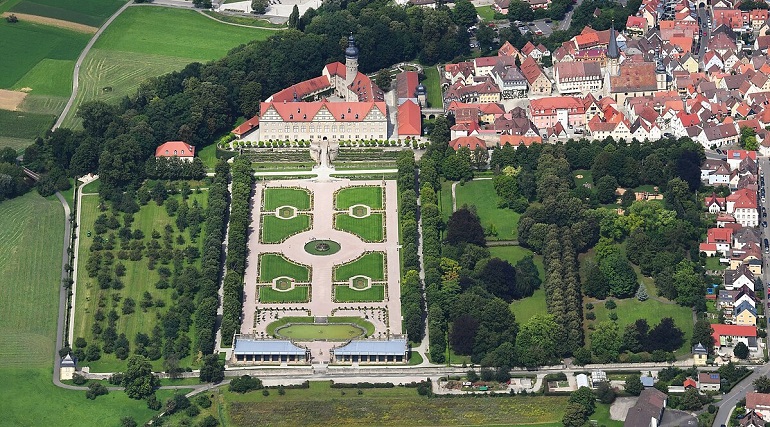
Weikersheim Castle began its distinguished history in the 12th century when it was constructed as the first seat of the Lords of Hohenlohe, though the exact year remains unknown. The earliest mention of a family member was Conrad of Weikersheim in 1153, whilst the settlement itself was first recorded in 837 CE in a deed from Fulda Monastery under the name 'Wichartesheim'. Originally built as a moated fortress, the castle served as the ancestral seat of the Hohenlohe dynasty for over 400 years, with the family establishing additional castles nearby at Hohlach (later becoming Hohenlohe) and Brauneck. The medieval structure retained its defensive character throughout the early centuries, complete with its imposing bergfried (keep) which still stands today as a symbol of the castle's ancient origins.
The transformation of Weikersheim from medieval fortress to Renaissance palace began in 1586 when Count Wolfgang II of Hohenlohe-Weikersheim took up residence following a division of the Protestant territories amongst three brothers. Working alongside his wife Magdalena of Nassau-Dillenburg, sister of William the Silent of Orange, Wolfgang embarked upon an ambitious reconstruction project that would create one of southwestern Germany's finest Renaissance palaces. The new palace featured an unusual three-sided triangular floor plan designed by Georg Robin, though only the south wing was completed between 1595 and 1603 by master builder Wolf Beringer. The centrepiece of this Renaissance transformation was the magnificent Rittersaal (Knights' Hall), completed around 1600, which measures 40 metres in length and features an elaborate coffered wooden ceiling by Elias Gunzenhäuser decorated with realistic hunting scenes.
The castle's baroque splendour emerged during the early 18th century under Count Carl Ludwig of Hohenlohe, who inherited Weikersheim in 1709 and ruled for over fifty years until around 1760. Together with his wealthy wife, Princess Elisabeth Friederike Sophie of Oettingen-Oettingen, Carl Ludwig redecorated the apartments and created the stunning baroque gardens that remain largely unchanged today. The garden complex, designed by Daniel Mathieu in 1708, exemplifies baroque landscaping with its axial layout, elaborate fountain systems, and remarkable collection of sculptures by the Sommer family depicting the four seasons, elements, winds, and Olympian gods. Most famous amongst these are the whimsical Weikersheimer Zwerge (Weikersheim dwarfs), sixteen caricatures of contemporary courtiers that represent the only complete surviving gallery of garden sculptures inspired by Jacques Callot. The baroque additions culminated with the construction of the impressive orangery in 1723, stretching nearly 100 metres in length with its distinctive arcaded wings that separate the formal gardens from the surrounding countryside. Following Carl Ludwig's death around 1760, the property was divided between the Langenburg and Neuenstein branches of the family, eventually leading to its sale to the state of Baden-Württemberg in 1967.
Description
Architectural Excellence
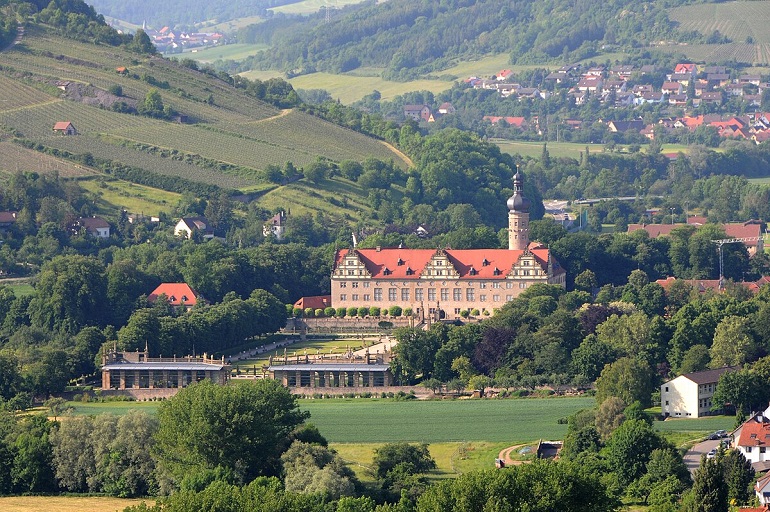
The palace showcases an extraordinary and highly unusual triangular ground plan that distinguishes it from virtually every other castle in Europe. This distinctive three-sided design, conceived in the late 16th century, creates a striking visual impact when viewed from above and reflects the innovative architectural thinking of the Renaissance period. The south wing, completed between 1595 and 1603, features an impressive façade adorned with six elaborate scrollwork gables that exemplify the decorative exuberance of the era.
The castle's most distinctive external feature is the preserved medieval tower (bergfried) from the original 12th-century moated castle, which serves as a powerful symbol connecting the palace's ancient origins with its Renaissance transformation. This tall, imposing structure provides a dramatic contrast to the more refined architectural.
The Knights' Hall: A Renaissance Masterpiece
The crown jewel of Weikersheim Castle is undoubtedly the magnificent Knights' Hall (Rittersaal), completed around 1600. This extraordinary chamber represents one of the finest examples of Renaissance architecture in southwestern Germany and is considered amongst the best-preserved ceremonial halls of its era. The hall measures an impressive 40 metres in length and overwhelms visitors with its opulent furnishings and artistic treasures.
The most striking feature is the elaborate coffered wooden ceiling, crafted by master carpenter Elias Gunzenhäuser between 1583 and 1606. Each recessed panel contains vivid, realistic hunting scenes painted by Balthasar Katzenberger of Würzburg between 1601 and 1602. These colourful depictions not only demonstrate exceptional artistic skill but also contain hidden alchemical symbols reflecting Count Wolfgang II's passion for this mystical science.
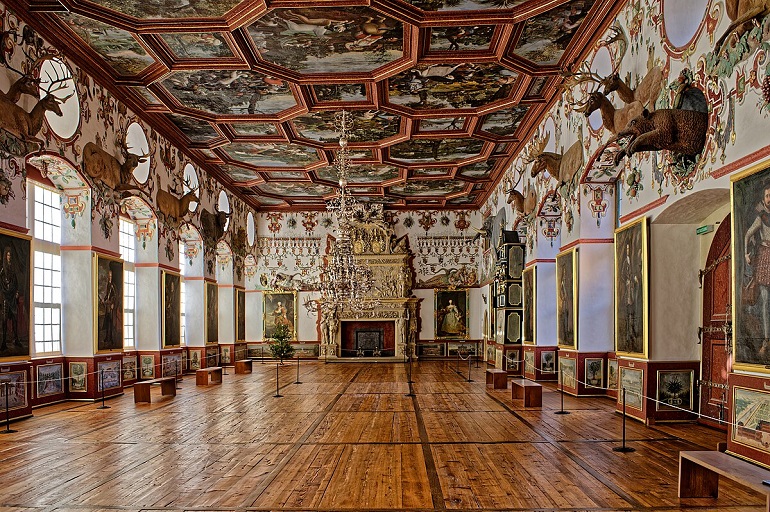
The walls of the Knights' Hall are adorned with life-sized, three-dimensional painted stucco animals that appear to leap from their surfaces. These remarkably realistic figures represent various game animals, including the famous elephant of Weikersheim, which has become one of the castle's most beloved and recognisable features. The hall also features an ornate fireplace with unusual reliefs and an impressive portal, all designed to convey the political and cultural aspirations of the Hohenlohe counts.
Baroque Splendour: The State Apartments
During the early 18th century, Count Carl Ludwig and his wife Princess Elisabeth Friederike Sophie of Oettingen-Oettingen transformed portions of the castle into sumptuous Baroque living quarters. These state apartments represent some of the finest preserved aristocratic interiors in Germany, with their original furnishings largely intact due to the family's eventual departure and the palace's subsequent period of gentle neglect.
The Mirror Cabinet stands as perhaps the most exquisite room within the palace. Completed in 1718, this intimate chamber served as Princess Elisabeth Friederike Sophie's private treasure room. The walls are covered in rich red silk damask, whilst silver-plated and gilded lime-wood ribbons and leaf tendrils support round mirrors and small consoles. This elaborate decorative scheme, believed to be designed by the renowned Sommer family of sculptors, creates a dazzling interplay of light and reflection. The cabinet houses an extraordinary collection including East Asian porcelain, glazed earthenware from Ansbach, precious miniatures, and elaborate figures crafted in silver and precious stones. Among the most remarkable pieces is a silver "Indian Priest" automaton that could be wound up to walk about the room.
The princess's audience room, known historically as the "Beautiful Room," showcases exquisite Baroque furnishings and has been painstakingly restored to its 18th-century glory. The state bedchamber features one of the palace's most precious possessions: an elaborate state bed with intricate carvings and magnificent fabrics that exemplifies the luxury expected in aristocratic residences of the period.
Throughout the state apartments, visitors encounter rich tapestries, gold leather wallpaper, and an impressive collection of glazed earthenware from the famous Ansbach pottery works. These rooms also display oriental ceramics and period furniture that provide an authentic glimpse into the refined lifestyle of the German nobility.
The Alchemist's Legacy
A unique feature of Weikersheim Castle is the alchemy exhibition housed in the former palace kitchen. This fascinating display pays homage to Count Wolfgang II von Hohenlohe's passion for alchemical experimentation. Based on his extensive surviving notes, the exhibition features a recreated model of the count's laboratory and explores the mystical world of early 17th-century alchemy. The exhibition demonstrates how alchemists worked towards their ultimate goal of transmuting base metals into gold, whilst inadvertently developing techniques that would later contribute to modern chemistry.
An alchemy garden has been established on the site where the count's original laboratory tower once stood, featuring plants that were traditionally associated with alchemical and magical practices during the Renaissance period.
The Baroque Garden Paradise
Beyond the palace walls lies one of Germany's most spectacular Baroque garden complexes, designed in the French style during the early 18th century. The garden exemplifies the Baroque ideal of nature tamed and organised according to strict geometric principles, creating a "garden kingdom" that extends the palace's grandeur into the surrounding landscape.
The parterre gardens are laid out in elaborate patterns with precisely maintained borders and flowering beds that change seasonally. At the centre of this formal arrangement stands the magnificent Hercules Fountain, featuring the ancient hero in combat with the Hydra (dragon Ladon) atop a mound of tuff stone. Water spurts dramatically from the dragon's mouth, creating a dynamic focal point that exemplifies the Baroque love of theatrical water features.
The garden's most famous residents are the 75 Baroque statues that populate the grounds, creating an unparalleled sculptural ensemble. The elegant statues in the parterre represent classical figures such as Apollo and Diana, whilst allegorical representations include the Planets (Mercury, Saturn, Venus, and Mars), the four Seasons, the four Elements, and the four Winds.
The most whimsical and celebrated features are the 16 Weikersheimer Zwerge (Weikersheim Dwarfs), a unique gallery of comical figures traditionally identified as caricatures of Count Carl Ludwig's court retinue. Created by sculptor Johann Jakob Sommer of Künzelsau between 1711 and 1712, these large dwarf figures are extraordinarily rare in European palace gardens and represent something quite distinct from both traditional garden gnomes and the small collector's figures popular in other palaces. Each dwarf has its own distinctive character and costume, creating a humorous yet sophisticated commentary on 18th-century court life.
The Magnificent Orangery
The garden reaches its climax with the impressive double-winged orangery, constructed by Christian Lüttich in 1723. This arcaded building extends for nearly 100 metres and serves multiple functions as both a winter shelter for exotic plants and an architectural masterpiece that frames the view of the surrounding countryside. The orangery's sophisticated design, with its arc de triomphe motifs, creates a dramatic backdrop for the garden whilst simultaneously opening vistas to the natural landscape beyond.
The eastern wing of the orangery can be visited and houses collections of lemon and orange trees along with other exotic plants that would have been considered marvellous curiosities in 18th-century Germany. During winter months, the more delicate garden statues are carefully wrapped and stored here for protection.
Additional Garden Features
The palace grounds include several other charming structures that enhance the overall experience. The gardener's house from 1708 features beautiful frescoes and stucco decoration on its ground floor, which served as a sala terrena (garden hall), whilst the upper floor housed the gardener's living quarters.
The bird house and tea house, both built in 1715 as elegant two-storey pavilions, provided intimate spaces for courtly entertainment. The bird house featured an aviary on the ground floor and a salon above, whilst the tea house contained a grotto at ground level topped by a charming "saletta."
A rose garden, originally laid out in 1865, presents both historical and modern rose varieties, whilst the kitchen garden displays herbs and vegetables that would have been cultivated for the palace kitchens during the height of the court's residence.
A Perfectly Preserved Ensemble
What makes Weikersheim Castle truly exceptional is its remarkable state of preservation. Unlike many German palaces that suffered destruction during wars or underwent extensive modernisation, Weikersheim has retained its authentic character largely unchanged since the 18th century. This extraordinary preservation is due to the gradual decline of the Hohenlohe-Weikersheim line and the subsequent period during which the palace remained largely uninhabited, entering what has been romantically described as a "Sleeping Beauty slumber."
Today, this magnificent ensemble serves not only as a museum but also as the summer home of Jeunesses Musicales Germany and the location of the renowned TauberPhilharmonie concert hall, ensuring that the palace continues to fulfil its role as a centre of cultural excellence whilst preserving its historic grandeur for future generations.
Getting There
By train, Weikersheim Castle can be reached via the regional train network, with a direct connection from Bad Mergentheim to Weikersheim. Travellers arriving from Würzburg or larger cities should change at Lauda onto the service bound for Weikersheim; from the station, the castle is about a 15-minute walk through the picturesque town centre.
By bus, regular routes operate from nearby towns such as Crailsheim and Bad Mergentheim directly to Weikersheim. Upon arrival at the main bus stop, it is a short 10-minute walk to the castle, following signs towards the Marktplatz, where the castle is prominently located.
By car, Weikersheim is accessible from the motorway junctions on the A7 or A81, with well-signposted roads leading to the town. Parking is available near the Heiligen Wöhr, from where you can enjoy a pleasant stroll into the historic centre and towards the castle.
Best Time to Visit
The best time to visit Weikersheim Castle is during the late spring to early autumn period, from April through October, when the palace maintains its extended opening hours from 9:00 AM to 6:00 PM and the magnificent baroque gardens are at their most enchanting. Spring offers particularly pleasant weather conditions, with temperatures gradually warming from April onwards, whilst the gardens burst into bloom, creating an ideal backdrop for exploring the elaborate parterre and the famous dwarf statues. Summer brings longer days and warmer temperatures, perfect for leisurely strolls through the extensive grounds, though this period also coincides with the Jeunesses Musicales festival activities in July and August, which add a vibrant cultural dimension but may mean larger crowds. Early autumn remains delightful, with comfortable temperatures and the gardens still in full splendour before the palace reduces its opening hours from November through March to just 10:00 AM to 5:00 PM. Winter visitors should note the more restricted hours and potentially challenging weather conditions in the Tauber Valley, though the castle's interior treasures and the romantic atmosphere of the snow-dusted baroque gardens can still provide a memorable experience for those willing to brave the colder months.


