



| Contents |
|---|
Introduction
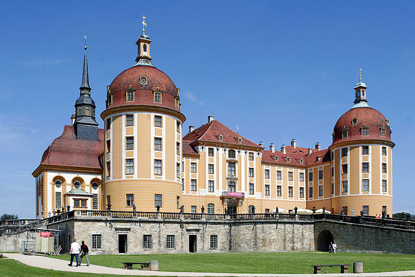
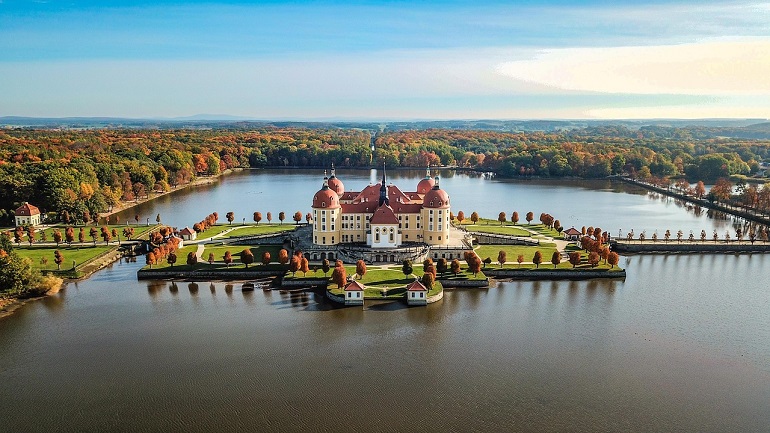
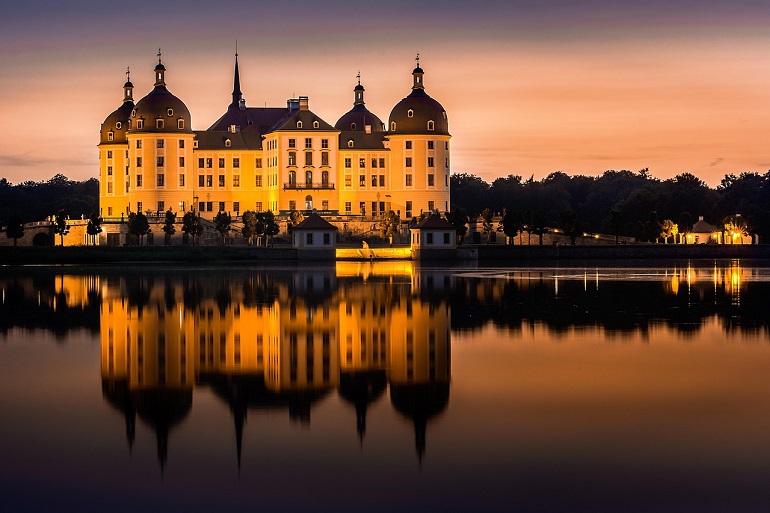
Moritzburg Castle, located in the German state of Saxony, is a notable example of Baroque architecture, situated on an artificial island in the castle's lake. Originally a Renaissance hunting lodge built for Duke Moritz of Saxony in the 16th century, it was significantly remodelled and expanded in the 18th century under the commission of Augustus the Strong, Elector of Saxony and King of Poland. This transformation, overseen by architect Matthäus Daniel Pöppelmann, gave the castle its current symmetrical design with four distinctive round towers and its characteristic yellow and white colouring. The castle served as a hunting seat and pleasure palace for the Saxon electors and kings, and today it functions as a museum, showcasing opulent interiors and art collections from the Baroque period.
Interesting Facts about Moritzburg Castle
- Moritzburg Castle is a Baroque palace set on a symmetrical artificial island with four round towers, about 13 km northwest of Dresden, originally built as a hunting lodge for Duke Moritz of Saxony between 1542 and 1546.
- Augustus the Strong transformed Moritzburg from 1723 to 1733 into a lavish hunting and pleasure residence, commissioning architects Matthäus Daniel Pöppelmann and Zacharias Longuelune and laying out formal ponds, avenues and a game preserve.
- The castle chapel, begun under Elector John George II, was consecrated in a Catholic rite in 1697 after Augustus the Strong converted to Catholicism to secure the Polish crown.
- Moritzburg houses one of Europe’s most important collections of hunting trophies alongside ornate gilt leather wall hangings and the famed Feather Room decorated with over a million coloured feathers.
- The surrounding cultural landscape includes the Rococo Little Pheasant Castle, a miniature harbour and Saxony’s only lighthouse, adding maritime flair to the lakeside setting.
- Elector Frederick Augustus III further shaped the landscape in the late 18th century, integrating new buildings and water features that enhanced the palace’s axial vistas and designed park.
- Prince Ernst Heinrich of Saxony, last Wettin resident at Moritzburg from 1933 to 1945, hid family treasures in the park; some were recovered by amateur archaeologists in 1996.
- Every winter the grounds evoke the beloved fairy-tale film “Three Wishes for Cinderella,” with seasonal exhibitions inviting visitors to walk in the princess’s footsteps.
- The ensemble’s symmetry and island setting make Moritzburg one of Saxony’s most photogenic moated castles and a hallmark of Wettin courtly hunting culture.
- Augustus the Strong’s unrealised vision for a “Temple of Diana” with exotic animal enclosures highlights the site’s origin as a stage for spectacular festivals and hunts on land and water.
History
Moritzburg Castle's origins trace back to 1542, when Duke Maurice (Moritz) of Saxony commissioned the construction of a Renaissance-style hunting lodge on a granite dome in the wildlife-rich Friedewald Forest. The original structure, built between 1542 and 1546, featured four round towers connected by defensive walls and served as the centre of Saxon hunting activities. The castle was strategically positioned to take advantage of the surrounding forests and natural ponds, which provided ideal conditions for the elaborate courtly par force hunts favoured by the Saxon nobility. Under Elector John George II of Saxony, the lodge was expanded between 1661 and 1671 with the addition of a chapel designed by architect Wolf Caspar von Klengel, representing an early example of Baroque architecture in the region.
The castle's transformation into a magnificent Baroque palace began in 1723 under the direction of Elector Augustus the Strong, who enlisted renowned architect Matthäus Daniel Pöppelmann for the ambitious project. Augustus envisioned creating a "Temple of Diana" - a pleasure palace surrounded by exotic animal enclosures housing lions, cheetahs, and European bison, where he could stage opulent feasts, hunts, and even naval battles on the castle pond. The conversion work, which continued until 1733, involved the collaboration of Saxony's finest craftsmen and artists to create magnificent interiors across seven halls and more than 200 rooms. The chapel was consecrated in Catholic rites in 1697 following Augustus's conversion to Catholicism to secure his election as King of Poland. Though Augustus died in 1733, leaving his grand vision unfinished, the castle had already achieved remarkable structural clarity and harmony with its landscaped surroundings.
Following Augustus the Strong's death, further developments continued under his great-grandson, Elector Frederick Augustus III of Saxony, who enhanced the castle grounds at the end of the 18th century. Between 1770 and 1776, the Little Pheasant Castle (Fasanenschlösschen) was constructed, along with additional features including a building for bird nest storage, the large Well of Venus, living quarters for Count Camillo Marcolini, and a remarkable maritime setting on the Great Lake complete with a miniature harbour, jetty, and lighthouse - Saxony's only lighthouse. From 1933 to 1945, Prince Ernst Heinrich of Saxony served as the castle's final royal resident before the House of Wettin was expropriated by the postwar Soviet administration. During this period, some of the most precious Wettin art treasures were buried in the castle park, though most were discovered and carried off by Soviet troops; however, in 1996, amateur archaeologists unearthed several boxes containing jewels and gold ornaments that had remained hidden. Today, Moritzburg Castle stands as one of Germany's most important Baroque palaces and achieved international fame as the filming location for the 1973 fairy-tale film "Three Nuts for Cinderella".

Description
Architectural Marvel
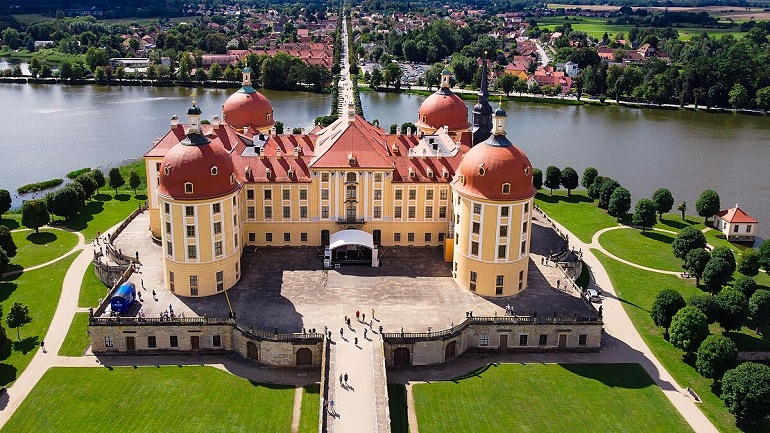
The castle presents a striking square layout with four cylindrical towers positioned at each corner, directly connected to the main building. Built primarily from high-quality Saxon sandstone, the baroque structure features an elevated position on a raised base, enhancing its commanding presence over the surrounding landscape. The castle's harmonious proportions and elegant facades showcase the finest examples of Saxon baroque craftsmanship from the early 18th century.
The main entrance on the south side leads to a reception hall characterised by ribbed vaults, a delightful remnant of the original Renaissance structure. Throughout the building, ornamental stucco work adorns ceilings and walls with intricate reliefs and mouldings, whilst custom-made furnishings and coffered ceilings demonstrate the exceptional carpentry skills of the period.
The façade, rendered in warm shades of yellow with white architectural details, creates a striking contrast against the blue sky and surrounding water, producing an idyllic scene that reflects perfectly in the lake's surface. Eight former watch posts surround the artificial island, serving as reminders of the building's original function as a Renaissance hunting lodge.
Palace Layout and Organisation
The interior comprises twelve distinct residential quarters containing over 200 rooms designed to accommodate the royal electoral family, their distinguished guests, and extensive household staff. The ground floor houses reception halls and essential service areas, whilst the first floor features the grand ceremonial rooms and state apartments that form the palace's crown jewels.
Tower Functions
- Northeast Tower (Kitchen Tower): Housed the main food preparation facilities and royal kitchens
- Northwest Tower (Bread Tower): Contained the palace bakery and bread storage
- Southeast Tower (Administrative Tower): Managed all electoral household affairs and record-keeping
- Southwest Tower (Hunter's Tower): Stored weapons, hunting equipment, and sporting accessories
Magnificent Interior Rooms
The Great Dining Hall (Speisesaal)
The dining hall serves as perhaps the most spectacular room within the castle, with walls adorned by an impressive collection of 71 red deer antlers dating between 270 and 400 years old. This remarkable display represents centuries of royal hunting expeditions and diplomatic gifts, including the world's heaviest red deer antlers, weighing over 19.8 kilograms and spanning nearly two metres. Among the prized specimens is a 66-point red deer antler from an animal killed by Elector Frederick III of Brandenburg in 1696.

The Feather Room (Federzimmer)
The castle's most extraordinary chamber contains wall panels and a four-poster canopy bed decorated with tapestries woven from over one million feathers. Originally acquired by Augustus the Strong in 1723 for his Japanese Palace, these intricate textiles were crafted from peacock, pheasant, guinea hen, and duck feathers using a unique weaving technique where individual feathers were incorporated as weft rather than glued or tied to the canvas. The room underwent a remarkable 19-year restoration completed in 2003, with each individual feather carefully cleaned and dried in specialised nitrogen chambers.
The Monstrosity Room (Monströsensaal)
Also known as Diana's Hall, this unique space houses 39 pairs of contorted antlers from deer affected by diseases or injuries. These fascinating specimens provide insight into the natural anomalies that intrigued Saxon nobility and demonstrate their dedication to collecting unusual hunting trophies that defied conventional expectations.
The Billiards Hall (Billiardsaal)
Named after a former luxury billiard table, this grand chamber contains monumental paintings on leather by Louis de Silvestre. The room exemplifies the baroque passion for combining recreational pursuits with artistic magnificence, featuring golden leather frescoes that transform leisure activities into opportunities for cultural refinement.
Baroque Leather Tapestry Rooms
Moritzburg houses the largest collection of baroque leather tapestries in existence, with eleven rooms still showcasing these remarkable works of art. Created from thin calfskin, goatskin, or sheepskin during the 17th century, the tapestries feature hand-painted scenes from Greek mythology, with Diana, the Goddess of Hunting, prominently featured throughout the designs. These masterpieces were enhanced with silvered and gilded elements, creating stunning visual displays that shimmer in changing light conditions.
The Porcelain Quarter (Porzellanquartier)
This historical exhibition space displays an extensive collection of Chinese, Japanese, and Meissen porcelain featuring hunting, exotic, and mythological motifs. Animal figurines and decorative pieces relate directly to Moritzburg's original determination as a hunting lodge, whilst the finest examples demonstrate the global reach of Saxon royal collecting.
State Apartments and Reception Rooms
The palace's numerous state apartments contain examples of extraordinary opulence in their lacquered and ornate furniture. Particularly notable is the Augsburg-crafted silver furniture styled after Louis XIV's silver furniture at Versailles, representing the height of European courtly taste. Engraved and inlaid weapons for hunting are displayed throughout these chambers, whilst gilded tapestries, ornate ceiling paintings, and gold-leafed leather wallpaper create an atmosphere of unparalleled baroque luxury.
Royal Carriage Collection
The entrance hall showcases a magnificent collection of royal carriages, providing insight into the ceremonial transport methods employed by Saxon royalty. These elaborately decorated vehicles demonstrate the importance of maintaining royal dignity even during travel.
Palace Chapel
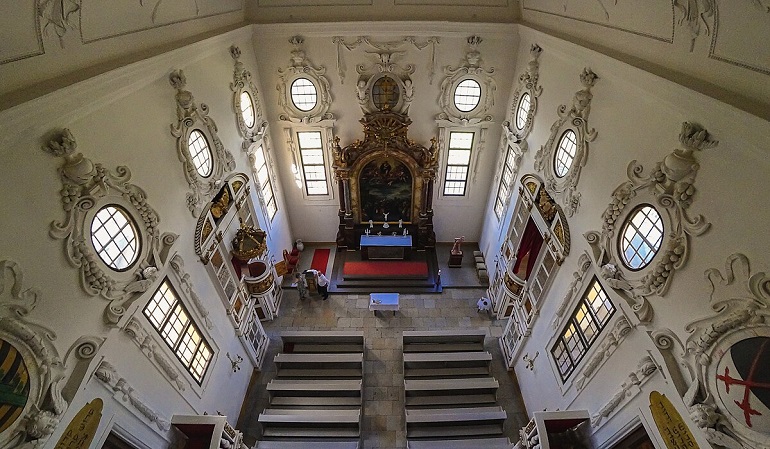
The baroque chapel, completed between 1661 and 1671 under the direction of Wolf Caspar von Klengel, represents one of the earliest examples of baroque religious architecture in Saxony. Originally Lutheran, it was consecrated in Catholic rites in 1697 following Augustus the Strong's conversion to Catholicism. The chapel features a marble altar, intricate stucco decorations, and a magnificent fresco on the vault depicting the Ascension of Christ, creating a devotional space that maintains both spiritual significance and architectural grandeur.
Magnificent Grounds and Estate
Castle Park and Formal Gardens
The French-style gardens extend northward from the castle, covering approximately 230 by 150 metres in a distinctive U-shaped layout. Although the original grand design was never completed due to Augustus the Strong's death in 1733, the park underwent reconstruction in the 19th century as a romantic-style landscape. Current restoration efforts, ongoing since 1990, aim to recreate the original 1740 French garden design with geometric patterns, sculpted hedges, and strategically positioned sculptures that complement the castle's baroque grandeur.
The Little Pheasant Castle (Fasanenschlösschen)
Located 2.5 kilometres east of the main castle, this exquisite rococo hunting lodge represents one of Germany's most beautiful small palaces. Built between 1769 and 1782, the building underwent extensive restoration between 2010 and 2013 to preserve its incredible chinoiserie and rococo-style artefacts. The structure features exotic Asian-inspired decoration, including unique wall tapestries crafted from feathers, straw, pearls, and Chinese embroideries. The building is crowned by an intricate turret topped with a gilded figure of a Chinese mandarin, creating a whimsical focal point that captures the 18th-century European fascination with Oriental aesthetics.
Maritime Complex and Lighthouse
The estate includes Saxony's only lighthouse, part of an elaborate miniature harbour complex complete with jetty and maritime buildings. This unique feature was designed for staging elaborate naval battle reenactments, providing aristocratic entertainment during the age of absolutism. The maritime setting creates an extraordinary contrast in landlocked Saxony, demonstrating the boundless imagination and resources of royal entertainments.
The Great Pond and Water Features
The large pond surrounding the castle's island was created by combining four smaller medieval ponds, resulting in an artificial lake that serves both aesthetic and practical purposes. Additional waterways and channels throughout the estate were historically used for carp production, combining beauty with utility in typical baroque fashion. The monumental Venus Fountain, one of Saxony's largest baroque fountains, marks the eastern terminus of an elaborate canal system running parallel to the main avenue.
Forest Landscape and Hunting Grounds
The Friedewald Forest features an eight-armed, star-shaped system of forest alleys radiating outward, originally designed for royal fox hunting with hounds. This geometric approach to landscape design reflects baroque principles of imposing human order upon natural settings. Over the centuries, the entire area was developed through the damming of ponds, creation of artificial islands, forest aisles, canals, tree-lined avenues, and formal gardens into a masterfully designed cultural landscape.
Approach and Setting
The castle's approach via the magnificent chestnut tree avenue provides visitors with gradually unfolding views of the castle's reflection in the water. This carefully orchestrated reveal creates one of Europe's most romantic architectural experiences, where anticipation builds as the baroque masterpiece slowly emerges from its forest setting. The entire ensemble was designed to demonstrate the power and aesthetic sensibility of Saxon royalty whilst creating an integrated work of art that encompasses architecture, landscape design, and natural beauty.
Seasonal Transformations
During winter months, Moritzburg Castle transforms into a fairy-tale setting that served as the magical backdrop for the legendary film "Three Wishes for Cinderella". The castle grounds become a winter wonderland where visitors can explore the film sets and walk in the footsteps of the beloved cheeky princess, adding an extra layer of enchantment to the baroque splendour.
Cultural Landscape Integration
The entire Moritzburg estate represents centuries of careful development where human artistry and natural beauty were combined to create a unified cultural landscape. Tree-lined avenues, artificial islands, strategically positioned viewpoints, and carefully maintained sightlines work together to frame the castle from multiple perspectives, ensuring that visitors experience the baroque vision from every angle. This integration of architecture, garden design, water features, and forest management creates a comprehensive example of 18th-century landscape architecture that remains largely intact today.
Getting There
By train Travel to Dresden (Hauptbahnhof or Neustadt) and take the S-Bahn or a regional train to Radebeul Ost or Coswig; from there either ride the heritage Lößnitzgrundbahn steam railway to Moritzburg station (follow the signed footpath for about 15–20 minutes to the castle) or connect to a regional bus that stops near Schloss Moritzburg.
By bus/coach Regional buses link Dresden, Radebeul, Coswig and Meißen with Moritzburg; alight at the “Schloss Moritzburg” stop for a short, well-signed walk to the gates. Coaches can use designated set-down points in the village, with parking provided nearby.
By car Moritzburg lies north-west of Dresden; follow signposts from the city or leave the A4/A13 at the appropriate exit (e.g., Dresden-Nord or Radeburg) and continue towards Moritzburg. Public car parks are clearly signposted around the ponds, and the castle is reached on foot via the causeway.
Best Time to Visit
The best time to visit Moritzburg Castle is during the spring and summer months from April to October, when the castle offers extended opening hours (10:00 am to 6:00 pm) and access to all its attractions, including the magnificent Baroque Exhibition and the famous Feather Room which are closed during winter. Summer presents the castle at its most enchanting, with lush gardens in full bloom, vibrant landscapes surrounding the lake, and ideal conditions for exploring both the main castle and the Little Pheasant Castle through the forest paths. The warmer months also provide the perfect opportunity to enjoy leisurely walks around the castle lake and through the picturesque grounds, whilst spring and autumn offer equally stunning scenery with fewer crowds. However, even winter visits have their charm, as the castle takes on a magical, frost-covered appearance reminiscent of a fairy tale, though visitors should note the reduced opening hours (9:30 am to 5:30 pm) and limited access to certain exhibitions during the colder months from November to February.