| Contents |
|---|
Introduction
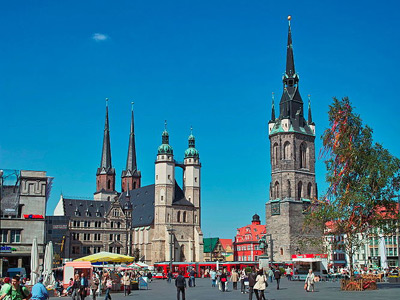
State capital and chemical powerhouse under the GDR, Halle (pop. 226,000) is a clashing mix of graceful historical buildings and modern eyesores. The city's name derives from the Celtic word for salt, and Halle's saltworks operated for over 1000 years until 1869. The compact historic centre features the Marktplatz with its five-tower skyline, the Red Tower and Market Church, and sites linked to Martin Luther. Cultural institutions are prominent, including the Handel House museum in the birthplace of George Frideric Handel, the Opera, and the Moritzburg Museum of Art in a former episcopal palace. The city is also home to the Martin Luther University Halle-Wittenberg and the Leopoldina, Germany’s National Academy of Sciences. Notable museums include the State Museum of Prehistory, which exhibits the Bronze Age Nebra Sky Disk, and the Beatles Museum. Parks and river islands along the Saale provide green spaces, while the Giebichenstein area combines a hilltop castle with a renowned art school. As the birthplace of Georg Friedrich Händel, Halle host the annual Handel Festival.
Interesting Facts about Halle an der Saale
- Halle is the largest city on the River Saale and a major economic and educational centre in central Germany.
- The Martin Luther University of Halle-Wittenberg, one of Germany’s oldest universities, is based here alongside the state’s largest university hospital.
- The German National Academy of Sciences, the Leopoldina, has its seat in Halle.
- The city’s name is linked to salt; Halle’s historic wealth grew from salt production and trade.
- George Frideric Handel (Georg Friedrich Händel) was born in Halle, and his birthplace is now the Handel House music museum.
- The State Museum of Prehistory in Halle displays the renowned Nebra Sky Disc, a Bronze Age masterpiece.
- Halle’s radio tower is the second-tallest lattice tower in Germany, reflecting the city’s role as a broadcasting hub.
- The Saale-Elster Viaduct, Germany’s longest bridge by total length, passes through Halle’s area on the high-speed rail line.
- Peißnitz Island on the Saale offers expansive green space within the city, alongside the hilltop Bergzoo.
- The city centre showcases a blend of Gothic, Renaissance, Baroque, Art Nouveau, and modern architecture.
History
Halle an der Saale's history spans nearly three millennia, with its origins firmly rooted in the ancient practice of salt harvesting. Archaeological evidence reveals continuous human settlement from the Upper Palaeolithic Period, with Neolithic pottery dating to approximately 4000 BCE and Bronze Age salt mining operations that gave the city its distinctive identity. The city's name derives from a Pre-Germanic word for salt, whilst the river Saale itself contains Germanic roots relating to salt production. By the end of the Bronze Age around 1000 BCE, Halle had developed the distinctive Brikettage technique—clay moulds used for making salt bricks—which became a defining characteristic of the Halle culture until its end around 400 BCE. The earliest documented mention of Halle as a fortress dates from 806 CE, when it was chartered as a town in 981 by the Holy Roman Emperor Otto II.
Throughout the medieval period, Halle flourished as a significant commercial centre whilst maintaining a complex political structure that often led to internal strife. The city became part of the Archbishopric of Magdeburg in 968 and remained under ecclesiastical control until 1680, though this period was marked by continuous tensions between the Halloren (saltworkers), German settlers, and the ruling archbishops. From 1281 until 1478, Halle held membership in the prestigious Hanseatic League, reflecting its importance in medieval European trade networks. The city's independence ended dramatically in 1478 when internal feuding between democratic guilds and patrician saltpan owners led a demagogue councillor to open the city gates to the archbishop's soldiers, resulting in the construction of the fortress Moritzburg to subjugate the townspeople. Despite this setback, Halle embraced the Protestant Reformation in 1522, becoming an important centre for Martin Luther's movement and later for Pietism under Prussian rule.
The city's modern transformation began when it passed to Brandenburg in 1648 following the Peace of Westphalia, marking the start of its Prussian era that would continue until German unification. Halle became a distinguished seat of learning with the founding of its university in 1694, whilst also gaining cultural prominence as the birthplace of composer George Frideric Handel in 1685. During the Napoleonic Wars, the city witnessed the Battle of Halle on 17 October 1806, where French forces clashed with Prussians through the covered bridges, streets, and marketplace before extending into the eastern suburbs. In 1815, Halle was incorporated into the Prussian Province of Saxony, later serving as the capital of Saxony-Anhalt Land from 1945 to 1952, and subsequently as capital of Halle Bezirk (district) in East Germany until reunification in 1990. The fall of communism brought significant challenges, with the collapse of heavy industry leading to population decline from a peak of 305,000 in 1991 to its current level of approximately 242,000, making it the second-largest city in Saxony-Anhalt after Magdeburg.
Main Attractions
Marktplatz (Market Square)
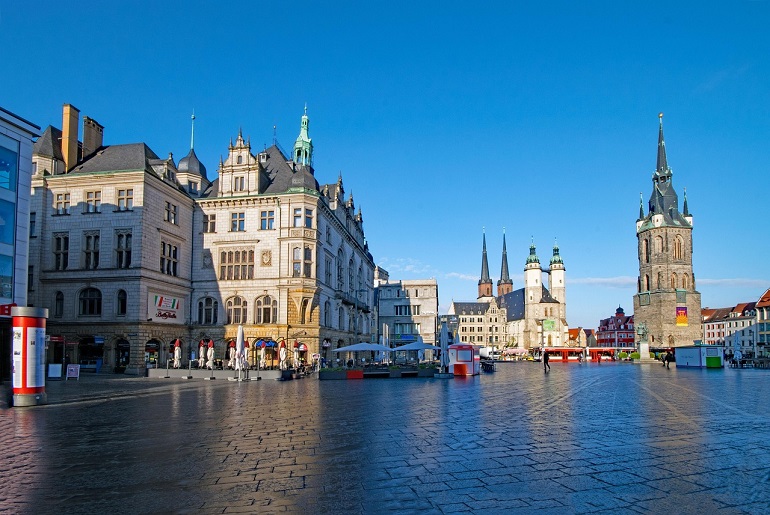
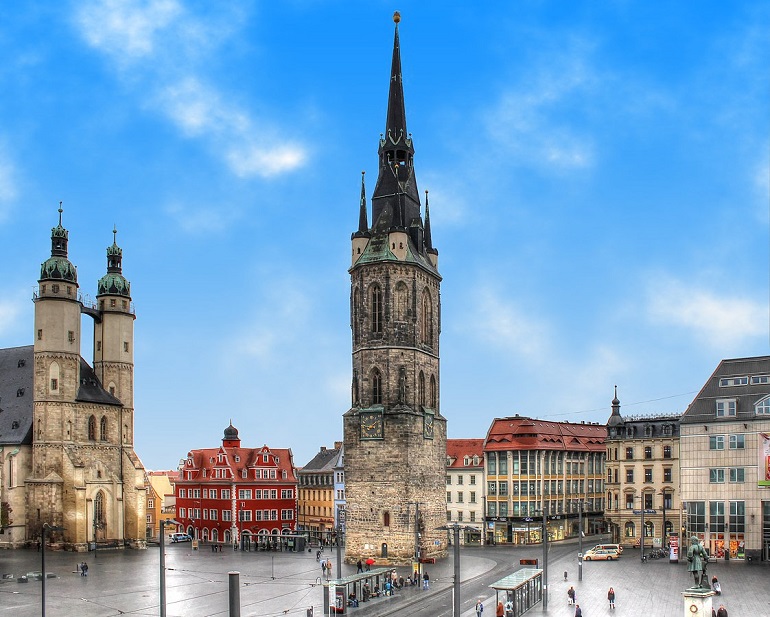
The historic Market Square serves as the heart of Halle’s old town and contains several notable landmarks. At its centre stands the imposing Market Church of St Mary (Marktkirche), built between 1529 and 1554 using elements from earlier medieval churches dating to the 11th and 12th centuries. The church features four distinctive towers: the two western octagonal towers, called the Blue Towers, are clad in dark blue slate, while the eastern Hausmannstürme are linked by a bridge that once served as the city’s fire watch. The square also holds an 1859 monument to George Frideric Handel, honouring the baroque composer born in Halle in 1685.
Roter Turm (Red Tower)
The Red Tower forms part of Halle’s most recognisable skyline feature, rising beside the Market Church’s four towers to create the famous five-tower silhouette. Built as a free-standing campanile between 1418 and 1503 for the former St Mary’s Church, the tower was gutted by artillery fire in April 1945 and lost its original spire. Subsequent restoration preserved the main structure, and the tower remains one of the city’s most photographed symbols.
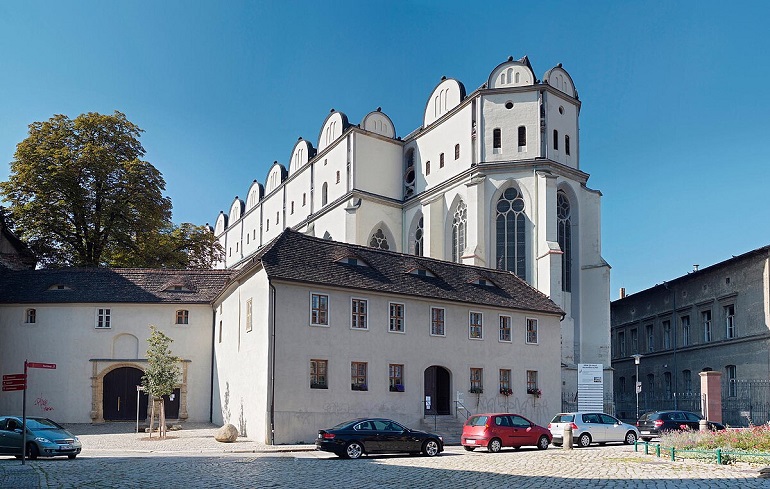
Halle Cathedral and Cathedral Square (Dom und Domplatz)
The Cathedral and its surrounding square constitute a significant ensemble of ecclesiastical architecture. Successive building phases reveal styles from Romanesque foundations to later Gothic and Baroque additions, while the open square hosts concerts and civic events that maintain the site’s central role in city life.
Giebichenstein Castle
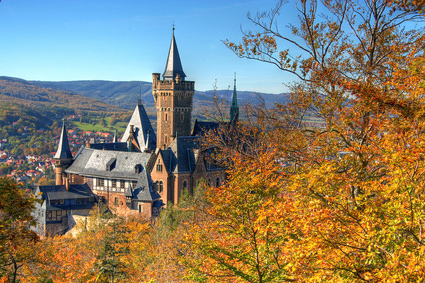
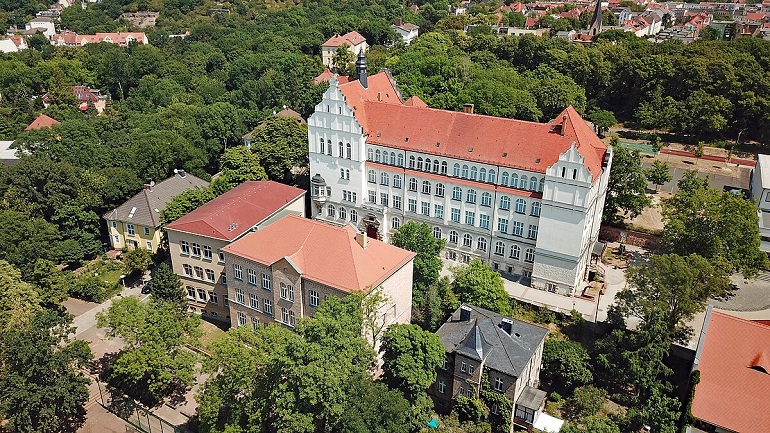
Perched on a rocky hill above the Saale River, Giebichenstein Castle affords sweeping views across the city. Today the site hosts the Burg Giebichenstein University of Art and Design, yet visitors can still walk the grounds and enjoy the panoramic outlook. Its elevated position makes the castle a popular vantage point for photography and a striking reminder of Halle’s medieval heritage.
Natural Attractions
Zoo Halle (Bergzoo)
Situated on Reilsberg hill, the Mountain Zoo combines wildlife exhibits with impressive city vistas. The hillside layout allows visitors to observe a variety of exotic and native species while overlooking Halle’s extensive green areas. As one of the city’s leading family attractions, the zoo blends conservation education with recreational opportunities.
Botanical Garden
Established in 1698 in the former gardens of the Archbishops of Magdeburg, the Botanical Garden is managed by Martin Luther University Halle-Wittenberg and forms part of the “Garden Dreams” network. It hosts a wide array of plant species in a historically significant setting and, as one of Germany’s oldest botanical gardens, offers both educational programmes and tranquil spaces for relaxation.
Peißnitz Island
Peißnitz Island lies in the Saale River and provides a verdant retreat within easy reach of the city centre. Its walking paths, open lawns and riverside areas cater to joggers, cyclists and families seeking outdoor recreation, making it a favoured spot for locals and visitors alike.
Pestalozzi Park
Pestalozzi Park delivers much-needed green space in the urban fabric of Halle. Shaded paths, play areas and expansive lawns accommodate leisure activities and community events, reinforcing the city’s reputation for abundant parks and public gardens.
Other Places of Interest
Stadtgottesacker
This Renaissance cemetery, inspired by Italian camposanto design, showcases arcaded walls and ornate tombs that reflect Halle’s architectural and cultural history. Its preserved structures illustrate early modern burial practices and offer a quiet setting for contemplation and historical exploration.
Francke Foundations (Franckesche Stiftungen)
Founded in the early 18th century by theologian August Hermann Francke, the Francke Foundations form an extensive educational and social complex. Historic school buildings, orphanages and libraries testify to Halle’s longstanding focus on learning and philanthropy, and today the site continues to house academic and cultural institutions that preserve its pioneering legacy.
Top Museums
Archaeological and Historical Museums
Landesmuseum für Vorgeschichte (State Museum of Prehistory)
The State Museum of Prehistory stands as one of Central Europe's most important archaeological museums. Housed in a magnificent building constructed between 1911 and 1913 according to designs by Wilhelm Kreis, the museum's collection of over 10 million finds includes numerous pieces of European and even global significance. The museum's crown jewel is the Himmelsscheibe von Nebra (Nebra Sky Disc), which was inscribed on UNESCO's "Memory of the World" documentary heritage list in June 2013. This extraordinary bronze disc from 1600 BCE represents the world's oldest known concrete depiction of astronomical phenomena and ranks among the most significant archaeological discoveries of the past century.
The permanent exhibition takes visitors through elaborately designed sections covering the Old, Middle, and New Stone Ages, Bronze Age, Iron Age, and early Roman Imperial period. Exceptional presentations bring stone and bronze age life to reality with displays featuring wild cave lions and imposing mammoths, contemplative Neanderthals, shamans, burial chambers, and princely graves.
Stadtmuseum Halle (Halle City Museum)
Located in the former residence of the Halle philosopher Christian Wolff and the former printing and publishing house of Gebauer & Schwetschke, the City Museum preserves Halle's urban history. The permanent historical exhibition invites visitors to immerse themselves in bygone eras and discover fascinating details from over 1,200 years of Halle's heritage. The museum complex extends beyond its main building to include several historic towers: the Red Tower, the Hausmann Towers on the market square, the Leipzig Tower, and the Oberburg Giebichenstein.
Art Museums
Kunstmuseum Moritzburg Halle (Moritzburg Art Museum)
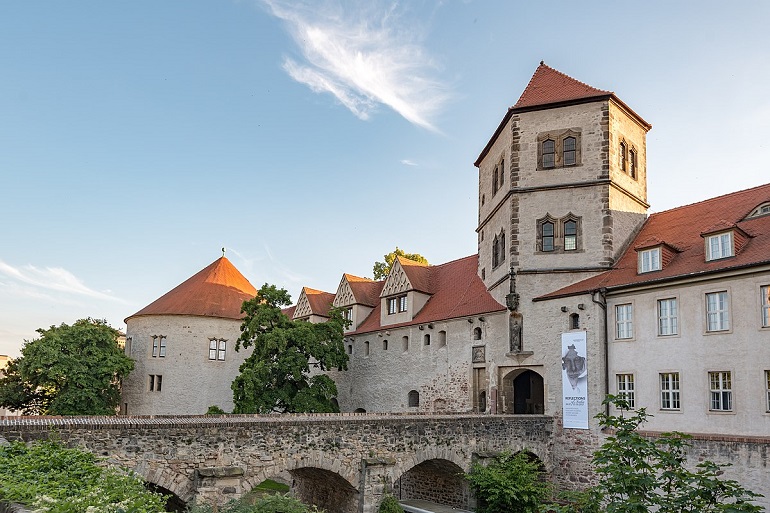
The Moritzburg Art Museum represents a fascinating architectural dialogue between old and new. The ruins of the late Gothic building have been preserved in their original state, with modern exhibition galleries known as "white cubes" literally suspended within them, all crowned by a lightweight, angular roof. This award-winning architectural approach creates a seamless blend of history and modernity.
Originally founded in 1885 as the city's museum of arts and crafts, the museum has evolved into one of Germany's most important institutions for classical modernism. The museum's collections encompass paintings, graphics, sculpture, applied arts and design, photography, coins, and medals. The permanent display "Paths of Modernism" presents graphics, handicrafts, painting, photography, design, and coins from the 20th century. The museum regularly hosts sensational special exhibitions that attract art lovers from around the world.
The Moritzburg Castle itself, built around 1480 as an archbishop's residence, carries its own historical significance. Though heavily damaged by fire during the Thirty Years' War and only partially restored after 1900, it received its magnificent new building in 2008. Its original military purpose remains evident in features such as ramparts, moats, and various battlements.
Musical Heritage Museums
Händel-Haus (Handel House)
The birthplace of Georg Friedrich Handel now houses a museum dedicated to the great Baroque composer. Two permanent exhibitions provide comprehensive insights into Handel's life and work. The museum features historical Handel portraits and a baroque theatre that presents various Handel operas. A second exhibition takes visitors on a chronological journey through the history of musical instruments, where visitors can even play copies of these historical instruments.
The nearby Wilhelm-Friedemann-Bach-Haus hosts the exhibition "Music City Halle," which celebrates famous Halle composers from five centuries. The Handel House Foundation has organised the internationally renowned Handel Festival since 1922.

Beatles Museum
Since relocating from Cologne in 2000, Halle has been home to the world's largest public Beatles institution. Spread across more than 350 square metres, the museum comprehensively documents the success story of the legendary "Fab Four" through 1970 and the "post-Beatles" era. The collection features rarities, curiosities, and numerous original items chronicling the musical development of John Lennon, Paul McCartney, George Harrison, and Ringo Starr. Highlights include first concert posters from Liverpool, documents from their Hamburg period, rare records, and much more.
Specialised Museums
Halloren Schokoladenerlebniswelt (Halloren Chocolate Museum)
This unique chocolate museum presents itself across more than 750 square metres at the company's headquarters. Visitors embark on an impressive journey through the Halloren experience world, learning fascinating details from 3,500 years of cocoa and chocolate history. The museum offers glimpses into the "transparent production" of Germany's oldest chocolate factory, which began as a small confectionery. A particular highlight is the unique Halloren chocolate room, created using more than 1,400 kilograms of chocolate and 300 kilograms of marzipan.
DB Museum Halle (Railway Museum)
The DB Museum houses fascinating original vehicles that delight railway enthusiasts of all ages. The remarkable exhibition informs visitors about the history of the traditional railway city of Halle and the old locomotive shed IV, which now houses the museum. Approximately 20 historical railway vehicles are on display, including steam locomotives from the Reichsbahn era as well as old electric and diesel locomotives. The museum places particular emphasis on Deutsche Reichsbahn series from the former East Germany. Young railway fans especially enjoy the large model railway.
Franckesche Stiftungen (Francke Foundations)
The Francke Foundations represent an extraordinary cultural monument of European significance. Beyond educational and social institutions, several museum facilities are located here, including the reconstructed art and natural history cabinet from 1741, the library building from 1728 with its originally preserved backdrop magazine, and the Canstein Bible collection. The Historic Orphanage houses several cultural-historical permanent and temporary exhibitions.
Salinemuseum (Salt Museum)
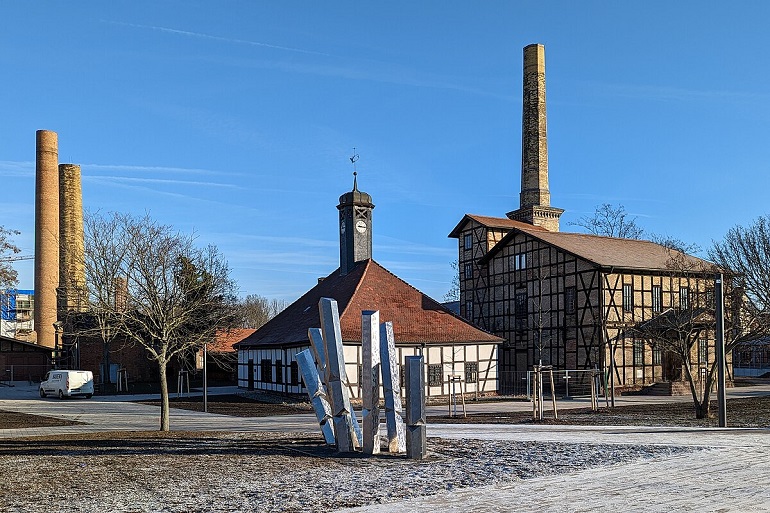
The Salt Museum holds great identity-forming significance for Halle, as salt extraction and salt trade formed the city's economic backbone for centuries. The listed ensemble is considered one of Germany's most significant saltworks monuments. From 1721 to the mid-20th century, this site housed the city's most important salt production facility.
Local Cuisine
Halle an der Saale blends Saxon-Anhalt tradition with a down-to-earth, seasonal kitchen, where hearty German fare—think roasts, schnitzel and potato dishes—meets river fish and modern bistro cooking in cosy taverns and relaxed brasseries. The city’s sweetest calling card is the Halloren-Kugeln, praline-like “globes” from Germany’s oldest chocolate factory founded in 1804, inspired by the buttoned uniforms of Halle’s historic salt workers and still produced locally today. Across Saxony-Anhalt, favourites like Harzer Roller (a tangy sour-milk cheese) also feature on platters and snack boards, pairing well with regional beers and crisp local whites, while Halle’s restaurants range from traditional Gasthäuser to contemporary spots that weave in lighter poultry, fresh fish and classic Central European comfort cooking.
Getting There
By train Halle sits on Germany’s high-speed rail axis, with frequent ICE and regional services linking major hubs such as Berlin and Leipzig; the fastest trains from Berlin take about 1h–1h10, and the Erfurt–Leipzig/Halle high-speed line further streamlines long-distance connections across the country.
By coach Long-distance coaches run to Halle on networks like FlixBus, with direct and connecting services from cities including Berlin and Amsterdam, typically taking around 2–8 hours depending on origin and route.
By car Halle is easily reached by motorway from neighbouring cities such as Leipzig and Berlin; journey times are competitive on well-maintained autobahns, complemented by fast intercity rail and coach alternatives if preferring not to drive.
| Travel destinations in Saxony-Anhalt | ||||||||||||||
|---|---|---|---|---|---|---|---|---|---|---|---|---|---|---|
|
|
|
|
| ||||||||||
|
|
|
|
| ||||||||||
|
|
|
| |||||||||||