



Introduction
The Walhalla memorial is a neoclassical hall of fame situated approximately 10km east of Regensburg, overlooking the Danube River. Commissioned by King Ludwig I of Bavaria and completed in 1842, the monument honours prominent figures from German history with over 130 busts and 65 plaques displayed within its Parthenon-inspired structure. Visitors can reach the memorial by ascending 350 marble steps from the riverbank or via local road and river transport options. Inside, the collection spans around 2,000 years, featuring influential personalities from various fields, reflecting the broad historical and cultural legacy of German-speaking peoples. The Walhalla serves both as an architectural landmark and a significant site commemorating German heritage.
Interesting Facts about the Walhalla memorial
- Walhalla is a neo-classical memorial hall overlooking the Danube near Regensburg, modelled on the Parthenon in Athens.
- It was commissioned by King Ludwig I of Bavaria and opened in 1842 after twelve years of construction.
- The memorial is named after Valhalla from Norse mythology, the hall of slain warriors.
- Inside are around 130 busts and 65 plaques honouring distinguished figures from 2,000 years of Germanic history, including Albert Einstein, Beethoven, and Goethe.
- The collection commemorates not only Germans but also notable figures from other German-speaking regions, such as Austria, Switzerland, and even early Anglo-Saxon Britain.
- King Ludwig I’s concept was inspired by a desire to unify German-speaking peoples and remind them of their shared heritage following Napoleon’s conquests.
- Built high above the Danube, the temple offers impressive panoramic views of the river and countryside, attracting visitors for both its architecture and scenery.
- The construction cost 666,666 pounds, equivalent to about 60 million pounds today.
- The architectural design is clad in marble both inside and out, symbolising dignity and permanence.
- New busts are added on the recommendation of the Bavarian Academy of Sciences and approval by the Bavarian government, keeping the memorial up to date with modern achievers.
- Despite being modelled on the Parthenon, the Walhalla is not a direct copy; its interior features a unique free design.
- Locals and visitors alike enjoy the large grassy lawn surrounding the memorial, making it a popular spot for picnics and gatherings.
History
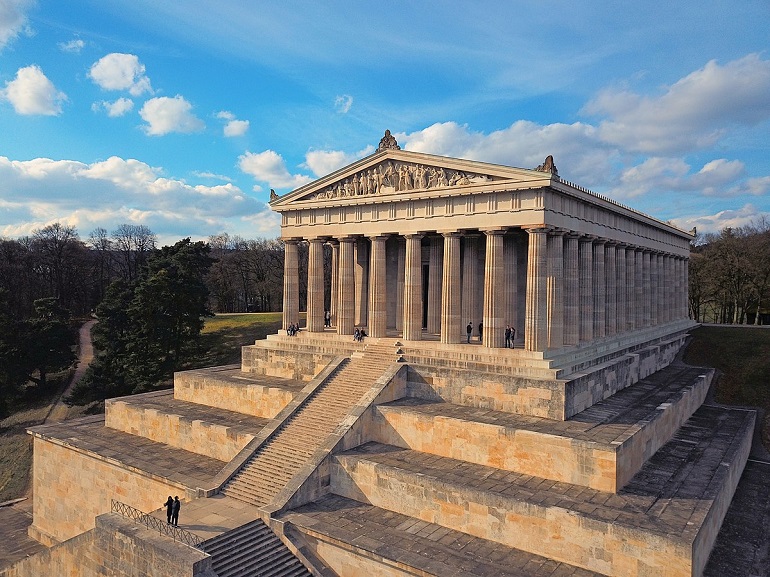
The Walhalla memorial in Bavaria stands as one of Germany's most significant 19th-century national monuments, perched majestically on a hilltop overlooking the Danube River near Regensburg. Conceived in 1807 by Crown Prince Ludwig I of Bavaria following what he regarded as a humiliating defeat by Napoleonic armies, the memorial was envisioned as a unifying symbol to remind all Germans of their common heritage and to support the growing momentum for German unification. Under the influence of historian Johannes von Müller, who also made the initial selection of personalities to be honoured, the project took its name from Valhalla, the warrior's paradise of Germanic mythology. The foundation stone was laid in 1830, and the memorial was ceremoniously opened on 18 October 1842, having cost £666,666 to construct—equivalent to £60 million today.
The memorial itself represents a masterpiece of Neoclassical architecture, designed by Ludwig I's favourite architect, Leo von Klenze, one of the most important Neoclassical masters of the 19th century. Primarily inspired by the famous Parthenon on the Acropolis in Athens, the temple building rises above a massive tiered substructure, though Klenze's free design of the interior prevents it from being merely a copy of the ancient Greek structure. The entire building is clad inside and out with precious marble, creating a stunning visual impact that has made it one of Bavaria's most recognisable landmarks. The temple's impressive facade features a portico with columns surrounding the main structure, and visitors must climb 358 marble steps to reach the entrance.
Inside the memorial, the vast hall houses 65 plaques and 130 busts covering 2,000 years of Germanic history, beginning with Arminius, victor at the Battle of the Teutoburg Forest in 9 CE. The walls display busts and memorial plaques of the "Walhalla comrades" chosen by Ludwig I and his advisors—a selection of rulers, generals, scientists, and artists considered exemplary in the 19th century. Notable figures include Albert Einstein, Ludwig van Beethoven, Wolfgang Amadeus Mozart, Johann Wolfgang von Goethe, Martin Luther, Johannes Kepler, and Otto von Bismarck. Above the busts runs a frieze by Martin von Wagner depicting an idealised history of the Germanic people from the first migrations to Christianisation in the early Middle Ages. Since 1962, new busts have been added at intervals of five to seven years, with selections made by the Bavarian Council of Ministers, advised by the Bavarian Academy of Sciences.
Description
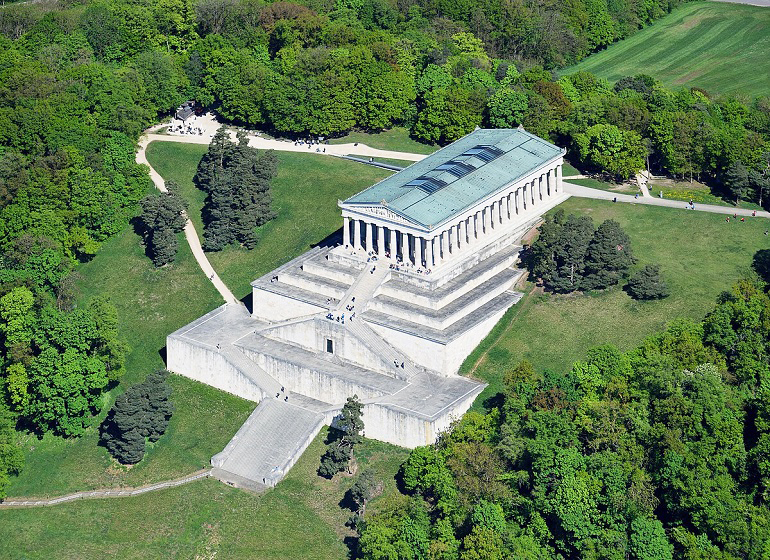
A gleaming neo-classical temple poised high above the Danube, the Walhalla memorial offers visitors an immersive encounter with both monumental architecture and an unrivalled panorama of the Bavarian landscape. Conceived as a hall of fame, the building today attracts travellers less for its historical back-story than for its breathtaking design, serene ambience and thoughtful visitor facilities.
Setting and First Impressions
Approaching through beech and oak woodland, the temple’s pentelic-white façade seems to hover over the river valley. Even before mounting the first step, visitors absorb a sweeping horizon that includes the sinuous course of the Danube, the crenellated ruins of Donaustauf castle and—on a clear day—the distant twin spires of Regensburg Cathedral. The juxtaposition of Hellenic form against Bavarian greenery sets an almost theatrical scene: marble gleams against foliage, while the river beyond lends a shifting ribbon of reflected light.
Atmospheric Qualities
- Soundscape: Birdsong and leaf-rustle replace urban noise; the colonnade channels a soft echo that heightens the sense of ceremony.
- Microclimate: At 400 metres above sea-level, gentle breezes moderate midsummer heat; in cooler months, the stone radiates retained warmth long after sunset.
- Aromas: Seasonal linden blossom mingles with the faint mineral tang of marble dust on warm days.
Architectural Style and Exterior Detailing
Layout and Dimensions
The memorial complex—including its multi-tiered substructure—measures 125 metres long and 55 metres high, yet the visible “temple block” occupies a footprint of 66.7 metres by 31.6 metres, standing 20 metres to the cornice.
| Metric | Measurement |
|---|---|
| Overall length (including base) | 125 m |
| Overall height | 55 m |
| Temple length | 66.7 m |
| Temple width | 31.6 m |
| Temple height to cornice | 20 m |
Doric Peripteral Colonnade
Modelled on Athens’ Parthenon, the temple follows the Doric order: fluted shafts without bases, plain echinus-and-abacus capitals and an alternating triglyph-metope frieze. Fifty-two columns encircle the cella, eight across each short façade and fourteen along the long sides, delivering the rhythmic solidity typical of a peripteral octastyle plan.
Sculptural Gables
Behind the columns, pedimental groups in pristine Carrara marble dramatise two pivotal tableaux:
- Southern gable: Germania personified presides over allegorical figures of freedom and renewal.
- Northern gable: Arminius rallies Germanic tribes against Roman legions.
Though executed in nineteenth-century Bavaria, both compositions respect classical conventions of depth gradation and diagonal spear lines, giving the tympana a lively chiaroscuro in raking light.

Marble Staircase
A monumental 358-step open staircase drops directly towards the riverbank, its treads polished by generations of visitors. Mid-flight landings provide lateral glimpses of forested slopes, inviting pauses for photographs or picnics.
Interior: The Hall of Fame
Spatial Proportions
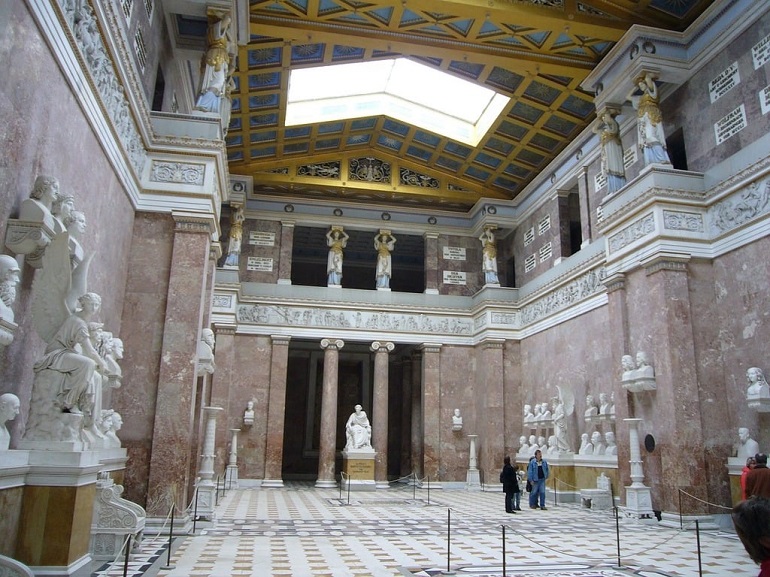
Upon entry through bronze-clad timber doors, travellers step into a hall 48 metres long, 15 metres wide and 16 metres high. The marble floor’s subtle chequerboard pattern reflects daylight from clerestory lunettes, while bronze-framed coffers punctuate the barrel-vaulted ceiling, each inset with gilded stars that sparkle beneath discreet LED up-lighting installed during recent conservation works.
Busts and Plaques
A current roster of 132 busts and 65 marble tablets lines the walls in two tiers. The collection spans 2,000 years of German-language achievement, from the ancient chieftain Arminius to the physicist Max Planck, admitted in 2022. Each bust rests on an inscribed socle of dark serpentine, contrasting with the pale shell of the wall.
Curatorial Rhythm
- Busts appear alphabetically within broad professional categories—arts, sciences, governance—rather than strictly chronological order.
- Plaques memorialise deserving figures for whom no authentic likeness survives; their gilded Roman capitals gleam on green-veined marble.
Decorative Friezes
A continuous narrative frieze above the bust line illustrates an idealised Germanic history, sculpted by Martin von Wagner. Guardians of the frieze—six winged Victory figures in gilded bronze—also anchor the roof trusses, an innovative iron framework rare for the 1840s.
Ambience and Lighting
Natural daylight enters through clerestory windows oriented to avoid direct glare yet provide a silvery side-light that accentuates facial modelling on the busts. After dusk, concealed LED luminaires reproduce warm candle-light colour temperatures, maintaining the contemplative mood without the smoky residue of former gas torches.
Acoustically, the coffered vault tempers echoes, allowing hushed conversation despite the hall’s cavernous volume. During periods of high summer visitation, this design prevents speech from ballooning into an overwhelming din, preserving a sense of solemnity.
Panoramic Views and Surroundings
From the columned peristasis, visitors enjoy a 270-degree sweep of the Danube’s ox-bow and the fertile plains beyond. At sunrise the river’s surface mirrors amber skies; by evening the descending sun silhouettes the temple itself, offering photographers a prized subject. In autumn, the hillside becomes a tableau of ochre and carmine foliage that frames the marble like a living picture window.
Accessibility and Visitor Amenities
Mobility Access
- Parking: Two designated bays directly beside the memorial, accessed via a barrier opened with the EU disability key.
- Pathway: A gently graded gravel route avoids the main staircase; maximum gradient 6 percent.
- Entrance: Removable threshold ramp and 80 centimetre-wide doors.
- Interior: Entire hall is on a single level with non-slip marble paving.
Additional Facilities
| Facility | Detail |
|---|---|
| Disabled toilet | Located behind the temple; EU key access |
| Portable stools | Free loan from ticket desk for visitors needing rest |
| Tactile bronze scale-model | Positioned near ramp for visually impaired orientation |
| Snack kiosk | Seasonal; sells Bavarian pretzels, soft drinks and coffee |
The Monumental Staircase and Approach
While the barrier-free path delivers ease, many visitors relish the ceremonial ascent via the main flight. Each rise measures a comfortable 16 centimetres—steep enough to feel grand yet shallow enough to be manageable for most healthy adults. Benches punctuate the climb at regular intervals, shaded by mature limes and maples whose branches arch overhead like a natural propylaea.
Architectural Materiality
Marble Palette
- Exterior: Locally quarried Kelheim limestone forms the substructure; façades are clad in unweathered Untersberg marble, whose fine grain affords crisp mouldings.
- Interior: Pale grey Carrara for columns and walls; contrasting dark serpentine for plinths; Belgian black marble borders the floor field.
Structural Innovation
An iron truss roof—pioneering at the time—permits a clear-span cella without interior supports, thereby ensuring an uninterrupted vista of busts. The beams, hidden within the timber-lined attic, remain accessible for inspection through discreet ceiling hatches installed during a 1980s conservation campaign.
Visitor Flow and Interpretive Media
Entry tickets include a concise multi-language guidebook mapping each bust and plaque in floorplan format. An optional audio-handset supplements the static numbers with short vignettes and ambient soundscapes: organ chords accompany Bach, rolling surf underscores Zacharias Werner’s poem Der vierundzwanzigste Februar, and so forth. QR codes at four touchscreen kiosks link to the memorial’s official app, providing deeper biographical essays and high-resolution imagery.
Practical Advice for On-Site Enjoyment
- Dress: Marble retains coolness; even in July a light cardigan proves useful.
- Timing: Arrive shortly after the 09:00 opening to enjoy solitude before mid-morning coach parties.
- Photography: Tripods forbidden inside; monopods accepted if fitted with rubber tips. External drone flights require Bavarian heritage authority permission.
- Well-being: Bottled water allowed; avoid glass that could scratch marble surfaces.
Sustainability and Preservation Measures
Recent interventions utilise reversible conservation methods. Laser micro-ablation cleans biological patina on outer columns, leaving benign lichen in non-critical areas to share ecological niches with wall-creeping insects. A ground-source heat pump now mitigates interior humidity fluctuations, protecting both marble and bronze.
Comparative Snapshot: Exterior versus Interior
| Aspect | Exterior | Interior |
|---|---|---|
| Order | Doric peripteral octastyle | Doric pilasters framing bust bays |
| Column count | 52 fluted shafts | 6 caryatid-style Victories |
| Primary stone | Untersberg marble | Carrara marble |
| Dominant light | Natural, high UV | Filtered, UV-screened windows |
| Colour palette | Ivory stone, green forest, blue sky | Pale marble, gilded coffers, bronze busts |
Photography and Sensory Highlights
- Early Morning: Low sun slants through the western colonnade, striping the stylobate with alternating bands of brilliance and shadow—ideal for chiaroscuro imagery.
- Midday: Marble’s latent sparkle emerges; busts show fine crystalline reflections under the ceiling’s golden coffer mosaics.
- Blue Hour: Post-sunset illumination bathes the temple in a cobalt wash, contrasting warmly lit interior apertures against the darkening sky.
- Winter Frost: Hoar crystals on the flutes accentuate vertical lines; breaths of visitors condense visibly, adding ephemeral drama.
Glossary of Architectural Terms
- Peripteral
- A temple surrounded by a single row of columns on all sides.
- Octastyle
- Featuring eight columns along the façade.
- Doric Order
- The oldest and simplest of classical Greek architectural styles, characterised by unadorned capitals and no bases.
- Stylobate
- The platform on which columns stand.
- Triglyph
- Three-channelled vertical panel in a Doric frieze.
- Metope
- The square panel between triglyphs, often sculpted.
- Cella (naos)
- The inner chamber of a classical temple.
- Coffered Ceiling
- Ceiling with recessed panels, often gilded.
Getting There & Around
By train The most convenient way to reach the Walhalla memorial by train is to travel to Regensburg Hauptbahnhof, which is the nearest major railway station. From there, you can seamlessly continue your journey to the memorial via local public transport or by taxi.
By bus From Regensburg’s main station, take bus number 5 towards Donaustauf. The bus ride brings you to the Walhallastraße stop at the base of the hill below the memorial. Buses run frequently throughout the day, though service is reduced on Sundays and holidays. From the bus stop, a short walk up a series of steps leads you directly to the monument.
By car If travelling by car, follow the A3 motorway and exit at Neutraubling/Barbing, heading towards Donaustauf. There is a large car park at the top of Walhallstraße, just a brief walk from the entrance to the memorial. Ample parking is available, making this a convenient option for those journeying by automobile.


