



| Contents |
|---|
Introduction
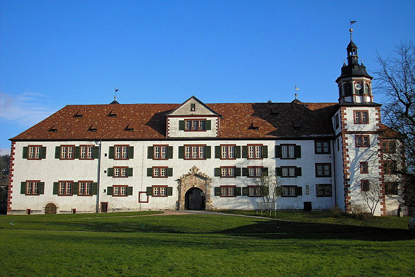
Wilhelmsburg Castle, situated on a gentle foothill above the medieval town of Schmalkalden, was erected between 1585 and 159 as a secondary residence for Landgrave William IV of Hesse-Kassel. Designed in the late Renaissance style with a nearly square, four-winged layout, the castle remains largely unaltered since its completion in 1618. Unimpressive from the outside, the castle's interior is beautifully decorated by Renaissance murals and stucco. The adjacent castle chapel, consecrated in 1590, features an early Protestant arrangement with altar, pulpit and organ aligned vertically, and houses a wooden organ still in playable condition. Today, the complex serves as a museum displaying permanent exhibitions on the Renaissance, the Reformation and the Schmalkaldic League, and includes original interior decorations, stucco work and historical murals.
Interesting Facts about Wilhelmsburg Castle
- Wilhelmsburg Castle is considered one of the most important and best-preserved Renaissance castles in central Germany, retaining virtually its original structure since completion.
- Construction of the castle began in 1584 and was completed in 1618, originally serving as a secondary residence for the Landgraves of Hesse-Kassel.
- The castle’s four-winged design and nearly square ground plan exemplify ideal Renaissance architecture, with exceptional interior decorations and innovative spatial arrangements.
- Wilhelmsburg Castle features a magnificent Renaissance chapel, built in 1590, which is among the oldest newly constructed Protestant churches in Germany and pioneered the unique vertical arrangement of altar, pulpit, and organ.
- Its Renaissance organ, crafted in 1589, is one of the oldest playable wooden organs in Central Europe and still sounds during concerts today.
- The castle houses splendid halls including the Giant's Hall and the White Hall, famed for their murals, stucco, and historical exhibitions.
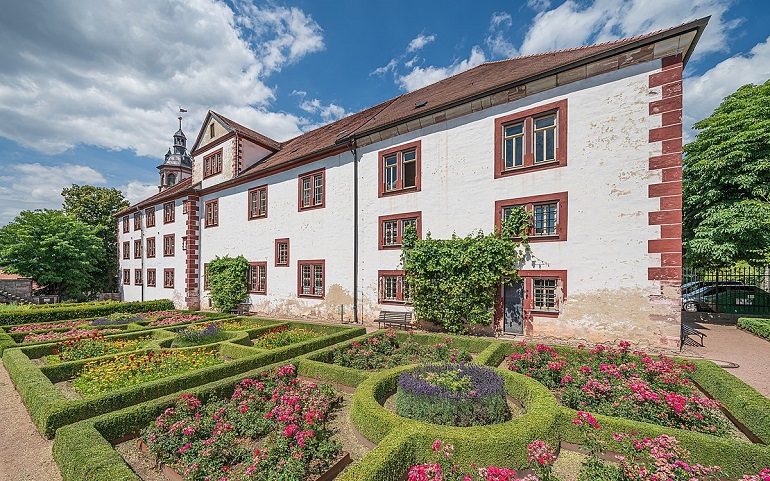
- The pleasure gardens created from 1602, planted with medicinal herbs and ornamental plants, were redesigned in the late 17th century and are now recognised as one of the oldest garden monuments in central Germany.
- Wilhelmsburg Castle played a notable role in the political and religious history of the period, acting as a centre of the Protestant Schmalkaldic League and the Reformation.
- Since 1994, the castle and its grounds have been managed by the Thuringian Castles and Gardens Trust, with permanent exhibitions on Renaissance lifestyle and the Reformation.
History
The castle's origins trace back to 1583, when Landgrave Wilhelm IV of Hesse-Kassel acquired sole ownership of the Lordship of Schmalkalden, which had previously been shared with the Counts of Henneberg. As a symbol of his new dominion, Wilhelm IV ordered the demolition of the 12th-century Waltaff Castle that occupied the site and commissioned the construction of a magnificent Renaissance palace to bear his name. Construction began in 1584, and whilst the castle was inaugurated on 23 May 1590, the ambitious project remained incomplete. The interior furnishings were procured from Kassel, reflecting the high standards expected of this secondary residence.
The castle's construction continued under Wilhelm IV's son, Landgrave Maurice (Moritz), who frequently resided at Wilhelmsburg and oversaw the completion of the building works in 1618. During Maurice's reign from 1592 to 1627, the decorative paintings throughout the castle were completed, and the comprehensive castle grounds were further developed with outbuildings and elaborate gardens. The terraced pleasure gardens, herb gardens, kitchen gardens, and orchards were laid out from 1602 onwards, featuring fountains, hedges, and plantings of medicinal herbs, vegetables, flowers, and vines in the true spirit of Renaissance garden design. The castle flourished again from 1690 as the widow's residence of Landgravine Hedwig Sophie, and subsequently under her son Landgrave Karl, who ruled from 1677 to 1730 and was particularly notable for his garden redesigns. However, successive generations of Hessian landgraves used the castle less frequently, and by the early 19th century, it had been abandoned altogether.
Wilhelmsburg Castle represents a masterpiece of Renaissance architecture, constructed as a four-winged structure with a nearly square floor plan and stairway towers positioned at the corners of the central courtyard. The comprehensive castle complex includes parade grounds, a gatekeeper's house, pleasure gardens, a kitchen garden, a prison tower, stables, a bakery, and a brewery, demonstrating the self-sufficient nature of aristocratic residences of the period. The castle's interior is renowned for its exceptional decorative programme, featuring halls adorned with scrollwork, strapwork, and elaborate paintings, including a copy of the Iwein epic by Hartmann von Aue. The magnificent castle church, designed by Dutch architect Willem Vernukken in 1590, holds particular historical significance as one of the oldest and most beautiful newly built Protestant churches in Germany. Its innovative arrangement of altar, baptismal font, pulpit, and organ in a vertical axis became a pioneering model for Lutheran church architecture throughout the 18th century. The church houses a remarkable Renaissance organ built by Daniel Meyer in Göttingen, which remains one of the oldest playable wooden organs in Central Europe, featuring 252 wooden pipes and producing its distinctive sound including a unique "bird cry" effect. In 1873, the Association for Henneberg History and Geography purchased the castle and established it as a museum, and since 1994, it has been managed by the Stiftung Thüringer Schlösser und Gärten (Thuringian Castles and Gardens Foundation).
Description
Wilhelmsburg Castle's four-winged, nearly square layout encloses a spacious central courtyard, lending it an air of both regality and intimacy. The exterior presents a harmonious balance of ornament and restraint. Mannerist portals and mullioned windows punctuate the otherwise serene white walls, while richly carved gables—once hidden beneath later roof alterations—hint at the building’s original decorative ambitions. Surrounding the main edifice, neatly laid out pleasure gardens and a traditional kitchen garden offer glimpses of seasonal blooms and herbs, framing the castle against undulating woodlands.
Stepping inside, visitors tread upon creaking wooden floors that have borne witness to more than four centuries. The journey through the castle unfolds much like a sequence of theatrical acts:
-
Landgrave’s Chamber
A ground-floor retreat where simple furnishings speak of private repose. Muted frescoes on the walls recall early Germanic legends, creating a quietly evocative ambience.
-
Giant’s Hall (Riesensaal)
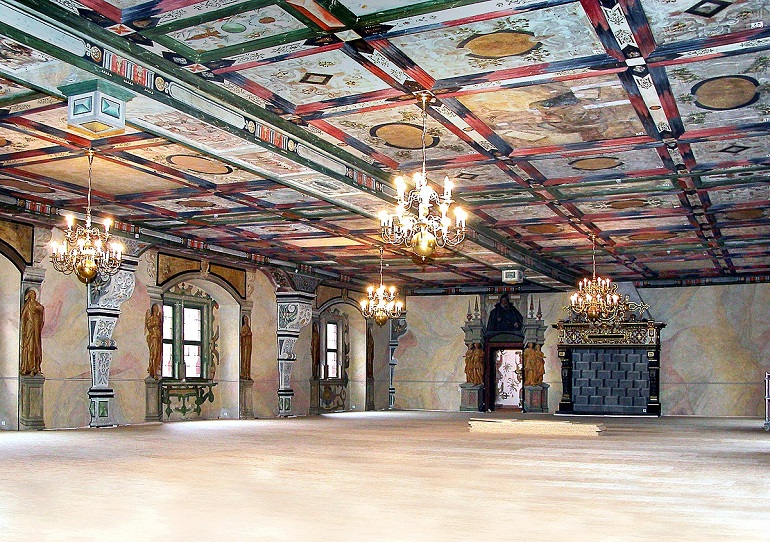
Dominated by a coffered and painted ceiling, this grand ballroom dazzles with its elaborate stucco scrollwork. Light filters through tall windows, illuminating original furniture pieces and the richly patterned wooden panels beneath.
-
Festal Banqueting Hall
Here, high-relief strapwork adorns the walls, while the vaulted ceiling arches overhead in an intricate lattice of plaster and paint. The chamber’s lofty proportions and gentle acoustics make it ideal for intimate concerts and lectures.
-
White Hall
As its name suggests, this chamber exudes clarity and calm. Whitewashed walls and simple Ionic pilasters provide a serene setting for temporary exhibitions, allowing artworks or displays to take centre stage.
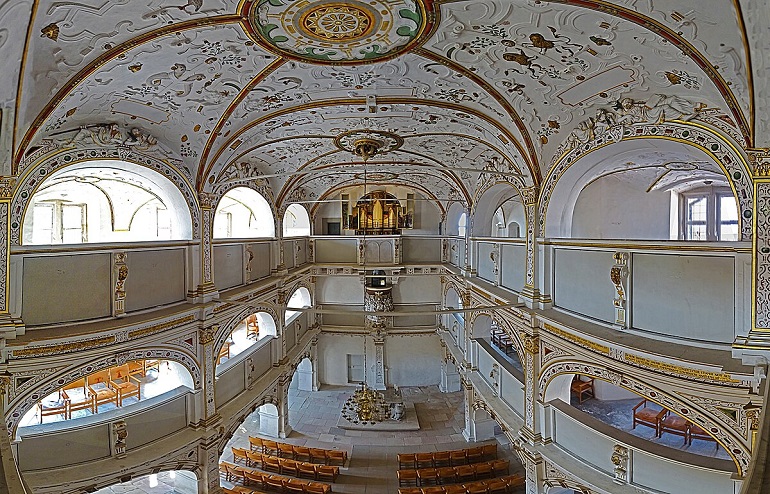
The three-storey castle chapel is a highlight of spatial ingenuity. For the first time in Protestant church design, altar, pulpit and organ align vertically, drawing the eye heavenwards. Sunlight dances through narrow clerestory windows, glinting off the polished wooden pipes of the Renaissance organ—one of Europe’s oldest still in playable condition. Visitors often pause here to savour the chapel’s hushed acoustics, imagining the organ’s rich timbre resonating across the courtyard.
Beyond its walls, a brief stroll leads to the former gatekeeper’s house and the remains of a small prison tower, each echoing the castle complex’s multifaceted past. Meanwhile, from the terrace walkways, panoramic vistas unfurl across the half-timbered town below and the rolling Thuringian hills beyond—a reminder that Wilhelmsburg is not merely an architectural gem but a commanding vantage point.
Getting There
By train Wilhelmsburg Castle is easily reached via train; simply take the Süd-Thüringen-Bahn to Schmalkalden station. From there, it is a pleasant walk through the charming historic centre and slightly uphill, with the castle towering above the town and clearly signposted.
By coach or bus Travellers arriving by coach or bus will find connections to Schmalkalden from several regional towns; local town buses also stop within walking distance of the castle, making access straightforward from other parts of the city.
By car If arriving by car, follow signs to Schmalkalden and then to Wilhelmsburg Castle; parking is available on site and nearby, so you can leave your vehicle within easy reach of the castle entrance.
Best Time to Visit
The ideal period to explore Wilhelmsburg Castle is from late spring through early autumn—roughly May to September— the castle’s four-winged Renaissance splendour is bathed in warm daylight, the gardens are in full bloom and daily opening hours run from 10 am until 6 pm. During this time the weather is pleasantly mild, making the ascent from the half-timbered town enjoyable and offering stunning vistas over the Thuringian Forest. Early summer brings a lively cultural calendar, with open-air concerts in June, special exhibitions and even a Museum Night in September, ensuring visitors can savour both the castle’s original murals and stucco work and a variety of events against the backdrop of one of Germany’s best-preserved Renaissance palaces.


