



Gendarmenmarkt at sunset, Berlin.
Introduction

With a population of just 2.5 million for 29,478 km2, Brandenburg is the second most sparsely populated German state after its northern neighbour, Mecklenburg-Vorpommern. Berlin, a city state of its own, is in fact more populous, with 3.5 million inhabitants.
Composed in large part of wetlands and woodlands, Brandenburg is one of the greenest states in Germany, with 15 large protected areas making up nearly a third of the total land area. The capital of Brandenburg is Potsdam. Its historical capitals were first Brandenburg, then Berlin.
Brandenburg is home to Germany's only indigenous minority, the Sorbs, descendants of 6th-century Slavs who settled the region. They are mostly confined in the southeast of the state, around Cottbus.
Famous people from Brandenburg include (chronologically): the philosopher and diplomat Wilhelm von Humboldt, the physician and physicist Hermann von Helmholtz, the naturalist and biologist Ernst Haeckel, and the Nobel Prize chemist and physicist Walther Nernst.
Famous people from Berlin include (chronologically): the geographer and naturalist Alexander von Humboldt, the painter Max Liebermann, Nobel Peace Prize chancellor Gustav Stresemann, the founder of the Bauhaus School Walter Gropius, the Nobel Prize poet and playwright Nelly Sachs, and the actress and singer Marlene Dietrich.
History of Brandenburg
The region that comprises modern Brandenburg has been inhabited since antiquity, initially forming part of Magna Germania which extended to the Vistula River. By the 7th century, Slavic peoples had settled extensively throughout the area, with the Hevelli tribe establishing themselves in the west around the Havel River and the Sprevane in the east. The Slavs built important fortifications, including a major castle on Dominsel island in present-day Brandenburg an der Havel, and established settlements whilst worshipping various deities such as the three-headed god Triglav. German conquest began in earnest under Henry the Fowler in the early 10th century, who captured the Slavic capital of Branibor (Brennabor) around 928-929. Emperor Otto I established the Northern March in 948 and founded the Bishoprics of Brandenburg and Havelberg to exert imperial control, though a great Wendish uprising in 983 temporarily drove imperial forces from the territory and returned the region to Slavic control.
The definitive German conquest and Christianisation of Brandenburg occurred under Albert the Bear, who was made Margrave of the North March in 1134 by Lothar, Duke of Saxony. Albert and his Ascanian heirs systematically conquered, colonised, and Christianised the region over the following century, gradually assimilating the Slavic population culturally, politically, and economically. By 1157, the Margraviate of Brandenburg was fully established as a major principality of the Holy Roman Empire, with its ruler recognised as an imperial elector by the mid-12th century—a right confirmed by Emperor Charles IV's Golden Bull in 1356. The territory was organised into three marches: the Old March (Altmark) west of the Elbe, the Middle March (Mittelmark) between the Elbe and Oder, and the New March (Neumark) east of the Oder. Brandenburg prospered throughout the 13th century, with numerous new towns founded including Berlin, though the extinction of the senior Ascanian line in 1320 led to a period of political instability and noble rebellion during the 14th century.
The revival of Brandenburg's fortunes began in 1415 when Holy Roman Emperor Sigismund appointed Frederick of Hohenzollern as Elector, establishing a dynasty that would dominate European politics for centuries. Frederick I moved the capital from Brandenburg an der Havel to Berlin in 1417, whilst his successors, particularly Frederick II Iron Tooth (1440-70) and Albert III Achilles (1470-86), systematically curbed rebellious nobles and expanded Hohenzollern influence over neighbouring territories including Pomerania. The dynasty's power expanded dramatically when Elector John Sigismund inherited the Duchy of Prussia in 1618 through marriage, creating Brandenburg-Prussia and establishing the foundation for the later Kingdom of Prussia in 1701. Despite suffering devastating losses during the Thirty Years' War (1618-1648), when an estimated half the population was killed or displaced, Brandenburg emerged stronger through the Peace of Westphalia, gaining the Bishopric of Minden, Principality of Halberstadt, and succession rights to Farther Pomerania. The Hohenzollern electors continued to accumulate territories, ultimately transforming Brandenburg from a modest march into the core of what would become the dominant German state and, after 1871, the heart of the German Empire.
Clickable Tourist Map of Berlin & Brandenburg
Note that dots, castle icons and national parks are not clickable on the mobile version. Please use the desktop version for optimal navigation.

Blank map of Schleswig-Holstein by Grundkarte TUBS, Relief by Alexrk2. Tourist locations by Maciamo. CC BY-SA 3.0.
Attractions
West
| Rheinsberg Palace |
|---|

 Rheinsberg Palace, or Schloss Rheinsberg, stands gracefully on the eastern shore of Lake Grienericksee in Brandenburg, forming a harmonious union of water, parkland and splendour. Its three-winged ensemble, punctuated by twin towers, embodies the refined elegance of early Frederician Rococo, complemented by later Neoclassical embellishments. Rheinsberg Palace, or Schloss Rheinsberg, stands gracefully on the eastern shore of Lake Grienericksee in Brandenburg, forming a harmonious union of water, parkland and splendour. Its three-winged ensemble, punctuated by twin towers, embodies the refined elegance of early Frederician Rococo, complemented by later Neoclassical embellishments. |
| Berlin (※) |
|---|
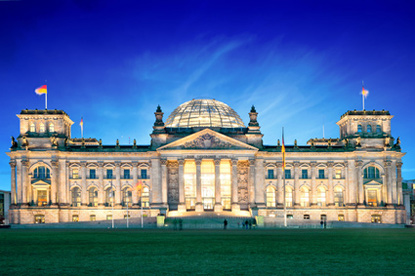
 Berlin, Germany's capital and largest city, is home to 3.9 million residents and stands as the European Union's most populous city (within the city boundaries). Located in eastern Germany along the Spree River, Berlin covers 891 square kilometers, with nearly one-third of its area composed of forests, parks, and waterways. The city blends historical landmarks like the Brandenburg Gate, Reichstag building, and remnants of the Berlin Wall with contemporary culture, featuring over 180 museums, a vibrant arts scene, and diverse culinary offerings including 23 Michelin-starred restaurants. Lying in ruins after WWII, torn by the Cold War, disfigured by grim concrete tenements under the GDR, the reunification gave Berlin a new lease of life, and an opportunity to reinvent itself, with panache. From iconic landmarks like the Brandenburg Gate and the East Side Gallery to world-class museums on Museum Island, Berlin offers a wealth of experiences for every traveller. Berlin, Germany's capital and largest city, is home to 3.9 million residents and stands as the European Union's most populous city (within the city boundaries). Located in eastern Germany along the Spree River, Berlin covers 891 square kilometers, with nearly one-third of its area composed of forests, parks, and waterways. The city blends historical landmarks like the Brandenburg Gate, Reichstag building, and remnants of the Berlin Wall with contemporary culture, featuring over 180 museums, a vibrant arts scene, and diverse culinary offerings including 23 Michelin-starred restaurants. Lying in ruins after WWII, torn by the Cold War, disfigured by grim concrete tenements under the GDR, the reunification gave Berlin a new lease of life, and an opportunity to reinvent itself, with panache. From iconic landmarks like the Brandenburg Gate and the East Side Gallery to world-class museums on Museum Island, Berlin offers a wealth of experiences for every traveller. |
| Potsdam ※ |
|---|
 Potsdam (pop. 185,000), the capital of the German state of Brandenburg, is a historic city located about 25 kilometres southwest of Berlin's city centre. With over 1,000 years of history, it is renowned for its UNESCO World Heritage sites, which include the Palaces and Parks of Potsdam covering approximately 500 hectares of parkland and encompassing 150 buildings dating from 1730 to 1916. The city served as a residence for Prussian kings and the German Emperor until 1918, and its planning embodied ideas of the Age of Enlightenment through a careful balance of architecture and landscape. Key attractions include Sanssouci Palace, the summer residence of Frederick the Great, the New Palace, Cecilienhof Palace (site of the 1945 Potsdam Conference), and the Dutch Quarter with its 134 distinctive red brick houses. Potsdam also boasts the famous Studio Babelsberg, one of Europe's oldest film studios, earning the city UNESCO Creative City of Film status in 2019.
 |
| Brandenburg an der Havel |
|---|

 Settled by the Slavs in the 6th century, Brandenburg (pop. 74,000) is the oldest city in the eponymous state. It was the seat of the Margraviate of Brandenburg until the new Hohenzollern rulers moved their court to Berlin in 1417. Ravaged by WWII and mutilated by communist urban planning, the town has been slowly regaining some of its historical charm. There are nevertheless a few interesting landmarks, such as the Brandenburg Cathedral, St. Catherine's Church, and several preserved medieval towers that define its skyline. The town centre is uniquely distributed across three islands and both banks of the river, connected by a series of bridges. Settled by the Slavs in the 6th century, Brandenburg (pop. 74,000) is the oldest city in the eponymous state. It was the seat of the Margraviate of Brandenburg until the new Hohenzollern rulers moved their court to Berlin in 1417. Ravaged by WWII and mutilated by communist urban planning, the town has been slowly regaining some of its historical charm. There are nevertheless a few interesting landmarks, such as the Brandenburg Cathedral, St. Catherine's Church, and several preserved medieval towers that define its skyline. The town centre is uniquely distributed across three islands and both banks of the river, connected by a series of bridges. |
| High Fläming Nature Park |
|---|

 The High Fläming Nature Park offers visitors a captivating blend of natural beauty and cultural heritage across its 827 square kilometres. Often referred to as "Germany's smallest upland," the park features rolling hills, flowering meadows, expansive forests and the 200-metre Hagelberg mountain. History enthusiasts will appreciate the four mediaeval castles in Bad Belzig, Raben, Wiesenburg and Ziesar, alongside late Romanesque fieldstone churches built with glacial boulders. The park boasts well-signposted themed paths, including the 147-kilometre "Burgenwanderweg" castle trail, the "Kunstwanderweg" art trail, and the "Bergmolchwanderweg" Alpine newt trail. Nature lovers can observe diverse wildlife such as the middle spotted woodpecker (the park's mascot), brook lampreys, brown trout, crayfish, and great bustards in the "Belziger Landschaftswiesen" meadows. Unique geological features include the "Rummeln" (narrow, branching dry valleys), whilst the region's name honours the Flemish settlers who made their home here in the 12th century. The High Fläming Nature Park offers visitors a captivating blend of natural beauty and cultural heritage across its 827 square kilometres. Often referred to as "Germany's smallest upland," the park features rolling hills, flowering meadows, expansive forests and the 200-metre Hagelberg mountain. History enthusiasts will appreciate the four mediaeval castles in Bad Belzig, Raben, Wiesenburg and Ziesar, alongside late Romanesque fieldstone churches built with glacial boulders. The park boasts well-signposted themed paths, including the 147-kilometre "Burgenwanderweg" castle trail, the "Kunstwanderweg" art trail, and the "Bergmolchwanderweg" Alpine newt trail. Nature lovers can observe diverse wildlife such as the middle spotted woodpecker (the park's mascot), brook lampreys, brown trout, crayfish, and great bustards in the "Belziger Landschaftswiesen" meadows. Unique geological features include the "Rummeln" (narrow, branching dry valleys), whilst the region's name honours the Flemish settlers who made their home here in the 12th century. |
East
| Lower Oder Valley National Park |
|---|
 Lower Oder Valley National Park (Unteres Odertal National Park in German), Germany's only floodplain national park, is located in the state of Brandenburg and forms a cross-border protected area with the Lower Oder Valley Landscape Park in Poland. Established in 1995, the park encompasses 10,500 hectares of polder landscape that is flooded each winter and dries out in the summer, creating a unique and dynamic wetland habitat. This environment serves as one of Central Europe's most significant areas for birdlife, offering a sanctuary for species like the white-tailed eagle and black stork, and acting as a crucial resting spot for vast numbers of migratory cranes and geese. The marshes and forests are also home to whooper swans, ruffs, aquatic warblers, corn crakes, golden orioles, as well as otters and beavers. Visitors can explore the landscape through an extensive network of cycling and hiking trails, which feature numerous observation towers providing wide views across the river valley.
 |
| Chorin Abbey |
|---|
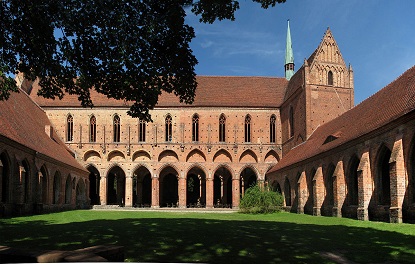
 Chorin Abbey, situated in the Schorfheide-Chorin Biosphere Reserve, is a former Cistercian monastery renowned as a significant example of early Brick Gothic architecture. It was founded by in 1258 by the Margrave of Ascania and had a far-reaching influence on the Slavic population that occupied the region in medieval times. Chorin Abbey is generally considered one of the finest examples of Brick Gothic in East Germany. Following its secularisation during the Protestant Reformation, the abbey was dissolved in 1542 and fell into disrepair. Its architectural importance was recognised in the 19th century, leading to restoration efforts championed by the architect Karl Friedrich Schinkel. Today, the preserved ruins serve as a cultural monument, hosting a variety of events, including the annual Chorin Music Summer festival. Chorin Abbey, situated in the Schorfheide-Chorin Biosphere Reserve, is a former Cistercian monastery renowned as a significant example of early Brick Gothic architecture. It was founded by in 1258 by the Margrave of Ascania and had a far-reaching influence on the Slavic population that occupied the region in medieval times. Chorin Abbey is generally considered one of the finest examples of Brick Gothic in East Germany. Following its secularisation during the Protestant Reformation, the abbey was dissolved in 1542 and fell into disrepair. Its architectural importance was recognised in the 19th century, leading to restoration efforts championed by the architect Karl Friedrich Schinkel. Today, the preserved ruins serve as a cultural monument, hosting a variety of events, including the annual Chorin Music Summer festival. |
| Niederfinow Boat Lift |
|---|

 The main reason to visit Niederfinow is to see the Niederfinow boat lift, situated on the Oder-Havel Canal between Berlin and Stettin. It comprises two distinct structures: the original lift, which opened in 1934, and a new, larger lift that began service in 2022. Both lifts overcome a vertical difference of 36 metres. The older lift, now a protected industrial monument, was Germany's oldest in operation until its decommissioning. The new structure is Germany's tallest boat lift and was built to accommodate larger, modern vessels, ensuring the canal remains a vital transport link. The main reason to visit Niederfinow is to see the Niederfinow boat lift, situated on the Oder-Havel Canal between Berlin and Stettin. It comprises two distinct structures: the original lift, which opened in 1934, and a new, larger lift that began service in 2022. Both lifts overcome a vertical difference of 36 metres. The older lift, now a protected industrial monument, was Germany's oldest in operation until its decommissioning. The new structure is Germany's tallest boat lift and was built to accommodate larger, modern vessels, ensuring the canal remains a vital transport link. |
| Lübben & Lübbenau |
|---|

 The twin towns of Lübben (pop. 14,000) and Lübbenau (pop. 15,500), 10 km apart, are the touristic heart of the Spree Forest, declared Biosphere Reserve by the UNESCO. The towns are crisscrossed by 400 km of canals, along which visitors are conveyed in traditional boats, which have historically been the primary means of transport for its inhabitants. Today, these waterways are a central feature for visitors, with traditional punt boat tours offering a distinct way to experience the landscape's unique alder forests and hay meadows. The whole lot, with the wooden houses and bridges is extremely picturesque. The twin towns of Lübben (pop. 14,000) and Lübbenau (pop. 15,500), 10 km apart, are the touristic heart of the Spree Forest, declared Biosphere Reserve by the UNESCO. The towns are crisscrossed by 400 km of canals, along which visitors are conveyed in traditional boats, which have historically been the primary means of transport for its inhabitants. Today, these waterways are a central feature for visitors, with traditional punt boat tours offering a distinct way to experience the landscape's unique alder forests and hay meadows. The whole lot, with the wooden houses and bridges is extremely picturesque. |
| Cottbus |
|---|
 Cottbus (pop. 95,000) is a university town and the cultural and political centre of the Sorbs/Wends in Lower Lusatia, a Slavic minority of East Germany. As a result, the city is officially bilingual, with signage and public life conducted in both German and Lower Sorbian. It is located on the river Spree and is notable for its parks, particularly the expansive Branitz Park, a masterpiece of landscape design created by Prince Hermann von Pückler-Muskau. The city also features a historic old town (Altstadt) with medieval gates and towers, alongside the distinctive Art Nouveau State Theatre (Staatstheater Cottbus).
 |
| Eupedia's Rating System |
|---|
Cities, towns, villages & historic buildings
Natural attractions
|
 : Local interest
 : Moderately interesting
 : Outstanding place
 : Must-see in the country
 : Top cities in Europe