



| Contents |
|---|
Introduction
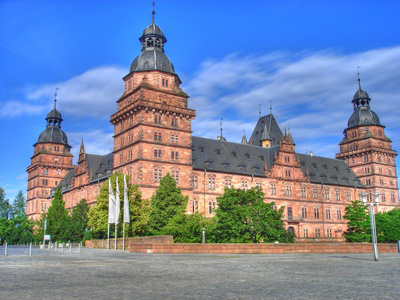
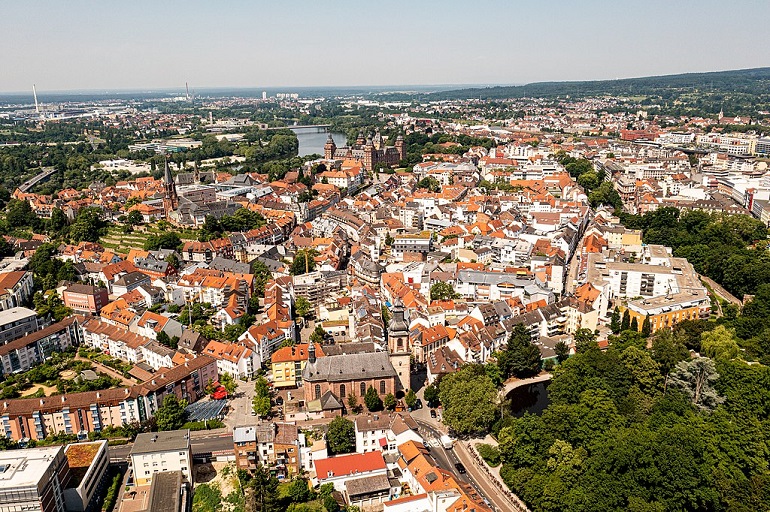
Located at the confines of Hesse, approximately 40km southeast of Frankfurt, Aschaffenburg (pop. 73,000) is known chiefly for two historic sites: Schloss Johannisburg, an imposing Renaissance palace, and the Pompejanum, a faithful replica of a Roman villa.
For 200 years Schloss Johannisburg served as the second residence of the Prince-Bishops of Mainz. Unfortunately the castle was badly damaged by Allied bombings at the end of WWII and very little remains of the original interior. The castle now houses a small museum showing scaled reproductions of ancient Greek and Roman temples and other constructions, as well as a few pieces of modern art. Don't expect to find beautifully moulded ceilings, ancient parquet flooring, tapestries on walls or other precious artefacts. There is nothing left of the grand stately home of the Prince-Bishops. The massive, well restored edifice is nevertheless well worth a look and Aschaffenburg deserves a stop on your way between Frankfurt and Würzburg or Bamberg.
Interesting Facts about Aschaffenburg
- Aschaffenburg is affectionately nicknamed "the Bavarian Nice" due to its mild, sunny climate reminiscent of the Mediterranean.
- The city boasts the magnificent Schloss Johannisburg, a Renaissance masterpiece built between 1605 and 1614, which houses a major art collection and the world's largest assemblage of cork architectural models.
- Aschaffenburg's Pompejanum is a unique replica of a Roman villa from Pompeii, commissioned by King Ludwig I of Bavaria in the 19th century.
- The town served as the summer residence of the archbishops of Mainz for over 800 years, strongly influencing its art and architecture.
- Aschaffenburg’s Old Town surprises visitors with its picturesque half-timbered houses and lively historic atmosphere.
- The city straddles the river Main and is considered a cultural and economic centre on the western edge of Bavaria, just southeast of Frankfurt.
- Founded as a Roman settlement, Aschaffenburg later played key political and religious roles in German history, including hosting important synods and imperial assemblies.
- The Schönbusch Park, adjacent to the city, is one of Bavaria’s oldest English landscape gardens.
- Despite severe wartime destruction, Aschaffenburg has been lovingly restored and today blends tradition with vibrant urban life.
- Its annual cultural calendar is packed, featuring the Schönbusch Serenades, Bach Days, and various art exhibitions highlighting both its local heritage and international influences.
History
Aschaffenburg's origins stretch back to ancient times, with the earliest archaeological evidence pointing to Stone Age settlements in the area. The name itself derives from the old German meaning "castle at the ash tree river," referring to the River Aschaff that flows through the town. Originally settled by the Alemanni in the 5th century, the region later came under Roman influence with legions stationed here, before being conquered by the Franks around 550 CE. By the 8th century, Saint Boniface had reportedly founded a Benedictine monastery dedicated to St. Michael, which later became the Kollegiatstift St. Peter und Alexander in 957. The town gained early royal significance when King Louis the Younger married Liutgard of Saxony here in 869, with Aschaffenburg serving as a royal residence.
The medieval period marked Aschaffenburg's transformation into a major ecclesiastical and political centre under the Archbishopric of Mainz, which controlled the town for over 800 years from around 982. The settlement was chartered in 1173 and became one of the most important secondary residences of the Mainz electoral archbishops. The town's strategic importance was enhanced by the construction of the first wooden bridge across the Main in 987/989 by Archbishop Willigis, establishing it as a crucial trading centre on historic commercial routes. Aschaffenburg hosted significant ecclesiastical and political events, including a synod in 1292 and an imperial Diet in 1447 that prepared the Aschaffenburg Concordat between the empire and the papacy.
The Renaissance brought architectural grandeur to Aschaffenburg with the construction of Schloss Johannisburg between 1605 and 1614, built by Electoral Archbishop Johann Schweikard von Kronberg on the site of an earlier medieval castle that had been destroyed in the Margravial War of 1552. This magnificent palace served as the summer residence of the Mainz electors and became one of the town's most defining landmarks alongside the collegiate church dating from 974. Aschaffenburg's ecclesiastical rule ended when it became part of Bavaria in 1814, subsequently flourishing under Bavarian rule with King Ludwig I contributing the distinctive Pompejanum in the 19th century due to his love for the city's mild climate. Throughout its history, the town has maintained its reputation for Italian-inspired architecture and Mediterranean charm, earning it recognition as a "Bavarian Nice."
Main Attractions
Historical and Architectural Landmarks
Johannisburg Palace
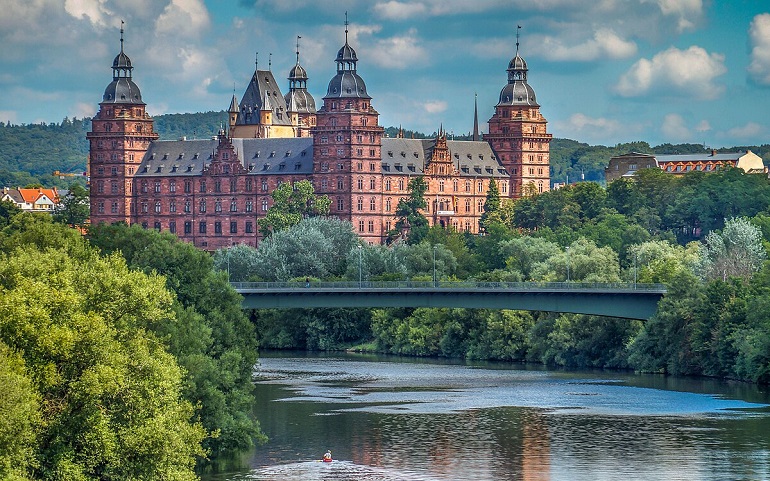
Located in the centre of Aschaffenburg on the banks of the River Main, Johannisburg Palace was the second residence of the archbishop-electors of Mainz until 1803. The massive red sandstone complex is one of the most significant examples of German Late Renaissance palace architecture.
History and Construction
The palace was erected between 1605 and 1614 by the Strasbourg architect Georg Ridinger for Johann Schweikhard von Kronberg, the Prince Bishop and Elector of Mainz. The massive four-winged complex replaced a medieval castle that had been largely destroyed in 1552 during the Margravial War, though Ridinger incorporated the 14th-century keep as the fifth tower of his new design. The project cost approximately one million guilders and was funded through taxes from the archbishop's territories.
Until 1803, when the ecclesiastical principalities ended in Germany, Johannisburg Palace served as the second residence of the Prince Bishops of Mainz, after their primary seat in Mainz itself. Following territorial reorganisations during the Napoleonic period, the palace eventually passed to the Kingdom of Bavaria.
Architecture
The palace features a perfectly symmetrical four-winged design arranged around a square inner courtyard, with four corner towers reaching 52 metres in height across eight storeys. The building is constructed from local red sandstone quarried from the Spessart hills near Aschaffenburg. The windows, gates and doors of both exterior and interior courtyard façades display elaborate architectural ornamentation, particularly noticeable in the triangular gables.
At the end of the 18th century, the interior was redesigned in Neoclassical style according to plans by architect Emanuel Joseph von Herigoyen. The palace suffered severe damage during Allied bombing in the final days of World War II, requiring extensive restoration work that continued for nearly two decades.
Collections and Exhibitions
The palace houses several notable collections and exhibition spaces. The State Gallery contains 253 paintings, primarily assembled by Friedrich Karl von Erthal, the last Elector and Archbishop of Mainz. The collection includes significant works by Lucas Cranach the Elder and his workshop, originally commissioned by Cardinal Albrecht of Brandenburg. Additional highlights include a Passion series by Aert de Gelder, Rembrandt's last pupil.
The Parament Chamber displays ecclesiastical textiles and liturgical equipment from the former Mainz cathedral treasury, featuring precious embroidery made with gold, silver and silk thread. The chamber also provides access to the princes' gallery overlooking the palace chapel.
The palace holds the world's largest collection of architectural models made from cork, comprising 45 detailed reproductions of ancient Roman buildings. These models were created between 1792 and 1854, primarily by court confectioner Carl May and his son Georg May. The collection includes the Colosseum, the Pantheon, the Pyramid of Cestius, and various triumphal arches.
The Palace Chapel features Renaissance altar, pulpit and portal sculptures by Hans Juncker from the early 17th century. The Princely Apartments display original Neoclassical furniture, clocks, chandeliers, porcelain and bronze objects. The Municipal Palace Museum occupies 1,400 square metres and presents artworks and historical exhibits spanning six centuries of local history.
Pompejanum
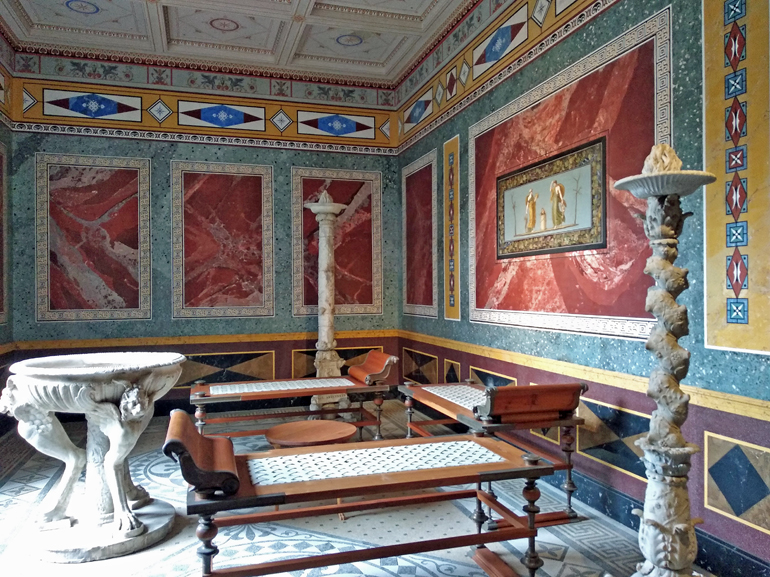
The Pompejanum is a 19th-century replica of a Roman villa from Pompeii, commissioned by King Ludwig I of Bavaria and completed in 1840. Situated on the southern bank of the Main beneath Johannisburg Palace, the villa was conceived as a study model of ancient domestic architecture and as inspiration for artists and architects. Its interiors are decorated with vivid frescoes, ornate stucco work and intricate mosaics, while the surrounding gardens are planted with Mediterranean species to evoke an Italian villa estate.
Historical Background
King Ludwig I, an enthusiastic lover of antiquities, was inspired by the excavations at Pompeii to create this idealised representation of Roman domestic architecture. The project was not intended as a royal residence but rather as an educational facility where art lovers and scholars in Germany could study ancient Roman culture without travelling to Italy. Ludwig I particularly favoured Aschaffenburg for its mild climate, which he referred to as "Bavarian Nice."
Architecture and Design
The villa follows the traditional Roman domus layout, with rooms arranged around a central atrium featuring an open inner courtyard with a water basin. The ground floor contains reception and guest rooms, kitchen, dining room, and various service quarters arranged around two courtyards: the Atrium and the Viridarium (garden courtyard). The upper floor houses the family living rooms and bedrooms.
The interior decoration includes recreated wall paintings and mosaic floors based on ancient Roman models. The building features Mediterranean architectural elements and is surrounded by a garden with warm-climate plants including figs, almond trees, vines, and pines.
War Damage and Restoration
The Pompejanum suffered severe damage during the Second World War. Restoration work began in 1960 and continued in several phases. The most extensive restoration involved recreating the mural paintings that had been destroyed. The building was fully restored and reopened to the public in 1994.
Current Status
Since 1994, the Pompejanum has functioned as a museum displaying original Roman artworks from the Bavarian State Collections of Antiquities and the Glyptothek in Munich. The exhibits include Roman portraits, statues, decorative marble works, bronzes, glassware, and everyday objects. The presentation includes detailed documentation about the history of Pompeii.
Stiftsbasilika St. Peter und Alexander
Stiftsbasilika St. Peter und Alexander stands as one of Aschaffenburg’s oldest surviving structures, with origins in the second half of the 10th century. Originally part of a Benedictine abbey, the basilica displays Romanesque foundations alongside Gothic additions dating from the 13th century. The interior features a richly decorated altarpiece, medieval carvings, and ecclesiastical relics, while the adjacent abbey museum (excluded here) interprets its cultural history. The church remains an active Catholic parish, welcoming worshippers and visitors drawn to its blend of architectural styles and its role in the city’s religious heritage.
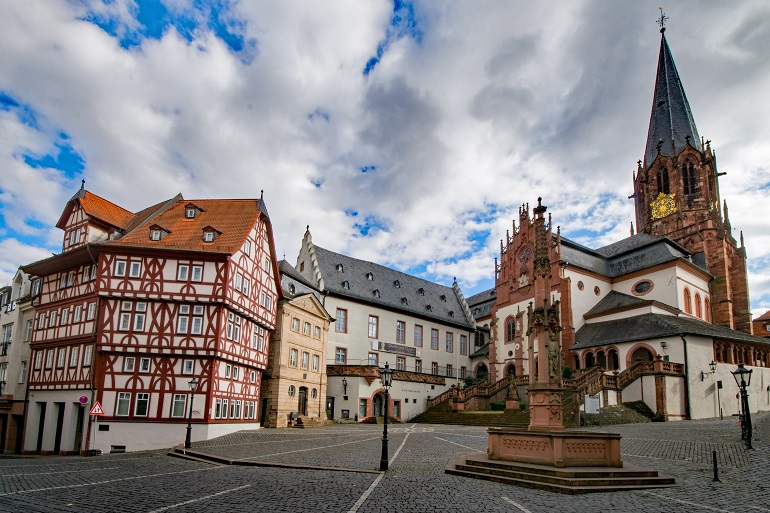
Ludwigsbrunnen
Ludwigsbrunnen is a historic fountain erected in 1842 to honour King Ludwig I on what was once the city’s market square. Crafted from local sandstone with wrought-iron detailing, the fountain comprises a central water basin surrounded by sculpted designs reflecting 19th-century tastes in public ornamentation. It served both as a civic monument and a drinking trough for horses in its early years and has undergone conservation work to retain its original form. Ludwigsbrunnen remains a focal point of the pedestrianised plaza known locally as Ludwigsplatz.
Parks and Gardens
Schönbusch Palace and Landscape Park
The Schönbusch Palace and Landscape Park stretch over some 160 hectares southwest of the city centre, marking one of southern Germany’s earliest English-style gardens. Initiated in 1775 by Elector-Archbishop Friedrich Karl Joseph von Erthal with designs by Emanuel Joseph von Herigoyen and completed under Friedrich Ludwig von Sckell, the park features carefully shaped lakes, streams, artificial hills with viewing towers, the red-painted Devil’s Bridge and various garden follies such as the Temple of Friendship and the Philosopher’s House. The neoclassical garden palace, built between 1778 and 1782, offers ten state rooms furnished in Louis-Seize style. A visitor centre in the former kitchen interprets the garden’s history and maintains year-round access to the grounds.
Schlossgarten
Adjacent to Johannisburg Palace, the Schlossgarten comprises formal lawns and tree-lined promenades that frame views of the castle and the River Main. Established in the early 17th century and later styled with baroque and neoclassical elements, the garden offers public access to chestnut-tree alleys, manicured flowerbeds and benches for relaxation. Paths connect to the riverside promenade, making the Schlossgarten a pleasant urban green space that balances historical layout with modern leisure use.
Urban Spaces and Promenades
Aschaffenburger Altstadt
The Aschaffenburger Altstadt is the city’s medieval heart, characterised by narrow cobbled streets, half-timbered houses and historic squares. The pedestrianised zone around Schloßgasse and Stiftsgasse contains architectural remnants from the Middle Ages alongside renovated townhouses housing cafés, boutiques and artisan shops. Key landmarks include the Herstallturm guard tower and the Dalberg Fountain. Wheelchair-accessible routes allow visitors to explore this cultural district, which hosts seasonal markets and public events.
Mainpromenade Aschaffenburg
The Mainpromenade Aschaffenburg follows the riverbank from the city ferry landing through landscaped parks to the outskirts of the city centre. A level walkway accommodates both pedestrians and cyclists and features benches, cycle stands and picnic areas. The promenade provides unobstructed views of Johannisburg Palace across the water and includes access points to boat tours and riverside cafés. Seasonal events such as fireworks displays and open-air concerts are often held in the adjacent park lawns.
Recreational and Entertainment Venues
f.a.n. Frankenstolz Arena
The f.a.n. Frankenstolz Arena is Aschaffenburg’s principal indoor sports and events venue, with a seating capacity of around 5 000. Opened in the late 20th century, the arena hosts ice hockey matches, handball fixtures, concerts and exhibitions. Facilities include tiered spectator seating, VIP boxes and integrated catering areas. Regular public ice-skating sessions are offered outside of major events, and the arena’s location adjacent to transport links ensures ease of access.
ZEEEM Racing Hall
The ZEEEM Racing Hall presents a modern indoor go-kart and racing simulator experience in Aschaffenburg. Housed within a large industrial unit, the venue features electric karts on a custom track layout, as well as virtual reality racing simulators designed to replicate professional circuits. Safety equipment and instruction are provided, and groups can book timed sessions. The hall also includes a café area and viewing gallery for spectators.
Trails and Outdoor Activities
Franken-Hessen-Kurpfalz Path
The Franken-Hessen-Kurpfalz Path is a long-distance hiking and cycling route that traverses the regions of Franconia, Hesse and the Palatinate. Within Aschaffenburg, the trail skirts the city’s western suburbs, offering waymarked passages through mixed woodlands, vineyard slopes and riverside meadows. Sections near the city are suitable for day walks and connect with public transport stops. Interpretive panels along the route explain local geology, flora and historical sites, making it popular with both recreational walkers and serious trekkers.
Top Museums
Art, History & Palaces
Schlossmuseum (Johannisburg Palace Museum)
Housed in the iconic red sandstone Johannisburg Palace, the Schlossmuseum showcases six centuries of art, city history, decorative arts, and the famous Lautenschläger Collection. Highlights include works by Lucas Cranach the Elder, masterpieces of German and Netherlandish painting, intricate crockery models of Roman architecture, and changing special exhibitions. Its sweeping galleries combine local heritage with treasures gathered by the curators of Mainz, making it essential for history and art enthusiasts alike.
Stiftsmuseum (Abbey Museum)
The Stiftsmuseum presents a vivid panorama from local prehistory to the Baroque, set in an atmospheric former abbey. Its acclaimed treasury includes medieval illuminated manuscripts, silverwork, and the renowned Magdalene altar from Lucas Cranach’s workshop, as well as archaeological finds from the Neolithic, Roman, and Frankish eras. The combination of art, archaeology, and ecclesiastical treasures offers a deep immersion into the spiritual and cultural past of the region.
Gentil Haus (Gentil House)
Once the private villa of collector Anton Gentil, the Gentil Haus is a charming 'artist’s house' filled with an eclectic art collection that spans paintings, medieval altars, folk objects, East Asian artefacts, and more. The house itself, designed in the spirit of the Arts and Crafts movement, provides a unique atmosphere that reflects both the collector’s personal vision and the period’s design ideals.
Modern & Contemporary Art
Christian Schad Museum
Internationally unique, this museum is dedicated to the entire oeuvre of Christian Schad, a key figure of New Objectivity. Featuring over 3,200 works across three floors, it traces Schad’s evolution through modernism, Dada, and beyond. Schadographs (photograms), portraits, and experimental pieces are shown in a contemporary space that also contextualises his life with connections to European cultural history, making the museum a hub for modern art admirers.
KirchnerHAUS Aschaffenburg
The birthplace of expressionist Ernst Ludwig Kirchner, this lovingly restored house museum features a documentation centre on the artist’s formative years, a dedicated reference library, and rotating exhibitions on Kirchner and Die Brücke. Its intimate scale and authentic setting provide an evocative glimpse into the childhood influences that shaped one of Germany’s most renowned modernists.
Kunsthalle Jesuitenkirche (Jesuit Church Art Gallery)
Set in a rebuilt 17th-century baroque church, the gallery offers dramatic architecture and is Aschaffenburg’s leading venue for temporary exhibitions on classical modernism and contemporary art. The high walls, stucco, and spiritual traces of the old church provide a stunning backdrop to works by both established and experimental artists, making every exhibition an event in its own right.
Neuer Kunstverein Aschaffenburg e.V. (KunstLANDing)
This vibrant, contemporary art association is based in a classicist former brewery and offers regularly changing exhibitions highlighting international, regional, and experimental art. Renowned for dynamic installations, family programming, and artist talks, KunstLANDing is where local creativity meets global art discourse.
Science & Regional History
Naturwissenschaftliches Museum (Natural History Museum)
The Natural History Museum, set in the baroque Schönborner Hof, invites visitors to discover the geology, fauna, and flora of the Spessart region and beyond. The displays—from mineral collections and fossilised creatures to dazzling butterflies—are presented in a way that is accessible, educational, and appealing to visitors of all ages, cementing its status as a must-visit for families and naturalists.
Bachgau-Museum Großostheim
Just outside Aschaffenburg, this regional museum centres on the cultural history, agriculture, crafts, and daily life of the Bachgau region. With engaging displays on the area’s prehistory, viticulture, and local industries, it’s an excellent destination for those keen to explore rural Franconian heritage in a family-friendly setting.
Local Cuisine
Traditional taverns and cosy beer halls serve up regional classics such as Schäufele (slow-roasted pork shoulder), Bratwurst (grilled sausages), and rich, comforting Schnitzel. Side dishes like Kartoffelknödel (potato dumplings) and tangy Sauerkraut often accompany main meals, while sweet treats including Apfelstrudel provide the perfect finish. Whether you’re savouring rustic fare in a centuries-old inn or sampling contemporary takes on regional dishes, Aschaffenburg’s food scene celebrates the best of Bavarian and Franconian tradition.
Getting There
By train, Aschaffenburg is well connected to major German cities such as Frankfurt, with direct Deutsche Bahn and ICE services taking as little as 28–40 minutes and departures running frequently from Frankfurt (Main) Hauptbahnhof. Travellers from other European cities can typically make connections in Frankfurt or via major German railway hubs, ensuring a smooth and efficient journey.
By coach or bus, companies like FlixBus operate services to Aschaffenburg from numerous German and continental cities. Buses arrive at the central bus station, and travelling by coach is a convenient option for those looking to access the city from various regional locations or nearby European hubs.
By car, Aschaffenburg sits conveniently near the A3 motorway. Approaching from Frankfurt or Würzburg, drivers can easily reach the city by following well-signposted Autobahn routes, with ample parking available in and around the city centre.


