| Contents |
|---|
Introduction
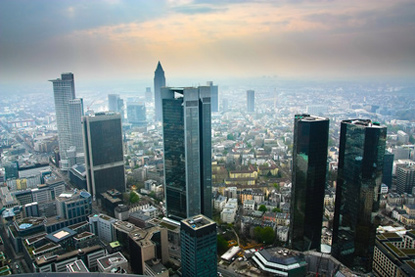
Wetzlar (pop. 54,000) is a university city, situated on the River Lahn about 51 kilometres north of Frankfurt. The city is positioned at the convergence of three low mountain ranges—the Taunus to the south, the Westerwald to the west, and the Rothaar Mountains to the north—making it a natural geographical hub in the Lahn-Dill region. A former free imperial city, Wetzlar gained historical prominence as the seat of the Imperial Chamber Court (Reichskammergericht) of the Holy Roman Empire from the 16th to 18th centuries. The city is renowned for its well-preserved medieval old town featuring half-timbered houses, narrow cobblestone streets, and its distinctive unfinished cathedral, St. Mary's (Wetzlarer Dom), which began construction in 1230 and uniquely combines Romanesque, Gothic, and Baroque architectural styles. Wetzlar holds significant literary importance as the place where Johann Wolfgang von Goethe spent time in 1772 as a trainee lawyer, inspiring his famous novel "The Sorrows of Young Werther." Additionally, the city is celebrated as the birthplace of 35mm photography, where Oskar Barnack invented the Leica camera in 1913, establishing Wetzlar as a centre of precision optics and engineering that continues to this day.
Interesting Facts about Wetzlar
- Wetzlar was once a free imperial city and became famous for being the seat of the Imperial Supreme Court (Reichskammergericht) of the Holy Roman Empire.
- The city inspired Johann Wolfgang von Goethe's seminal novel The Sorrows of Young Werther after his stay here as a young legal trainee in 1772.
- Wetzlar is renowned as the birthplace of Leica cameras and remains a centre for optical and precision engineering, with a legacy stretching back to the 19th century.
- The Cathedral of St Mary (Wetzlarer Dom) began construction in the 12th century and, uniquely, remains unfinished to this day, combining Romanesque, Gothic, and Baroque styles.
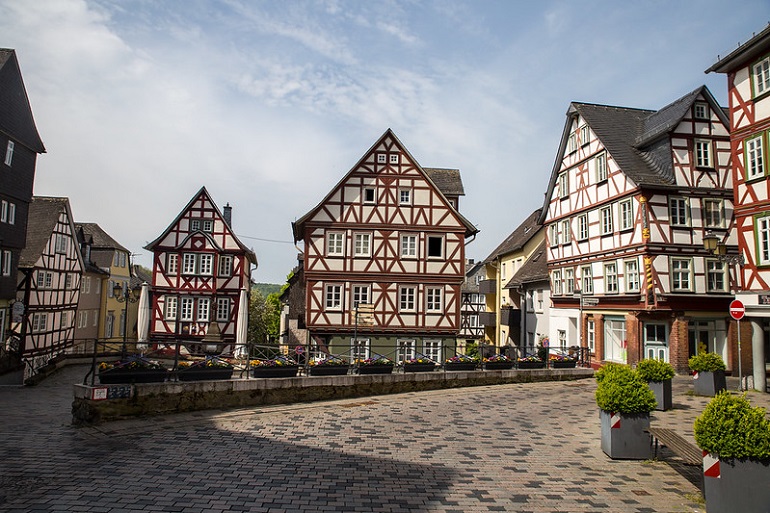
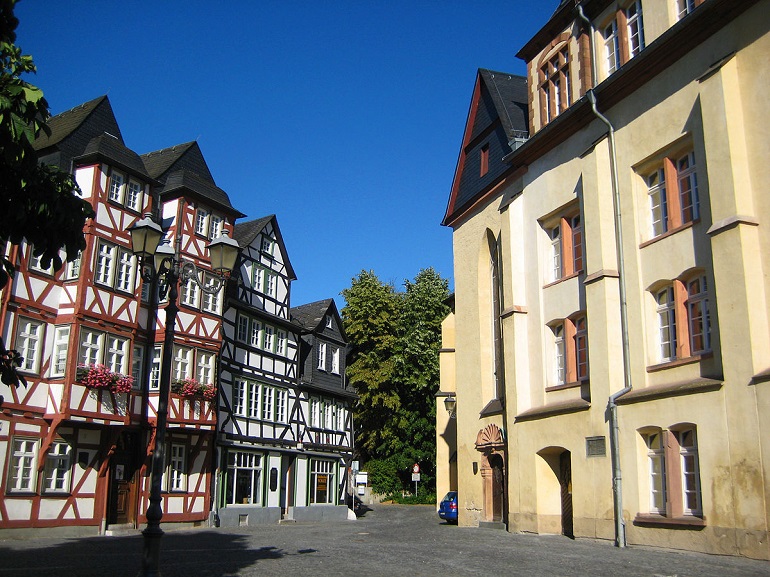
- Wetzlar's charming old town is filled with half-timbered houses and narrow, cobbled lanes, preserving the feel of a medieval German settlement.
- The city's Optics Trail (Optikparcours) features 24 science-themed installations, letting visitors explore Wetzlar's optical heritage in a playful way.
- The Old Lahn Bridge, dating from the 13th century, provides picturesque views of the town and is a testament to medieval engineering.
- Wetzlar was a major industrial hub, with over 100 ore mines in operation during the 19th century before shifting focus to optics and engineering.
- The literary museums Lottehaus and Jerusalemhaus commemorate Goethe's life and work in Wetzlar, as well as his muse Charlotte Buff and friend Karl Wilhelm Jerusalem.
- Wetzlar hosts Europe's largest collection of fantastic literature, the Phantastische Bibliothek (Fantastic Library).
- The town's original medieval street names, such as Buttermarkt, Fischmarkt and Eisenmarkt, reflect its historic trading roots.
- Despite suffering damage in the Second World War, much of Wetzlar's medieval architecture—and its tranquil character—has been preserved.
- Wetzlar is surrounded by five parks that trace the path of the former old town wall, with sections of the wall still visible today.
History
Wetzlar's origins can be traced back to ancient times, with Bandkeramiker settlements dating from approximately 5,000 years BCE on the western town limits. The area has been inhabited continuously for millennia, evidenced by Celtic La Tène period iron ore extraction and smelting activities that established a metallurgical tradition spanning 2,500 years. Roman presence is documented through archaeological remains from Augustus's reign (27 BCE – 14 CE), including a military camp at nearby Dorlar and the uncompleted city of Waldgirmes Forum, which was abandoned after Rome's defeat at the Battle of the Teutoburg Forest. The town's name likely emerged between the 3rd and 8th centuries, with the final syllable "-lar" suggesting Celtic or Frankish origins, possibly referring to wooden defences around the settlement. The first written documentation of "Wetzlar" appears in 1141, though the town's foundations were established much earlier.
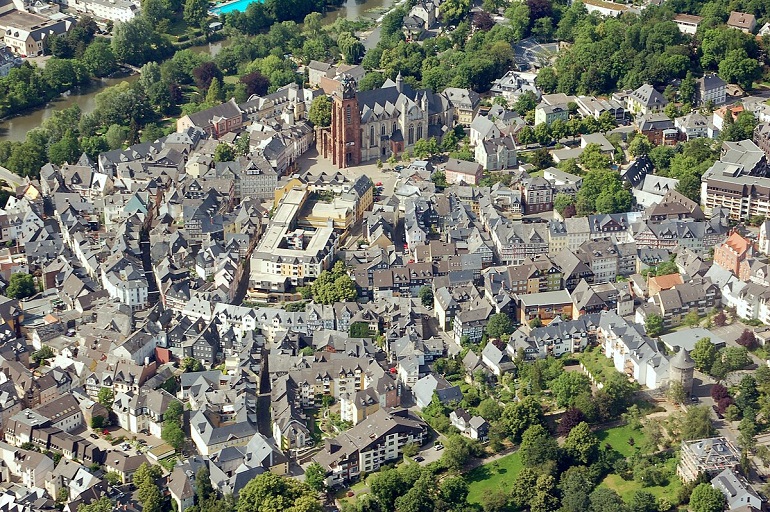
Wetzlar's medieval period marked its transformation into a significant imperial city. In 897, Conradine Gebhard, Count in the Wetterau and later Duke of Lorraine, consecrated a Church of the Saviour at the site of the present cathedral. The town developed around this ecclesiastical centre as merchants and craftsmen settled along the vital trade route from Frankfurt to Cologne and Antwerp, known as the Hohe Strasse, which forded the River Lahn where a stone bridge was later constructed in the 13th century. Emperor Frederick Barbarossa confirmed imperial privileges for Wetzlar's burghers in April 1180, elevating the settlement to the prestigious status of an imperial free town. By the mid-14th century, the population had reached approximately 6,000, making it a substantial city by medieval standards. The town's fortifications, built between 1250 and 1300, stretched 1.7 kilometres with walls reaching up to 11 metres in height. Construction of the magnificent Wetzlar Cathedral began in 1230, though remarkably, this architectural masterpiece remains unfinished to this day.
The early modern period brought Wetzlar unprecedented political and cultural prominence when the Holy Roman Empire's highest court, the Reichskammergericht (Imperial Chamber Court), relocated from Speyer to Wetzlar in 1689 following French devastation during the War of the Palatinate Succession. This judicial centre employed approximately 150 staff, including 20 judges, whilst an additional 750 residents derived their livelihood from court-related activities, making it the town's primary economic driver. Wetzlar's legal significance attracted scholars, lawyers, and officials from across the Empire, transforming the small town into one of the Holy Roman Empire's de facto capitals alongside Vienna and Regensburg. The town's most famous visitor was Johann Wolfgang von Goethe, who arrived in 1772 as a legal trainee and drew inspiration from local events to pen his internationally acclaimed novel "The Sorrows of Young Werther". When the Holy Roman Empire dissolved in 1806, the court's closure marked the end of Wetzlar's imperial importance, though it subsequently found new prosperity during the Industrial Revolution as a centre for precision engineering and optical manufacturing, most notably with the establishment of Leitz (later Leica) in 1849.
Main Attractions
Wetzlar Cathedral (Dom)
The Wetzlar Cathedral, officially called Dom Unserer Lieben Frau, stands as the city's most distinctive landmark and is particularly notable for remaining unfinished after centuries of construction. Construction commenced in 1230 on the site of a 12th-century Romanesque basilica, but was never completed due to financial difficulties throughout the medieval period. This lengthy building process has resulted in a unique architectural tapestry that combines Romanesque, Gothic, and Baroque elements within a single structure. The cathedral's most striking feature is its asymmetrical western façade, where the northern tower remains an incomplete stump whilst the southern tower was completed with a Baroque roof in 1590. The church serves as a Simultaneum, having been shared by both Protestant and Catholic congregations since the Reformation - an arrangement that continues today with two separate altars and reversible pews in the choir. The interior contains notable medieval artwork including a 14th-century Pietà and wall frescoes from the early 14th century. During the Second World War, Allied bombing on 8 March 1945 destroyed much of the interior including the famousained glass windows, and both organs, though the structure was subsequently rebuilt.
Old Town (Altstadt)
Wetzlar's remarkably well-preserved medieval old town presents an authentic glimpse into German urban planning from the Middle Ages. The historic centre is characterised by narrow cobblestone streets, medieval market squares, and an exceptional collection of half-timbered houses dating from the 14th to 17th centuries. Notable examples include the building at Brodschirm 6, which is Wetzlar's oldest half-timbered structure dating from 1356, distinguished by its vertical beams spanning the entire height and hanging trusses typical of medieval construction. The Zur Alten Münz at Eisenmarkt 9, built in 1599, was constructed on the site of a medieval mint and features a French inscription indicating it was likely built by Protestant Walloon refugees. The old town retains much of its original medieval street pattern and is surrounded by substantial sections of the original city wall, built between 1250-1300, which reached heights of up to 11 metres and included five gates and at least nine towers. Today, these walls are complemented by a green belt of parks that follows the medieval fortifications.
Alte Lahnbrücke (Old Lahn Bridge)
The Alte Lahnbrücke represents one of Hesse's oldest surviving stone bridges and serves as one of Wetzlar's most photographed landmarks. Constructed in the latter half of the 13th century and first documented in 1288, this seven-arched bridge spans 104 metres across the River Lahn and formed part of the crucial medieval trade route connecting Frankfurt and Cologne. The bridge is built from distinctive regional Devonian limestone, later known as Lahn marble, which gives it its characteristic appearance. Originally, the bridge featured two gate towers on either end that served defensive purposes, but these were demolished in the first half of the 19th century. The bridge's seven circular arches vary in span from 7.40 to 10.50 metres, and the roadway is arched, rising 1.90 metres towards the old town and 2.40 metres towards the new town. Following structural concerns, the bridge was closed to motor traffic in 2011 and now serves exclusively pedestrians and cyclists. Near the bridge stands a water and light organ that performs hourly shows between 10:00 and 21:00, accompanied by musical pieces.
Lottehaus (Lotte House)
The Lottehaus serves as a literary shrine dedicated to Johann Wolfgang von Goethe's connection to Wetzlar and his most famous novel, "The Sorrows of Young Werther". Originally constructed in 1653 as the administrator's residence for the Teutonic Order's establishment in Wetzlar, the half-timbered building became the childhood home of Charlotte Buff, born there on 11 January 1753. Charlotte, known as Lotte, was the daughter of Heinrich Adam Buff, who served as the Teutonic Order's administrator from 1740. During Goethe's summer stay in Wetzlar in 1772 as a legal intern at the Imperial Chamber Court, he frequently visited this house and fell in love with Charlotte, who was already engaged. This unrequited love, combined with the suicide of his friend Karl Wilhelm Jerusalem, inspired Goethe's groundbreaking epistolary novel published in 1774. The museum, established by Wetzlar citizens in 1863, displays period furniture, household objects, portraits, and manuscripts from the Buff family, providing authentic insight into 18th-century bourgeois life. Three rooms are specifically devoted to Goethe's Werther, containing the precious first edition alongside contemporary reactions, parodies, translations, and documentation of the famous "Werther fever" that swept Europe.
Burg Kalsmunt (Kalsmunt Castle Ruins)
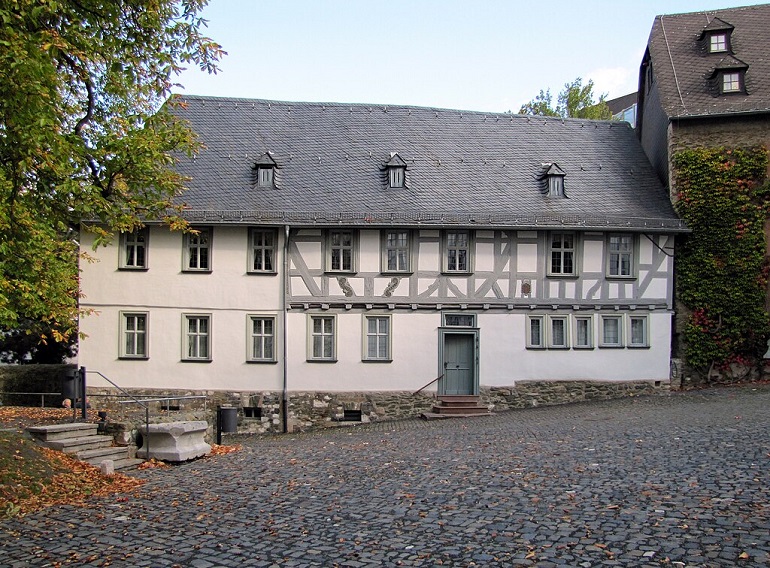
The ruins of Burg Kalsmunt crown a distinctive 256-metre basalt cone overlooking Wetzlar, representing the remains of an important Imperial castle built around 1180 during the reign of Frederick I Barbarossa. The castle was strategically positioned to protect the rising Imperial city of Wetzlar and formed the northern terminus of the Staufen defensive system that included castles at Münzenberg, Friedberg, and Gelnhausen. The fortress guarded the vital "High Road" trade route and the important ford crossing of the Lahn known as "Eiserne Hand". The castle served as an Imperial mint, with coins bearing the inscription "Calsmund" representing the oldest written mention of the site. By 1604, the castle had fallen into ruin and was subsequently used as a stone quarry. Today, visitors can see the remains of the 11-metre-high keep with its characteristic Staufen-era ashlar blocks, parts of the curtain wall, foundations of the gate structure, and sealed cellar openings. The ruins are freely accessible, and guided tours with tower climbing are offered on Sundays, providing panoramic views over Wetzlar and the Lahn valley. The site has become a popular destination for hikers, with multiple walking routes including the Lahnwanderweg and the 3-Towers Way passing through the area.
Deutschordenshof (Teutonic Order Court)
The Deutschordenshof represents one of the largest establishments of the Teutonic Order in central Hesse and serves as an important complex of medieval and early modern buildings. Founded in 1285 when the Marburg Ballei established a branch office in Wetzlar, the complex originally included administrative buildings, residential quarters, storage facilities, and a chapel dedicated to Saint Elizabeth. The order managed extensive agricultural lands in the Wetzlar region and played a significant economic role in the Imperial city until secularisation in 1809. The complex grew over time through various additions, with parts of the original 13th-century wall still visible today as the oldest structural elements. The main buildings now house the City and Industry Museums, whilst the Lemmers-Danforth Collection of Renaissance and Baroque furniture and handicrafts is displayed in the Baroque Palais Papius within the complex. The courtyard features ancient chestnut trees and includes "Lotte's Garden," a herb garden created to commemorate Goethe's probable favourite dish of "Green Sauce," containing herbs such as parsley, chives, sorrel, pimpernel, borage, and chervil. The entire complex provides insight into medieval religious life, urban administration, and the transition from religious to secular governance.
Wetzlar's Green Belt
Wetzlar's old town is encircled by an attractive green belt consisting of five interconnected parks that follow the course of the medieval city walls. These parks, primarily named after Wetzlar's twin towns, include the Rosengärtchen in the north, Siena-Promenade in the east, Avignon-Anlage in the south along with areas at Leitz-Platz and Wetzbach, and Colchester-Anlage in the west. The Grüngürtelweg (Green Belt Way) allows visitors to walk the complete 2.3-kilometre circuit around the old town, though the route includes challenging topography with a 47-metre elevation difference and numerous steps in some sections. The Rosengärtchen, originally a cemetery from 1757-1881, now functions as a park with a 1,000-seat open-air theatre and contains historical gravestones including a memorial to Karl Wilhelm Jerusalem, the model for Goethe's Werther character. The park also features a monument to Karl Kellner (1826-1855), founder of Wetzlar's optical industry. The Siena-Promenade connects the Wöllbacher Gate with the Upper Gate, notable for its mature tree population. These green spaces were created from former fields, meadows, and gardens that once lay outside the medieval walls and now provide popular recreational areas for residents and visitors whilst preserving views of the historic city walls.
Top Museums
History and Literature
Stadtmuseum Wetzlar
The Stadtmuseum is located in the historic buildings formerly belonging to the Teutonic Order. Its exhibitions illuminate the city’s development from prehistory through to the industrial age. Artefacts and installations range from archaeological finds and items depicting daily life in Wetzlar to displays focusing on sacred art, the importance of the Wetzlar Cathedral, and the impact of the Reichskammergericht period. Notably, the adjacent Tithe Barn serves as a space for temporary exhibitions on topics related to local culture and history, including the region’s industrial evolution in optics, precision engineering, and ironworking.
Jerusalemhaus (Jerusalem House)
The Jerusalemhaus is a significant stop for literary enthusiasts. It is the former residence of Karl Wilhelm Jerusalem, whose tragic fate became a central theme in Goethe’s aforementioned novel. The museum, preserved as a cultural monument, offers a window into late 18th-century daily life, as well as a wealth of exhibits devoted to Goethe, his contemporaries, and the socio-intellectual environment of the era.
Reichskammergerichtsmuseum (Imperial Chamber Court Museum)
This specialist museum delves into the history and operation of the Reichskammergericht—the highest court of the Holy Roman Empire. Its fascinating exhibits explain the court’s legal, social, and historical significance, with documents, portraits, furniture, and contemporary prints helping visitors understand the evolution of law and justice in early modern Europe.
Art and Decorative Arts
Palais Papius (Lemmers-Danforth Collection)
Palais Papius houses the extraordinary Lemmers-Danforth collection, dedicated to domestic interiors from the Renaissance and Baroque periods. Strolling through this baroque palace, one can find opulently furnished rooms that re-create the elegance and domestic artistry of a bygone era, with a focus on European furnishings, decorative arts, and historical household culture.
Science and Technology
Viseum Wetzlar (Museum of Optics and Precision Engineering)
Paying tribute to Wetzlar’s distinguished role in the optical industry, the Viseum is an interactive experience that traces the journey of optics and precision engineering, from scientific foundations to modern applications. The museum, set in a restored 18th-century townhouse, features hands-on displays showcasing inventions and techniques by Wetzlar’s legendary engineers and physicists. The influence of optics on science, industry, and daily life is vividly illustrated, making it an engaging experience for all ages.
Ernst Leitz Museum
Situated at the modern Leitz Park, this dynamic museum is devoted to the world of photography, focusing particularly on the Leica brand. The museum is structured into experience zones that delve into seeing and perception, the history of photographic technology, and the creative art of photography. Guests can engage with interactive exhibits, from experimenting with optical phenomena to understanding the technical and creative features of Leica equipment, including opportunities to handle cameras and take their own photographs. The museum curates both historical artefacts and contemporary photographic art, bridging past and present in the evolution of photography.
Local Cuisine
Wetzlar’s local cuisine boasts a delicious array of Hessian specialities best savoured in its inviting taverns and cosy beer gardens. Food lovers should try Handkäse mit Musik, a tangy sour milk cheese marinated in vinegar and oil, topped with onions and caraway seeds—an iconic local dish. Another must-taste is Grüne Soße (Green Sauce), a fresh herbal sauce made from seven different herbs, typically served with boiled eggs and potatoes. Accompany your meal with a glass of the region’s famous Äbbelwoi (apple wine), a refreshing, lightly alcoholic cider beloved by locals. Don’t miss the lively weekly market, where you can sample a variety of local breads, cheeses and street foods, all while soaking in Wetzlar’s vibrant atmosphere.
Getting There & Around
By train Wetzlar is served by regular regional and long-distance trains, including connections from major German cities such as Frankfurt am Main and Giessen. The journey is straightforward, and the central railway station is conveniently located within walking distance of the old town.
By bus Several regional and intercity bus services operate routes to Wetzlar, with stops at the main bus terminal near the city centre. Buses offer connections from neighbouring towns and are a practical option for those travelling locally.
By car Wetzlar is easily accessible by motorway, most notably via the A45 and A480, which link the city to the wider Hessian and German road network. Ample parking is available at various locations around the city, making car travel convenient for visitors.