



| Contents |
|---|
Introduction
Eichstätt is a small town situated in the Altmühl Valley. With a population of 13,500, it may come as a surprise that Eichstätt was once a prince-bishopric, as attested by the disproportionately grand architecture for its modest size. It is home to the only Catholic university in Germany. The town’s history dates back to Roman times, and it features a well-preserved old town with significant ecclesiastical and secular buildings, including Eichstätt Cathedral and the Willibaldsburg. Eichstätt is also an entry point to the Altmühltal Nature Park, offering various walking and cycling trails, and is noted for its fossil quarries on the outskirts, which attract geology enthusiasts.
Interesting Facts about Eichstätt
- Eichstätt is located in Bavaria on the Altmühl river and is the seat of the Roman Catholic Diocese of Eichstätt.
- The town is renowned for its beautifully preserved baroque city centre.
- Eichstätt is one of the smallest university towns in Europe, hosting the only Catholic university in Germany, the Catholic University of Eichstätt-Ingolstadt.
- In the 8th century, Eichstätt became an important bishop's seat under St Willibald, who built the first cathedral in the city.
- The region is famous for the discovery of spectacular fossils, including the Berlin specimen of Archaeopteryx, which was unearthed near Eichstätt.
- The town's origins trace back to at least 10,000B.C., with settlement evidence from the Stone Age and traces of Roman occupation.
- Eichstätt is situated in the heart of the Altmühl Valley Nature Park, known for its picturesque natural setting and cycling routes.
- The baroque cityscape largely results from the rulership of powerful prince-bishops, which earned it the nickname 'capital of Catholicism' in Germany.
- The area surrounding Eichstätt features notable quarries of Jurassic limestone, which have played a pivotal role in palaeontological research.
- Willibalds-Castle, overlooking the city, houses the Jura Museum and displays fossils and artefacts from local prehistoric and Roman history.

History
The Ancient Origins and Medieval Foundation
Eichstätt's history stretches back approximately 12,000 years, with the first traces of human settlements dating to around 10,000 BCE. The town's name itself derives from Celtic origins, reminiscing of ancient Celtic settlements in the region. The settlement was later established on the site of an old Roman station known as Aureatum or Rubilocus. The most significant moment in Eichstätt's early history came in 741 CE when St. Willibald, nephew of St. Boniface, founded the Diocese of Eichstätt and built the first cathedral. Between 870 and 879, the mortal remains of St. Walburga, Willibald's sister, were transferred from Heidenheim to Eichstätt, making her tomb an important place of pilgrimage and leading to the establishment of the Benedictine Abbey of St. Walburga in 1035. In 908, the episcopal seat was granted market, coinage, toll and fortification rights under Bishop Erchanbald, and the city received its walls and charter.
The Prince-Bishopric Era and Religious Power
During the 11th century, Eichstätt reached its first heyday and was designated a "town" for the first time, with the construction of the second, Romanesque cathedral. The town's unique political structure emerged in 1305 when the power and inheritance of the former stewards of Eichstätt, the counts of Hirschberg, passed to the bishops due to the end of their family line. This created the prince-bishops of Eichstätt, who held both ecclesiastical and secular authority over the region until secularisation in 1802. The 14th and 15th centuries saw Eichstätt flourish once again due to the industriousness of its citizens, with four new suburbs created and the third cathedral built with new cloisters and mortuary. The prince-bishops constructed the Willibaldsburg castle as a symbol of their secular authority and as fortification for the town. In the 16th century, Eichstätt became a centre of re-Catholicisation and experienced another revival, earning the nickname 'capital of Catholicism' in Germany. During this period, the famous botanical garden "Hortus Eystettensis" was created, and the important botanical book of the same name was first published in 1613.
Destruction, Reconstruction, and Integration into Bavaria
The devastating Thirty Years' War brought catastrophe to Eichstätt in 1634 when Hessian and Swedish troops conquered the city, burning large parts of it to ashes. However, this destruction led to one of the most remarkable transformations in the town's history. The rebuilding of Eichstätt into a glittering Baroque capital by Southern European architects Jakob Engel, Gabriel de Gabrieli and Maurizio Pedetti lasted more than a century, giving the town its distinctive architectural character that visitors admire today. The 18th century marked the completion of the palace with its square (Residenzplatz) and represented the last heyday of Eichstätt's history as a prince-bishop's seat. The Napoleonic era brought dramatic change when Eichstätt was secularised and integrated into Bavaria in 1802. From 1817 to 1833, under Bavarian sovereignty, the principality of Eichstätt was ruled by the Dukes of Leuchtenberg, until it belonged to Bavaria permanently in 1855. The town's position as a relative backwater between Munich, Nuremberg and Ingolstadt meant that industrialisation largely passed it by, helping to preserve its historic character and sparing it from much destruction during the wars of the 20th century. An episcopal see was reestablished in 1821, maintaining Eichstätt's religious significance in the modern era.
Main Attractions
Eichstätt Cathedral (Dom)
The cathedral, known as the Cathedral Church of the Blessed Virgin Mary, St. Willibald and St. Salvator, represents a remarkable blend of architectural styles spanning several centuries. The two towers are Romanesque whilst most of the main structure dates from the 14th century Gothic period, with the western façade displaying Baroque elements. The interior features the Late Gothic Pappenheim Reredos measuring close to 9 metres in height and a Renaissance statue of a seated St Willibald, the first local bishop. The cathedral houses the tomb of Saint Willibald, who arrived in Eichstätt in 740 and founded the monastery that eventually led to the cathedral's construction. The two-storey cloisters were added around 1425.
Willibaldsburg Castle
This castle complex sits prominently on a hilltop overlooking Eichstätt and served as the prestigious residence of the bishops from 1355 to 1725. The fortress was begun in 1355 and extended during the second half of the 16th century. The most significant architectural feature is the high-Renaissance Gemmingen building with its distinctive twin-towered façade, built according to plans by Elias Holl starting in 1609. The western wing of the building complex has housed the Jura Museum since 1976, featuring exhibits on Jurassic history, fossils, and the famous Archaeopteryx. The southern wing contains the Prehistoric and Early History Museum.
Schutzengelkirche
This Catholic church was constructed by the Jesuits in 1614 following the Catholic Reformation. The building underwent several reconstructions throughout its history, initially built in late Renaissance style and later modified to Baroque style during the 18th century. During the Thirty Years' War, the church sustained damage but was subsequently restored. A complete restoration took place between 1961 and 1964 following the Second World War, though its artistic and cultural value remained intact. The church is attached to the seminary and features numerous fine appointments.
Residenzplatz
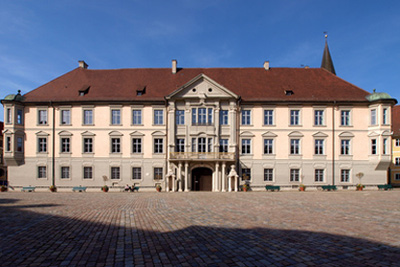
Built during the 18th century under the direction of the prince-bishop of Eichstätt, this square represents the pinnacle of the city's Baroque architecture. Two Italian master builders contributed to its southern European flair, distinguishing it from other Franconian towns. After several modifications over two centuries, the city restored the square to its original glory in 1985. Today it serves as the most beautiful square in the city, surrounded by historical buildings and official institutions including the City Hall and the main building of Caritas.
Former Prince-Bishop's Residence
The Ehemalige fürstbischöfliche Residenz is an impressive three-winged palace constructed in Baroque style. This former residence of the prince-bishops of Eichstätt features a notable cast iron staircase and impressive railings. The building represents the secular power and architectural ambitions of the ecclesiastical rulers who governed the city for centuries.
Hofgarten der Eichstätter Sommerresidenz
These formal gardens belong to the former summer residence of the prince-bishops and showcase typical Baroque garden design. The gardens provide a peaceful retreat within the city and demonstrate the refined lifestyle of Eichstätt's former ecclesiastical rulers. The carefully maintained grounds reflect the Italian influence that characterises much of Eichstätt's architecture and landscaping.
Fossiliensteinbruch Blumenberg
This fossil quarry offers visitors the opportunity to search for Jurassic-era fossils in the limestone formations that are characteristic of the Altmühl Valley region. The site is easily accessible and the rock layers can be readily separated for fossil hunting. The quarry represents the geological significance of the area, which is renowned for its well-preserved Jurassic limestone deposits and fossil discoveries.
Naturpark Altmühltal
The Altmühl Valley Nature Park encompasses the area surrounding Eichstätt and provides extensive opportunities for outdoor activities. The park features well-marked hiking trails, cycling routes, and scenic walking paths along the Altmühl River. Notable trails include the Altmühl-Panoramaweg, which offers magnificent views of the valley landscape. The park also encompasses various geological and botanical features, including the Fossil Trail which provides information about the palaeontological significance of the region.
Top Museums
Domschatz- und Diözesanmuseum Eichstätt
Set within the historic heart of Eichstätt, this museum presents a fascinating journey through twelve centuries of the diocese's artistry, spirituality, and personalities, showcasing goldsmith work, medieval tapestries, ecclesiastical textiles, and treasures from the cathedral's crypt. With thematic rooms blending medieval, baroque, and modern architecture, it's an essential stop for lovers of sacred art and local history.
Jura Museum Eichstätt
Spectacularly situated in the Willibaldsburg castle, this natural history museum is famed for its world-class collection of Jurassic fossils from the Solnhofen limestone, including the iconic Archaeopteryx and the predatory dinosaur Juravenator. Lively aquariums and multimedia guides bring Eichstätt’s prehistoric marine world alive for all ages, making it a top European site for palaeontology enthusiasts.
Museum für Ur- und Frühgeschichte
Also located in the Willibaldsburg, this museum provides a chronological adventure from the Palaeolithic era to early medieval times, spotlighting mammoth and hyena skeletons, Celtic artefacts, unique Roman finds like the only 'Groma' north of the Alps, and early medieval burial objects, giving rich context to Eichstätt’s archaeological past.
Museum "Das Jurahaus"
Unique among Eichstätt’s museums, the museum resides in a restored 17th-century workman’s house, exploring the distinctive local 'Jurahaus' building tradition. It uses the house itself, original decorative elements, and oral histories (even an audio guide narrated by former inhabitants) to immerse visitors in centuries of everyday life and architectural heritage.
Museum Bergér
Family-run and deeply atmospheric, this palaeontology museum near the Blumenberg quarry invites fossil fans to marvel at displays bursting with exquisitely preserved Jurassic insects, plants, and marine reptiles—most unearthed by the Bergér family themselves—and offers hands-on insights into fossil preparation and the region's famed lithographic industry.
Jura-Bauernhof-Museum
A short drive from Eichstätt in Hofstetten, this open-air farmhouse museum transports visitors into the rustic working world of Jura farmers. The 17th-century homestead, with living quarters, barns, kitchens and outbuildings, is superbly presented with original artefacts, seasonal rural performances, and special events, offering unparalleled insights into rural Bavarian life of yesteryear.
Local Cuisine
Local restaurants proudly serve Bavarian classics such as Schweinebraten (roast pork), Weißwurst (white sausage), and Knödel (dumplings made from bread or potatoes), often accompanied by tangy Sauerkraut or a freshly baked Brezn (pretzel). The area is also renowned for specialties like Altmühltal-style roast beef and dishes made with locally sourced venison. For something a little lighter, try Kässpätzle—a baked noodle dish with cheese and onion—or seasonal treats including wild mushrooms in summer and white asparagus in spring. No visit would be complete without sampling sweet delicacies such as Apfelstrudel (apple strudel) or Dampfnudeln (steamed dumpling with fruit sauce), perfectly paired with a cup of locally roasted coffee. For the thirsty, Eichstätt’s inns and beer gardens pour fine Hofmühl beer, embodying the friendly hospitality and flavours of the Altmühltal valley.
Getting There & Around
By train, Eichstätt is easily reached by regional trains, with connections from larger cities like Munich and Nuremberg via Ingolstadt. From Ingolstadt, frequent regional services take travellers directly to Eichstätt Bahnhof, where a short local train brings you to Eichstätt Stadt, just a brief walk from the historic centre.
By bus, several regional buses operate between Eichstätt and neighbouring towns, especially from Ingolstadt. Direct buses are also available, providing a reliable choice, though train connections are often faster for most routes in the region.
By car, reach Eichstätt by taking the A9 motorway and exiting at either “Altmühltal” from the north or “Lenting” from the south, then following well-marked local roads to the town. The scenic drive through the Altmühltal region offers beautiful views and convenient access for those preferring the flexibility of travelling by automobile.


