



| Contents |
|---|
Introduction
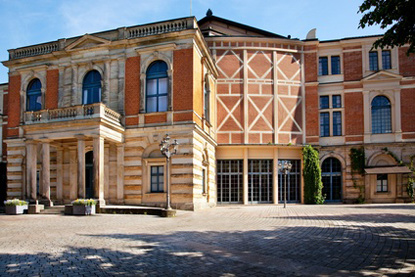
Bayreuth (pop. 75,000) is most famous for the annual Bayreuth Festival, dedicated to the works of composer Richard Wagner, which attracts visitors from around the world. The festival was founded by Richard Wagner in 1876 as a dedicated venue for his operas, an event still well alive today. The city had been a cultural capital since Princess Wilhelmine of Prussia, Frederick the Great's sister, invited architects and artists from all over Europe and founded the Margravial Opera House, now a UNESCO World Heritage site. Other notable attractions include elegant parks like the Hofgarten and the baroque Neues Schloss.
Interesting Facts about Bayreuth
- Bayreuth is internationally renowned for hosting the annual Bayreuth Festival, dedicated exclusively to the operas of Richard Wagner.
- Bayreuth was once the residence of the Margraves of Brandenburg-Bayreuth, who enriched the city with magnificent Baroque architecture during the 18th century.
- Margravine Wilhelmina, the favourite sister of Frederick the Great, left a significant cultural mark on Bayreuth, commissioning the famous Margravial Opera House now UNESCO-listed.
- The University of Bayreuth, founded in 1975, gives the city a vibrant and youthful character.
- Composer Franz Liszt died in Bayreuth whilst visiting his daughter Cosima, who was Wagner’s widow, and is buried in the city alongside Wagner.
- The city sits charmingly between the Fichtel Mountains and the Franconian Jura, along the Red Main river.
- The acoustics of the Bayreuth Festival Theatre are globally famous, described as unique and legendary among opera enthusiasts.
- Bayreuth is notable for its strong beer tradition and offers several local breweries, making it an attractive destination for beer lovers.
History
Bayreuth's history stretches back to the late 12th century, when it was first documented in 1194 as "Baierrute" by Bishop Otto II of Bamberg, though the town is believed to have been founded by the counts of Andechs around the mid-12th century. The name itself derives from the syllable "-rute," meaning "clearing," combined with "Baier-," indicating immigrants from the Bavarian region. By 1231, Bayreuth had achieved town status (civitas), likely receiving its town charter between 1200 and 1230. The town was ruled by the counts of Andechs-Merania until their extinction in 1248, after which it passed to the Hohenzollern burgraves of Nuremberg. Emperor Charles IV granted Burgrave Frederick V the right to mint coins for Bayreuth and Kulmbach as early as 1361. In 1398, Bayreuth was partitioned from Nuremberg to become the Principality of Bayreuth, though until 1604, the princely residence remained at Plassenburg Castle in Kulmbach.
The town's early history was marked by devastating disasters and political upheaval. In 1430, Hussites from Bohemia conquered and destroyed Bayreuth, razing the town hall and churches in acts of extreme cruelty. The town struggled through various calamities, including a great fire in 1605 that destroyed 137 of its 251 houses, a plague outbreak in 1602 that killed over 1,000 inhabitants, another major fire in 1621, and significant damage during the Thirty Years' War when imperial troops captured and looted the town in three consecutive years from 1632 to 1634. However, a turning point came in 1603 when Margrave Christian moved the aristocratic residence from Kulmbach to Bayreuth, establishing the town as the seat of power. Under Christian Ernest, who ruled from 1661 to 1712, Bayreuth began to flourish with the addition of baroque buildings, the founding of the Christian-Ernestinum Grammar School, and the construction of monuments commemorating his participation in the liberation of Vienna from Turkish siege in 1683.
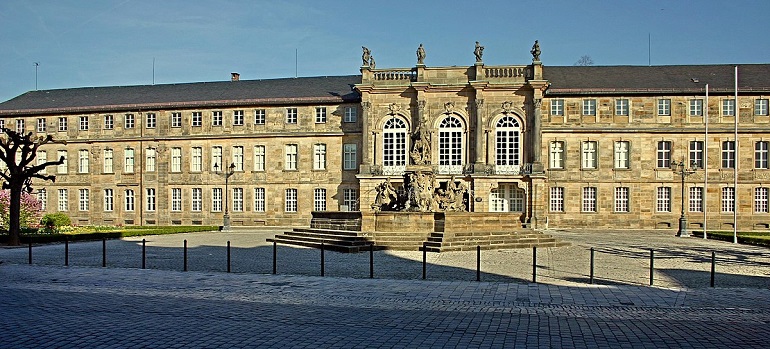
Bayreuth reached its golden age during the reign of Margrave Frederick and his wife Margravine Wilhelmina, sister of Frederick the Great, from 1735 to 1763. This period saw the creation of numerous magnificent baroque buildings that defined the city's architectural character, including the UNESCO World Heritage Margravial Opera House (1744-1748), which was the largest opera house in Germany for over a century, the New Palace with its courtyard gardens, and the Sun Temple at the Hermitage. This era also gave birth to a unique architectural style known as "Bayreuth Rococo". Following the death of the childless Frederick Christian in 1769, Bayreuth became a secondary residence under Charles Alexander from Ansbach. The principality's independence ended in 1791 when the last margrave abdicated, leading to Bayreuth becoming part of a Prussian province under Karl August von Hardenberg's administration from 1792. The town later passed to Bavaria in 1810 following the Napoleonic Wars. The most significant modern development in Bayreuth's cultural history began in 1872 when composer Richard Wagner chose the town as his residence, establishing the Festspielhaus opera house and launching the famous Richard Wagner Festival in 1876, which continues to attract opera enthusiasts from around the world.
Main Attractions
Margravial Opera House
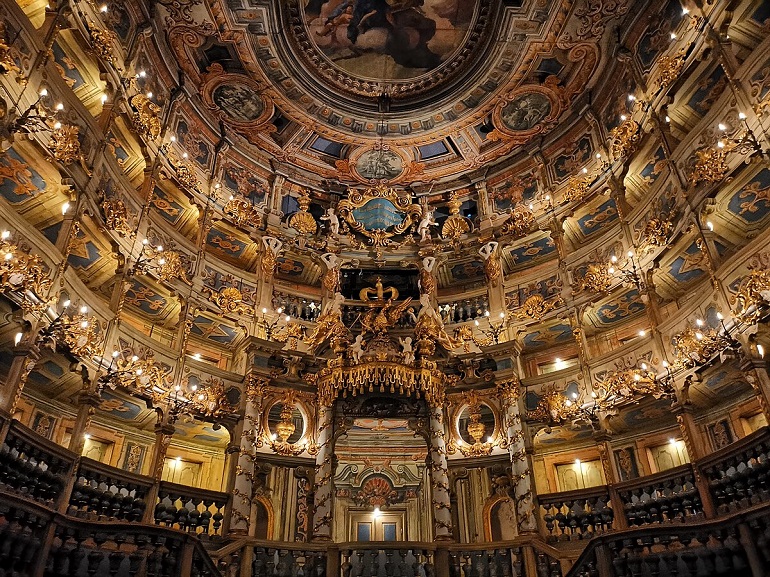
Commissioned by Margravine Wilhelmine and built between 1744 and 1750, this free-standing Baroque court theatre survives almost entirely in its original state. The sandstone façade by court architect Joseph Saint-Pierre fronts a largely wooden auditorium designed by Italian theatre specialists Giuseppe and Carlo Galli Bibiena, seating about 500 spectators in a bell-shaped plan that enhances acoustics. Recognised by UNESCO in 2012 for its exceptional preservation and architectural value, the building exemplifies 18th-century festival culture and foreshadows the larger public opera houses of the 19th century. Guided visits focus on the restored illusionistic décor completed after a five-year conservation campaign that ended in 2018.
Bayreuth Festspielhaus
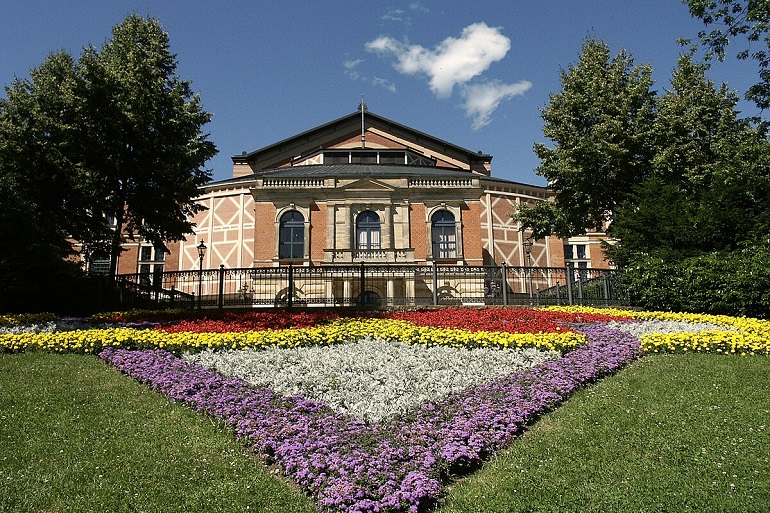
Richard Wagner selected Bayreuth in 1871 for a purpose-built festival theatre and oversaw its construction with architect Otto Brückwald from 1872 to 1875 on the “Grüner Hügel” north of the town. Funded principally by King Ludwig II of Bavaria, the timber-framed building opened in August 1876 with the first complete cycle of *Der Ring des Nibelungen*. It holds 1,925 seats arranged in a single raked wedge and features a recessed, covered orchestra pit that contributes to its celebrated acoustics. The Festspielhaus is used exclusively for the annual Bayreuth Festival, staged from 25 July to late August, during which around 30 performances of Wagner’s music dramas attract an international audience.
Hermitage Court Garden
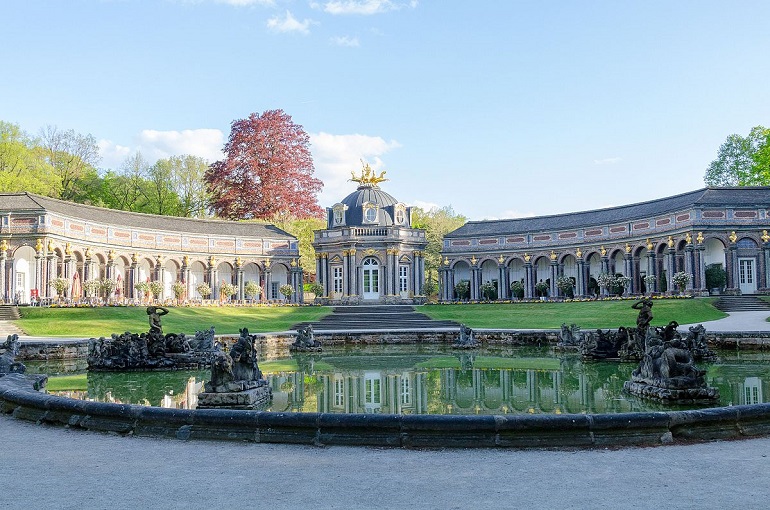
Margrave Georg Wilhelm began laying out this retreat in 1715 on the site of a former deer park, adding the four-winged Old Palace and scattered “hermit” huts. From 1735 Margravine Wilhelmine reshaped the grounds, introducing bosquets, avenues, fountains, the Temple of the Sun and, between 1749 and 1753, the New Palace with its oval arcades and gilded quadriga. The design eschews a dominant axis, giving each garden compartment a degree of independence unusual in high Baroque landscaping. Late-18th-century modifications added English-style winding paths, yet the Baroque water features and Ruined Theatre remain intact; the park is open free of charge year-round.
Hofgarten
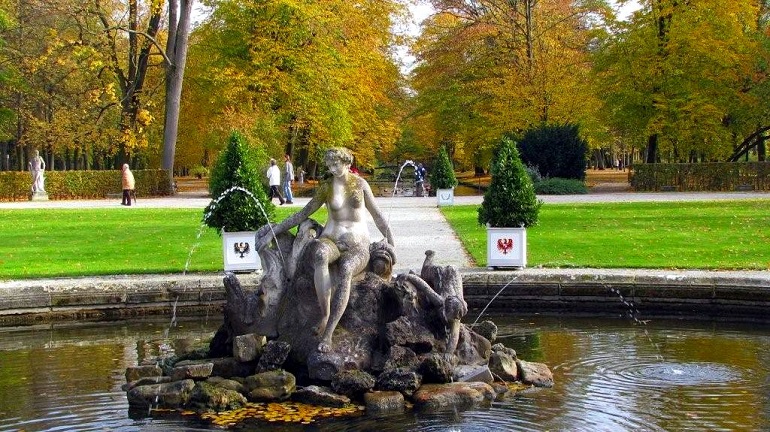
Bordering the New Palace, the Hofgarten originated as a court garden in the late 16th century and was redesigned by Margrave Friedrich and Margravine Wilhelmine after 1735 with straight alleys, hedge quarters and a right-angled canal containing four islands. Around 1790 Margrave Alexander converted the layout to the then fashionable English landscape style while retaining the axial watercourse and principal avenues. Today the 31.5-acre public park offers mature lime, willow and oak trees, ornamental statues such as Apollo and Juno, a children’s playground and shaded walking paths, providing a green corridor between the palace quarter and the city centre.
Ecological Botanical Garden
Established by the University of Bayreuth in 1978, this 16-hectare garden integrates research, teaching and recreation through near-natural plant displays organised by global biomes. More than 10,000 species grow outdoors and in 6,000–8,000 m² of greenhouses that recreate tropical rainforests, cloud forests and desert habitats. Additional sections include a one-hectare crop garden and long-term ecological experiment plots equipped with lysimeters and groundwater basins. Admission is free; outdoor areas open daily from early morning, while greenhouses operate on restricted weekday and holiday hours, with wheelchair-accessible paths throughout.
Tierpark Röhrensee
The Röhrensee park covers 13 hectares around a 1.6 hectare lake formed by merging two ponds in 1891; hollowed tree trunks once soaked here for the town’s early waterpipes, giving the site its name. In 1973 the city added animal enclosures, creating a small zoo that now houses Bennett’s wallabies, flamingos, emus, deer and domestic breeds in spacious, interpretive settings. Facilities include a large adventure playground, seasonal boat hire, fitness equipment and a kiosk, all offered with free entry. The park’s conservation and education efforts were recognised in 2018 by the UN Decade on Biodiversity initiative.
Top Museums
New Palace Museums (Neues Schloss)
Joseph Saint-Pierre’s New Palace enfolds several specialised displays that expand Wilhelmine’s cultural world.
- Margravine Wilhelmine’s Bayreuth: multimedia tableaux reconstruct courtly routines, literary salons and the margravine’s own compositions, situating her as Enlightenment polymath.
- Rummel Collection of Bayreuth Faience: some 400 pieces illustrate the technical evolution of the local manufactory, including distinctive coffee-brown glaze embellished with gold.
- Dr Loer Collection of Galant Miniatures: flirtatious portrait miniatures reveal eighteenth-century codes of sentiment and sociability.
Together these galleries complement the palace’s famed Palm Room, Chinese Mirror-Shard Cabinet and grotto chambers, epitomising the delicate intimacy of Bayreuth Rococo.
Richard Wagner Museum
Richard Wagner’s former villa, Haus Wahnfried, together with Siegfried Wagner House and a minimalist new wing, forms a tri-partite museum complex devoted to the composer’s life, works and turbulent after-story. Immersive displays trace Wagner’s artistic evolution, while reconstructed salons convey the domestic ambience cultivated by Cosima Wagner in the 1880s. An adjoining section scrutinises the Bayreuth Festival’s political entanglements, including the family’s relationship with National Socialism, using original stage models and archival film. The museum’s garden shelters the graves of Richard and Cosima, offering a contemplative conclusion to the visit.
Kunstmuseum Bayreuth
Housed in the Old Baroque Town Hall, the Kunstmuseum showcases modern and contemporary art across vaulted interiors that survived mediaeval fires and wartime destruction. Its core holdings emphasise twentieth-century works on and with paper, spanning Expressionism, Constructivism, Surrealism and Fluxus. Regularly changing exhibitions draw upon several private foundations, and the museum animates its programme through lectures and an active YouTube channel that extends curatorial dialogue beyond the gallery walls.
Franz Liszt Museum
Liszt’s last residence, a modest brick house beside Haus Wahnfried, now preserves 300+ artefacts ranging from his silent practice piano to intimate correspondence with daughter Cosima. Chronological galleries chart his itinerant career and late stylistic experiments, accompanied by a curated soundtrack that drifts through the rooms. Sculptures, life and death masks, and the Ibach concert grand deepen the portrayal of a composer whose final summers were inseparable from Bayreuth’s musical ferment.
Jean Paul Museum
Germany’s humourist-philosopher Jean Paul (Johann Paul Friedrich Richter) spent his last two decades in Bayreuth, and the museum dedicated to him occupies a villa once owned by Wagner’s daughter Eva. Autographs, first editions and portraiture drawn from the Hausser Collection evoke his prodigious output, while multimedia stations rebut the National Socialist misappropriation of his legacy. Design elements reference the writer’s fantastical imagery, immersing visitors in the whimsical, psychologically acute worlds he conjured on the page.
Iwalewahaus
Part museum, part research institute of the University of Bayreuth, Iwalewahaus curates Europe’s largest institutional collection of contemporary African art—more than 12,000 works. Rotating exhibitions tackle subjects such as Nollywood cinema, post-colonial photography and diasporic soundscapes, framed by conferences and artist residencies that turn the building into a live laboratory of cultural production. The facility’s relocation to a former commercial warehouse in the city centre mirrors its mission: to act as a porous bridge between global art discourses and local audiences.
Urwelt-Museum Oberfranken
Towering dinosaur casts outside a 16th-century civic structure announce a natural-history trove focused on the geology and palaeontology of Upper Franconia. Inside, a holotype skeleton of Nothosaurus mirabilis anchors a chronological journey through 500 million years, supplemented by mineral displays that explain why the region boasts such metallurgical diversity. Interactive “dragon caves” and fossil workshops make the museum popular with school groups while maintaining rigorous research credentials through partnerships on Triassic marine reptiles.
German Masonic Museum (Deutsches Freimaurermuseum)
Founded in 1902 to demystify Freemasonry, this is Germany’s sole museum devoted exclusively to Masonic culture. Around 500 objects—lodge aprons, ritual carpets, bijou badges and a rare Illuminati emblem—illustrate fraternal symbolism and its Enlightenment roots. A 16,500-volume reference library supports scholarly enquiries, and interpretive panels candidly address the Nazi confiscation and subsequent restitution of many holdings.
Historisches Museum Bayreuth
Occupying the city’s oldest schoolhouse, the Historical Museum narrates 800 years of urban evolution across three floors. Displays spotlight Bayreuth’s seventeenth- and eighteenth-century heyday as a margravial seat, with scale models, court costumes and a monumental diorama of the Hermitage gardens. The Burkhardt Collection of local faience—gleaming earthenware once coveted across Europe—underscores the city’s artisanal heritage. Education studios encourage inter-generational dialogue, reinforcing the museum’s role as civic memory-keeper.
Maisel’s Bier-Erlebniswelt
Set within the red-brick brewhouse of 1887, Maisel’s 4,500 m² “Beer Experience World” fuses an award-winning museum, working craft brewery and atmospheric tavern. Visitors thread past steam engines, copper mash tuns and perfumed hop lofts before descending into catacomb cellars once used for lagering during pre-refrigeration winters. Guinness World Records recognised the site in 1988 for its unrivalled collection of 5,500 branded glasses and 400 enamel signs—a colourful précis of Franconian drinking culture.
German Typewriter Museum
Reopened in 2024 inside a restored carriage house of Schloss Thiergarten, this niche institution chronicles 160 years of writing technology through 1,200 machines. Exhibits range from an 1860s wooden prototype to IBM’s electric Selectrics, illustrating mechanical ingenuity and shifting office labour patterns. Many devices remain operational, allowing guests to hear the percussive rhythm that once defined bureaucratic life.
Wilhelm-Leuschner-Gedenkstätte
In the modest birth-house of trade-union leader Wilhelm Leuschner, compact rooms document his trajectory from Bayreuth apprentice to Hessian Interior Minister and member of the 20 July 1944 anti-Hitler conspiracy. Original letters, clandestine photographs and audio testimonies underscore Leuschner’s call for democratic unity—words he reiterated hours before his execution in Berlin-Plötzensee. The memorial serves as both museum and study centre, supporting civic-education projects on resistance ethics.
Rollwenzelei – Jean Paul Stube
Just beyond the city gate stands the former tollhouse-inn where Jean Paul penned chapters of “Titan” while savouring potato suppers and Franconian beer. His tiny writing parlour, rescued from decay by a local preservation society, retains the simple desk, window view towards the Rauer Kulm and the fabled armchair praised by generations of literary pilgrims. Adjacent displays digitise eleven guest books filled with signatures ranging from Richard Wagner to Romy Schneider, attesting to the site’s enduring magnetism.
Local Cuisine
Among its culinary highlights, the Bayreuther Bratwurst stands out for its finger-thick, finely seasoned sausages typically served with hearty mustard. Equally renowned is Schäuferla, a mouth-watering slow-roasted pork shoulder often served with crisp crackling, dumplings, and red cabbage. For a taste of local comfort, try Blaue Zipfel (sausages simmered in a tangy vinegar and onion broth) or Stadtwurst mit Musik—cold sausages marinated with oil, vinegar, and onions. Sweet-toothed travellers will savour Lebkuchen (gingerbread), and pastries such as Bienenstich, filled with custard and crowned with toasted almonds. No visit is complete without exploring Bayreuth’s traditional taverns and beer gardens, where local brews like those from Maisel’s Brewery perfectly complement these beloved Franconian dishes.
Getting There & Around
By train, Bayreuth can be conveniently reached via regional trains connected to major hubs like Nuremberg and Bamberg, which are served by fast ICE and IC trains from across Germany and Europe. The main station, Bayreuth Hauptbahnhof, is located just north of the town centre and offers frequent regional services, particularly the Franken-Sachsen-Express, providing smooth onward journeys into the city and surrounding region.
By coach or bus, long-distance travel to Bayreuth is available with several companies, notably FlixBus, offering regular direct services from various German and European cities. Coaches often arrive at the central bus station (ZOH), making it a practical option for those seeking flexible and comfortable travel. Local buses efficiently connect the bus station, train station, and key destinations throughout Bayreuth, including the university and city centre.
By car, Bayreuth is easily accessible via the A9 motorway, with exits at both Bayreuth-Nord and Bayreuth-Süd. Well-signposted routes guide drivers to the city centre, university, and festival venues. Ample parking is available, but it is advisable to allow extra time around popular events as traffic congestion and parking demand may increase.


