| Contents |
|---|

Introduction
The former Imperial Abbey of Lorsch, 10 km east of Worms, was one of the most renowned monasteries of the Carolingian Empire. Though ruined today, the abbey's remains are among the most important pre-Romanesque buildings in Germany. In 774, Charlemagne himself consecrated the abbey church, elevating Lorsch to the status of an imperial monastery under royal protection. Over the centuries, the complex flourished as a centre of learning, art and medicine before falling into decline amid political conflicts and the Reformation. Today, the surviving 9th-century gatehouse (Torhalle), portions of the basilica and sections of the surrounding wall stand as some of the finest pre-Romanesque remains north of the Alps and have been recognised as a UNESCO World Heritage Site since 1991.
Two books from the monastery, the 1200-year-old Codex Aureus of Lorsch and the 800-year-old Lorsch Codex rank among the most important documents in early medieval German history.
Interesting Facts about Lorsch Abbey
- Lorsch Abbey was founded in 764 by Count Cancor and his mother Williswinda, making it one of the earliest Carolingian monasteries in Germany.
- Its Carolingian gatehouse (Torhalle) is one of the best-preserved architectural relics from the period and an iconic example of pre-Romanesque architecture.
- The abbey became a UNESCO World Heritage Site in 1991, recognised for its exceptional cultural and architectural significance.
- The abbey's scriptorium and library were among the largest in the Middle Ages, and the works produced here—including the celebrated Codex Aureus—are now scattered across 54 sites in 17 countries.
- The Lorsch Pharmacopeia, written around the late eighth century, is considered the earliest pharmaceutical manuscript of the Western Middle Ages.
- Kings such as Louis II the German and Louis III the Younger are buried at Lorsch Abbey, reflecting its former status as a royal burial ground.
- The abbey was a major centre for learning and manuscript production, playing a crucial cultural role in the Carolingian renaissance.
- According to legend, Lorsch Abbey is named in the famous German epic Nibelungenlied as the burial place of Siegfried.
- Charlemagne himself attended the consecration of the abbey in 774, personally highlighting its imperial importance.
- The famous Lorsch Codex, compiled in the twelfth century, provides the first documented mention of hundreds of European cities and towns, making it a fundamental historical source.
History
Lorsch Abbey, one of the most significant monastic establishments of the Carolingian Empire, was founded in 764 by Count Cancor and his widowed mother Williswinda as a proprietary monastery on their estate, Laurissa. The abbey was initially dedicated to Saints Peter and Paul and placed under the governance of Chrodegang, Archbishop of Metz, who became its first abbot. In 766, following a property dispute, the monastery was relocated to an Ice Age dune several hundred metres from its original site. A pivotal moment occurred in 772 when Abbot Gundeland, seeking royal intervention in legal disputes, transferred the abbey to Charlemagne, transforming it into a Royal abbey. The main church of Saints Peter, Paul, and Nazarius was consecrated in September 774 in Charlemagne's presence, marking the beginning of the abbey's most illustrious period.
The monastery reached its zenith following the death of Louis the German in 876, when it became the burial place for Carolingian royalty of the Eastern Frankish realm. By this time, Lorsch had become one of the wealthiest landowners east of the Rhine, controlling estates stretching from the North Sea coast to present-day Switzerland. Throughout the 11th century, the abbey flourished as a centre of power, spirituality, and culture, enjoying the status of a reichsabtei (sovereign principality) subject directly to the emperor. The monastery housed one of Europe's largest medieval libraries and produced the renowned Lorsch Pharmacopoeia in the late 8th century, which is considered foundational to modern medicine. However, this golden age ended when Pope Gregory IX deposed the last Benedictine abbot in 1226, and the abbey passed to the Archbishopric of Mainz in 1232, marking the end of its political independence.
The abbey's decline accelerated through successive changes in religious orders and political upheavals. After periods under Cistercian and later Premonstratensian control, monastic life ceased entirely in 1556 during the Protestant Reformation when Elector Ottheinrich dissolved the monasteries in his domain. The final destruction came during the Thirty Years' War when Spanish troops pillaged and demolished most of the abbey buildings in 1621. Subsequent French military campaigns in the late 17th century further devastated the ruins, which were thereafter used as a quarry for regional construction projects. Today, only the magnificent Königshalle (King's Hall) remains largely intact as a testament to the abbey's former glory—this 9th-century gatehouse represents one of the finest examples of Carolingian architecture and earned UNESCO World Heritage status in 1991.
Description
The Magnificent Königshalle (King's Hall)
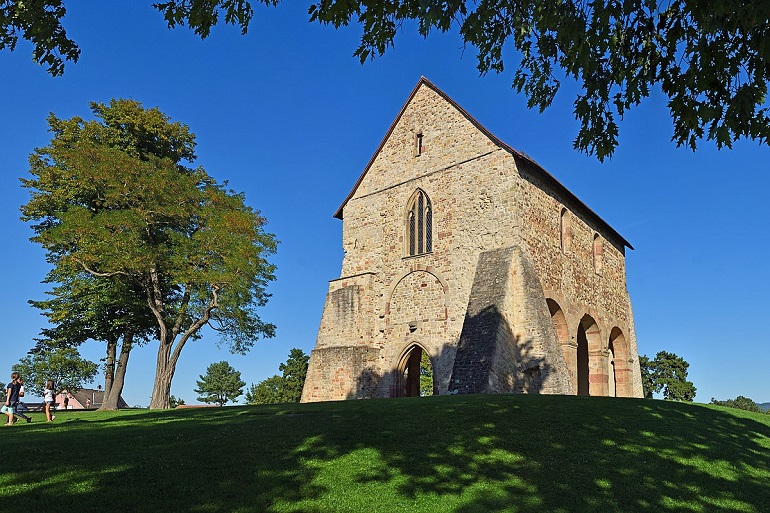
The crown jewel of Lorsch Abbey is undoubtedly the Königshalle, also known simply as the Torhalle or gatehouse. This extraordinary structure, dating from around 870 CE, represents one of the finest examples of Carolingian architecture north of the Alps. Standing proudly with its distinctive two-storey design, the Königshalle showcases a masterful blend of Roman architectural influences with early medieval craftsmanship.
The gatehouse features three grand round arches on the ground floor, framed by impressive composite capitals that echo classical Roman design. The striking façade displays an intricate mosaic-like pattern of red and cream sandstone, arranged in hexagonal and diamond shapes using the ancient Roman technique of opus reticulatum. Above the arches, fluted pilasters rise to support steep, gabled cornices, creating a distinctive zigzag pattern that dances across the upper storey.
What makes the Königshalle truly special is its remarkable preservation. Despite being over 1,200 years old, the building retains much of its original appearance, complete with surviving sculptural details and painted elements. The upper floor houses a fascinating room that can only be accessed through guided tours, where visitors can marvel over 1,000 years old. These ancient frescoes originally depicted an illusionistic loggia, as if viewers were standing in an open-air space looking out across a classical landscape.
The Basilica Fragment
Situated picturesquely atop the monastery hill, the basilica fragment provides tangible evidence of what was once described as a "wonder of splendour and beauty". This impressive stone remnant represents the western portion of a 12th-century church that formed part of the larger abbey complex. The fragment belongs to the three western bays of the central nave, which once connected to a much grander basilica that extended eastward.
The church ruins demonstrate the architectural evolution of the site, showing construction techniques from the 8th through the 18th centuries. Though much of the original structure was destroyed during the Thirty Years' War in 1621, what remains offers visitors insight into the scale and grandeur of the medieval monastery. The fragment stands as a poignant reminder of the abbey's former magnificence, with its weathered stones telling stories of centuries past.
The Ancient Monastery Wall
Encircling portions of the abbey grounds, the monastery wall represents the largest surviving original structure from the medieval complex. Standing three to four metres high and extending for approximately 500 metres, this substantial stone barrier primarily served to delimit and provide basic protection for the monastery grounds rather than function as a fortification.
Archaeological evidence suggests that sections of this wall date back to the early 9th century, with denarii from the time of Louis the Pious discovered during excavations. The wall's southern sections remain largely intact today, whilst the northern portions can be traced through archaeological findings and historical plans. Walking alongside these ancient stones, visitors can truly appreciate the scale of the original monastery and imagine the bustling religious community that once thrived within these boundaries.
The Museum Centre and Cultural Facilities
The Museum Centre, opened in 1995, serves as the intellectual heart of the visitor experience. Located north of the abbey grounds, this modern facility houses comprehensive exhibitions that illuminate the educational and cultural significance of Lorsch Abbey during its medieval heyday. The museum particularly focuses on the abbey's renowned scriptorium and library, which played crucial roles in preserving classical knowledge during the Carolingian Renaissance.
Visitors can explore the legacy of important manuscripts created at Lorsch, including the famous Lorsch Gospels, written entirely in gold, and the Lorsch Pharmacopoeia, a groundbreaking medical text from the 8th century that is now inscribed on the UNESCO Memory of the World Register. The museum also features a tobacco museum, reflecting Lorsch's later agricultural heritage from the 17th century onwards.
The Tithe Barn and Archaeological Collections
The imposing Tithe Barn, an 80-metre-long structure built in the 1590s from stones salvaged from demolished monastery buildings, now serves as a fascinating show depot for archaeological finds. This remarkable building symbolises both the destruction and continuity of the abbey's legacy, constructed entirely from reused monastic stonework.
Inside, visitors can examine objects from over 200 years of archaeological excavations, including late antique pieces from the 2nd and 3rd centuries, Carolingian columns and capitals, and various medieval artefacts. The barn houses cultural artefacts spanning multiple epochs, providing tangible connections to the layers of history buried beneath the abbey grounds.
The Medicinal Herb Garden
Behind the tithe barn lies a meticulously maintained herb garden based on the historic Lorsch Pharmacopoeia. This therapeutic garden features over 150 medicinal and aromatic plants, all documented in the 8th-century medical text that represents some of the earliest scientific medicine in the Western world. The garden is designed with accessibility in mind, featuring dry stone walls separating the planted beds and flat ramps connecting accessible pathways.
The herb garden offers visitors a sensory experience of medieval monastic life, where healing through plants formed a crucial part of the abbey's mission. Guided tours explain the historical significance of each plant and their traditional uses, bringing the ancient pharmaceutical knowledge to life in a beautiful, contemplative setting.
Lauresham Open-Air Laboratory
The Lauresham Experimental Archaeological Laboratory represents a unique addition to the World Heritage Site. This living laboratory recreates a typical Carolingian manor house from around 800 CE on a 4.1-hectare site. The complex includes approximately 25 authentic buildings - residential structures, farm buildings, stables, barns, workshops, and a chapel - all constructed using period-appropriate techniques and materials.
Lauresham serves as both an educational facility and an active research centre where scientists conduct ongoing experiments in early medieval agriculture, animal husbandry, and crafts. Visitors can observe traditional farming methods using draft oxen, witness ancient building techniques, and explore how people lived and worked during the Carolingian period. The site features diverse farm animals whose breeds approximate their medieval counterparts, along with period-appropriate gardens, fields, meadows, and pastures.
Visitor Information Centre
The award-winning Visitor Information Centre, completed in 2014, provides an elegant introduction to the World Heritage Site. This contemporary glass structure deliberately contrasts with the medieval architecture whilst blending harmoniously with the surrounding agricultural landscape. The centre serves as both a gateway to the site and a venue for museum education programmes, workshops, and temporary exhibitions.
The Redesigned Landscape
In 2014, the entire abbey grounds underwent a remarkable transformation designed by Berlin landscape architects Topotek1. Rather than attempting to reconstruct lost buildings, the innovative design uses subtle topographical interventions to make the absent monastery "felt" through the landscape. The footprints of vanished structures are outlined as gentle depressions in carefully maintained lawns, creating an "archaeological lawn" that invites visitors to walk through and explore.
The abbey grounds can be explored freely, whilst specific buildings and guided tours require tickets. The site operates year-round, with varying seasonal schedules for different facilities. Multiple guided tour options are available in several languages, ranging from architectural tours of the historic buildings to hands-on workshops at the experimental laboratory.
Getting There
By train, Lorsch Abbey is easily accessible from major cities such as Frankfurt or Heidelberg by regional trains with a change at Bensheim; from Lorsch train station, it is about a 10-minute walk to the abbey grounds, with clearly marked signs leading the way.
By bus, regional bus lines, such as 641, 643, and 646, connect Lorsch with the surrounding towns, and stops like “Bahnhof” and “Kaiser-Wilhelm-Platz” are both within a short, ground-level walk of the monastery complex.
By car, Lorsch can be reached via the A5 or A67 motorways, or the B3, B47, and B460 federal roads; convenient parking is available near the intersection of Nibelungenstraße and Klosterstraße or on Karolingerplatz, after which visitors enter the traffic-free centre on foot.
Best Time to Visit
The ideal time to explore Lorsch Abbey is between late spring and early autumn, roughly from May through September, when the weather in Hesse is at its pleasant. During these months daytime temperatures average between 18 °C and 25 °C, skies are often clear, and the famed peony and herb gardens burst into bloom, creating a vivid backdrop for the abbey’s Carolingian gatehouse and medieval ruins. Long daylight hours afford ample time for both a self-guided wander across the UNESCO World Heritage site and a leisurely guided tour of the King’s Hall, while the often-enjoyable summer evenings make nearby cafés and terraces especially inviting. Visiting in May or June helps you avoid the height of the high season crowds, yet still benefits from mild, comfortable conditions before the peak heat of midsummer.