



| Contents |
|---|
Introduction
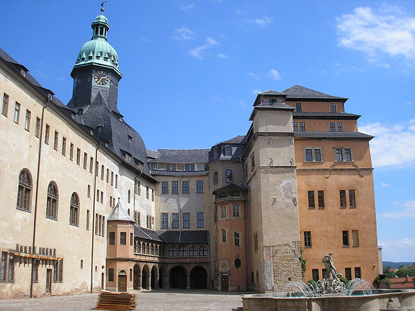
Sondershausen Palace is a four-winged complex whose origins date back to the late 13th. Over successive reigns, the medieval fortress was remodelled in Renaissance style during the 1530s–1550s, enlarged in the Baroque era from the 1680s, and augmented with Rococo and Neoclassical wings in the 18th and 19th centuries. Its prominent silhouette overlooks the market square and today houses a museum featuring historic rooms such as the Blue Hall and the Giants’ Hall, as well as the Carl-Schroeder Conservatoire of Music, all set within a landscaped park that includes stables and an octagonal concert house.
Interesting Facts about Sondershausen Palace
- Sondershausen Palace is one of the most significant palace complexes in Thuringia, noted for its unique four-wing irregular structure.
- The original foundation of the palace dates back to the late 13th century, having developed from a medieval castle into a grand residence.
- Throughout the centuries, the palace was the seat of the counts and princes of Schwarzburg, shaping the region’s history for generations.
- The grand Golden Coach, dating from the early 18th century and crafted in Paris, is the oldest and only surviving example of its kind in Germany—lavishly gilded and displayed in the palace museum.
- Sondershausen Palace blends architectural styles from the Renaissance, Baroque, Rococo, and historicism periods, reflecting continuous artistic evolution.
- The palace boasts the renowned “Thuringian Amber Room”, decorated with hand-cut, polished limestone tiles—unique in Germany.
- Its splendid Blue Hall, with blue and white Rococo décor, symbolises the state colours of Schwarzburg-Sondershausen and features a ceiling painting depicting the myth of Callisto.
- The Giants’ Hall is adorned with 22 Baroque ceiling paintings depicting scenes from Ovid's "Metamorphoses" and 16 life-sized stucco figures of Greek gods.
- The palace maintains a deep musical tradition: the court orchestra once delighted composer Franz Liszt, and today, the museum displays an exquisite collection of period musical instruments.
- The palace is set in a 30-hectare landscaped park, originally a pleasure garden, later redesigned in the 19th century and enhanced with historical buildings such as the octagonal house and orangery.
- Since 1952, Sondershausen Palace has hosted one of the most important museums in northern Thuringia, showcasing treasures like faience, period furniture, the mysterious medieval bronze “Püstrich”, and satirical world maps from the 16th century.
- Sondershausen Palace continues to serve both as a museum and a musical venue, with the renowned Loh Orchestra (founded in 1617) still performing concerts within its historic halls.
- The palace’s terrace offers a commanding view over the market square and the town of Sondershausen, adding to its scenic charm.

History
Medieval Origins and Renaissance Development
Sondershausen Palace has its roots in medieval fortifications, with the oldest building fabric dating from the end of the 13th century, attributed to the Counts of Hohnstein. The transformation from medieval castle to palatial residence began under Count Günther XL of Schwarzburg, who integrated the remaining medieval tower into an ambitious Renaissance palace project between the 1530s and 1550s. This early Renaissance complex consisted of the south, east and old north wings, establishing the foundation for what would become one of Thuringia's most architecturally significant palace complexes. The palace gained particular historical prominence during the Peasants' War of the early 16th century, when Count Heinrich XXXI of Schwarzburg and his son Günther XL remarkably sided with the peasants and joined Thomas Müntzer's "Christian League".
Baroque Grandeur and Rococo Refinement
The palace underwent its most dramatic transformation under Prince Christian Wilhelm I of Schwarzburg-Sondershausen, who reigned from 1666 to 1720 and initiated extensive building activity in the 1680s. During this period, the three Renaissance wings were substantially altered and enlarged in the elaborate Baroque style, with the magnificent Giants' Hall being constructed between 1680 and 1700. This extraordinary hall features 22 ceiling paintings depicting scenes from Ovid's "Metamorphoses" and 16 larger-than-life stucco figures representing Greek gods. The palace reached its final architectural configuration during the reign of Prince Christian Günther III of Schwarzburg-Sondershausen, when new west and north Rococo wings were commenced in 1764 under the direction of Quedlinburg architect Johann Heinrich Breit and Brunswick architect Martin Peltier. This period also saw the creation of the stunning Blue Hall in 1760, a two-storey Rococo masterpiece extending over galleries with dominant blue and white colouring reflecting the state colours of Schwarzburg-Sondershausen.

Neoclassical Completion and Modern Legacy
The 19th century brought the final major architectural phase when Prince Günther Friedrich Carl II engaged Carl Scheppig, a pupil of Karl Friedrich Schinkel, in 1836 to redesign much of the palace complex. Although financial constraints limited the scope, significant improvements were achieved including the redesigning of the eastern palace area towards the market with a palace terrace, guard house and stairs between 1837 and 1839, the rebuilding of the Rococo wings in neoclassical style from 1846 to 1851, and the erection of new stables from 1847 to 1849. The palace's construction history concluded with the addition of a two-storey gallery connecting the tower with the east and south wings in 1914-1915. Today, this irregular four-wing complex, acquired by the Palace, Castle and Gardens Trust of Thuringia in 1994, houses both the Palace Museum of Sondershausen and the Carl-Schroeder-Konservatorium district school of music, preserving its centuries-old musical tradition that once attracted Franz Liszt to perform with the court orchestra.
Description

Sondershausen Palace presents itself as a striking four-winged ensemble that commands the market square of its eponymous Thuringian town. Its external façades an elegant tapestry of Renaissance restraint, Baroque exuberance and Rococo flourish, all united by later neoclassical touches that lend the complex a harmonious grandeur.
Upon entering, visitors step into a sequence of sumptuous interiors whose original splendour remains almost entirely intact. The pièce de résistance is the Blue Hall, its two-storey expanse echoing with courtiers’ footsteps of old. Walls and galleries are swathed in sky-blue and ivory, the palace’s historic hues, while rococo scrolls and classically inspired mouldings frame an oval ceiling painting depicting the Callisto myth.
Adjoining this is the Giants’ Hall, a high Baroque marvel. Here, twenty-two ceiling panels narrate Ovid’s “Metamorphoses” in vibrant fresco, while sixteen larger-than-life stucco figures of Greek deities stand sentinel around the chamber. The long, barrel-vaulted proportions and relatively low ceiling give the room an intimate theatricality.
Not far off lies the unique Stone Room, often likened to a northern “Amber Room”. Every inch of its walls is covered in tiny, hand-cut tiles of plaster and pale limestone, polished to a gentle sheen. The result is an otherworldly chamber of subtle glow, where light and shadow play across patterns of natural veining.
Elsewhere, the Riesensaal (Giants’ Banquet Hall) impresses with its lavish stucco ceiling detail, and the Little Wendelstein Vault delights with its delicately ornamented stucco and painted panels, originally a private study. The small Liebhabertheater retains its intimate stage and gallery, evoking evenings of chamber drama, while the former Court Chapel still breathes with gentle light through its lancet windows and houses an elegantly carved pulpit and organ case.
Beyond the palace walls extends over thirty hectares of parkland. Originally a formal Baroque parterre, the grounds were later reshaped into an English landscape garden of sweeping lawns, meandering paths and reflective ponds. Ruined towers and an octagonal Karussellhaus punctuate the greenery, offering secluded corners for contemplation. An orangery—once home to exotic plants and courtly fêtes—still stands as a graceful colonnaded pavilion beside urn-lined terraces.
Today, the palace serves both as a museum and a centre for music education. Its grand halls host concerts by the renowned Loh Orchestra in the adjoining octagonal house, and a café in the former stables offers a chance to savour Thuringian delicacies beneath lofty arches.
Getting There
By train Sondershausen Palace is easily accessible by train via Sondershausen station, situated approximately 1.6km from the town centre. The station is conveniently linked to major cities and onward travel by local bus or taxi will bring you directly to the palace.
By coach or bus Regional and local buses serve the town of Sondershausen, providing connections from nearby cities and towns. Upon arrival at the Sondershausen bus station, it is a short walk or a quick local bus journey to the palace grounds.
By car Sondershausen is well connected by road and lies close to the A38 motorway, making it straightforward to reach by car. Ample parking is available near the palace, allowing for an easy approach and visit to this historic site.
Best Time to Visit
The ideal time to explore Sondershausen Palace is during the summer months of June through August, when the weather is at its warmest and sun and the castle comes alive with cultural events. Daytime temperatures typically range from 20 °C to 24 °C, offering comfortably warm conditions for strolling through the palace’s Renaissance façades and lush gardens. Long daylight hours—up to sixteen hours in late June—mean you can savour more of the palace’s richly decorated state rooms, including the famed Thuringian Amber Room and the baroque Golden Carriage. Moreover, this period coincides with the annual Thüringer Schlossfestspiele, an open-air music festival set in the castle courtyard that showcases opera and theatre against the splendid historic backdrop. Visiting in high summer thus combines the best of agreeable weather, extended daylight, and vibrant cultural life.


