| Contents |
|---|
Introduction
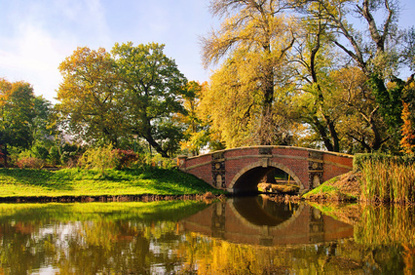
The Dessau-Wörlitz Garden Realm stands as a magnificent testament to 18th-century landscape design, philosophy, and cultural vision. Spanning approximately 142 square kilometres along the Elbe and Mulde rivers in central Germany, this extraordinary cultural landscape represents one of Europe's most significant achievements in landscape architecture. Recognized as a UNESCO World Heritage Site since 2000, the Garden Realm exemplifies the philosophical principles of the Age of Enlightenment through its harmonious integration of art, education, and economy. Created under the visionary leadership of Prince Leopold III Friedrich Franz von Anhalt-Dessau (1740-1817), this remarkable ensemble of parks, palaces, and gardens embedded within the natural floodplain landscape offers visitors an unparalleled journey through history, architecture, and horticultural innovation.
Interesting Facts about the Dessau-Wörlitz Garden Realm
- The Dessau-Wörlitz Garden Realm, a UNESCO World Heritage Site since 2000, was one of the first English-style landscape parks in continental Europe, created in the late 18th century under Duke Leopold III of Anhalt-Dessau.
- It features Europe’s only artificial volcano on Wörlitz Lake, built to replicate Mount Vesuvius with eruptions staged for 18th-century guests using fireplaces and water effects.
- The 142 km² site integrates Enlightenment principles, blending art, education and agriculture within its design, inspired by philosophers like Jean-Jacques Rousseau.
- Architectural highlights include the Gothic House, one of Europe’s earliest Neo-Gothic structures, and a Neoclassical replica of Rome’s Pantheon built in 1795.
- Visitors can explore six parks and five palaces, including the Rococo-style Mosigkau Palace and Großkühnau Castle, now housing the foundation managing the estate.
- The gardens are part of the Middle Elbe Biosphere Reserve, featuring meadows, orchards and waterways accessible via gondola rides from April to October.
- Entry to Wörlitz Park is free, though guided tours and boat trips require a fee, with combined tickets available for palaces like Oranienbaum and Luisium.
History
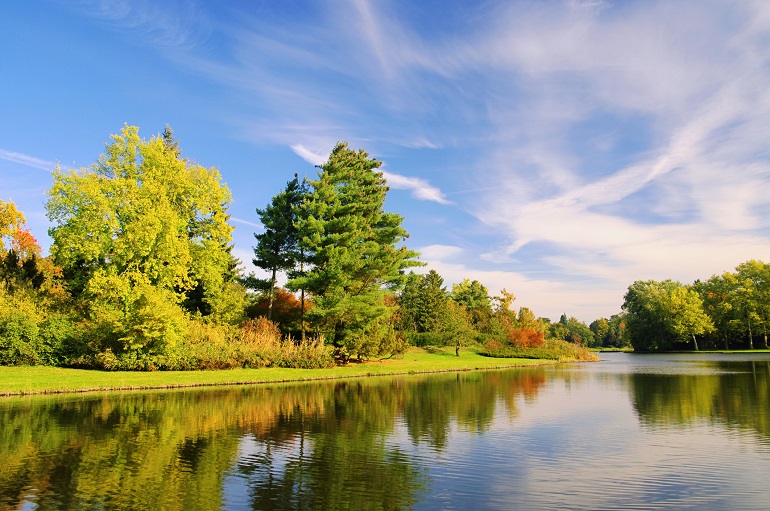
The genesis of the Dessau-Wörlitz Garden Realm can be traced to Prince Leopold III Friedrich Franz von Anhalt-Dessau, who ascended to the throne of his small principality at the age of 18 in 1758. Profoundly influenced by his Grand Tour travels through Europe, particularly to England and Italy, the prince embarked on a visionary project to transform his entire principality into a garden that would embody Enlightenment ideals. Beginning as early as 1765, he initiated calculated changes to the countryside with the dual purpose of beautifying the landscape and improving the lives of his subjects. This ambitious undertaking represented a revolutionary approach to governance, where aesthetic considerations were inseparably linked with practical reforms in agriculture, education, and infrastructure.
The prince's vision extended far beyond mere ornamental gardening; he sought to create a comprehensive "country beautification" that would serve as a model for progressive governance. Over the course of his nearly 60-year reign, Prince Franz systematically developed a series of interconnected landscape gardens, each with its own character yet bound together by sight lines, pathways, canals, and carefully planned plantations. His approach followed the maxim of combining "the useful with the pleasant," ensuring that the gardens served not only aesthetic purposes but also functioned as sites for innovative fruit cultivation, arable farming, and livestock husbandry. This integration of beauty and utility reflected the prince's enlightened worldview and his commitment to improving his principality through practical reforms inspired by his travels abroad.
The Garden Realm's development continued throughout the late 18th and early 19th centuries, with each new addition carefully integrated into the overall design concept. Even older gardens, such as those at Oranienbaum and Mosigkau, were skillfully incorporated into the expanding landscape. The result was a harmonious whole that stretched across approximately 142 square kilometres, weaving together castles, country houses, churches, ramparts, and various garden architectures within the alluvial landscapes along the Elbe and Mulde rivers. This historically unique "country beautification" project has been remarkably well-preserved to the present day, offering contemporary visitors a glimpse into the enlightened vision of Prince Franz and his collaborators.
Description
Wörlitz Park and Palace
Wörlitz Park stands as the undisputed centerpiece and culmination of Prince Franz's ambitious landscape beautification project. Created between 1764 and 1800, it holds the distinction of being the first English landscape garden on continental Europe, marking a revolutionary departure from the formal, geometric gardens that had dominated European garden design. Built on a cut-off side arm of the Elbe River, the park features abundant water areas that enhance its picturesque quality and create a sense of natural harmony. Spanning 112 hectares, the park comprises five individual garden sections that are ingeniously united through a sophisticated system of sight lines, paths, canals, and tree plantations to create a cohesive artistic whole. Numerous architectural elements and sculptures serve as focal points and visual anchors, establishing sight lines that extend far beyond the park's boundaries and integrate it with the surrounding landscape.
At the heart of Wörlitz Park stands Schloss Wörlitz, a building of immense architectural significance. Constructed between 1769 and 1773 under the direction of Friedrich Wilhelm von Erdmannsdorff, it represents Germany's first classicist building and a foundational work in German architectural history. The palace's design marked a revolutionary departure from the ornate Baroque style that had previously dominated, instead embracing clean lines, clearly delineated structural elements, emphasized wall surfaces, and discreet decoration. Intended as a "model house" for the new style, it was open to the public from its inception, reflecting Prince Franz's educational mission and desire to share his enlightened vision with his subjects and visitors alike. From the palace's belvedere, visitors can appreciate the park's unified composition and the prince's comprehensive vision for landscape design.
The interior of Schloss Wörlitz offers an equally remarkable experience, with its lavish decoration preserved in its entirety. The rooms reflect Prince Franz's travels to Italy and Great Britain, as well as his profound interest in ancient art. The palace houses an impressive collection of antique sculptures, Italian and Dutch paintings by famous masters, and English ceramics from the prestigious manufactory of Josiah Wedgwood. Erdmannsdorff adorned numerous rooms with delicate murals and stucco décor based on models from the ancient cities of Pompeii and Herculaneum, which he had visited with the prince during their Grand Tour. The prince's sophisticated taste is further evidenced by the furniture specially designed for the house, including an ensemble from the famous workshop of Abraham and David Roentgen. Following an extensive 20-year renovation, the palace can now be viewed in its entirety, offering visitors an unparalleled glimpse into the prince's enlightened worldview and aesthetic sensibilities.
Luisium Palace and Park: An Idyllic Retreat
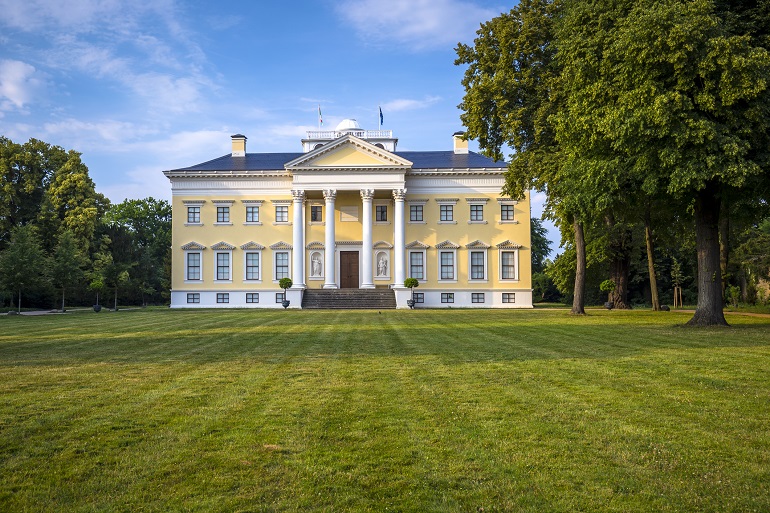
The Luisium represents one of the most intimate and charming elements of the Garden Realm, created as a private residence for Prince Franz's wife, Princess Louise von Anhalt-Dessau. Built between 1774 and 1778, this neoclassical country estate is widely regarded as the most idyllic of the grounds between Dessau and Wörlitz. Situated on a flood-free hill, the Luisium Palace is considered one of Friedrich Wilhelm von Erdmannsdorff's most beautiful architectural creations within the Garden Kingdom. The small, enchanting country house features graceful neoclassical wall and ceiling paintings and ornate stucco work that adorn its intimate rooms and cabinets. The delicate beauty and refined elegance of these decorative elements made the palace so unique that contemporaries referred to it as the "temple of female virtues," a testament to the princess's character and the special place this residence held in the Garden Realm.
Surrounding the palace is an English landscape garden of exceptional beauty, characterized by its harmonious blend of aesthetic and practical elements. The garden features a series of neo-Gothic and neoclassical architectural elements that enhance its picturesque quality, including the intriguing "snake house," elegant gatehouses, and a romantically conceived ruined arch. A main avenue divides the garden into two distinct sections, with the eastern half having been used from the very beginning for practical purposes such as fruit and vegetable cultivation. This close interweaving of the useful and the pleasant is particularly striking at the Luisium, embodying Prince Franz's philosophy of combining aesthetic beauty with practical utility. The original foal pasture adjacent to the Luisium continues to be home to horses, adding a dynamic, living element to the historic landscape and maintaining the connection between the garden's design and its practical functions.
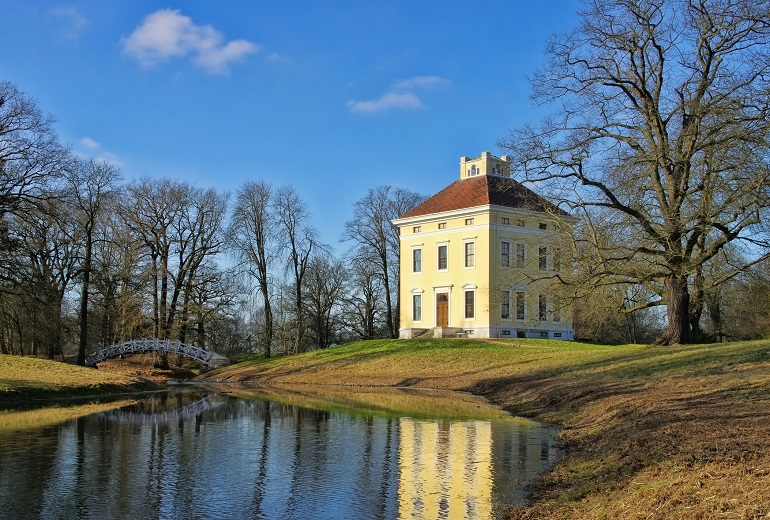
Oranienbaum Palace and Gardens: Dutch Baroque Splendor
Oranienbaum stands as an exceptional example of Dutch Baroque architecture and garden design in Germany, representing a distinct stylistic counterpoint within the predominantly English-influenced Garden Realm. The palace was originally constructed between 1683 and 1698 as a summer residence for Henriette Catherine of Orange-Nassau (1637-1708), who had married Prince Johann Georg II of Anhalt-Dessau. Upon establishing her residence in the town of Nischwitz, she renamed it Oranienbaum in 1673 as a tribute to her Orange-Nassau heritage. She commissioned Dutch architect Cornelis Ryckwaert to create an entire ensemble of town, palace, and gardens in the authentic Dutch style, a project that took fifteen years to complete. The result was a geometrically aligned complex where city, palace, and park form a harmonious whole that reflects the ordered aesthetic of Dutch Baroque design.
The interior of Oranienbaum Palace originally featured abundant decorative elements including precious leather wallpaper, porcelain, faience, and magnificent paintings that gave the castle an extraordinary splendor. Today, visitors can still appreciate this opulence in the fully tiled summer dining room, the leather wallpaper hall (which once served as Henriette Catharina's porcelain gallery), and the newly interpreted mirror crystal hall. The palace is flanked by outbuildings on both sides and opens onto the marketplace, at the center of which stands a wrought-iron orange tree symbolizing the House of Orange. The Dutch influence is particularly evident in the 28-hectare garden's emphasis on transverse axes, creating a formal, geometric layout characteristic of Dutch Baroque garden design.
In the late 18th century, Prince Franz, the great-grandson of Henriette Catharina, transformed a portion of the garden in keeping with contemporary tastes. Between 1793 and 1797, he converted the island garden adjacent to the palace parterre into an English-Chinese garden designed by the renowned English architect Sir William Chambers. This idyllic island landscape features arched bridges, carefully placed boulders, and architectural highlights including a Chinese house and a striking five-story pagoda atop a rocky hill. The garden was further enhanced in 1818 with the completion of an orangery on its southern edge, which at 176 meters in length is one of the longest in Europe. To this day, this impressive structure continues to serve its original purpose of housing and cultivating citrus plants, maintaining the living tradition of exotic horticulture that has been part of Oranienbaum's heritage for centuries.
Georgium Palace and Park: A Landscape of Art and Nature
The Georgium represents the second largest landscape park within the Garden Kingdom, surpassed in size only by the Wörlitz gardens. Created in 1780 by Prince Johann Georg (1748-1811), a younger brother of Duke Leopold III, this expansive park demonstrates a masterful integration of designed landscape and natural elements. What makes the Georgium particularly fascinating is how cleverly an existing floodplain forest, known as the Beckerbruch, was incorporated into the English landscape park. This thoughtful approach created a seamless transition between carefully designed garden art and the wild nature of the Elbe meadows, resulting in a harmonious whole that spans 97 hectares and extends all the way to the Elbe River. The principle of gradual transition from artfully designed formal garden to natural landscape is exceptionally well-executed here, embodying one of the central aesthetic principles of English landscape design.
At the heart of this verdant expanse stands the classicist Georgium Palace, designed by Friedrich Wilhelm von Erdmannsdorff. Rising like a silent sentinel from the green surroundings, the palace serves as both a visual anchor for the landscape and a repository of artistic treasures. Prince Johann Georg commissioned Master Gardeners Johann Georg Schoch and Johann Friedrich Eyserbeck to create a landscape park in the English style, stipulating that it should be open to the public from its inception. This commitment to public access reflected the enlightened values of the Garden Realm's creators and their desire to share beauty and knowledge with all citizens. In addition to the palace, the complex includes the "Blumengartenhaus" (flower garden house), orangery buildings, and the "Fremdenhaus," all constructed according to Erdmannsdorff's plans and contributing to the architectural richness of the ensemble.
Today, the Georgium Palace houses the Anhalt collection of art, including works by Albrecht Dürer—notably an old master print of his famous "Melencolia I"—and Lucas Cranach the Elder. The permanent exhibition of the painting collection is presented in more than 20 rooms on the palace's two upper floors, featuring approximately 250 carefully selected paintings arranged according to epochs and themes. This arrangement allows visitors to embark on an artistic journey through time, spanning from the 15th to the 20th century and from the late Middle Ages to the modern era. Throughout the surrounding park, numerous architectural elements enhance the landscape, including the artificial ruins of the Wallwitzburg, the Elbpavillon offering spectacular views over the garden landscape along the Elbe, and various small architectural features, seats, and sculptures that create important points of orientation within the extensive grounds.
Mosigkau Palace and Garden: Rococo Elegance
Mosigkau Palace stands as a unique jewel within the Garden Realm, offering a striking stylistic contrast to the predominantly neoclassical architecture found elsewhere in the ensemble. Often referred to as "little Sanssouci," this charming example of Rococo architecture was built by Princess Anna Wilhelmine of Anhalt-Dessau in 1752, making it one of the few largely preserved Rococo ensembles in central Germany. The palace captivates visitors with its elegant yet playful design, exuding a special lightness that combines magnificent decorative elements with a harmonious, symmetrical structure both inside and out. This architectural gem represents an important chronological layer within the Garden Realm, preserving the aesthetic sensibilities of the mid-18th century and enriching the stylistic diversity of the overall ensemble.
The interiors of Mosigkau Palace radiate an elegant opulence reflected in numerous exquisite details, from ornate stucco work to sumptuous furniture and precious wall coverings. The core area of the main building is formed by a gallery housing an impressive painting collection. Unique in Germany is the mostly preserved "baroque" hanging of artworks in recessed wall panels, creating a distinctive visual rhythm and spatial experience. The gallery primarily consists of paintings by renowned Dutch and Flemish artists of the seventeenth century, including Jan Brueghel the Elder, Peter Paul Rubens, Jacob Jordaens, Anthony van Dyck, and many others. These valuable works came to Anhalt through the inheritance of Princess Henriette Catharina, who had moved to Dessau for her marriage and was one of the four daughters of the stadtholders Frederik Hendrik of Orange-Nassau and Amalia van Solms.
Complementing the palace is a pleasure garden adorned with summery, colorful flowers and exotic potted plants that enhance its Rococo character. The garden invites exploration with features such as the palace's own maze, adding an element of playful discovery characteristic of Rococo garden design. Two orangeries house the collection of potted plants, some of which are centuries old, continuing the tradition of exotic horticulture that was highly prized in 18th-century garden design. The Mosigkau ensemble, with its distinctive architectural style and rich artistic collections, adds an important dimension to the Garden Realm, representing the aesthetic sensibilities that preceded the English landscape garden movement and providing historical context for the stylistic evolution visible throughout the Garden Kingdom.
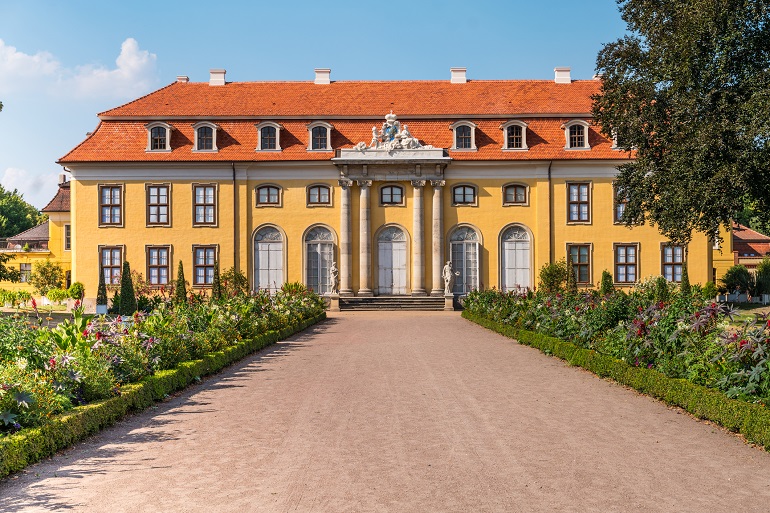
Großkühnau Castle and Park: The Western Gateway
Großkühnau Castle and Park form the western boundary of the Garden Realm, completing the extensive cultural landscape that stretches between Dessau and Wörlitz. Built for Prince Albert of Anhalt-Dessau and completed in 1780, the castle was modestly referred to by its owner simply as the "house," reflecting its relatively understated character compared to some of the other palaces in the Garden Realm. The building was very modestly and solidly furnished at the time of its construction, with decorative painting found only in the Banqueting Hall on the first floor and no artistic ornamentation elsewhere in the house. This simplicity aligned with the practical, utilitarian aspects of Prince Franz's vision for the Garden Realm, demonstrating that not every structure needed to be elaborate to contribute to the overall landscape concept. Since January 1998, the house has served as the administrative headquarters of the Kulturstiftung DessauWörlitz (KsDW), continuing its functional role within the Garden Realm's contemporary management.
The park at Großkühnau features an elongated, narrow garden laid out along the southern shore of Lake Kühnau, with its artificial islands creating picturesque views and reflections. The landscape includes fruit tree orchards and a vineyard, continuing the Garden Realm's tradition of combining aesthetic beauty with practical agricultural production. A highlight of the grounds is the hilltop Weinberg-Schlösschen (Vineyard Mansion), a neoclassical structure reminiscent of Italian architecture that evokes the spirit of the Grand Tour that so inspired Prince Franz and his contemporaries. This architectural gem, along with other small-scale structures and sculptures distributed throughout the garden, creates visual focal points and enhances the garden's overall sense of harmony. Together, the castle and its surrounding park at Großkühnau serve as a worthy conclusion to the Dessau-Wörlitz Garden Realm, embodying the prince's vision of integrating art, nature, and practical utility.
Getting There
The Dessau-Wörlitz Garden Realm is easily accessible via several transport options. From Dessau, you can take the hourly line 304 bus from Dessau Krötenhof to Wörlitz, Neue Reihe, which takes approximately 22 minutes. Alternatively, the Stadtwerke Dessau operates a train service from Dessau Hauptbahnhof to Wörlitz every four hours, with a journey time of 35 minutes. During the summer season (late March to late October), the historic Dessau-Wörlitzer Eisenbahn runs panoramic double-deck railbuses connecting Dessau main station with Wörlitz, offering a scenic journey for €5 one-way (€3.50 reduced) or €20 for a family day ticket. If you prefer to drive, the Garden Realm is about 18 km from Dessau, taking approximately 17 minutes and costing €3-5 in fuel. Visitors arriving from further afield can take the A9 motorway to either the Dessau Ost exit (for Oranienbaum and then Wörlitz) or the Vockerode exit with direct access to Wörlitz. Cycling enthusiasts will enjoy the 17 km bike path from Dessau Station through the beautiful Elbe floodplain landscapes.
Best Time to Visit
The best time to visit the Dessau-Wörlitz Garden Realm is from April to October, when the gardens are in full bloom and most attractions are open. During this period, visitors can enjoy gondola rides on Lake Wörlitz and the surrounding canals, with services running daily from 10:00 to 17:00 (11:00 to 15:00 in April and October). The palaces and castles within the Garden Realm are also open to the public during these months, typically from 10:00 to 18:00 (17:00 in April and October). Spring offers a magnificent display of blooming flowers, including carpets of purple crocuses in Park Wörlitz, whilst summer provides perfect weather for picnics and leisurely strolls. Autumn brings stunning foliage colours, making it an equally appealing time to visit. For those interested in special events, the Garden Realm hosts various festivals and concerts throughout the season, such as the Frühlingserwachen in spring and the Gartenreichsommer lake concerts from May to August.
| Travel destinations in Saxony-Anhalt | ||||||||||||||
|---|---|---|---|---|---|---|---|---|---|---|---|---|---|---|
|
|
|
|
| ||||||||||
|
|
|
|
| ||||||||||
|
|
|
| |||||||||||