



| Contents |
|---|
Introduction
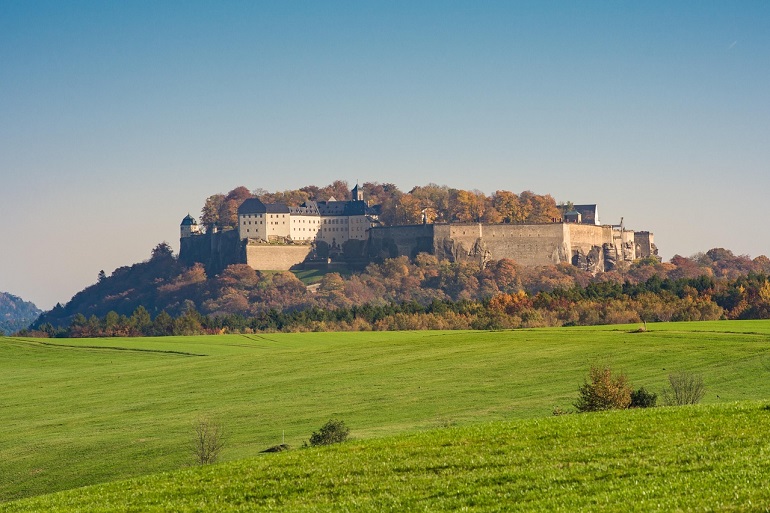
Königstein Fortress is a large hilltop fortification situated on a 9.5-hectare rock plateau, 240 metres above the River Elbe in the Saxon Switzerland region of Germany. The complex is enclosed by a 1,800-metre-long rampart with sandstone walls that stand up to 42 metres high. Within these walls are more than 50 buildings, some of which are over 400 years old, representing various architectural styles including late Gothic, Renaissance, and Baroque. Historically, the fortress served as a state prison, a place of refuge for Saxon monarchs during periods of political instability, and a secure location for storing state treasures and art collections from Dresden. It also contains the second-deepest castle well in Europe, which descends 152.5 metres into the rock.
Interesting Facts about Königstein Fortress
- Königstein Fortress crowns a 9.5-hectare sandstone plateau rising about 240 metres above the Elbe, making it one of Europe’s largest hilltop fortifications.
- The ramparts run roughly 1,800 metres with walls up to 42 metres high, encircling more than 50 historic buildings on the summit.
- Its 152.5-metre well is the deepest in Saxony and among the deepest castle wells in Europe, ensuring water security during sieges.
- First recorded in 1233 under Bohemian rule, the site’s name derives from the Latin in lapide regis, “on the king’s rock,” attested in 1241.
- Elector Christian I transformed the site into a modern bastioned fortress from 1589, reshaping it into the “Saxon Bastille” seen today.
- Despite its fearsome reputation, the fortress was never conquered and seldom saw direct combat, serving more as a secure refuge and symbol of power.
- For centuries it functioned as a dreaded state prison, with the Georgenburg later housing Saxony’s most infamous inmates.
- During crises such as 1756 and 1813, Saxon state treasures and Dresden art collections were sheltered within its casemates.
- In both World Wars, Königstein was used to hold prisoners of war and to safeguard priceless artworks from air raids.
- The fortress includes Germany’s oldest preserved barracks and extensive casemates, reflecting continuous upgrades to meet changing military needs.
- A legendary ascent occurred in 1848 when chimney sweep Sebastian Abratzky free-climbed the sheer sandstone walls, giving his name to the Abratzky Chimney route.
- The stronghold permanently passed to Saxony with the 1459 Treaty of Eger and later became the only Saxon fortress retained after 1815.
- By 1913 its military status was abolished, paving the way for its modern role as a museum and major tourist attraction in Saxon Switzerland.
- The plateau’s commanding position gave Saxony control over Elbe River traffic and a sweeping panorama across the Elbe Sandstone Mountains.
- Today, Königstein draws hundreds of thousands of visitors annually, offering exhibitions such as In Lapide Regis and year-round access on the clifftop site.
History
Dating back nearly eight centuries, the Königstein Fortress first appeared in historical records in 1233 when King Wenceslas I of Bohemia mentioned a "Burgrave Gebhard vom Stein" in an official document. The location was initially known by its Latin name "Lapis regis" (King's Rock) in 1241, reflecting its strategic importance as a Bohemian stronghold controlling the crucial Elbe River trade route from Bohemia. Originally belonging to the Kingdom of Bohemia, the medieval castle remained under Bohemian control until the early 15th century when it passed to the Saxon rulers of the House of Wettin, becoming permanently part of Saxony with the Treaty of Eger in 1459.
The transformation from medieval castle to impregnable fortress began in earnest during the late 16th century under Elector Christian I of Saxony. Between 1589 and 1591/97, Christian I initiated comprehensive reconstruction that would establish Königstein as the strongest fortification in Saxony. This period saw the construction of numerous essential structures including the Gatehouse, the Old Barracks, and the Christiansburg, whilst the jagged hilltop was enclosed with formidable high walls. A remarkable engineering feat was completed between 1563 and 1569 when workers bored a 152.5-metre deep well directly into the rock, solving the fortress's water supply challenges that had previously relied on cisterns and rainwater collection. The fortress underwent three major construction phases, with subsequent developments from 1619-1681 adding the John George Bastion, and final improvements from 1694-1756 completing the complex. During the reign of Augustus the Strong, the fortress gained notoriety for housing the world's largest wine barrel, constructed between 1722-1725 with a capacity of 249,838 litres, though it was eventually removed in 1818 due to deterioration.
Throughout its storied history, Königstein Fortress served multiple functions that reflected the changing needs of Saxon society. The Saxon Dukes and Prince-Electors primarily utilised it as a secure refuge during wartime, a hunting lodge, and a country retreat, taking advantage of its reputation as an unconquerable stronghold. Between 1591 and 1922, the fortress operated as Saxony's state prison, housing notable political prisoners including the Russian revolutionary Mikhail Bakunin. During both World Wars, it functioned as a prisoner of war camp, with French prisoners held there during the Franco-Prussian War (1870-1871) and again during the World Wars. The fortress's military significance diminished with the development of long-range artillery in the 19th century, leading to the abolition of its fortress status by the German Reichstag in 1913. Despite never being conquered by enemy forces, the fortress witnessed one remarkable breach in 1848 when chimney sweep Sebastian Abratzky successfully scaled its vertical sandstone walls, giving his name to a climbing route that remains popular today. After German reunification in 1991, Königstein Fortress became the property of the Free State of Saxony and now operates as a museum and cultural venue, preserving its rich heritage across 9.5 hectares of historical military architecture.
Description
Perched atop a rugged sandstone plateau overlooking the Elbe Valley, Königstein Fortress unfolds as one of Europe's most extensive hilltop strongholds. Encompassing nearly ten hectares of commanding ramparts, elegant bastions and more than fifty distinct structures, the site is a testament to the marriage of stone fortification and dramatic natural scenery. From soaring towers to subterranean chambers, each corner offers an immersive experience that blends architectural grandeur with the splendour of Saxon Switzerland's landscape. Beyond its formidable defences, the fortress has evolved into a vibrant cultural destination, presenting immersive exhibitions, theatre performances and themed culinary events within its historic walls. Visitors can savour panoramic vistas, delve into atmospheric casemates and enjoy a remarkable journey through space, rather than time.
Overview and Setting
Dominating a flat-topped hill roughly 240 metres above the Elbe River, the fortress plateau spreads across 9.5 hectares crowned by a continuous curtain of stone walls that stretch for an impressive 1.8 kilometres in circumference. These defences, reaching heights of up to 42 metres where the cliffs drop steeply, form an almost unbroken perimeter that echoes the natural contours of the rock. The fortress commands an area equivalent to thirteen football pitches, creating a veritable city in the sky that seems to emerge organically from the sandstone formations themselves.
Upon arrival at the plateau—whether via the year-round lift or the panoramic lift that operates seasonally—visitors step into an ensemble of barracks, armouries, watchtowers and pleasure pavilions, each carefully arranged to optimise both defence and habitation. The seamless fusion of natural outcroppings and sculpted stonework creates a unique atmosphere in which every parapet and bastion feels both organic and intensely purposeful. As a visitor moves from courtyard to courtyard, the interplay of rugged cliff faces and refined architecture instils a sense of awe and discovery.
The fortress's elevated position offers breathtaking 360-degree panoramic views across Saxon Switzerland National Park, stretching eastward towards the Ore Mountains and northward in the direction of Dresden. The 1.7-kilometre panorama trail that runs along the fortress walls provides multiple vantage points from which to absorb these sweeping vistas, with the meandering Elbe River threading through verdant valleys far below.
Architectural Evolution and Layout
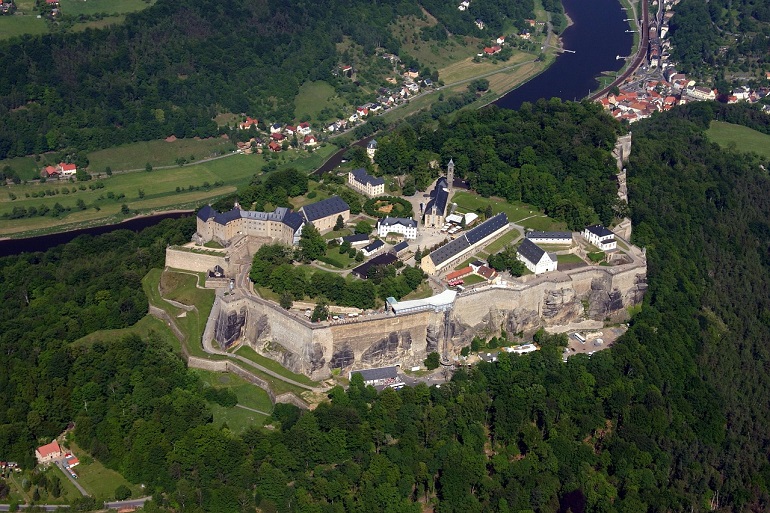
The fortress's layout reflects over eight centuries of continuous development, from its medieval origins as a modest Bohemian outpost to its transformation into Saxony's most impregnable stronghold. The architectural ensemble represents a remarkable synthesis of late Gothic, Renaissance, Baroque and 19th-century military engineering, creating a layered narrative written in stone across the plateau.
The fortress's layout is shaped by the elongated plateau atop the Königstein table hill, where defensive structures wrap like a protective belt around the edge. Radiating from a central open courtyard, a series of longitudinal barracks and casemate buildings extend along the north and south flanks, their arched façades providing covered walkways and strategic firing positions. These structures demonstrate the evolution from medieval castle architecture to modern fortress design, with thick walls pierced by carefully positioned gun ports and embrasures.
To the west, the monumental Gate House offers the principal entrance, its heavy portcullis and flanking machicolations a reminder of the fortress's martial pedigree. The gatehouse complex includes multiple defensive barriers, guardrooms and sally ports, designed to channel and control any assault on the fortress. On the eastern side, the bastion walls project outward in angular formations to cover potential approaches, creating interlocking fields of fire that would have made any frontal assault virtually impossible.
Throughout the complex, vaulted corridors and covered passages connect the principal structures, offering sheltered transit between storehouses, magazines and observation posts. This arrangement not only heightens the fortress's impregnability but also guides the visitor along a carefully choreographed journey from one vantage point to the next. The underground casemate system extends beneath much of the plateau, creating a hidden world of storage chambers, troop shelters and defensive positions carved directly into the living rock.
Key Architectural Features
The sprawling ensemble of defence works, residential quarters and utility buildings harbours a number of landmark features that reward exploration. Each of these components has been preserved or sensitively restored, ensuring that visitors can appreciate both the solidity of the medieval masonry and the refinement of later Baroque and Renaissance interventions.
Friedrichsburg Tower
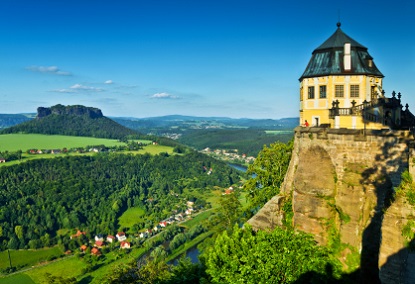
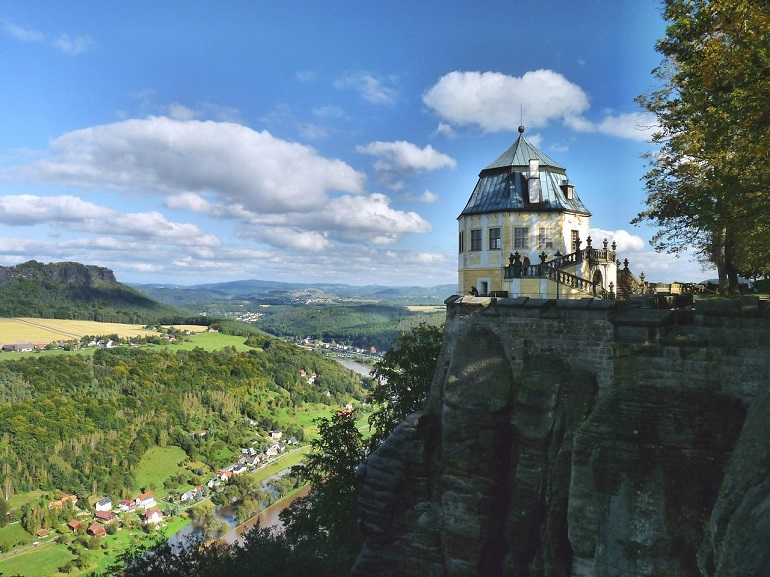
Perched on the precipitous eastern edge, Friedrichsburg Tower stands as the fortress's most iconic silhouette. Its distinctive yellow-painted walls and verdigris-tiled roof contrast vividly with the grey stone ramparts, while multiple windows afford sweeping views of the Elbe Valley and the wooded hills beyond. Originally conceived as a flanking watchtower during the late 16th century expansion, it now serves as a panoramic platform where visitors can experience the full drama of the fortress's clifftop position.
The tower's polygonal design represents sophisticated Renaissance military architecture, with its angled walls designed to deflect cannon fire whilst maximising observation capabilities. Climbing its circular stairway reveals successive vantage points, each offering a broader vista than the last, and at the top the sense of exposure is thrilling, with the valley floor seemingly suspended below one's feet. The tower also houses historical displays that illuminate the challenges of garrison life and the strategic importance of maintaining constant vigilance over the Elbe trade routes.
The Deep Well
At the heart of the plateau, the fortress's deep well plunges some 152.5 metres into the living rock, securing a vital water supply that remains one of the most remarkable engineering feats on site. This extraordinary shaft, bored between 1563 and 1569, ranks as the deepest well in Saxony and the second-deepest well in Europe, representing a triumph of Renaissance engineering that ensured the fortress's independence during prolonged sieges.
Visitors can peer down into the well shaft from a protected viewing gallery, sensing the full depth as the sunlight fades into the abyss. The well's construction required the removal of approximately eight cubic metres of water daily as workers descended ever deeper into the sandstone, using primitive tools and techniques that make the achievement all the more remarkable. Surrounding the well house, the original stone paving and carved rock face are preserved, while explanatory panels recount the painstaking labour required to bore through the sandstone without modern machinery.
The experience of standing beside this yawning chasm is both humbling and exhilarating, underscoring the ingenuity that once sustained the fortress under siege. The well continues to function today, its crystal-clear water demonstrating the enduring quality of the original engineering work.
Ramparts and Defensive Walls
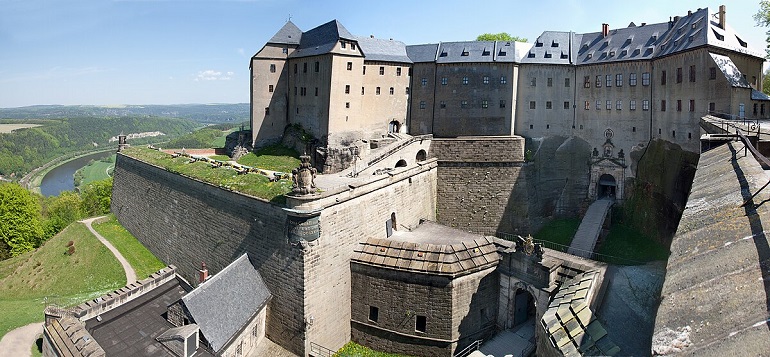
Encircling the high plateau, the ramparts and bastions present an unbroken defensive ring, their crenellated parapets and arrow slits offering both dramatic viewpoints and a palpable sense of martial readiness. These walls, rising in places to heights of 42 metres above the surrounding terrain, create one of Europe's most impressive examples of integrated cliff-face fortification.
A panorama walk along the parapet leads visitors over stone bridges and around angular bastion points, each designed to command the surrounding landscape. The ramparts incorporate both natural sandstone outcroppings and carefully dressed masonry, creating a defensive barrier that appears to grow from the rock itself. At no point is the sheer height of the walls more evident than where they rise directly from the cliff's edge, plunging into forest below.
The defensive system includes multiple battery ramparts constructed between 1870 and 1895, featuring eight firing points designed to provide all-round defence for the fortress. These late 19th-century additions represent the final phase of the fortress's military development, incorporating the latest advances in artillery technology. The ramparts also shelter gardens and grassy terraces, where flowering beds soften the otherwise austere stonework, creating secluded alcoves for reflection.
Casemates and Underground Chambers
Beneath the main thoroughfares lie the casemates and underground chambers, accessible via narrow staircases and arched entrances. These vaulted corridors once stored ammunition, housed troops and served as protective shelters during bombardment. The casemate system extends throughout much of the fortress, creating a hidden subterranean city that could accommodate the entire garrison during times of crisis.
Today, these atmospheric spaces host immersive displays that highlight the conditions of garrison life, with restored wooden supports and ambient lighting conveying the sense of subterranean enclosure. Visitors encounter authentic cannon emplacements, reinforced embrasures and stone-carved wall markings made by centuries-old stonemasons. The contrast between the bright open courtyards above and the cool, dimly lit corridors below lends each descent a palpable shift in atmosphere.
The casemates also served as secure storage for Saxony's state treasures and archival materials during times of conflict. During the Seven Years' War and again during the Napoleonic conflicts, Dresden's most precious art treasures found sanctuary within these stone chambers, demonstrating the fortress's role as a cultural as well as military stronghold.
Magdalenenburg and Christian's Pavilion
Towards the northern slope, the Renaissance-style Magdalenenburg and the adjoining Christian's Pavilion introduce an element of courtly elegance to the otherwise martial environment. With its refined façade, mullioned windows and ornamental stucco work, the Magdalenenburg provided a pleasure retreat away from the rigours of garrison duty, serving as a maison de plaisance where Saxon rulers could enjoy the fortress's spectacular setting in comfort.
Christian's Pavilion, an octagonal structure linked to both banquet halls and defensive artillery positions, features a soaring hall of mirrors and an ingenious rising table mechanism that once served royal banquets. This remarkable piece of Renaissance engineering allowed elaborate meals to be hoisted from kitchens below, emerging through the floor to delight royal guests. The pavilion's design ingeniously combines defensive capability with courtly sophistication, its observation windows doubling as gun ports when necessary.
The Magdalenenburg also housed one of history's most extraordinary vinicultural achievements: between 1722 and 1725, coopers working under the porcelain manufacturer Böttger constructed the enormous Königstein Wine Barrel, with a capacity of 249,838 litres, making it the largest wine barrel in the world. Though removed in 1818 due to deterioration, this massive vessel represented the heights of Saxon courtly excess under Augustus the Strong.
The delicate proportions and decorative detailing of these buildings form a striking counterpoint to the fortress's otherwise martial character, reminding visitors that Königstein served not only as a defensive stronghold but also as a royal retreat where the Saxon court could enjoy both security and refinement.
Historical Buildings and Architectural Gems
The Castle Chapel
The castle chapel, dating from the turn of the 13th century, represents the oldest surviving structure within the fortress complex. This modest Romanesque building predates the major military expansions and provides a tangible link to the fortress's medieval origins as a Bohemian border castle. Its simple stone construction and intimate proportions offer a marked contrast to the grander structures that followed, whilst its continued use for worship throughout the centuries demonstrates the spiritual life that persisted alongside military concerns.
Old and New Barracks
The Old Barracks (Alte Kaserne), constructed during the initial fortress expansion between 1589 and 1597, exemplify the practical architecture required for housing large garrison forces. These substantial stone structures feature thick walls, small windows for defence, and vaulted cellars for storage. The buildings were expanded during the third construction period (1694-1756) to accommodate growing military requirements.
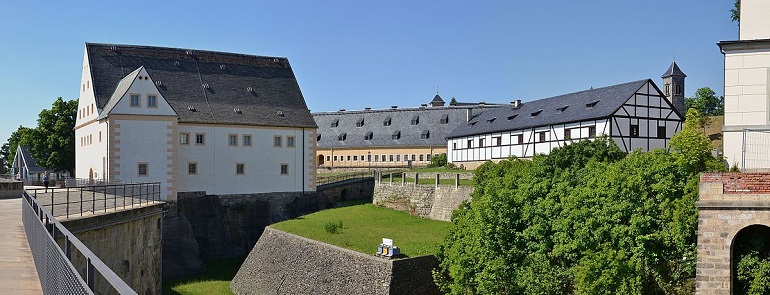
The New Armoury (Neues Zeughaus), originally built in 1631 as St. John's Hall (Johannissaal) and converted for military use in 1816, demonstrates the fortress's ability to adapt existing structures for changing needs. This building now houses extensive displays of historical weaponry and military equipment, its soaring interior spaces providing an impressive setting for cannon and small arms collections.
The Treasury
Constructed between 1854 and 1855, the Treasury (Schatzhaus) represents one of the fortress's final major building projects. This purpose-built structure was designed to house Saxony's state reserves and precious documents, with specially reinforced walls and secure storage chambers. Its 19th-century architecture reflects contemporary advances in security design whilst maintaining harmony with the fortress's overall architectural character.
Gardens and Natural Spaces
Despite its martial character, Königstein Fortress incorporates significant green spaces that soften its stone severity and provide peaceful retreats within the defensive walls. The fortress gardens feature carefully maintained flower beds, ornamental plantings and mature trees that create seasonal displays of colour against the grey stone backdrop.
The fortress forest occupies portions of the plateau where buildings are absent, providing habitat for local wildlife and creating natural windbreaks that moderate the exposed hilltop's harsh climate. Walking paths wind through these wooded areas, offering shaded alternatives to the sun-exposed rampart walks whilst maintaining the sense of enclosure and security that defines the fortress experience.
These landscaped areas demonstrate that even the most practical military installations required beauty and tranquillity to sustain the human spirit during long periods of isolation. The gardens also served practical purposes, providing fresh vegetables and herbs for the garrison whilst creating pleasant recreational spaces for off-duty soldiers and visiting dignitaries.
Exhibitions and Cultural Programming
Scattered across the plateau are over a dozen thematic exhibition spaces that bring the fortress's various functions to life. In former officer messes and barrack rooms, interactive stations for both adults and children invite hands-on engagement, from loading replica muskets to deciphering period maps. These displays utilise the authentic architectural settings to maximum effect, with original stone walls, vaulted ceilings and narrow windows creating atmospheric backdrops for historical interpretation.
The former armoury displays an extensive array of authentic artillery pieces and small arms, arranged beneath barrel-vaulted ceilings to evoke the weight of military preparedness. Period cannon from various eras demonstrate the evolution of artillery technology, whilst displays of muskets, pistols and edged weapons illustrate the personal armament carried by fortress defenders.
Temporary galleries rotate special exhibitions on topics ranging from porcelain manufacture (reflecting Böttger's pioneering work at the fortress) to the art of fortification design. These changing displays ensure that return visitors encounter fresh perspectives on the fortress's multifaceted history, whilst themed exhibitions often coincide with seasonal events or historical anniversaries.
Dedicated venues host theatrical reenactments and musical performances that exploit the fortress's natural acoustics and dramatic settings. The courtyard spaces and vaulted chambers provide atmospheric venues for everything from medieval music concerts to historical drama, with the authentic surroundings adding immeasurable atmosphere to these cultural presentations.
Visitor Experience and Accessibility
Königstein Fortress has been carefully adapted for modern comfort without diminishing its historic ambience. Multiple lift systems ensure accessibility for visitors of all mobility levels, with the main passenger lift and seasonal panoramic lift transporting guests effortlessly from the valley floor to the plateau. These systems eliminate the challenging climb that once restricted access to the fortress whilst preserving the dramatic transition from valley to summit.
Well-marked signposts and interpretive panels guide visitors through a suggested circular route that encompasses all major features whilst allowing for individual exploration and discovery. The fortress management has developed multiple touring options, from quick overview visits to comprehensive full-day explorations, ensuring that visitors with varying time constraints and interests can enjoy meaningful encounters with the site.
Seating areas and sheltered nooks are positioned throughout the complex, offering rest and contemplation points that take advantage of particularly spectacular views or architecturally significant spaces. These rest stops often include interpretive materials that provide context for the surrounding features, encouraging visitors to pause and absorb the fortress's complex history.
An audio guide system, available in multiple languages, supplements on-site interpretation panels with vivid storytelling and period accounts that bring the fortress's history to life. Professional guided tours depart regularly from the central courtyard, led by knowledgeable interpreters who can adapt their presentations to group interests and provide insights unavailable through self-guided exploration.
Educational programmes cater specifically to school groups and families, with age-appropriate activities that encourage active learning through exploration, role-playing and hands-on experiences. These programmes often utilise the fortress's dramatic setting to maximum pedagogical effect, helping young visitors understand historical concepts through direct engagement with authentic spaces and artifacts.
Both restrooms and luggage lockers are discreetly integrated into former storehouses and service buildings, ensuring modern conveniences without compromising the architectural integrity of the fortress. Additional amenities include baby-changing facilities, wheelchair-accessible pathways and emergency medical stations, reflecting the site's commitment to inclusive tourism whilst maintaining its historical character.
Culinary Experiences and Dining
Within the fortress walls, an impressive selection of dining establishments caters to various tastes whilst exploiting the unique atmospheric potential of the historic buildings. Each venue offers a different culinary philosophy and ambience, from refined regional cuisine to hearty traditional fare, all served within authentically restored historical spaces.
The panoramic restaurant, housed within the former officers' mess hall, serves sophisticated Saxon specialities against breathtaking views of forested slopes and distant mountains. Large windows frame the Elbe Valley landscape, whilst the restaurant's elevated position creates a sense of dining amongst the clouds. The menu emphasises regional ingredients and traditional preparation methods, offering visitors an authentic taste of Saxon cuisine in an unparalleled setting.
In the atmospheric casemates beneath the ramparts, the adventure restaurant provides a dramatically different dining experience within the fortress's underground chambers. Candlelit tables occupy spaces once used for ammunition storage, with vaulted stone ceilings and thick walls creating an intimate, almost medieval atmosphere. The themed menus often reflect historical periods, with dishes prepared using traditional recipes and techniques.
The historical tavern, styled as "Zum Musketier", focuses on hearty, rustic fare that would have sustained garrison troops throughout the centuries. This establishment occupies a former guardhouse and emphasises local brewing traditions, offering regional beers and robust meals designed for sharing. The tavern's atmosphere evokes the camaraderie of military life whilst providing modern comfort and quality.
For lighter refreshments and artisanal baked goods, the fortress bakery announces fresh loaves and pastries each morning, using traditional ovens that add authentic flavours to bread, rolls and seasonal specialities. Visitors can often observe baking demonstrations and participate in workshops that teach traditional techniques.
The panoramic beer garden, constructed atop one of the fortress's projecting bastions, offers the ultimate alfresco dining experience. Open during favourable weather, this elevated terrace provides 360-degree views whilst serving light meals, local beers and refreshing beverages. The setting sun viewed from this vantage point creates particularly memorable dining experiences, with the lights of distant Dresden beginning to twinkle as darkness falls.
Family-Oriented Features and Activities
Königstein Fortress delights younger visitors with a comprehensive suite of interactive offerings specifically tailored to families and educational groups. The fortress management recognises that engaging children with history requires active participation rather than passive observation, and has developed programming that transforms the historical site into an adventure playground whilst maintaining respect for its heritage value.
Special audio-guide tracks for children lead them on treasure-hunt style quests throughout the fortress, with age-appropriate narration that emphasises adventure, mystery and discovery. These guides often incorporate fictional characters from different historical periods who serve as companions during the exploration, making the experience more relatable and engaging for young minds.
Costume corners throughout the fortress allow little explorers to don period attire for photographs and role-playing. These dress-up stations feature child-sized versions of medieval clothing, military uniforms and court dress, enabling young visitors to literally step into history whilst creating memorable photographs for family albums.
Hands-on workshops teach traditional crafts such as masonry carving, medieval cooking techniques, and basic blacksmithing skills. These activities, led by skilled artisans and historical interpreters, provide tactile learning experiences that help children understand how people lived and worked within the fortress. The workshops often culminate in take-home projects that extend the educational experience beyond the visit.
Seasonal events throughout the year transform the fortress into a venue for family celebrations, ranging from Easter egg hunts that utilise the fortress's hidden chambers and secret passages to lantern-lit evening tours that reveal the site's more mysterious aspects. Winter celebrations often include traditional Christmas markets within the courtyards, whilst summer programming features outdoor performances and festivals.
Interactive discovery stations scattered throughout the fortress invite families to engage with history through games, puzzles and hands-on demonstrations. These stations often utilise replica artifacts that children can handle safely, providing tactile connections to historical periods that pure observation cannot achieve.
The combination of tactile experiences, costumed interpreters and immersive storytelling ensures that history becomes a vibrant, multi-sensory adventure for all ages. The fortress serves as a three-dimensional textbook where children can explore, discover and learn through direct engagement with authentic historical spaces.
Cultural and Event Programming
Throughout the year, Königstein Fortress serves as a venue for an impressive calendar of cultural events that exploit its dramatic setting and historical significance. These programmes range from intimate chamber music concerts in restored halls to large-scale outdoor festivals that fill the courtyards with thousands of visitors.
Historical reenactments represent some of the fortress's most popular special events, with costumed interpreters recreating specific moments from Saxon history. These performances often focus on pivotal events such as royal visits, military ceremonies or daily life during various historical periods. The authentic architectural settings provide unparalleled backdrops for these living history presentations.
Musical performances take advantage of the fortress's exceptional acoustics, particularly within the vaulted chambers and enclosed courtyards. Classical concerts often feature period instruments and repertoire appropriate to the fortress's various historical phases, whilst contemporary performances create interesting juxtapositions between ancient stones and modern artistic expression.
Art exhibitions utilise both indoor galleries and outdoor courtyards to display works that relate to themes of fortification, military history, royal court culture or regional artistic traditions. Temporary installations often incorporate the fortress's dramatic architecture as integral elements, creating site-specific works that could exist nowhere else.
Educational symposiums and academic conferences attract scholars and enthusiasts interested in castle architecture, military history and heritage preservation. These events often provide opportunities for visitors to meet leading experts and gain access to research findings that inform ongoing restoration and interpretation efforts.
Seasonal festivals celebrate traditional Saxon holidays and customs within the fortress walls, creating opportunities for visitors to experience historical celebrations in their authentic settings. These events often include traditional music, dance, cuisine and crafts that demonstrate cultural continuity from medieval times to the present.
Getting There
By train Travellers can reach Königstein Fortress by taking a train to Königstein station, which lies on the Dresden–Prague rail route; from there, it’s a pleasant walk of around 2 kilometres through the scenic town and up to the fortress.
By coach or bus Several regional bus services connect Dresden and neighbouring towns directly with Königstein, with stops near the fortress; this option is ideal for visitors looking for a straightforward journey without transfers or for those who wish to avoid the uphill walk from the train station.
By car Visitors arriving by car can follow the signs to Königstein from Dresden or the A17 motorway, with ample parking available at the foot of the fortress; from the car park, a short ascent via shuttle bus or on foot will deliver guests right to the entrance.
Best Time to Visit
The best time to visit Königstein Fortress is during the spring (late April to May) or autumn months, when you'll encounter fewer crowds and enjoy more comfortable weather conditions. Whilst the fortress remains open year-round from 9am to 5pm (extended to 6pm from April to October), summer months tend to be particularly busy with day-trippers from Dresden, making it nearly as crowded as the famous Neuschwanstein Castle. Spring offers the added benefit of wildflower-filled meadows and excellent hiking conditions in the surrounding Saxon Switzerland National Park, whilst autumn provides crisp, clear days perfect for appreciating the panoramic views from the fortress walls overlooking the Elbe Valley. For the best experience, arrive at opening time (9am) to beat the crowds, as visitor numbers typically increase significantly after 10am, particularly during peak season.