



| Contents |
|---|
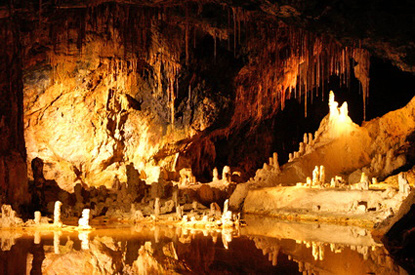
Fairy Grottoes, Saalfeld.
Introduction
The historical town of Saalfeld (pop. 29,000) is situated on the Saale River about 48km south of Weimar and just north of the Thuringian Highland. Documented since 899, Saalfeld is among Thuringia’s older towns and retains a compact, walkable historic centre within medieval walls. It is especially known for its Feengrotten (Fairy Grottoes), 1.5 km out of town, listed by the Guinness Book of Records as the world's most colourful grottoes.
Interesting Facts about Saalfeld
- Saalfeld, officially Saalfeld/Saale, is one of Thuringia’s oldest towns, first recorded in 899 and likely founded around a Thuringii fortress known as Hoher Schwarm or Sorbenburg.
- The town is famed for the Saalfelder Feengrotten (Fairy Grottoes), celebrated as exceptionally colourful show caves formed in former alum slate mines.
- Saalfeld served as a residence of the Saxe-Coburg-Saalfeld line of the House of Wettin, with Saalfeld Castle (on the site of a Benedictine abbey) housing the ducal court from the late 17th century.
- On 10 October 1806, the Battle of Saalfeld saw Prince Louis Ferdinand of Prussia killed in action against Napoleon’s forces under Marshal Lannes.
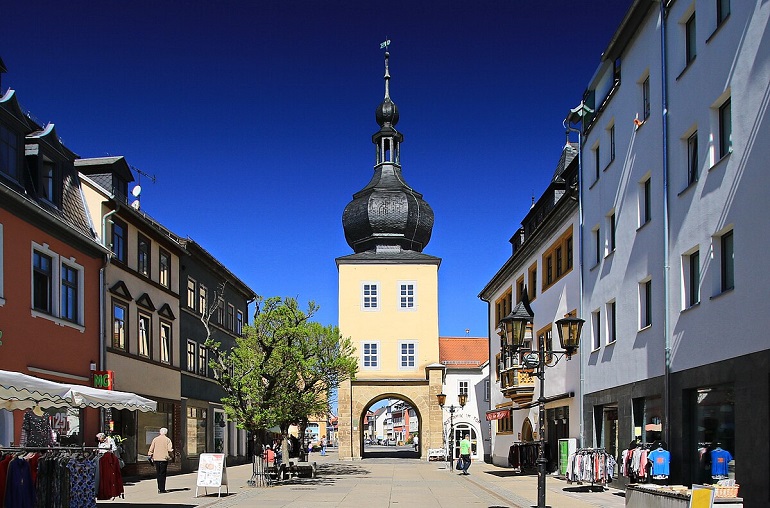
- Parts of Saalfeld’s medieval fortifications survive, including town walls, bastions and historic gates like the Darrtor, which offers panoramic views over the old town and surrounding hills.
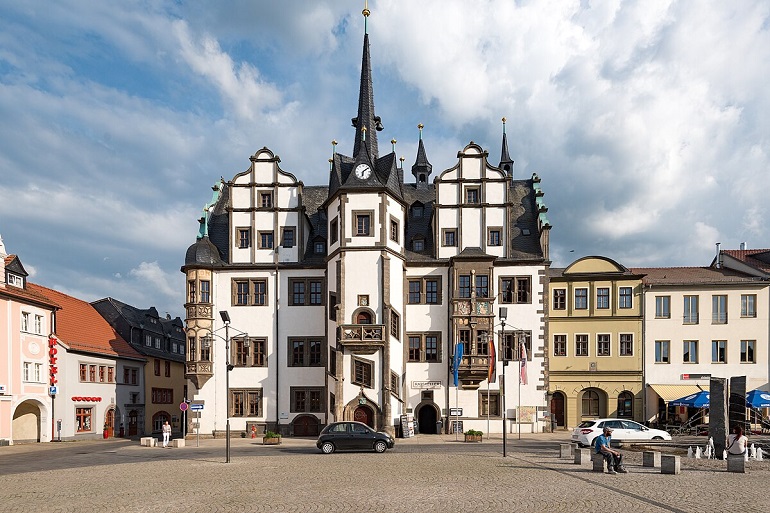
- The Renaissance Town Hall (1537) and the Gothic St John’s Church (completed 1514) reflect the town’s prosperity under the Wettin rulers and its rich architectural heritage.
- Saalfeld’s economy historically revolved around silver mining and Saale River transport, later diversifying into machinery, hosiery, chocolate, and brewing.
- As a key rail junction, Saalfeld retained steam operations longer than West Germany, becoming a magnet for railway enthusiasts during the GDR era.
- Together with Rudolstadt and Bad Blankenburg, Saalfeld forms a small tri-city area of roughly 70,000 people in the scenic Saale valley.
- Nicknamed the “Stone Chronicle of Thuringia,” Saalfeld’s compact centre features the Hoher Schwarm castle ruins, four city gates, and a museum in a former Franciscan monastery.
History
Medieval Origins and Early Development
Saalfeld stands as one of Thuringia's most historic towns, earning its nickname as the "Stone Chronicle of Thuringia" through over eleven centuries of remarkable history. The settlement's origins trace back to the 7th century, possibly founded around a Thuringii (Gothic) fortress known as Hoher Schwarm or Sorbenburg. The town was first officially documented in 899 CE, marking its place amongst Germany's oldest urban centres. Following the establishment of the Holy Roman Empire, Saalfeld received significant imperial attention when Emperor Frederick Barbarossa ordered the layout of an Imperial city, with parts of its medieval walls and bastions preserved to this day. In 1071, Archbishop Anno II of Cologne established a Benedictine abbey here, which quickly became an ecclesiastical centre in eastern Thuringia before being destroyed during the German Peasants' War in 1526. A Franciscan monastery was also established around 1250, though it too was dissolved during the Protestant Reformation.
Wettin Dynasty and Renaissance Grandeur
The town's fortunes changed dramatically in 1389 when it was acquired by Landgrave Balthasar of Thuringia, a member of the House of Wettin. Under Wettin rule, Saalfeld's economy flourished through surrounding mines, transport on the River Saale, and fishing—elements reflected in the barbels featured in the town's coat of arms. The dynasty reached its zenith when all Wettin lands, including Thuringian estates, were incorporated into the Electorate of Saxony in 1423. Following several devastating blazes in the early 16th century, Saalfeld was magnificently rebuilt in lavish Renaissance style. In 1675, Duke Albert V of Saxe-Coburg chose the town as his residence, leading to the construction of Saalfeld Castle from 1677 onwards on the site of the destroyed Benedictine abbey. The castle served as home to four generations of the Saxe-Coburg-Saalfeld branch until 1825, when Saalfeld remained one of two capitals of the duchy alongside Coburg.
Modern Transformation and Strategic Importance
The town witnessed significant military action during the Napoleonic Wars when, on 10 October 1806, Prussian and Saxon forces met French troops under Marshal Jean Lannes at the Battle of Saalfeld, resulting in the death of Prince Louis Ferdinand of Prussia. The 19th century brought industrial development with the opening of the Leipzig-Probstzella railway, further boosting Saalfeld's importance as a transportation hub. After World War I, Saalfeld became part of the newly established Free State of Thuringia, and during World War II, as a railway junction and Wehrmacht garrison town from 1936, it was heavily affected by strategic bombing. The post-war division of Germany saw Saalfeld become an Inner-German border station on the Saal Railway, serving as the southern terminus of East German train services and becoming renowned amongst railway enthusiasts for its continued use of steam locomotives. The town's modern chapter began with German reunification, and recent municipal mergers in 2018 and 2019 incorporated surrounding communities including Saalfelder Höhe, Wittgendorf, Reichmannsdorf, and Schmiedefeld.
Main Attractions
Historic Old Town and Market Square
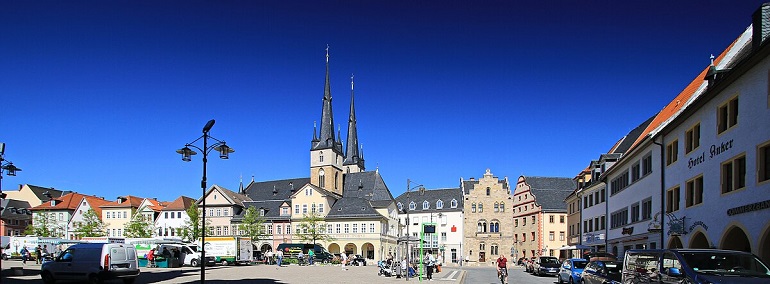
Historic Old Town and Market Square form the heart of Saalfeld’s preserved urban core. The market square is surrounded by gabled merchants’ houses, public buildings, and cobbled streets. This compact area is suited to exploration on foot, with guided walking tours typically lasting 90 minutes and covering the main civic, religious, and defensive sites in sequence. Key points include the town hall, St John’s Church, the Franciscan monastery remains, the four gates, and notable historic residences. The layout of the old town retains its medieval street plan, reflecting Saalfeld’s status as one of the oldest towns in Thuringia, first mentioned in 899.

Renaissance Town Hall (Rathaus Saalfeld)
Renaissance Town Hall (Rathaus Saalfeld) dominates the market square and is one of the town’s best-preserved civic buildings from the 16th century. Its current form reflects a rebuilding period after 1529, incorporating Renaissance design elements such as stepped gables and carved architectural details. The building has served as the seat of local administration for centuries and remains active in that role today. The exterior is visible at all times, while the interior is accessible during official openings or guided tours. The town hall is a focal point during market days and festivals, and it forms a central stop on walking routes that explore the city’s historic layers.
City Gates and Fortifications
City Gates and Fortifications represent the preserved parts of Saalfeld’s medieval defensive system, dating back to the 14th and 15th centuries. Four stone gate towers remain: the Darrtor, Blankenburger Tor, Oberes Tor, and Wetzelstor. These gates once controlled entry into the walled town and were linked by a defensive curtain wall and moat. Today, visitors can pass through these gates on foot or by road, and some offer elevated viewing points. The Darrtor in particular features an accessible parapet providing views over the Saale valley and towards the Thuringian Highland. The fortifications illustrate Saalfeld’s historical function as a defended settlement on important trade routes.
Hoher Schwarm Castle Ruins
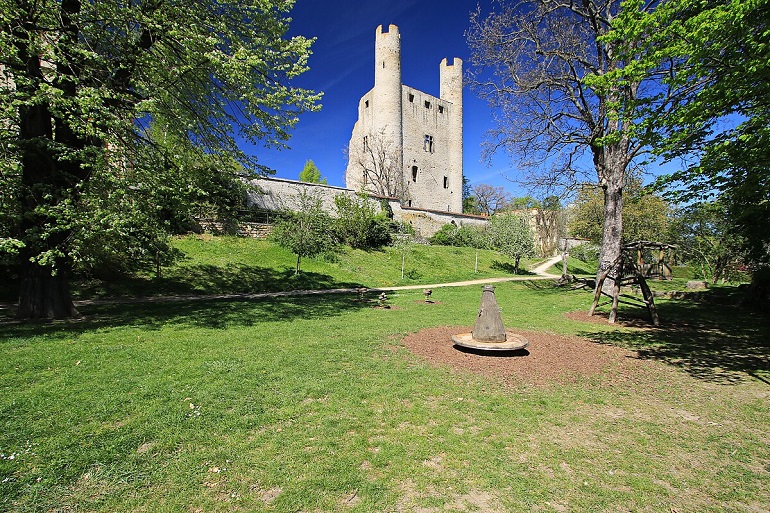
Hoher Schwarm Castle Ruins stand on elevated ground near the historic centre, visible from various points within Saalfeld. The remains consist mainly of sections of defensive stone walls and notable tall towers, reflecting the former scale of the medieval fortress. The castle’s origins date back to the 13th century, and it has been linked to both noble residence and defensive purposes, although it fell into disuse in later centuries. Access is by a short walk from the market square, and information boards on-site outline the history and architectural features. The location offers partial panoramic views over the old town and surrounding Saale valley, making it both a historic and visual landmark.
Saalfelder Feengrotten (Fairy Grottoes)
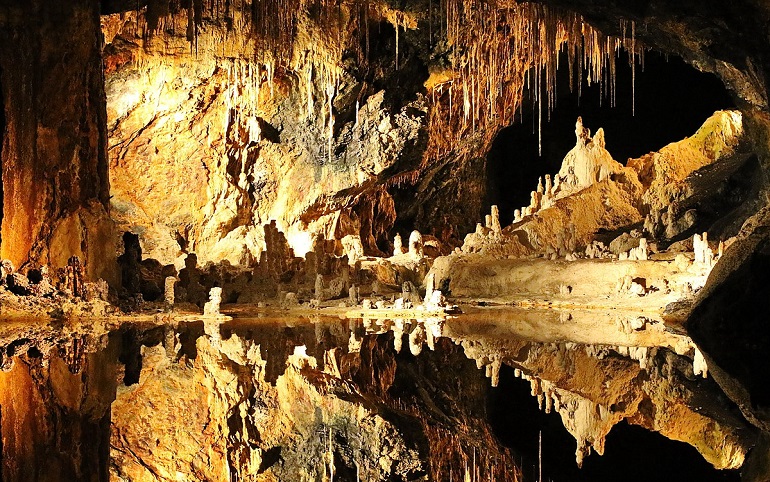
Saalfelder Feengrotten (Fairy Grottoes) are a redeveloped former alum shale mine whose mineral-rich waters have created unusually colourful stalactite and stalagmite formations. They have held a Guinness World Record since 1993 for being the “most colourful show grottoes in the world.” The site has been open to the public since 1914, following the rediscovery of the mine in 1910 and the discovery of its largest chamber, the Märchendom (“Fairy Kingdom”), in 1913. Guided tours take visitors through three main chambers while explaining the geological and mining history of the site. The wider complex includes a visitor centre with interpretive exhibits, an adventure area for children, and walking trails in the surrounding woodland. The temperature inside the grottoes stays around 8°C year-round, so visitors are advised to bring warm clothing.
Schloss & Park Saalfeld
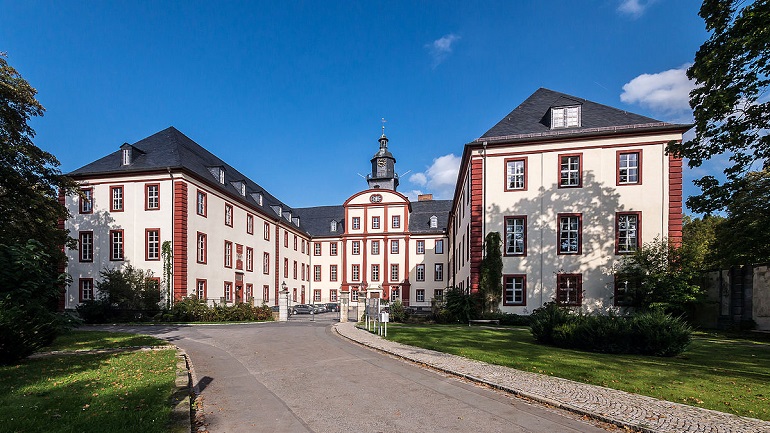
Schloss und Park Saalfeld comprise a Baroque residence complex with landscaped grounds linked to the former ducal seat of Sachsen-Saalfeld, developed mainly between the late 17th and early 18th centuries and later adapted for civic and cultural uses. The palace occupies a central plot near the old town and is characterised by a multi-wing layout around courtyards, with façades reflecting successive construction phases. The ensemble historically served administrative and residential functions for the duchy before passing through various state and municipal roles; today, it is used for events and public access to the surrounding park. The park features formal axes, mature trees, lawns, and paths that connect to the wider historic fabric, offering a green corridor within walking distance of the market square. Architectural details include stuccoed interiors in select sections and restrained exterior ornament typical of regional Baroque, while the grounds retain period structure despite later restorations.
Park und Villa Bergfried
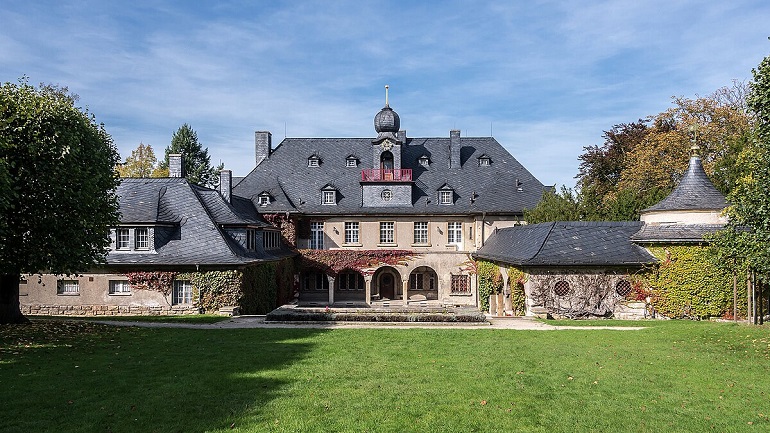
Park und Villa Bergfried is a landscaped park located a short walk from the town centre, surrounding a stately villa built in the early 20th century for an industrialist family. The park incorporates formal gardens, tree-lined avenues, and open lawns, making it a popular area for walking and relaxation. The villa itself is a striking example of period architecture and is occasionally used for cultural events and private functions. The grounds are freely accessible, while entry to the villa’s interior is restricted. The park plays a role in providing urban green space within Saalfeld’s otherwise compact historical setting.
St John’s Church (Johanneskirche)
St John’s Church (Johanneskirche) is the main parish church of Saalfeld and a prominent Gothic building whose construction dates to the late Middle Ages. It occupies a key site on the market square and has a tall tower visible across the town. The church reflects the town’s religious and civic history, with a layout and interior typical of Thuringian late-Gothic ecclesiastical architecture. Notable features include its ribbed vaulting, stained-glass windows, and historic organ. Regular services are held, and visitors can enter outside of service times to view the interior. The site is linked historically to the nearby Franciscan monastery and is included in most guided tours.
Top Museums
Stadtmuseum Saalfeld im Franziskanerkloster
The Saalfeld City Museum at the Franciscan Monastery stands as the town's premier cultural institution. Housed within a historic Franciscan monastery, the museum opened in 1904 and has since expanded to utilise the entire monastic complex for its displays. Spanning approximately 2,700 square metres, this museum offers visitors a comprehensive journey through Saalfeld's local history and cultural development.
The museum's setting within the medieval monastery buildings creates an atmospheric backdrop for its collections, combining architectural heritage with carefully curated exhibitions that chronicle the town's evolution through the centuries. The museum showcases various aspects of local history, providing insight into the daily life, traditions, and significant events that have shaped Saalfeld over the ages.
The Feengrotten Complex
One of Saalfeld's most remarkable attractions is the Feengrotten (Fairy Grottoes), which encompasses multiple interconnected museum experiences. This unique complex tells the fascinating story of centuries-old mining operations that began with miners searching for gold and silver but instead discovering valuable black alum shale.
The Underground Experience
The Feengrotten itself represents a remarkable transformation of industrial heritage into natural wonder. After the mine ceased operations around 1850, nature gradually transformed the abandoned caves into a colourful underground world. Guided tours reveal the intriguing history of the mine and provide fascinating glimpses into the lives of the miners who once laboured in these subterranean passages.
Grottoneum Museum
The Grottoneum serves as an interactive museum experience that engages all the senses. This innovative space allows visitors to read, learn, listen, touch, and even taste various exhibits at numerous information stations. The museum features interactive displays that demonstrate how light was brought into the mine, showcase the process of stalactite formation, and invite visitors to solve puzzles using coloured minerals. The grotto cinema provides a dramatic presentation of how these caves were formed 440 million years ago.
Feenweltchen Adventure World
Situated directly above the display mine, Feenweltchen creates a magical realm where elves, fairies, trolls, and forest spirits come to life. This adventure world appeals to visitors of all ages, offering an enchanting journey through a fairy-tale kingdom that culminates at the Fairy Tree-Top Castle.
Specialist Museums
Museum Rotschnabelnest
The Museum Rotschnabelnest represents another of Saalfeld's specialty museums, located on Goldgräberstraße. This institution contributes to the town's diverse museum landscape, though specific details about its collections and focus areas require further investigation.
Art and Culture
Saale-Galerie
The Saale-Galerie provides Saalfeld with its dedicated art gallery space. This venue focuses on artistic exhibitions and cultural presentations, offering visitors exposure to both contemporary and traditional artistic expressions.
Local Cuisine
Saalfeld serves up hearty Thuringian fare where grills smoke and potato aromas fill half-timbered streets: expect the region’s iconic Thüringer Rostbratwurst sizzling over charcoal, paired with glossy Thüringer Klöße (potato dumplings) that are hand-formed from a mix of raw and boiled potatoes for that springy bite. Classic mains lean meaty and rustic—think beer-marinated Rostbrätel (pork neck) with onions, braises like Sauerbraten, and venison in season—often matched with red cabbage and pan gravy for a proper Sunday plate. At markets and festivals, stands ladle out onion tarts and sheet-pan cakes alongside the beloved sausage, while traditional Gasthäuser around the old town keep recipes time-honoured but unfussy, letting the smoke, spice, and potatoes do the talking.
Getting There & Around
By train Saalfeld (Saale) is well connected on regional and long-distance rail, with direct and connecting services linking via Erfurt, Jena, Leipzig, Bamberg and Nuremberg, and onward ICE/IC connections across Germany; plan itineraries and live times with Deutsche Bahn’s planner or the DB Navigator app for the smoothest journey.
By coach or bus Long-distance coaches serve nearby Thuringian hubs such as Jena, Erfurt and Leipzig, from which regional trains or buses complete the short hop to Saalfeld; major operators like FlixBus run dense networks across Germany, making one-change itineraries straightforward.
By car Saalfeld sits just east of the A71/A73 corridor and is reached on good B-roads (notably the B85/B281) through the Thuringian Forest; approach from Erfurt via the A71 and regional routes, from Nuremberg/Bamberg via the A73 then B-roads, or from Leipzig via the A9 and cross-country connectors, with scenic drives and well-signed access into the town centre.


