| Contents |
|---|
Introduction
Wittenberg (pop. 45,500), officially Lutherstadt Wittenberg, is famous for being the birthplace of Martin Luther and of the Protestant Reformation. It is here that, in 1517, Luther wrote and nailed his 95 theses denouncing the abuses and corruption of the Roman Catholic Church. Many local attractions are associated with Martin Luther and Philipp Melanchthon, including the Castle Church, St Mary’s Church, the Lutherhaus and Melanchthonhaus, several of which are inscribed as UNESCO World Heritage.
Interesting Facts about Wittenberg
- Officially called Lutherstadt Wittenberg, the town is famed as the “cradle of the Reformation” due to its close association with Martin Luther.
- Luther is said to have nailed his 95 Theses to the doors of the Schlosskirche (All Saints’ Church) in 1517, a symbolic act that ignited the Protestant Reformation.
- The city’s UNESCO-listed “Luther Memorials in Eisleben and Wittenberg” include the Lutherhaus, Melanchthonhaus, Stadtkirche (St Mary’s), and the Schlosskirche.
- Wittenberg University was founded in 1502 by Elector Frederick the Wise and later merged with Halle to form the Martin Luther University of Halle-Wittenberg.
- Lucas Cranach the Elder and Younger, renowned Reformation-era artists and printers, lived and worked in Wittenberg, leaving a rich artistic legacy across the town.
- The bronze doors on the Schlosskirche, installed in the 19th century, bear the Latin text of Luther’s 95 Theses.
- Wittenberg served as a residence of the Saxon electors, elevating its political importance within the Holy Roman Empire.
- The town adopted the honorific “Lutherstadt” in the 20th century, reflecting its enduring Reformation heritage.
- St Mary’s Church (Stadtkirche) features Cranach’s famous Reformation altarpiece depicting the Last Supper with Luther among the figures.
- An oak marks the spot near the Elster Gate where Luther publicly burned the papal bull in 1520.
- Situated on the River Elbe, Wittenberg became a significant trading centre thanks to its strategic location.
- The historic old town is compact and well preserved, forming a walkable “culture mile” of major Reformation sites.
- The tombs of Luther and Philipp Melanchthon rest within the Schlosskirche.
- Wittenberg’s medieval town rights date from 1293, and its early growth was fostered under the House of Ascania and later the House of Wettin.
- The town lies roughly 90km south-west of Berlin and about 60km north of Leipzig, making it an easy day trip in central Germany.
History
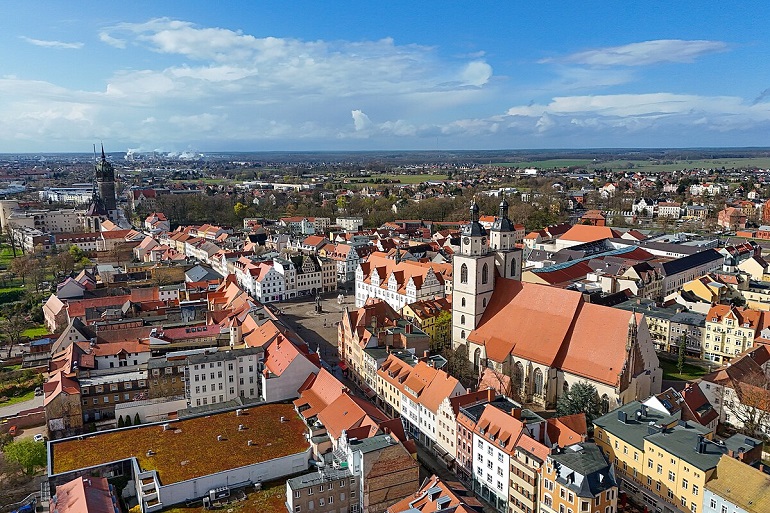
Wittenberg's history stretches back to the medieval period when it was first documented in 1180 as a modest village established by Flemish colonists under the Ascanian dynasty. The settlement gained political prominence in 1260 when it became the residence of the dukes of Saxe-Wittenberg, and by 1293 it had secured its town charter, marking its transformation into a recognised municipality. The town's strategic position on the River Elbe enabled it to flourish as an important trade centre throughout the following centuries, with its influence expanding significantly when control passed to the House of Wettin in 1423 following the extinction of the local Ascanian line. Under Frederick III "the Wise", Elector of Saxony from 1486 to 1525, Wittenberg reached its zenith as a regional political and cultural powerhouse, with the construction of a second bridge over the Elbe (1487-1490) and the famous castle church, the Schlosskirche (1496-1506).
The town's most enduring legacy stems from the Protestant Reformation, which began on 31st October 1517 when Martin Luther, a professor of theology at the newly founded University of Wittenberg (established in 1502), allegedly nailed his "95 Theses" to the wooden doors of the All Saints' Church. This act of defiance against the Catholic Church's sale of indulgences marked the beginning of a religious revolution that would reshape European Christianity and establish Wittenberg as the birthplace of Protestant Lutheranism. The university, which attracted notable scholars including Luther and his colleague Philipp Melanchthon, became one of Germany's most prestigious institutions of learning. The town also briefly hosted the more radical Anabaptist movement when the Zwickau prophets arrived in late 1521, though Luther himself suppressed them upon his return from exile at Wartburg Castle in 1522. The Reformation period culminated in significant political changes with the Capitulation of Wittenberg in 1547, which saw John Frederick the Magnanimous compelled to resign his electoral dignity to the Albertine branch of the Wettin family.
Wittenberg's subsequent history reflects the broader tumults of German politics and warfare. During the Seven Years' War in 1760, Austrian forces bombarded the town, causing significant damage including the destruction of the original castle church doors. The Napoleonic period brought French occupation in 1806, with Napoleon ordering the town's refortification in 1813, before Prussian forces under Bogislav Friedrich Emanuel von Tauentzien stormed Wittenberg in 1814. Following the Congress of Vienna, the town was transferred to Prussian control in 1815 and became part of the Province of Saxony, serving as a military fortress until after the Franco-Prussian War when its fortifications were dismantled. The 20th century saw Wittenberg become part of East Germany after World War II, before German reunification in 1990 restored its status as a significant cultural and historical destination. Today, the Luther Memorials in Wittenberg, alongside those in nearby Eisleben, have been recognised as a UNESCO World Heritage site since 1996, cementing the town's importance as a pilgrimage destination for understanding the origins of Protestant Christianity.
Main Attractions
Market Square and Old Town Hall
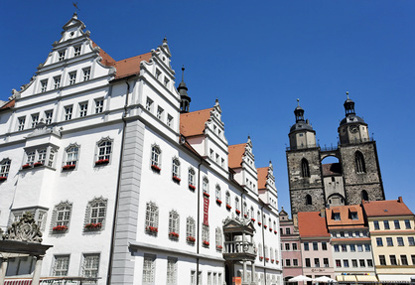
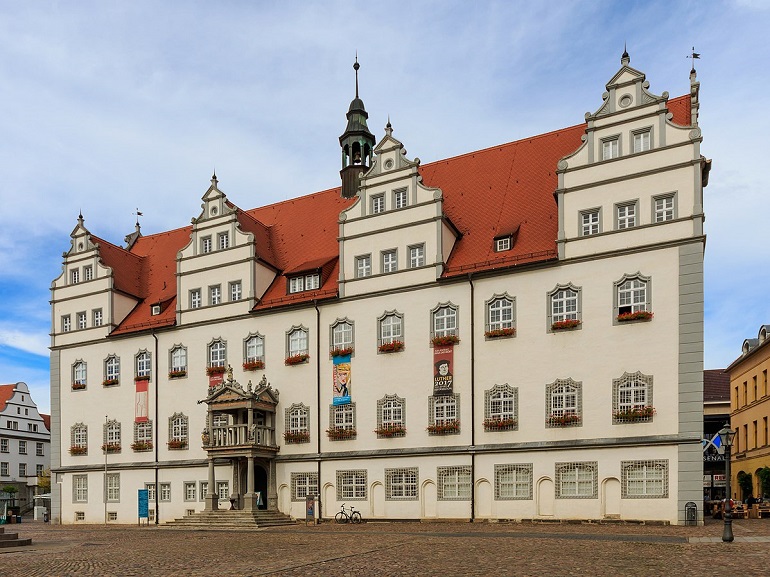
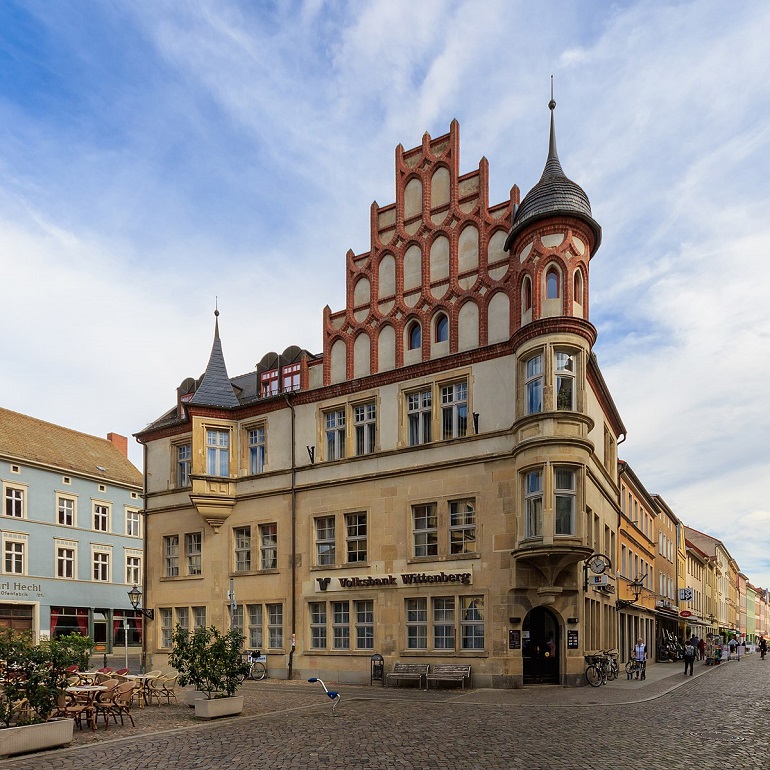
Wittenberg’s market square is a broad, open space framed by Renaissance and Baroque townhouses, with the Old Town Hall presenting a prominent stepped-gable façade and arcaded ground floor. Statues of Martin Luther and Philipp Melanchthon stand on the square, reflecting the town’s academic and theological past. The square functions as the principal gathering space for events and seasonal markets and is the starting point for most guided walks linking the Town Church, Cranach Courtyards, and Castle Church along the pedestrian main street. Interpretation panels around the square explain the development of the urban ensemble and its role during the Reformation period.
All Saints’ Church (Castle Church/Schlosskirche)
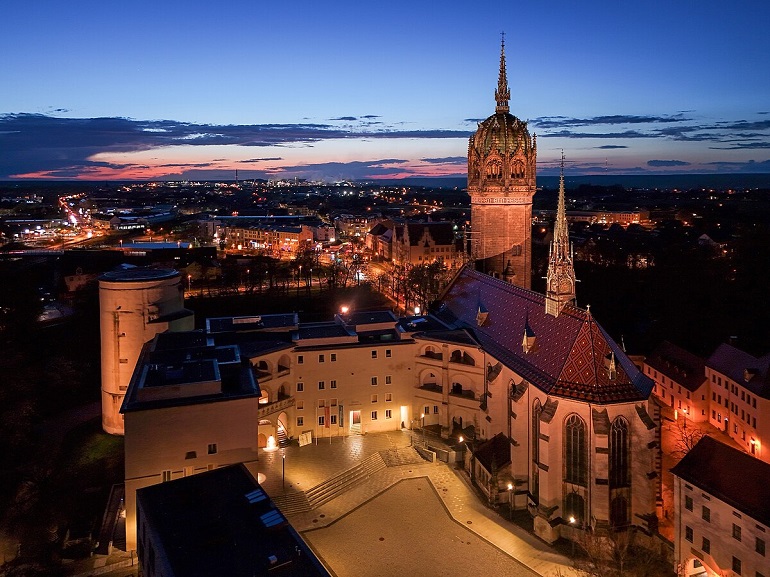
All Saints’ Church, commonly called the Castle Church, stands at the western end of the old town and is the site traditionally associated with Martin Luther’s publication of the Ninety-five Theses in 1517, commemorated today by bronze doors cast in 1858 bearing the Latin text. The church is a late Gothic hall structure with significant 19th-century restoration and contains the tombs of Martin Luther and Philipp Melanchthon in the chancel, as well as memorials to Saxon electors. Visitors can view its elaborate interior fittings and ascend the tower during opening hours for a panorama over the Elbe plain and Wittenberg’s historic core. The church forms part of the UNESCO World Heritage “Luther Memorials in Eisleben and Wittenberg,” reflecting its central role in Reformation history and its continued use as a place of worship and music.
St Mary’s Town Church (Stadtkirche)
St Mary’s, the parish Town Church, is the oldest church in Wittenberg and the principal venue for Luther’s preaching during the Reformation under the pastoral leadership of Johannes Bugenhagen. Architecturally, it is a late Gothic hall church with two towers and retains important ecclesiastical furnishings, including the altar designed by Lucas Cranach the Elder. The building anchors the medieval street plan at the market end of the main axis that runs to the Castle Church, making it an orienting landmark for walking the compact centre. Services and organ music are held regularly, and parts of the church can be visited outside service times, offering insight into the civic-religious life of the former electoral residence.

Historic Residential Streets (Collegienstraße and Schlossstraße)
Collegienstraße and Schlossstraße form the principal east–west pedestrian axis linking the market, academic buildings, and the Castle Church, lined with townhouses that display a range of Renaissance, Baroque, and later façades. Many properties carry plaques identifying former owners and functions, including printers, merchants, and university figures. The continuous frontage and narrow cross-streets give a representative impression of Wittenberg’s urban morphology, and the route is the most efficient way to traverse the main attractions on foot within a compact area.
Lutherhaus Courtyard and Augustinian Monastery Grounds
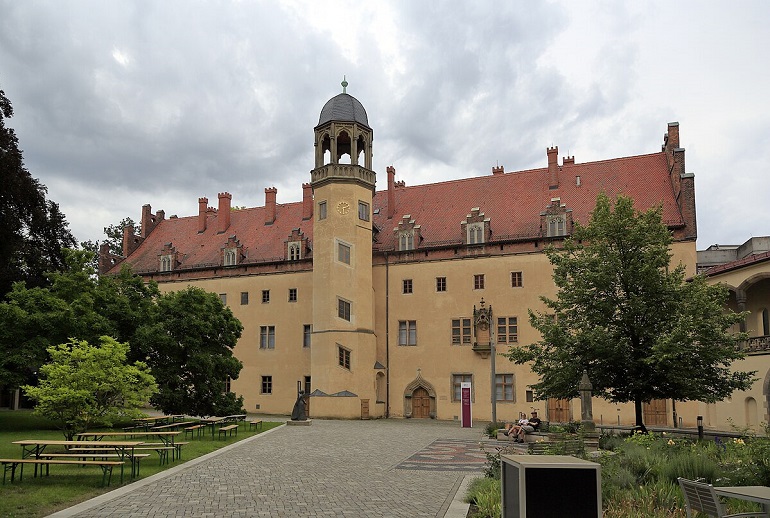
While the interior of the former Augustinian monastery complex functions primarily as a museum, the exterior grounds and courtyard can be appreciated as architectural and historical features without entering exhibition spaces. The monastic complex, converted into Luther’s residence after secularisation, retains cloister walks, a refectory façade, and ancillary buildings that illustrate the transformation from monastic use to university-related housing. The exterior setting provides context for understanding the academic quarter’s proximity to the main street and the churches, and it serves as a quiet pause point when walking between the market and the Castle Church.
Melanchthonhaus Garden and Façade
The Melanchthonhaus, a Renaissance dwelling associated with Philipp Melanchthon, presents an instructive street façade with period gables and inscriptions, and a compact garden that can be viewed from outside. The property exemplifies the living standards of Wittenberg’s learned elite in the 16th century, close to the centres of preaching and teaching. The exterior interpretation conveys Melanchthon’s role in education reform and his collaboration with Luther, complementing the wider urban narrative for visitors who prefer to experience sites from the street without entering museum interiors.
Cranach Courtyards (Cranach-Höfe)
The Cranach Courtyards consist of preserved residential, workshop, and printing premises associated with Lucas Cranach the Elder and his family, set around quiet inner courtyards off the main street. The complex illustrates the mixed residential-commercial character of the 16th-century town, where painting, book production, and pharmacy activities operated side by side. Restored façades and signage identify original functions and owners, and today the courtyards house small shops and studios that maintain the craft tradition of the site. Passageways connect the courtyards to adjacent streets, allowing a through-walk that links key Reformation-era addresses within minutes.
University Leucorea (Collegium Leucorea) Buildings
Remnants and successors of the University of Wittenberg, historically known as Leucorea, are situated along the main axis near the market, marking the academic heart of the town during the Reformation. Architectural elements and plaques indicate lecture halls and administrative spaces where theological and humanist ideas were exchanged. The buildings’ street presence situates the intellectual developments of the period in the urban fabric, with the proximity to printers, churches, and residences demonstrating the practical integration of scholarship, civic life, and religious reform.
Stadthaus and Civic Ensemble on Arsenalplatz
Adjacent to the historic centre, the Stadthaus stands within a civic ensemble on Arsenalplatz, occupying the site of former military and administrative buildings. The complex illustrates Wittenberg’s 19th- and early 20th-century urban development, with façades reflecting civic architectural styles distinct from the medieval core. The open square provides additional event capacity beyond the market and functions as a transitional space between the pedestrianised old town and surrounding residential streets.
Former Ramparts and Green Belt (Wallanlagen)
The historic defensive ramparts have been landscaped into a continuous green belt encircling the old town, providing shaded walking and cycling routes separated from traffic. The path network passes earthworks, moat traces, and small ornamental gardens, with benches and play areas at intervals. A noted vantage point, the Bunkerberg, offers a modest elevation for views towards the town’s towers and the floodplain beyond. Installations associated with the 2017 Reformation anniversary, including mirrored bridges and improved signage, make the circuit straightforward to follow for a loop that typically takes under an hour at a leisurely pace.
Bunkerberg Viewpoint on the Ramparts
The Bunkerberg is a landscaped elevation within the ramparts that provides a low-rise viewpoint across treetops to the towers of St Mary’s and the Castle Church. Accessed by gentle paths, it is used by locals for short walks and by visitors seeking orientation shots of the skyline. Seating at the top makes it a practical rest point on a loop of the green belt, and its position helps explain the relationship between the historic centre and the surrounding floodplain.
City Gates and Gatehouses (traces)
While Wittenberg’s medieval fortifications have been largely reworked into green spaces, traces of former city gates and gatehouses remain legible in street alignments and occasional structural elements. Interpretive signage and surviving foundations indicate where principal entries once controlled access along trade routes running parallel to the Elbe. These points help visitors reconstruct the town’s historical defensive perimeter and understand how the rampart system related to waterways, the market axis, and the location of ecclesiastical buildings.
Reformation Memorials and Plaques in Public Space
Across the old town, discrete memorials, reliefs, and plaques mark addresses connected with the Reformation, including residences, printing houses, and teaching locations. These markers provide a self-guided layer of interpretation that can be followed without joining an organised tour. The distribution of plaques demonstrates the density of historically significant activity within a small radius and allows a thematic visit structured by specific figures or events, complementing the principal church and university sites.
Luther Garden (Luthergarten)
The Luther Garden is a landscaped area created to commemorate the Reformation anniversary with a planting scheme that associates individual trees with church bodies from around the world. Paths radiate in a plan that symbolically references Reformation themes while providing a calm outdoor setting near the ramparts. Name plaques and maps identify donors and participating communities, and the garden integrates with the wider green belt, allowing a looped walk that connects to other open spaces and viewpoints without crossing busy streets.
Elbe River Promenade and Bridge Views
A short walk from the old town leads to the Elbe riverfront, where levees and paths offer uninterrupted views across the floodplain and towards the low-lying riparian landscape. The promenade is suitable for cycling and walking and provides access points to long-distance routes along the Elbe. Seasonal water levels shape the appearance of side channels and wetlands, and the open skyline offers photography opportunities of Wittenberg’s towers from a distance. Wayfinding from the Castle Church area to the river is straightforward, making it a convenient extension to a heritage-focused itinerary.
Middle Elbe Biosphere Reserve (near Wittenberg)
The Middle Elbe Biosphere Reserve begins near Wittenberg and extends along the river corridor, protecting floodplain forests, meadows, and oxbow lakes that are characteristic of the Elbe landscape. Access from town enables half-day excursions for birdwatching and quiet walking on embankments and field tracks. The reserve’s proximity adds ecological variety to a visit centred on historic architecture, and its terrain is generally flat, making it suitable for relaxed cycling. Waymarked segments of regional routes connect the urban edge with the wider protected area.
Top Museums
Luther House
The Luther House stands as the crown jewel of Wittenberg's museums, housing the largest museum dedicated to the history of the Reformation. This remarkable building served as Martin Luther's home for over 35 years, where the Protestant reformer and founder of Lutheranism lived and wrote much of his revolutionary work. Today, visitors can explore authentic settings that provide a glimpse into Luther's life and the decisive events of the Reformation. The museum features original exhibits from Luther's time, offering detailed displays on his teachings, personal life, and the profound social impact of his ideas. As a UNESCO World Heritage site, the Luther House represents one of the most significant locations in religious and political history.
Melanchthon's House
The Melanchthonhaus is a stunning Renaissance building that stands as one of the most architecturally beautiful townhouses in Wittenberg. Known for its late Gothic framed windows and distinctive round-arched tiered gable, this historic residence belonged to Philipp Melanchthon, Luther's fellow reformer and an important figure who often gets overshadowed by Luther's fame. The museum provides visitors with an opportunity to learn about Melanchthon's impressive contributions to the Reformation and his significant role in shaping Protestant thought. The building itself exemplifies Renaissance architectural style and offers insights into the living conditions of influential Reformation figures.
Cranach Foundation (Cranach-Stiftung)
The Cranach Foundation celebrates the artistic legacy of Lucas Cranach the Elder and his son, Lucas Cranach the Younger, both of whom were residents of Wittenberg. This art museum showcases the works of these renowned Renaissance painters whose art is recognised across numerous international locations. The foundation allows visitors to explore Cranach's artistic connections to Martin Luther and other important figures of the era through photographs of his works, displays about his home, and exhibitions highlighting his relationships with key personalities of the Reformation period. The museum reveals the fascinating intersection between art and religious reform during this pivotal historical moment.
Museum of City History (Museum im Zeughaus)
Located in the historic armoury building, the Museum of City History offers a comprehensive journey through Wittenberg's development across the centuries. The museum features over 400 original exhibits that tell the story of the area from prehistoric times through the Middle Ages, early modern period, and into the present day. Visitors can admire the museum's "crown jewels," including a "giant rib" from Frederick the Wise's collection of relics and the Lord Mayor's chain of office. The centrepiece of the exhibition is an incredibly detailed miniature view showing Wittenberg as it appeared in 1873, spread across 20 square metres and inviting visitors to spot the subtle differences from today's cityscape.
The museum also houses "Riemer's World", a permanent ethnological exhibition featuring numerous artifacts from the famous collector Julius Riemer. This unique display, the only permanent ethnological exhibition in Saxony-Anhalt, focuses primarily on Africa and Oceania and includes a fascinating natural history section complete with the skeleton of a giant eel.
House of History (Haus der Geschichte)
The Haus der Geschichte provides an immersive experience into local social history, particularly focusing on life during the German Democratic Republic (GDR) era. This three-storey museum features rooms furnished to recreate authentic bedrooms, kitchens, and living spaces from different time periods, including a reconstructed kindergarten setting. The museum houses extensive exhibits from the GDR period, with knowledgeable staff members available to provide detailed information about the artifacts and their historical context. The museum offers a tangible connection to the everyday life experiences of previous generations in the region.
Christian Art Foundation (Stiftung Christliche Kunst Wittenberg)
The Christian Art Foundation houses a significant collection of Christian art graphics created by internationally renowned artists from the 20th century to the present day. The foundation focuses on works containing religious-existentialist content, providing visitors with a unique opportunity to explore how faith and art intersect through contemporary artistic expression. This collection demonstrates the continuing influence of Wittenberg's spiritual heritage on modern artistic creation and offers insights into how contemporary artists interpret religious themes.
Futurea Science Centre
The Futurea Science Centre represents Wittenberg's commitment to scientific education and discovery. This specialty museum provides interactive experiences and educational opportunities that make scientific concepts accessible to visitors of all ages.
Augustenum
The Augustenum serves as a history museum that complements the other Reformation-related sites in the city. Visitors with sufficient time can explore this institution alongside the Luther House for a more comprehensive understanding of the historical context surrounding the Reformation period.
Tierpark Wittenberg
While technically a zoological garden rather than a traditional museum, the Tierpark Wittenberg offers a unique blend of historical and natural attractions. Located on Juristenstraße on the outskirts of the old town, this facility provides visitors with an opportunity to experience wildlife whilst remaining within the historic context of Lutherstadt Wittenberg.
Local Cuisine
Wittenberg's culinary scene blends down-to-earth Saxony-Anhalt traditions with cosy, beer-friendly fare, best sampled in its historic inns and brewery restaurants around the market square. Expect hearty plates built around regional pork and potatoes, with local menus often featuring Bratwurst with sauerkraut, schnitzel, and warming goulash soup, alongside seasonal game, mushrooms, and orchard produce from the surrounding countryside. Cheese lovers should look for regional varieties such as Börde Speck semi-soft cheese, while potato-focused taverns serve rustic skillet dishes and dumplings that pair neatly with malty dark beers from the town brewery. Desserts and café stops lean classic and comforting, but it’s the robust, savoury mains—washed down with local beer or Saale-Unstrut wines—that define Wittenberg’s satisfying, no-nonsense flavour profile.
Getting There
By train Lutherstadt Wittenberg sits on the high-speed Leipzig–Berlin line, with frequent ICE and IC services stopping at Lutherstadt Wittenberg Hbf; typical journey times are around 40–45 minutes from Berlin Hbf and about 40 minutes from Leipzig Hbf, while slower RE/RB trains also run at regular intervals via regional links.
By coach or bus Long-distance coaches serve routes linking Lutherstadt Wittenberg with major cities such as Berlin, Leipzig, and Frankfurt, and regional buses connect nearby UNESCO towns including Dessau-Roßlau and Wörlitz, providing a practical option if travelling from hubs without direct rail; planners and aggregators list multiple intercity and regional connections to and from the town.
By car The town is just east of the A9 (Nuremberg–Berlin) motorway: exit at junction 8 (Coswig) and follow the B187 towards Lutherstadt Wittenberg, where local signage guides the final approach into the centre; the A9/E51 also offers alternative exits such as Klein Marzehns when arriving from the Berlin direction, with the town lying at the crossroads of the B2 and B187.
| Travel destinations in Saxony-Anhalt | ||||||||||||||
|---|---|---|---|---|---|---|---|---|---|---|---|---|---|---|
|
|
|
|
| ||||||||||
|
|
|
|
| ||||||||||
|
|
|
| |||||||||||