| Contents |
|---|

Introduction
Magdeburg (pop. 242,000) is the capital of Saxony-Anhalt and its largest city. Founded by Charlemagne, and favoured residence of Emperor Otto I, Magdeburg was one of Germany's most important medieval cities. Its medieval town laws, known as the Magdeburg Rights, were copied in most of Central and Eastern Europe.
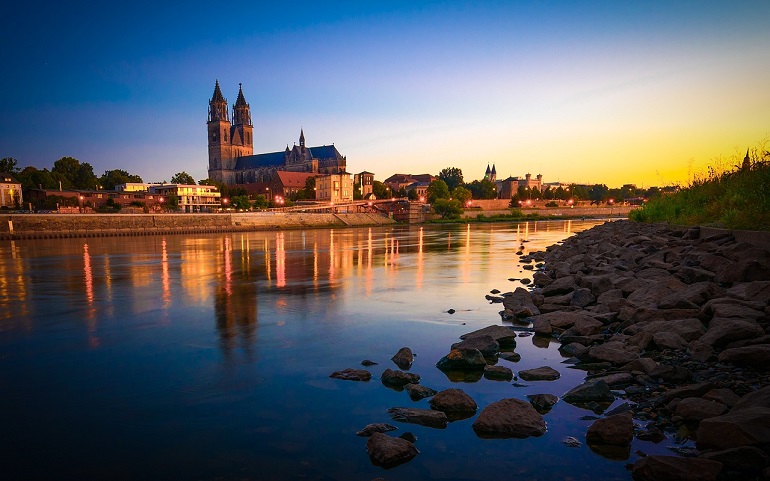
Wholly rebuilt after WWII, mostly in concrete, modern Magdeburg is an industrial city with few sights apart from its cathedral, one of the oldest in the country and the first built in Gothic style. Other sights include the Magdeburg Horseman on Alter Markt, the modern Hundertwasser-designed Green Citadel, and expansive green spaces such as Elbauenpark with the Millennium Tower.
Interesting Facts about Magdeburg
- The city gave its name to the influential “Magdeburg rights,” a medieval town law adopted across Central and Eastern Europe.
- Emperor Otto I (Otto the Great) chose Magdeburg as an imperial centre and is buried in Magdeburg Cathedral.
- Magdeburg Cathedral (Saints Catherine and Maurice) is considered Germany’s first Gothic cathedral and a defining city landmark.
- The Magdeburg Rider is the first free-standing equestrian statue north of the Alps.
- Scientist Otto von Guericke, famed for the Magdeburg hemispheres vacuum experiment, was a native of the city.
- Magdeburg suffered three major devastations: a great fire in 1207, the 1631 sack during the Thirty Years’ War, and heavy bombing in 1945.
- The city was a prominent member of the Hanseatic League in the Middle Ages.
- Magdeburg features Europe’s longest water bridge, the Magdeburg Water Bridge, linking canal systems over the Elbe.
- The Green Citadel (Die Grüne Zitadelle) by Friedensreich Hundertwasser adds striking contemporary architecture in pink hues.
- Elbauenpark’s Millennium Tower is among the world’s tallest wooden structures of its kind and houses a science exhibition.
- Magdeburg served as East Germany’s most important inland port, a role reflected in its transport links and waterways.
- Otto-von-Guericke University (founded 1993) underscores the city’s modern research and engineering profile.
- The city’s cultural scene spans the Art Museum in the Monastery of Our Lady, the Cultural History Museum, and Theater Magdeburg.
- Wide boulevards and post-war architecture in the centre reflect extensive reconstruction after the Second World War.
History
Founded by Charlemagne in 805 as Magadoburg (meaning "mighty fortress" in Old High German), the city was strategically fortified in 919 by King Henry the Fowler as a bulwark against Magyar and Slavic invasions. The settlement truly flourished under Otto I (Otto the Great), who granted the city to his English-born wife Edith as a morning gift in 929. Queen Edith resided frequently in Magdeburg, and upon her death was buried in the Benedictine abbey of Saint Maurice, later rebuilt as the magnificent cathedral. Otto I himself was eventually interred in Magdeburg Cathedral after establishing the Archbishopric of Magdeburg in 968, making the city a crucial imperial and ecclesiastical power base that influenced German colonisation of Slavic lands east of the Elbe.
During the medieval period, Magdeburg emerged as one of the most prosperous and influential cities in the Holy Roman Empire. The city received commercial privileges in 1035, establishing the right to hold trade exhibitions and conventions. This formed the foundation of what became known as Magdeburg Rights - a comprehensive municipal law system that spread throughout Central and Eastern Europe, becoming the epitome of German town law. By the 13th century, Magdeburg had joined the prestigious Hanseatic League and, with over 20,000 inhabitants, ranked amongst the largest cities in the Holy Roman Empire. The city maintained active maritime commerce westward to Flanders and the North Sea countries whilst serving as a vital trading hub for the German interior. However, this golden age was punctuated by disasters, including devastating fires in 1188 and 1207 that destroyed large portions of the city, including the original Ottonian cathedral.
The early modern period brought both religious transformation and catastrophic destruction to Magdeburg. The city embraced the Protestant Reformation in 1524 after Martin Luther preached there, having previously attended school in the city around 1497. Magdeburg became a renowned stronghold of Protestantism, publishing Luther's writings and the influential anti-Catholic "Magdeburg Centuries". However, the city's Protestant defiance during the Thirty Years' War led to one of history's most brutal urban massacres when imperial troops under Count Tilly stormed Magdeburg in 1631, killing approximately 20,000 to 25,000 of the city's 30,000 inhabitants and reducing the population to merely 4,000. The city made a remarkable recovery under the leadership of scientist-mayor Otto von Guericke, who conducted his famous vacuum experiments with the Magdeburg hemispheres just six years after the war's end. Following the Peace of Westphalia in 1648, Magdeburg became part of Brandenburg-Prussia in 1680, later serving as capital of the Prussian province of Saxony from 1815. After surviving Napoleon's occupation and heavy Allied bombing in 1945 that destroyed much of the city centre, Magdeburg was rebuilt and became the capital of the newly formed state of Saxony-Anhalt following German reunification in 1990.

Main Attractions
Magdeburg Cathedral (Magdeburger Dom)
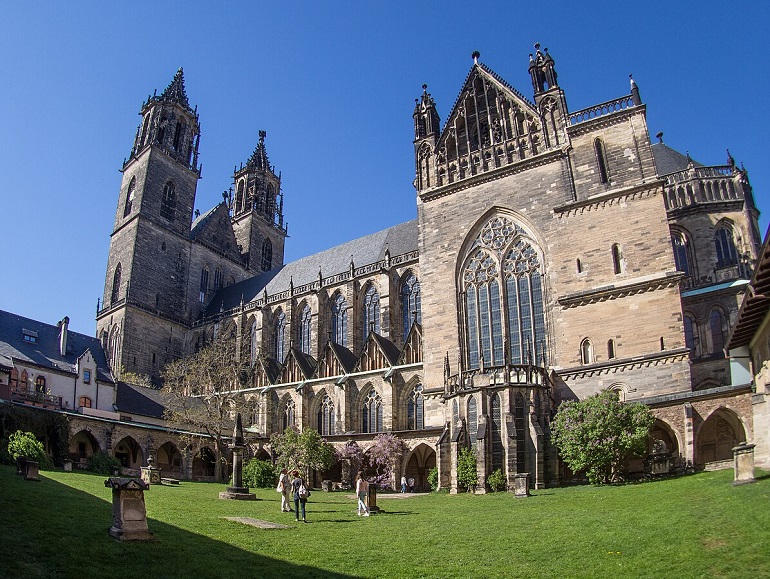
The Cathedral of Saints Maurice and Catherine is Magdeburg's most prominent landmark and Germany's first Gothic cathedral. It is 120 metres long and the central nave is 32 metres high. Construction began in 1209 after a fire destroyed the earlier Romanesque church and was completed in 1520. The cathedral houses the tomb of Emperor Otto I, who died in 973, and contains the sculpture of Saint Maurice, regarded as the oldest depiction of a Black person in Central European art. Its twin towers dominate the city's skyline.
Alter Markt (Old Market)
Alter Markt has long been the city's civic centre and includes the Gothic town hall. The square displays a bronze replica of the Magdeburg Horseman, the first free-standing equestrian statue north of the Alps, depicting Emperor Otto I. A statue group symbolising the medieval Magdeburg Rights also stands here, and the square hosts regular markets and festivals throughout the year.

Grüne Zitadelle (Green Citadel)
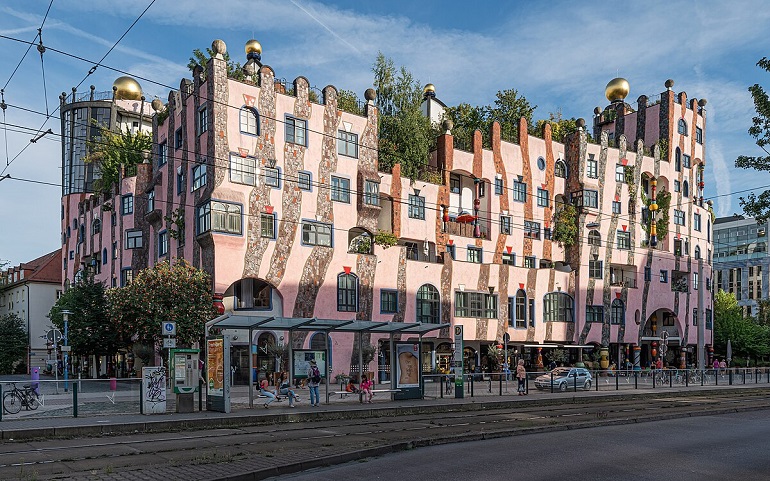
The Green Citadel is one of the last buildings designed by Friedensreich Hundertwasser and was finished in 2005. The complex combines flats, offices, shops, a theatre, and a café, characterised by vivid colours, irregular lines, and a roof planted with trees. Hundertwasser intended it as an urban oasis where architecture and nature coexist, and it has become one of Magdeburg's most photographed sites.
Jahrtausendturm (Millennium Tower) in Elbauenpark
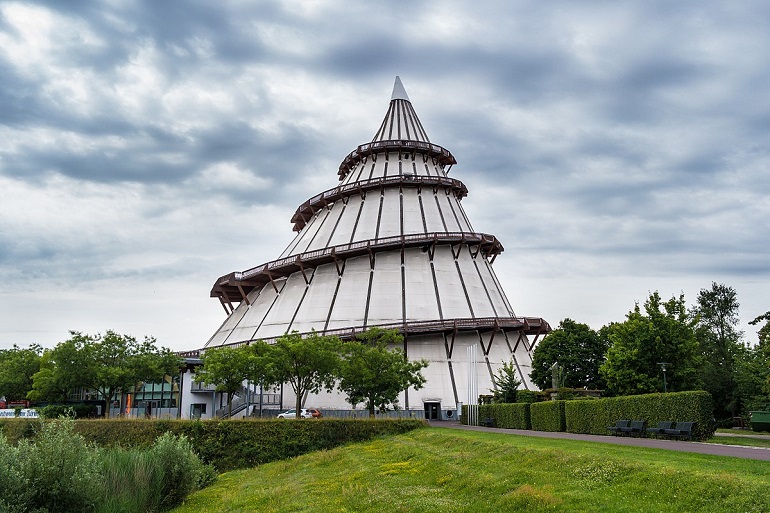
The Millennium Tower, erected for the 1999 Federal Garden Show, is a 60-metre wooden structure that presents 6,000 years of scientific and technological history across five exhibition levels. Interactive displays range from ancient Egyptian building techniques to a working Foucault pendulum. A spiral ramp leads to a viewing platform 43 metres high, giving panoramic views over Elbauenpark and the Elbe.
Magdeburg Water Bridge
Opened in 2003, the Magdeburg Water Bridge is Europe’s largest navigable aqueduct. It is 918 metres long, 34 metres wide and 4.25 metres deep, carrying the Mittelland Canal over the Elbe to link it with the Elbe-Havel Canal. Constructed with 24,000 tonnes of steel and 68,000 cubic metres of concrete, it allows commercial vessels to bypass the river level and includes separate paths for pedestrians and cyclists.
Stadtpark Rotehorn
Covering the island of Rotehorn in the Elbe, Stadtpark Rotehorn is one of Magdeburg’s largest green spaces. Designed in 1871 by landscape architect Peter Joseph Lenné, the park mixes rare plants, tree-lined avenues, and ponds. It provides venues for cultural and musical events, including the annual city festival, while offering a quiet retreat within walking distance of the centre.
Herrenkrug Park
Herrenkrug Park on the northern Elbe bank originated in the 19th century as a leisure ground attached to the historic Herrenkrug Hotel. Once a fashionable resort for European nobility, it retains romantic pathways, mature trees, and formal flower beds. The park remains popular for strolling, picnicking, and river views.
Hasselbachplatz
Hasselbachplatz and the surrounding streets form Magdeburg’s main entertainment quarter. The square is packed with pubs, bars, and restaurants that create the city’s most concentrated nightlife and dining scene, making it the usual evening meeting point for residents and visitors alike.
Top Museums
Art Museums
Kunstmuseum Magdeburg – Kloster Unser Lieben Frauen
Housed in the oldest surviving building in Magdeburg, the Kunstmuseum Magdeburg stands as the most important venue for contemporary art and sculpture in Saxony-Anhalt. Located in the heart of the old town near the Elbe River and Magdeburg Cathedral, this former monastery represents the city's eventful history through its architecture, which has been shaped by prosperity, destruction, and the will to rebuild. The museum focuses exclusively on contemporary art, making it a unique cultural destination that bridges the city's medieval past with modern artistic expression.
Historical Museums
Dommuseum Ottonianum
Officially opened in November 2018, the Dommuseum Ottonianum (DOMA) is situated next to Magdeburg Cathedral and offers visitors an exceptional journey through medieval European history. The museum tells the compelling story of Emperor Otto the Great and his wives, as well as the role Magdeburg played in German history. Spread across 650 square metres of exhibition space, the museum presents three key thematic areas from medieval Europe.
Visitors can explore the cathedral's construction phases, learn about the various exhumations of Empress Eadgyth, admire statues of St Mauritius, and discover the internal and external politics of Otto's domains alongside the power of the early medieval church. The museum provides a logical route that guides visitors through this rich historical narrative, making it essential for understanding Otto's significance and Magdeburg's pivotal role in German history.
Kulturhistorisches Museum Magdeburg
Originally established in 1906 as the Kaiser-Friedrich Museum, the Museum of Cultural History continues to operate from its historic building. This traditional city museum presents Magdeburg's extensive history through both permanent and special exhibitions, whilst also showcasing important art-historical pieces. The museum offers a comprehensive overview typical of a main city museum, featuring archaeological finds, natural history specimens, and cultural artefacts that document the city's development over the centuries.
Science and Technology Museums
Otto-von-Guericke-Museum
Dedicated to one of Magdeburg's most famous sons, this science museum celebrates the legacy of Otto von Guericke, the renowned 17th-century scientist and mayor of Magdeburg who pioneered vacuum experiments and atmospheric pressure studies. The museum provides insight into his groundbreaking scientific contributions and their lasting impact on physics and engineering.
Technikmuseum Magdeburg
The Technikmuseum offers a fascinating glimpse into industrial history, uniquely housed in the former steel construction hall of the heavy machinery construction combine "Ernst Thälmann". This industrial setting adds authentic historical atmosphere to the museum, making it particularly appealing for visitors interested in technology and Germany's industrial heritage. The museum's location in this former industrial facility provides a tangible connection to Magdeburg's manufacturing past.
Special Interest Museums
Villa p. – Figurenspielsammlung Mitteldeutschland
Located in the Buckau district, this protected timber-framed villa houses the Figurenspielsammlung of the Magdeburg Puppet Theatre. The villa p. represents a unique destination that combines historical architecture with the rich tradition of German puppetry, offering visitors insight into this distinctive cultural art form whilst preserving an important example of traditional German building techniques.
Schmetterlingshaus
Situated within the Elbauenpark on the north side, this butterfly house offers a unique natural experience with diverse butterfly species in a controlled environment.
Zoo Magdeburg
Beyond its role as a zoological garden, the zoo also functions as a natural history museum, providing educational experiences about wildlife and conservation.
Local Cuisine
Magdeburg’s cuisine reflects the hearty traditions of Saxony-Anhalt, drawing on the fertile Börde’s produce and a taste for robust, pork-forward dishes; look out for Bötel (pork knuckle), a local classic often served rustic and generously, and sweet local bakes like Magdeburger Schmalzkuchen that pair well with coffee on a leisurely afternoon. Regional staples from across the state regularly appear on city menus, including the iconic Salzwedeler Baumkuchen from the Altmark and the famed Halberstädter Würstchen, which underscore the area’s long sausage-making tradition. Cheese lovers can explore distinctive regional varieties and specialities tied to Saxony-Anhalt’s dairying heritage, while beer from nearby producers complements the down-to-earth plates that define dining in this Elbe city.
Getting There
By train Magdeburg Hbf sits on key east–west routes with frequent Deutsche Bahn services, including IC/ICE links, making it straightforward to reach from major hubs such as Berlin and Hanover; direct trains from Hanover typically run hourly and take about 1h20–1h30, with high-speed services on these corridors providing a quick, comfortable option for arrivals into Saxony-Anhalt’s capital.
By coach or bus Long-distance coaches serve Magdeburg’s central bus station with extensive connections across Germany and neighbouring countries; major operators such as FlixBus link the city with destinations including Berlin, Prague, Amsterdam, Hamburg and more, offering a practical alternative if travelling from places not directly connected by rail.
By car Magdeburg is conveniently placed on the A2 autobahn between Hanover and Berlin, with additional access via the A14 that connects towards Halle/Leipzig and Dresden, providing straightforward motorway driving into the city from multiple directions in eastern and northern Germany.
| Travel destinations in Saxony-Anhalt | ||||||||||||||
|---|---|---|---|---|---|---|---|---|---|---|---|---|---|---|
|
|
|
|
| ||||||||||
|
|
|
|
| ||||||||||
|
|
|
| |||||||||||