



| Contents |
|---|
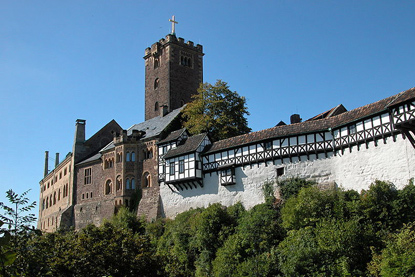
Wartburg Castle, Eisenach.
Introduction
Set in the northern foothills of the Thuringian Forest, the charming Renaissance town of Eisenach (pop. 42,500) is famous for being the birthplace of Johann Sebastian Bach. Martin Luther spent his childhood here too, and spent ten months in hiding at Wartburg Castle, where he translated the New Testament from Greek to German, the first translation into a modern language in over a millennium. Richard Wagner's opera Tannhäuser is based on the famous Minstrels' Contest that took place at Wartburg around 1207.
Interesting Facts about Eisenach
- Eisenach is famously known as the birthplace of the composer Johann Sebastian Bach.
- Wartburg Castle in Eisenach is a UNESCO World Heritage Site and was the setting for Martin Luther's translation of the New Testament into German.
- The legendary German composer Richard Wagner set his opera "Tannhäuser" at Wartburg Castle, drawing inspiration from the town.
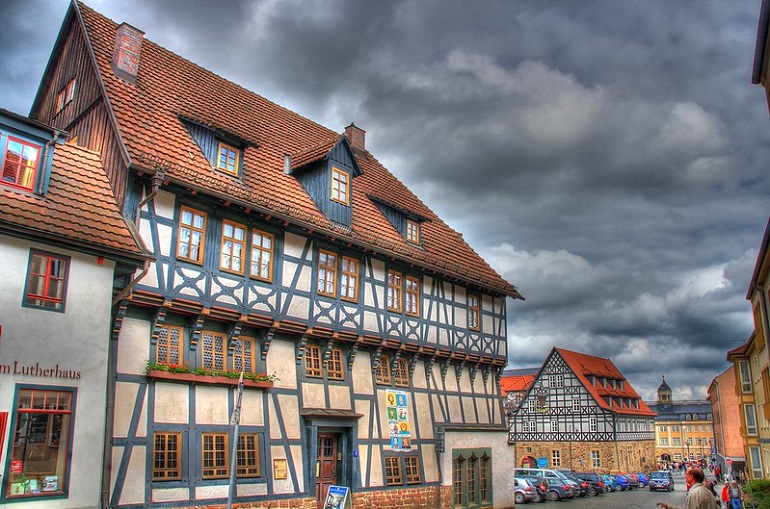
- Martin Luther attended school in Eisenach and described it as "my beloved town," with the Lutherhaus now serving as a museum in his honour.
- Eisenach's Automobilwerk, founded in 1896, produced the famous East German Wartburg cars and is still an important car production centre today.
- The town boasts a striking mix of historic buildings, including one of the narrowest half-timbered houses in Germany, measuring just 2.05 metres wide.
- Eisenach was once the site of one of Thuringia’s largest Jewish communities, which suffered greatly during the Nazi era.
- The famous German poet Johann Wolfgang Goethe was captivated by Eisenach and called it a marvellous place.
- Eisenach lies at the edge of the Thuringian Forest, giving the town a fairy-tale atmosphere reminiscent of the Brothers Grimm stories.
- The city was the founding location of the Social Democratic Workers’ Party, a precursor to Germany’s modern SPD, in 1869.
History
Mediaeval Origins and Early Prominence
Eisenach's origins can be traced back to an 8th-century Frankish settlement near Petersberg hill, though written records are scarce from this early period. The town's prominence truly began in 1067 when Louis the Springer established the legendary Wartburg castle above the settlement. Eisenach was first officially mentioned in documents dating to 1150, where it was referred to as "Isinacha". During the 1180s, the town was formally established through the construction of three independent market settlements around the Saturday market (today's Karlsplatz), the Wednesday market (today's Frauenplan), and the Monday market (today's Marktplatz). Its strategic location at the crossroads between the Thuringian Forest and the Hainich mountains made Eisenach a vital stopping point along the Via Regia trade route connecting Frankfurt to Erfurt and Leipzig, transforming it into a prosperous merchant town. The Wartburg became the main residence of the powerful Ludowingian dynasty, making Eisenach the leading city in western Thuringia and northern Hesse.
Religious and Cultural Significance
The town's religious and cultural importance peaked during the Middle Ages when Saint Elizabeth lived at the court of the Ludowingians between 1211 and 1228, later becoming the patroness of Thuringia and Hesse. Following the extinction of the Ludowingian line in 1247, Eisenach fell under the control of the Wettin dynasty in 1264 and was officially chartered in 1283. The town's association with religious reform began when young Martin Luther attended St. George's Latin school between 1498 and 1501 in preparation for his university studies. Most significantly, Luther was hidden at Wartburg castle by Frederick the Wise in 1521-22 to protect him from the Imperial ban, during which time he translated the New Testament from Greek into German. This translation became crucial both for the German Reformation and the development of standard German language. Luther famously referred to Eisenach as "ein Pfaffennest" (a clerical backwater) due to the remarkable ratio of 300 monks and nuns per 1,000 inhabitants during his time there.
Musical Heritage and Modern Development
Eisenach's cultural legacy was further enriched when Johann Sebastian Bach was born in the town in 1685, when it formed part of the Holy Roman Empire. His father, Johann Ambrosius Bach, worked as a musician in the town, and other renowned composers including Johann Pachelbel, Johann Christoph Bach, and Georg Philipp Telemann were also associated with Eisenach during this period. The town briefly became the capital of its own dukedom (Saxe-Eisenach) from 1596 to 1741, before being incorporated into Saxe-Weimar. The 19th century brought significant political importance when Eisenach hosted the Wartburg Festival in 1817, where students advocated for German unification and liberal constitutional reforms. Industrial development began early with the first factories established in the first half of the 19th century, and the town was connected to the railway network in 1847. In 1869, prominent socialists August Bebel and Wilhelm Liebknecht founded the SDAP (one of the predecessors of today's SPD) in Eisenach, with the Eisenach Programme serving as the party's main manifesto. The Fahrzeugfabrik Eisenach (FFE), later Automobilwerk Eisenach, was established in 1896, marking the beginning of car production in the town.
Main Attractions
Wartburg Castle
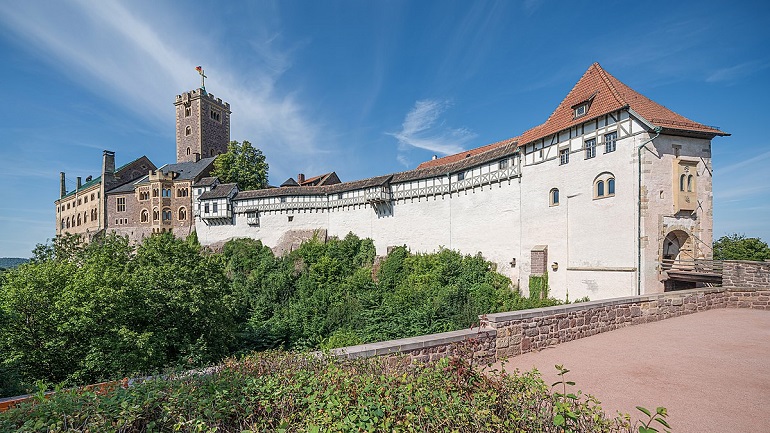
Wartburg Castle, a UNESCO World Heritage Site since 1999, is a fortress of profound historical and cultural significance that dominates the skyline above Eisenach. Construction began around 1067, and the structure represents a blend of architectural styles, most notably the late-Romanesque period visible in its main residential building, the Palas. This section contains the opulent Knights' Hall and the Singers' Hall, which was the legendary setting for the medieval minstrels' contest, the Sängerkrieg. The castle is famously associated with Martin Luther, who, under the protection of Frederick the Wise, sought refuge here in 1521–22. During his stay in a modest room known as the Lutherstube, he translated the New Testament from Greek into German, a pivotal act in the Protestant Reformation. Earlier, the castle was home to St. Elisabeth of Hungary, renowned for her charitable work. In 1817, it hosted the Wartburg Festival, a key gathering of student fraternities (Burschenschaften) advocating for German unification, cementing its status as a national symbol. The castle complex is extensive, and visitors can explore its courtyards and ramparts, which offer panoramic views across the Thuringian Forest.
Eisenach Altstadt (Old Town)
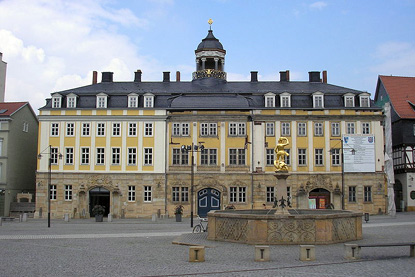
Eisenach's Old Town (Altstadt) is a compact and historically rich area defined by its cobblestone streets, narrow alleys (Gassen), and well-preserved half-timbered houses. The central point is the main square, the Markt, which is flanked by several significant buildings. The pink-stuccoed Town Hall (Rathaus) has Renaissance origins but was rebuilt in a Baroque style after a fire. Opposite stands the former City Palace (Stadtschloss), an 18th-century ducal residence. Dominating the square is the late-Gothic St. George's Church (Georgenkirche), a site of major historical events: it is where Johann Sebastian Bach was baptised in 1685 and where Martin Luther preached during the Reformation. While the famous Lutherhaus and Bachhaus are now museums, their historic facades contribute significantly to the Old Town's character. Walking through the area reveals numerous architectural details and provides a strong sense of the city's past as a ducal seat and a centre of German cultural history.
Kartausgarten
The Kartausgarten is a large and historic public park located west of Eisenach's Old Town. Its name derives from the Carthusian monastery (Kartause) that was founded on this site in 1378 and dissolved during the Reformation. While the monastery buildings are gone, remnants of the old enclosure wall can still be seen within the park. The grounds were later transformed into a ducal kitchen garden before being developed into a landscaped public park in the 19th century. A key architectural feature is the Wandelhalle, an elegant, covered promenade built in the late 19th century that offers shelter and a place for reflection. The park contains a variety of mature and rare trees, a central pond, expansive lawns ideal for picnics, and a children's playground, making it a favoured spot for recreation among local families. Its network of paths provides a quiet green space for walking and relaxation, bridging the city's history with its present-day community life.
Burschenschaftsdenkmal
The Burschenschaftsdenkmal is a commanding monument situated on the Göpelskuppe hill, constructed between 1900 and 1902. It was designed by the architect Wilhelm Kreis and features sculptures by Otto Geyer. The 33-metre-tall structure was erected to honour the members of the German Burschenschaften (student fraternities) who died in the Franco-Prussian War of 1870–71, and more broadly, to celebrate the fraternities' long campaign for German national unity, which began with the 1817 Wartburg Festival. Architecturally, it is a prime example of the Wilhelminian style with strong Art Nouveau (Jugendstil) influences. Inside, a domed Honour Hall features intricate ceiling frescoes depicting scenes from Germanic mythology and history, alongside stained-glass windows. The central motto, "Ehre, Freiheit, Vaterland" (Honour, Freedom, Fatherland), reflects the ideals of the movement. From its viewing platform, the monument provides one of the most comprehensive panoramic views of the area, including a direct line of sight to Wartburg Castle and the city of Eisenach below.
Natural Attractions around Eisenach
Dragon Gorge (Drachenschlucht)
The Dragon Gorge, or Drachenschlucht, is a remarkable geological formation located in the southern part of Eisenach. This narrow gorge, carved by a stream through Zechstein conglomerate rock over millennia, stretches for approximately three kilometres. Its defining feature is the extreme narrowness of the canyon, where the moss-covered rock walls are in places less than a metre apart, creating a cool and shaded microclimate even on warm days. The hiking path consists of a series of metal grates and boardwalks fixed directly above the flowing water, providing a unique and immersive experience. The trail is part of the larger Thuringian Forest Nature Park and is a designated "National Geotope". It is a popular segment of a circular walking route that often includes the Hohe Sonne, a former ducal hunting lodge, allowing for a longer excursion. Due to its accessibility and relatively flat terrain within the gorge itself, it is suitable for most walkers, including families, offering a direct encounter with the region's natural forces.
Landgrafenschlucht
The Landgrafenschlucht, or Landgrave's Gorge, offers a more tranquil and expansive hiking experience compared to the nearby Dragon Gorge. This wider gorge features a scenic loop trail that meanders through a mature beech forest, following the path of a gentle stream. The route is characterised by impressive rock formations and cliffs, but the path itself is broader and less enclosed, making for a peaceful walk amidst nature. The trail is well-maintained and suitable for family outings and walking with dogs. Its name references the Landgraves of Thuringia, who historically ruled the region and used the surrounding forests for hunting. A typical circular hike through the Landgrafenschlucht and adjacent smaller gorges can take a few hours and connects to a wider network of trails, allowing for customised route lengths. It serves as an excellent alternative for those wishing to experience the area's geological beauty without the larger crowds often found at the Drachenschlucht.
Elfengrotte
The Elfengrotte, or Fairy Grotto, is a small and picturesque rock formation nestled within the woodlands on the hiking trail between the Dragon Gorge and the Burschenschaftsdenkmal. It is not a true cave system but rather a shallow, moss-draped rock shelter or recess in the hillside, creating an intimate and secluded spot. Its name evokes folklore and a sense of enchantment, which is enhanced by the surrounding dense forest of beech and oak trees. The grotto is a popular, short diversion for hikers and families, particularly those with children, who are drawn to its fairy-tale atmosphere. While a minor attraction in scale, its charm lies in its simplicity and the natural beauty of its setting. It serves as a memorable landmark on local walking routes and exemplifies the small natural wonders scattered throughout the Thuringian Forest around Eisenach.
International Mountain Trail of Friendship Eisenach–Budapest
Eisenach is the official western terminus of the International Mountain Trail of Friendship (Internationaler Bergwanderweg der Freundschaft Eisenach–Budapest), often abbreviated as the EB Trail. This trans-European long-distance footpath was established during the Cold War era, originally connecting several socialist states of the Eastern Bloc. It stretches for over 2,700 kilometres from the Thuringian Forest in Germany to Budapest in Hungary. The trail officially begins near the Hotel am Burschenschaftsdenkmal and is marked with a distinctive blue horizontal stripe. The initial sections leading out of Eisenach take hikers through the classic landscapes of the region, including lush forests and rolling hills. While few undertake the entire journey, the starting segment is a popular local hiking route, offering day-trippers and casual walkers a chance to tread the beginning of this historic path and connect with a wider European trekking heritage.
Top Museums
Bachhaus Eisenach
The Bachhaus Eisenach is a must-visit site for music enthusiasts, as it is the world's first museum dedicated to Johann Sebastian Bach, situated in a 15th-century manor believed to be his birthplace. The museum immerses visitors in Bach's life and art through meticulously reconstructed living quarters, a collection of original baroque instruments, and interactive multimedia exhibits. Hourly live concerts using period instruments make for a sensory-rich experience. This museum uniquely interweaves tradition with innovation, making Bach's world tangible for all ages.
Lutherhaus Eisenach
Lutherhaus Eisenach stands as both a shrine to the Reformation and a testament to half-timbered architecture, located in the house where Martin Luther likely lived as a schoolboy. The award-winning permanent exhibition 'Luther and the Bible' provides a thought-provoking exploration of Luther's legacy, featuring treasures such as Cranach paintings and Ai Weiwei's 'Man in a Cube' sculpture. Interactive media stations and contemporary exhibitions critically engage visitors with Luther's influence and the evolving perception of the Bible. The museum’s deep historical resonance is complemented by a dynamic approach to scholarship and public memory.
Automobile Welt Eisenach
Automobile Welt Eisenach vividly chronicles over a century of automotive innovation on the original AWE factory site, making it a gem for technology and motor history aficionados. The extensive collection showcases local legends like Dixi, Wartburg, and even pre-war BMWs alongside rare race and concept cars. Authentic workshops and interactive stations illustrate the development of car manufacturing, from early 20th-century craftsmanship to modern engineering feats. It stands out for its hands-on displays and focus on regional industry, providing both nostalgia and technical fascination.
Wartburg Castle Museum
The Wartburg Castle Museum, set within the walls of the UNESCO World Heritage-listed Wartburg Castle, offers an enthralling journey through a millennium of German and European history. The museum’s collection includes masterpieces by Lucas Cranach, richly woven tapestries, Renaissance artefacts, and imposing sculptures. The setting itself—steeped in legends, from the Singers' War to Martin Luther’s fateful translation of the New Testament—enhances the immersive experience. Combining art, culture, and grandeur, this museum is unparalleled for those seeking grandeur and historical depth.
KUNSTpavillon Eisenach
The KUNSTpavillon is Eisenach’s centre for contemporary art, transforming a listed Bauhaus-influenced pavilion into a dynamic venue for modern visual art, live performances, and cultural dialogue. Rotating exhibitions highlight both regional and international artists, often engaging with topical themes and experimental formats. The venue also fosters creativity through workshops and live music, making it especially appealing for those with an interest in the present-day arts and cultural currents. Its open, inclusive atmosphere and architectural significance enrich Eisenach’s museum landscape beyond historical collections.
Hörselbergmuseum
Located in nearby Wutha-Farnroda, the Hörselbergmuseum delves into the rich natural and folkloric history of the Hörselberge region. Its exhibitions span geology, flora and fauna, legendary tales, and traditional Thuringian baking, providing an engaging look at local culture. Creative educational projects make this museum especially appealing to families and those interested in rural heritage, nature, and myth. Its local focus and hands-on learning approach offer a charming contrast to Eisenach’s urban museums.
Local Cuisine
A visit to Eisenach is not complete without sampling Thuringian bratwurst, a succulent sausage often flame-grilled and served with mustard, as well as real Thuringian dumplings, typically made from potatoes and enjoyed with rich sauces or roasted meats. Restaurants such as Kartoffelhaus and local market stands frequently highlight these classics alongside seasonal treats and robust cheeses. Whether indulging in traditional fare at a rustic eatery or enjoying regional specialities at an open-air market, food lovers will find Eisenach to be a true delight for the palate.
Getting There & Around
By train, Eisenach is easily accessible from major cities throughout Germany, with direct InterCity and InterCityExpress (ICE) services stopping at Eisenach Hauptbahnhof. The town enjoys frequent connections, especially from Erfurt, Frankfurt, and other regional hubs, making rail a convenient and comfortable option for travellers.
By coach or bus, long-distance providers such as FlixBus operate services into Eisenach, typically arriving at the centrally located bus station near the Hauptbahnhof. This journey is direct from several regional cities and can be a practical alternative, especially if you're coming from areas not directly served by rail.
By car, motorists can reach Eisenach via the A4 motorway, which connects with other major routes across Thuringia and the wider region. The road network makes self-driving straightforward, offering the flexibility to explore the lush countryside and nearby attractions at your own pace.


