



| Contents |
|---|
Introduction
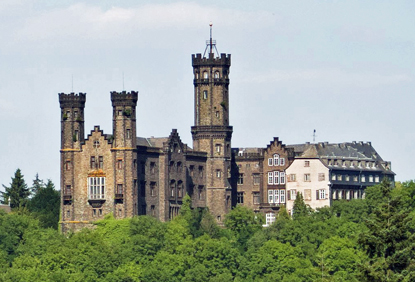
Schaumburg Castle, perched atop the 225-metre-high Nesselberg hill overlooking the Weser Valley in Rinteln, dates back to 12th century and combines medieval fortification with 19th-century neo-Gothic alterations. Originally the seat of the Counts of Schaumburg-Lippe, it passed into Hohenzollern hands after the Austro-Prussian War of 1866 and was returned by Emperor Wilhelm II in 1907. Today the privately owned site is open daily without charge, offering visitors visible remains of its outer bailey, squat corner towers and a restored curtain wall, as well as a hilltop restaurant beside the castle gate and seasonal guided tours from May to October.
Interesting Facts about Schaumburg Castle
- Schaumburg Castle dates back to at least the 12th century, with its earliest mention in a document from 1197.
- The castle originally served as a fortified military stronghold before being transformed into a residential palace in later centuries.
- Its striking neo-Gothic main tower, built between 1850 and 1855, stands 42 metres tall and is octagonal in shape.
- The castle was once owned by the ruling family of Waldeck and Pyrmont and later served as the retirement residence of SS General Josias, Hereditary Prince of Waldeck and Pyrmont.
- Today, Schaumburg Castle is privately owned, with its ownership having changed hands several times in recent decades.
- The original medieval fortress was partly constructed of basaltic rock and featured strong walls and corner towers, designed for defence.
- Archduke Stephan of Austria, once exiled to the castle, devoted himself to scientific pursuits and added the "Stephansbau" wing to house his mineral collection.
- The estate has seen periods of neglect and restoration, resulting in the loss of significant portions of its historic interiors and features.
- Schaumburg Castle offers wonderful panoramic views over the surrounding forests and the Weser Valley from its hilltop location.
- Although not generally open for public sightseeing, guided tours are occasionally available, and the castle remains an iconic landmark of the region.

History
Schaumburg Castle traces back its origins at least to the 12th century when it was first documented in 1197 as “Schowenburg”. The castle was initially constructed as a military fortress perched atop a raised rock spur, fortified with robust walls and squat towers. Throughout the Middle Ages, it changed hands among influential noble families, including the Counts of Leiningen and the House of Westerburg, often as a result of inheritance, sale, or political manoeuvring. The Westerburg family notably expanded the complex in the late 13th century, and by the 15th century, they had unified various parts of the estate into a single possession.
Over the centuries, Schaumburg Castle witnessed numerous transformations reflecting the architectural tastes and ambitions of its owners. In the 1780s, the medieval stronghold underwent extensive renovations, first in the Classicist style and later in the Neo-Gothic fashion. The most remarkable changes came under Archduke Stephan of Austria in the mid-19th century, who initiated a grand conversion into the Tudor Gothic style. He added the “Stephansbau” wing to house his impressive mineral collection and created lush gardens, greenhouses, and animal enclosures within the castle grounds. Several areas of the estate, such as libraries and stables for Hungarian riding horses, were modernised or repurposed, displaying a blend of opulence and naturalistic pursuits.
In modern times, the castle’s ownership became increasingly fragmented. Following Archduke Stephan’s death in 1867, Schaumburg Castle passed through the hands of several noble families and, after protracted litigation, eventually came to the House of Waldeck-Pyrmont. The rise of railway travel with the construction of the Lahntalbahn in 1862 made the castle accessible to tourists, transforming it into a popular destination. During the 20th century, the estate was sold to various private owners, which, along with sporadic use and limited maintenance, led to substantial deterioration and loss of original furnishings. Despite these challenges, Schaumburg Castle continues to attract visitors, its layered history visible in its walls and gardens.
Description
The Castle Grounds
The castle complex showcases the robust architecture typical of medieval German fortifications. Ancient stone walls, weathered by time yet still imposing, encircle the site, whilst sturdy defensive towers punctuate the perimeter. These structures, though showing their age, retain an authentic medieval character that transport visitors back to a bygone era.
One of the castle's most striking features is the magnificent old court lime tree, a towering natural monument that has witnessed centuries of history. This ancient tree creates a focal point within the courtyard, its massive trunk and spreading canopy providing both shade and a sense of timeless grandeur.
The castle also houses a rather atmospheric prison, complete with the gloomy stone chambers that once confined medieval miscreants. These underground spaces offer a fascinating glimpse into the darker aspects of castle life, with their thick walls and restricted light creating an appropriately sombre mood.
Panoramic Views
The castle's elevated position provides breathtaking panoramic views across the Weser Valley. From the castle grounds, visitors can gaze out over a patchwork landscape of rolling hills, meandering rivers, and scattered villages. The vista stretches for miles, encompassing virtually the entire district in a sweeping panorama that changes with the light and weather.
For those seeking even more spectacular viewpoints, forest walking paths marked with red signs lead to higher elevations. These woodland trails wind through mature trees and eventually reach additional vantage points that offer even more expansive views of the Weser Valley below.
Dining and Facilities
The rustic restaurant "Schaumburger Ritter" sits directly adjacent to the castle entrance, providing convenient refreshment options for visitors. This establishment offers traditional German cuisine in a setting that complements the medieval atmosphere of the castle itself.
Visitor Experience
Schaumburg Castle maintains an appealingly authentic, lived-in quality as it remains privately owned by a local family. This personal ownership gives the site a more intimate feel compared to heavily commercialised tourist attractions, though visitors should expect a somewhat more rustic experience as a result.
The castle grounds are freely accessible to the public year-round, allowing visitors the flexibility to explore at their own pace. Guided tours are available during the warmer months, typically featuring expert commentary enriched with local stories and folklore that bring the castle's character to life.
The surrounding woodland provides excellent opportunities for extended walks, with well-marked trails leading through the forest. These paths offer a perfect complement to a castle visit, allowing visitors to fully appreciate the natural setting that makes Schaumburg Castle such a memorable destination.
Getting There
By train Schaumburg Castle is best reached by taking a train to Rinteln, the closest major station. From Rinteln, you can take a short taxi ride or embark on a scenic walk to the castle, which is situated just outside the town and known for its beautiful views of the Weser Valley.
By bus or coach While the direct bus or coach connections to Schaumburg Castle itself are limited, regional buses do operate to Rinteln from various nearby cities, where you can continue your journey by taxi or on foot to the castle.
By car If you are travelling by car, Schaumburg Castle is easily accessible via the local road network near Rinteln. There is signposted parking near the site, and visitors should note that it is a short walk from the parking area up to the castle entrance, ensuring a tranquil setting away from busy traffic.
Best Time to Visit
The ideal time to explore Schaumburg Castle is in late spring through early autumn, roughly from May until September, when the weather is mild, the woods are lush and the long daylight hours afford superb over the Weser Valley. Public guided tours run from May to October, making summer weekends particularly rewarding for history buffs keen to wander through ancient walls and hear tales of medieval life. Visiting on a clear, dry day ensures uninterrupted views from the castle’s elevated perch, while shoulder-season months like May and September offer pleasant temperatures and fewer crowds than high summer.
| Travel destinations in Rhineland-Palatinate | ||||||||||||||
|---|---|---|---|---|---|---|---|---|---|---|---|---|---|---|
|
|
|
|
| ||||||||||
|
|
|
|
| ||||||||||
|
|
| ||||||||||||


