Introduction
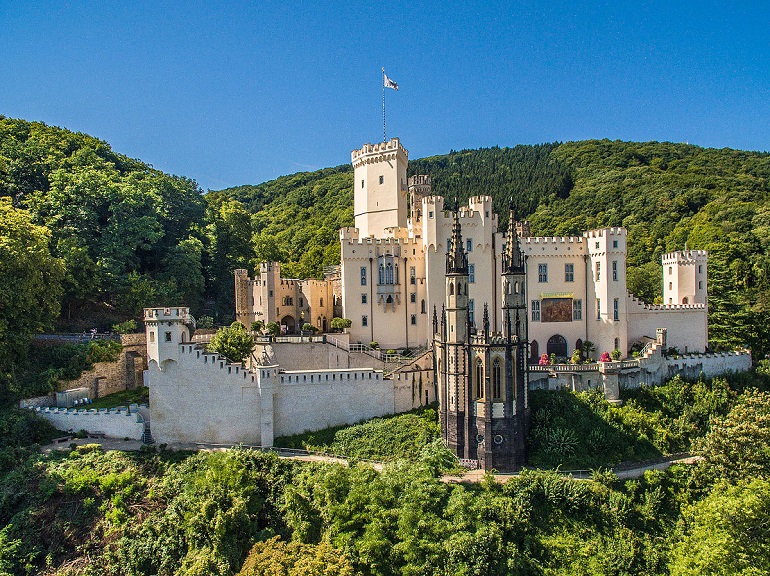
Stolzenfels Castle rises magnificently above the left bank of the Rhine near Koblenz, its romantic silhouette a striking feature of the river’s dramatic landscape. Surrounded by lush woodland and perfectly manicured gardens, the castle stands as a jewel of 19th-century Gothic Revival architecture, often cited as the epitome of Rhine Romanticism. Stolzenfels Castle was originally built between 1242 and 1259 by the Prince-Bishop of Trier. Destroyed by the French in 1689 during the Nine Years' War, the ruins were given by the city of Koblenz to King Frederick William IV of Prussia in 1823. Under his direction and to designs by Karl Friedrich Schinkel, the medieval remains were transformed between 1836 and 1842 into a Gothic Revival summer palace, complete with landscaped terraces and gardens by Peter Joseph Lenné. Today, the castle forms part of the Upper Middle Rhine Valley UNESCO World Heritage Site and is open to visitors, who can explore its historical reception rooms, cloistered courtyard and panoramic river views.
Interesting Facts about Stolzenfels Castle
- Stolzenfels Castle was originally built in the mid-13th century as a toll castle to control and collect fees from ships passing along the Rhine.
- The original medieval fortress was destroyed by French troops in 1689 during the Nine Years' War, leaving it in ruins for over a century.
- In 1823, the city of Koblenz gifted the ruined castle to Crown Prince Frederick William of Prussia, who was inspired to reconstruct it in the spirit of Romanticism.
- The castle was rebuilt in the 19th century into a Gothic Revival palace, designed by celebrated architects including Karl Friedrich Schinkel and Friedrich August Stüler.
- Stolzenfels Castle became a favoured summer residence of the Prussian royal family, serving as a symbol of prestige and cultural refinement.
- Queen Victoria attended the inauguration of the castle's Gothic chapel in 1845 during her visit to the Rhine.
- The castle's lavish interior decoration, much of it original, and its beautifully terraced gardens are regarded as outstanding examples of Rhine Romanticism.
- Stolzenfels Castle offers panoramic views of the picturesque Upper Middle Rhine Valley, today a UNESCO World Heritage Site.
- After the First World War, Stolzenfels Castle became state property and has since been open to the public as a museum.
- The castle grounds feature interactive tours, family-friendly amenities, and provide an enchanting encounter with the grandeur of 19th-century royal life.
History
The original fortress was constructed between 1244 and 1259 by Arnold II, Prince-Bishop of Trier, primarily as a strategic fortification to collect tolls from ships navigating the river. Its position not only helped assert the power of the Prince-Bishopric of Trier but also served as a counterbalance to rival fortifications erected across the river. Over the centuries, the castle underwent several extensions and improvements, notably in the 14th century. However, Stolzenfels suffered greatly during periods of military conflict, being occupied by Swedish troops in the Thirty Years' War and ultimately destroyed by the French in 1689 during the Nine Years’ War.
For much of the 18th century, the castle lay in ruins and was even used as a quarry. In 1802, the city of Koblenz acquired the property, and in 1823, the ruins were gifted to Crown Prince Frederick William of Prussia. Deeply inspired by the landscapes of the Rhine, the Crown Prince initiated an ambitious reconstruction project, transforming the medieval fortress into a stately Gothic Revival palace. Esteemed architects such as Karl Friedrich Schinkel, Friedrich August Stüler, and landscape gardener Peter Joseph Lenné contributed to the castle’s romantic design and parkland. By 1842, the main buildings and gardens were completed, and the castle was inaugurated with a grand celebration that included a torchlight procession and medieval costumes. Queen Victoria herself visited in 1845 during the inauguration of the castle's Gothic chapel.
Stolzenfels Castle continued to serve as a summer residence for the Prussian royal family and became a prime example of 19th-century interior and garden design. Following the First World War, it became state property, managed as a cultural monument for the region of Rhineland-Palatinate. Remarkably, Stolzenfels still possesses its original 19th-century furnishings and architectural elements, including the Large and Small Knights' Halls. Since 2002, Stolzenfels Castle has formed part of the UNESCO World Heritage Site "Upper Middle Rhine Valley." The castle underwent major renovations in the early 21st century, culminating in its full restoration and reopening to visitors. Today, Stolzenfels offers travellers a fascinating glimpse into both medieval and 19th-century royal life in the Rhineland.
Description
Architectural Features
The castle presents an enchanting mix of medieval grandeur and romantic elegance. Its delicate turrets, ornate crenellations, and sweeping terraces evoke both the martial might of a fortress and the refined style of a royal residence. Harmoniously blending ochre-hued walls with flat roofs, arcades, and balconies, the exterior whispers of Italian serenity. Strolling along winding stone paths, visitors are continually treated to breathtaking vistas over the Rhine Valley and the rolling vineyards beyond.
Interior Highlights
Stolzenfels Castle’s interiors transport visitors to a bygone era of royal sophistication. Many rooms are furnished with exquisitely restored period pieces, giving a fascinating glimpse into 19th-century aristocratic life. Highlights include:
- Knights’ Halls: The Large and Small Knights’ Halls, lavishly decorated and lined with historic frescos, are striking examples of the castle’s ceremonial spaces.
- Royal Apartments: Intricately adorned living quarters showcase authentic furniture, ornate wall coverings, and decorative objects, all reflecting the refinement of Prussian court culture.
- Chapel and Grand Staircase: The castle chapel’s stained glass windows and the impressive grand staircase enhance the sense of opulence and reverence.
- Viewing Terraces: Several rooms open onto terraces offering panoramic views of the Rhine and surrounding woodlands.
Gardens and Landscape
The castle is approached via a serpentine walkway through the landscape park, an artistic collaboration between architecture and nature. Designed by the renowned gardener Peter Joseph Lenné, these gardens are a romantic delight for any visitor. Rose-covered pergolas, ornate fountains, secluded benches, and wildflower meadows create an idyllic setting around the castle walls.
Getting There
By train, travellers can take regular services to Koblenz Hauptbahnhof, the city's main rail station, from numerous German and international locations. Upon arrival in Koblenz, onward connections to the castle are straightforward, as local buses frequently depart from the central station towards Stolzenfels.
By coach or bus, local bus line 670 offers a direct and convenient route from Koblenz city centre to the 'Stolzenfels-Schlossweg' stop. From there, it is a short and well-signposted walk up to the castle through scenic paths, making public transport an easy option for visitors.
By car, drivers should follow signs towards Koblenz and then Stolzenfels Castle, using the address 'Rhenser Straße 15, 56075 Koblenz' for navigation. A multi-storey car park is available at the foot of the castle, and visitors reach the entrance after a pleasant 20-minute walk uphill through landscaped grounds.
Best Time to Visit
The ideal occasions to explore Stolzenfels Castle fall in the gentle warmth of late spring (May to June) or the crisp calm of early autumn ( to October). During these shoulder-season months the weather is pleasantly mild—perfect for savouring the terraced gardens and panoramic Rhine views—while visitor numbers remain lower than in the bustling summer peak. This balance of comfortable temperatures, fewer crowds and full access to both the castle’s historic interiors and its landscaped parklands ensures a more relaxed and enchanting experience of this Gothic Revival gem.




