Germany Guide  |
|---|
|
| | Top German Cities |
|---|
|
| | Top National Parks |
|---|
|
| | Photos |
|---|
|
| | German States |
|---|
|
| | Europe Guide |
|---|
|
| | Travel Tools |
|---|
|
|
|
|
Schleswig-Holstein Travel Guide
 Beach Westerland, Sylt Island, North Frisia. Beach Westerland, Sylt Island, North Frisia.
Introduction

Almost entirely flat, Schleswig-Holstein is the northernmost German state and was part of Denmark until 1864 (after the Danish defeat in the Second Schleswig War). For most of its history, the region was therefore Danish, and bilingual place names are frequent. With a land area of 15,763 km² and a population of 2,835,000, Schleswig-Holstein is slightly larger than Montenegro or the U.S. state of Connecticut, and as populous as Albania or the U.S. states of Utah or Kansas.
Schleswig-Holstein is mostly a maritime region, with ports on both the North Sea and the Baltic Sea. Its largest port, Lübeck is the historical capital of the Hanseatic League which controlled trade over most of northern Europe between the 13th and 17th centuries.
Between the 9th and the 13th centuries, Schleswig-Holstein was part of the Duchy of Saxony and was known as Nordalbingia.
Famous people from Schleswig-Holstein include (chronologically): Nobel Prize writer and classical scholar Theodor Mommsen, Nobel Prize physiologist Emil Adolf von Behring, Nobel Prize physicist Max Planck, novelist Heinrich Mann, Nobel Prize novelist Thomas Mann, and Nobel Peace Prize Chancellor Willy Brandt.
History of Schleswig-Holstein
The region comprising modern Schleswig-Holstein has a complex history shaped by centuries of conflict between Danish and German powers, with its origins rooted in the early medieval period when it was inhabited by West Germanic tribes including the Cimbri, Angles, Jutes, and Saxons, alongside North Germanic Danes and Frisians. The Vikings established the prosperous trading settlement of Hedeby (Haithabu) near the Schlei inlet, which became one of the largest settlements in Northern Europe with up to 2,000 inhabitants during the first millennium, protected by the Danevirke, a 30-kilometre defensive fortification stretching across the Schleswig isthmus that was first constructed in 737 CE and repeatedly strengthened over subsequent centuries. In 811, the River Eider was declared the border between the Frankish Empire and Denmark, establishing a frontier that would remain contested for over a millennium, whilst in 934 the German king Henry I established the March of Schleswig between the Eider and Schlei as an outpost of the Holy Roman Empire. The region became formally divided into two distinct entities: Schleswig developed as a Danish fief and duchy from the 12th century onwards, remaining legally part of Denmark, whilst Holstein to the south became part of the Holy Roman Empire. From 1460, the King of Denmark ruled both Schleswig and Holstein as duke, creating a peculiar constitutional arrangement whereby the Danish monarch held territories both within and outside the Holy Roman Empire, with Holstein later becoming a member of the German Confederation after 1815.
The 19th century witnessed intense nationalist conflicts over the region, known as the Schleswig-Holstein Question, as both Danes and Germans claimed rightful sovereignty over the territories. Whilst Holstein's population was entirely ethnically German, Schleswig had been predominantly Danish until extensive German influence led to the Germanisation of South Schleswig during the late 18th and early 19th centuries, creating a complex linguistic and cultural boundary. In 1848, Denmark attempted to formally annex Schleswig through the Eider Policy, prompting the First Schleswig War in which Prussia invaded but Denmark ultimately prevailed. However, the balance shifted dramatically in 1864 when Denmark passed the November Constitution tying Schleswig more closely to the Danish kingdom, triggering the Second Schleswig War in which Prussian and Austrian forces crossed the border on 1 February 1864. The war proved catastrophic for Denmark, particularly after the loss of the historic Danevirke fortification without a fight, causing substantial psychological shock to the Danish nation. The Treaty of Vienna concluded the conflict on 30 October 1864, forcing Denmark to cede the duchies of Schleswig, Holstein, and Saxe-Lauenburg to Prussia and Austria. Prussia subsequently absorbed both duchies in 1867, creating the province of Schleswig-Holstein, whilst Article 5 of the 1866 Treaty of Prague promised North Schleswig's population a future vote on constitutional affiliation, though this provision was not immediately implemented.
Following Germany's defeat in the First World War, the Allies mandated plebiscites in Schleswig under the Treaty of Versailles to resolve the long-standing territorial dispute. The region was divided into voting zones, and on 10 February 1920, the northern zone voted overwhelmingly (approximately 75 per cent) to rejoin Denmark, whilst the southern portions voted on 14 March 1920 to remain with Germany, establishing the modern border between Denmark and Germany. The Danish-speaking North Schleswig was subsequently returned to Denmark and renamed South Jutland (Sønderjylland), restoring the historical name used before Gerhard III of the House of Schauenburg changed it to Schleswig. After the Second World War, Schleswig-Holstein absorbed over one million refugees from former German territories in Eastern Europe, significantly altering the region's demographic composition. The southern portion of the historical region, now the German federal state of Schleswig-Holstein, became one of the founding states of the Federal Republic of Germany in 1949, whilst the northern portion remains part of Denmark as the Region of Southern Denmark. The archaeological sites of Hedeby and the Danevirke, testifying to the region's Viking heritage and medieval significance, were inscribed as a UNESCO World Heritage Site in 2018, recognising their outstanding importance to European history.
Clickable Tourist Map of Schleswig-Holstein
Note that dots, castle icons and national parks are not clickable on the mobile version. Please use the desktop version for optimal navigation.
Blank map of Schleswig-Holstein by Grundkarte TUBS, Relief by Lencer. Tourist locations by Maciamo. CC BY-SA 3.0.
Attractions
Schleswig
|
Wadden Sea National Park ※ |
|---|
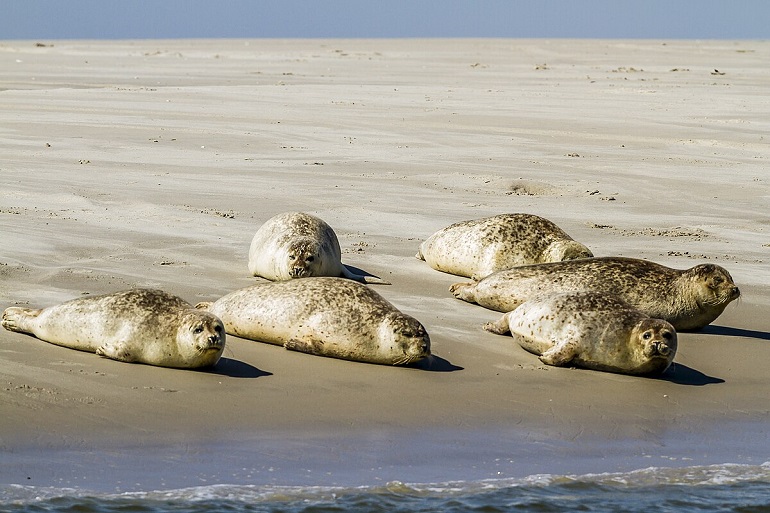
 The Wadden Sea National Park offers visitors a unique opportunity to experience the world's largest tidal flats system, recognised as a UNESCO World Heritage Site since 2014 for its globally significant geological and ecological values. This dynamic landscape, shaped by the ebb and flow of tides, features salt marshes, dunes, and vast mudflats where visitors can enjoy extraordinary activities like walking on the seabed during low tide or hand-picking oysters with expert guides. The area serves as a crucial stopover for 10-12 million migratory birds annually, making it comparable to an international airport for birds, and houses Denmark's largest population of common seals. Beyond its natural wonders, the Wadden Sea boasts a rich cultural history including land reclamation and dyke construction, while offering unique experiences such as "Black Sun" starling murmurations and Dark Sky stargazing on Mandø island, where it becomes pitch black at night. |
| Friedrichstadt |
|---|
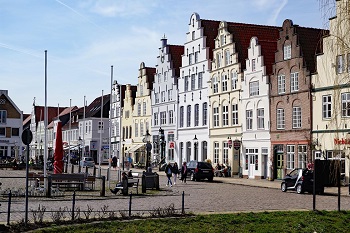
 Friedrichstadt, founded in 1621 by Dutch religious refugees invited by Duke Friedrich III, reflects a unique blend of Dutch architecture and urban design with canals, stepped gable houses, and a chequerboard street plan. Known as "Little Amsterdam," its grid layout, waterways and 17th-century merchant façades reflect a tradition of tolerance among Remonstrants, Mennonites, Catholics and Jews. Today, guided canal boat tours, cobbled lanes, historic bridges and small museums offer a compact, walkable glimpse into early modern urban planning, while the nearby Eider and Treene rivers invite relaxed cycling, walking and paddleboarding. |
| Husum |
|---|

 Husum (pop. 24,000) is a small harbour town on the North Sea coast, which makes a convenient base to explore the North Frisian islands and the Wadden Sea National Park. The town was the birthplace of the novelist Theodor Storm, who coined the epithet "the grey town by the sea". The compact centre features a working inner harbour, gabled merchants’ houses, and the NordseeMuseum, while Schloss vor Husum, a 16th-century castle with a baroque garden, sits a short walk away. In late March, the grounds of Schloss Husum are covered by a huge carpet of purple crocuses, well worth a detour in your are in the region. |
| Flensburg |
|---|

Flensburg (pop. 91,000) is Germany’s northernmost city and the third-largest in Schleswig-Holstein, located at the inland tip of the Flensburg Fjord about 7km south of the Danish border. The city has a bilingual German–Danish character and is home to a recognised Danish minority with dedicated schools and cultural institutions. Flensburg has a long history as a merchant port. In the 16th century it already traded as far as the Mediterranean, Greenland and the Caribbean. In the 18th century, cane sugar was imported from the Danish West Indies and refined in Flensburg. The main sight is the Maritime Museum, which has an interesting section of the rum trade. Flensburg is also known nationally for the Federal Motor Transport Authority’s driver penalty points register, the handball club SG Flensburg-Handewitt, and the Naval Academy at Mürwik. |
|
Schloss Glücksburg |
|---|

 Constructed between 1582 and 1587, Glücksburg Castle (a.k.a. Glücksburg Palace or Schloss Glücksburg) sits on the shores of the Flensburg Fjord. It was originally built as a residence for the Dukes of Schleswig-Holstein-Sonderburg-Glücksburg, and has been used occasionally by the Danish Kings. Nicknamed the Wasserschloss ('water castle') owing to its position in the middle of a lake, it is one of the most important Renaissance castles in northern Europe. |
| Schleswig |
|---|

Located at the end of the Schlei Förde (Slien Fjord), Schleswig (pop. 27,000) grew out of the Viking settlement of Haithabu (Hedeby), which flourished as one of northern Europe's biggest trading town between the 9th and 10th centuries. From the 12th century, the region was ruled by the Dukes of Gottorf, whose palace houses the Schleswig-Holstein Landesmuseum, the city's main attraction. The other one is the pretty fishing village of Holm, southeast of the Old Town. |
Holstein
| Kiel |
|---|

 Kiel (pop. 250,000) is the capital and largest city in Schleswig-Holstein, as well as a major German naval base and maritime centre. The city hosts Kiel Week each June, one of the world’s largest sailing events, and serves as a key ferry and cruise hub for the western Baltic. Almost completely destroyed in WWII, Kiel doesn't offer much in terms of historical buildings. Notable attractions include the Maritime Museum, where three historic ships are moored, and the Aquarium, whose seals are quite popular with kids, while the fjord shoreline offers beaches such as Falckenstein and promenades at Laboe and Schilksee. The Olympic sailing competitions of the 1936 and the 1972 Summer Olympics were held in Kiel. |
|
Schloss Ahrensburg |
|---|

Ahrensburg Castle is one of the Renaissance gems of northern Germany. It was built in 1585 by Daniel Rantzau, a general of the King of Denmark. Acquired in 1759 by Heinrich Carl von Schimmelmann, the castle was remodelled in the baroque tastes of the day.The white-painted brick structure sits on a small island surrounded by a moat and features distinctive stepped gables, decorative stonework, and well-preserved interiors that reflect the lifestyle of North German nobility during the late 16th and early 17th centuries. |
| Lübeck ※ |
|---|
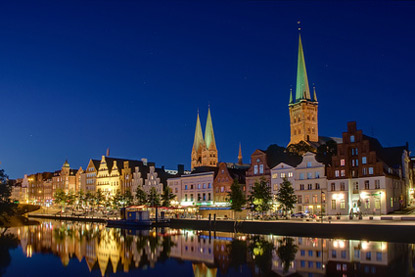
 Former capital of the Hanseatic League, Lübeck (pop. 217,000) is a pristine medieval city of brick merchant houses and copper-spired churches enclosed on an island by the Trave has been listed by UNESCO since 1987. Lübeck is still the largest German port on the Baltic Sea. Founded in the 12th century, it grew as a major trading hub of the Hanseatic League, reflected in landmarks such as the Holstentor city gate, the gabled merchants’ houses along the Obertrave, and St. Mary’s Church with its twin towers. The compact Altstadt features seven major church spires, narrow lanes, and historic courtyards, while museums like the European Hansemuseum and the Buddenbrook House explore the city’s commercial and literary heritage. As the home of the Nobel-prize winners Thomas Mann and Günter Grass, the city has top-notch literary museums dedicated to each author. |
|
Schloss Eutin |
|---|

Nestled beside the tranquil waters of the Great Eutin Lake, Eutin Castle is an impressive four-winged residence that radiates elegance and architectural grandeur. With its distinctive red-brick façade, graceful towers, and stately gate tower, the castle forms a picturesque focal point in the heart of Schleswig-Holstein’s scenic lakelands. Eutin originally belonged to the Prince-Bishops of Lübeck, and later became the summer residence of the Dukes and subsequently Grand Dukes of Oldenburg. The four-winged medieval castle was expanded and refurbished luxuriously over the last 300 years. |
|



 : Local interest
 : Moderately interesting
 : Outstanding place
 : Must-see in the country
 : Top cities in Europe