



Altena Castle.
Introduction
Built by the Counts of Berg in the 12th century, Burg Altena was the seat of the influential House of the Marck. In 1912, it became the world's first youth hostel established within a castle, which is is still used as such today. The castle also houses two museums: the Museum of the County of Mark and the World Youth Hostels Museum.
History
All started in 1108, when Adolf and Everhard von Berg were granted a piece of land in the Sauerland region by Emperor Henry V in reward for their faithful service.
They erected a castle on top of Mount Wulfseck, which they originally called Wulfeshagen, and later renamed Altena. After the acquisition of the March of Oberhof in 1198, the Counts of Altena re-styled themselves 'Counts of the Marck' (or 'Mark' or 'March') or 'Grafen von den Mark' in German. It is under this name that they were to be remembered in history, notably in the Principality of Liège in present-day Belgium, where they would provide three influential Prince-Bishops (known under the Francisied surname 'de La Marck') between 1313 and 1538. Two Counts of La Marck would also become Archbishop-Elector of Cologne (including Engelbert III, who had already been Prince-Bishop of Liège), and two others Prince-Bishops of Münster.
In 1368, Adolph III of the Marck inherited the County of Cleves from his uncle John of Cleves. Adolph's son, Adolph IV, would become the first Duke of Cleves in 1417. His own children with Marie of Burgundy would marry into many powerful European families (Bavaria, Brunswick-Lüneburg, Guelders, Navarre), including his daughter Mary who would become the mother of King Louis XII. In the 16th century, the Duchies of Jülich-Berg and Guelders came into the hands of the House of La Marck.
From 1392, the Counts of the Marck only resided occasionally at Altena Castle, preferring their properties in Münster, Cologne, Liège and in the Meuse Valley, such as Seraing-le-Château and Sedan. In 1424, Count Eberhard II von der Mark (1364-1440) had built the castle in and become lord of Sedan. In the mid-15th century, Robert I of La Marck would become Duke of Bouillon. Robert I's great-great-grandson, Henri Robert de la Marck, added the title of Prince of Sedan to that of Duke of Bouillon. His daughter, Charlotte, was the last La Marck of that branch. She married Henri de La Tour d'Auvergne, and their descendants kept the title of Duke of Bouillon until the French Revolution.
Following the extinction of the House of La Marck in 1609, the County of Mark and Duchy of Cleves were the first states in West Germany to be annexed by Brandenburg-Prussia, in 1614. Altena Castle was turned into a militay garrison, then a county jail from 1766 to 1811, and eventually a hospital from 1856 until 1906.
In 1912, Richard Schirrmann acquired the castle and transformed it into one of the world's first permanent youth hostels, and the first to be housed in a castle.
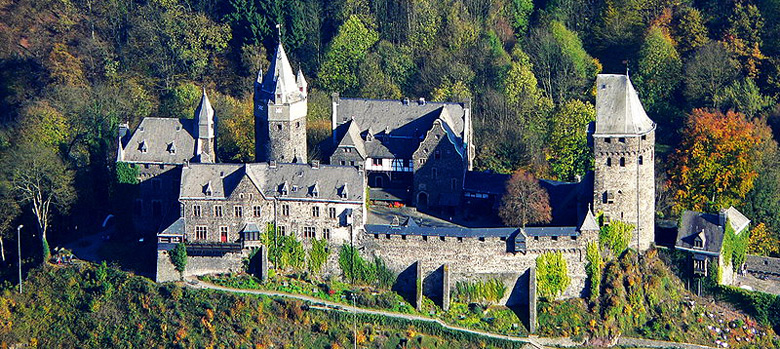
Aerial view of Altena Castle.
Opening Hours & Admission
The castle is open from Tuesday to Friday from 9:30 am to 5:00 pm, and on weekends from 11:00 am to 6:00 pm. It is closed on Mondays as well as on 24th, 25th and 31st December and 1st January. Admission costs 5 € for adults and 2.5 € from children from 6 to 17 years old. Entry is free under 6 years old.
Access Map
View Larger Map
Getting There
To reach Altena Castle, you have several convenient options. By car, navigate to Fritz-Thomee-Straße 80, 58762 Altena, using the A45 motorway and following signs for 'Burg Altena'. Parking is available nearby for a small fee of around €2-€4. If using public transport, take a train to Altena Station from major cities like Dortmund (journey time approximately 1-1.5 hours), then catch bus 527 towards 'Altena - Burg' for about €2.50. Alternatively, the innovative 'infotainment elevator' offers a barrier-free option from Altena's pedestrian zone, whisking visitors through a 90-metre experience tunnel and 80 metres upwards to the castle in just 30 seconds. For those already in Altena town centre, a pleasant 20-30 minute uphill walk along well-marked paths provides beautiful views of the surrounding Lennental. The castle is open Tuesday to Friday from 9:30 to 17:00, and weekends from 11:00 to 18:00, with admission costing €5 for adults and €2.50 for children aged 6-17 (free for under 6s).
Best Time to Visit
The best time to visit Altena Castle is during the spring and summer months, from April to September. During this period, the weather is generally mild and pleasant, making it ideal for exploring the castle grounds and enjoying the panoramic views of the surrounding Sauerland region. The castle's outdoor areas are particularly lovely in late spring when the gardens are in full bloom. Summer offers the advantage of longer daylight hours, perfect for leisurely tours and outdoor activities. Additionally, this time of year often features special events and medieval festivals, adding an extra layer of excitement to your visit. However, if you prefer a quieter experience with fewer crowds, consider planning your trip for weekdays or the shoulder seasons of early spring or late autumn. Regardless of when you choose to visit, Altena Castle's rich history and stunning architecture promise a memorable experience.
| Travel destinations in North Rhine-Westphalia | ||||||||||||||
|---|---|---|---|---|---|---|---|---|---|---|---|---|---|---|
|
|
|
|
| ||||||||||
|
|
|
|
| ||||||||||
|
| |||||||||||||


