



| Contents |
|---|
Introduction
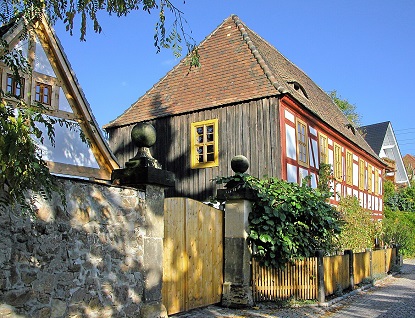
Located in the Elbe valley 10 kilometres northwest of Dresden, Radebeul (pop. 34,000) is renowned for its well-preserved 19th-century architecture and extensive vineyards that form part of the Saxon Wine Route. Its landscape is characterised by terraced vineyards and historic wineries, including the state-owned Wackerbarth Castle. The town is also strongly associated with the German author Karl May, who lived and died in Radebeul; the Karl May Museum, housed in his former villa, is a significant local landmark. Another notable feature is the heritage narrow-gauge railway, the Lößnitzgrundbahn, which offers scenic journeys through the local area.
Interesting Facts about Radebeul
- Radebeul is a leafy wine-growing town on the Elbe just northwest of Dresden, often dubbed the “Nice of Saxony” for its mild climate and pleasant landscape.
- It sits within the Meißen wine area, one of Germany’s most northerly and easterly viticultural zones, with vineyards climbing steep slopes above the river.
- The town is a gateway to the Saxon Wine Route and Wine Trail, with estates such as Hoflößnitz and Schloss Wackerbarth showcasing centuries of winemaking.
- Schloss Wackerbarth in Radebeul continues one of Europe’s oldest sparkling-wine traditions, dating back to an 1836 mousseux cellar inspired by Champagne methods.
- Radebeul is inseparably linked with the novelist Karl May, whose former home “Villa Shatterhand” anchors the Karl May Museum and its ethnographic collections.
- The museum complex includes Villa Bärenfett, a log cabin in May’s garden that opened as an ethnological exhibit in 1928 and later expanded to honour his life and work.
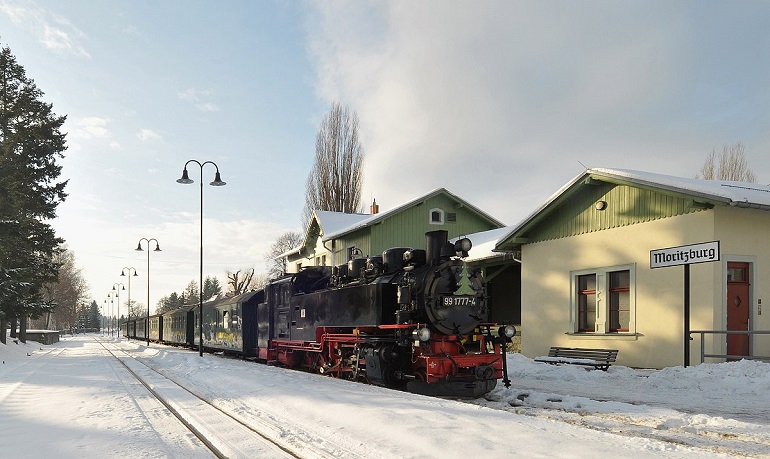
- A historic steam narrow-gauge line, the Lößnitzgrundbahn, runs from Radebeul through the valley to Moritzburg Castle, offering nostalgic rides through wine country.
- Altkötzschenbroda, the old village green, is a charming square for an evening glass of local wine amid restored houses and inns.
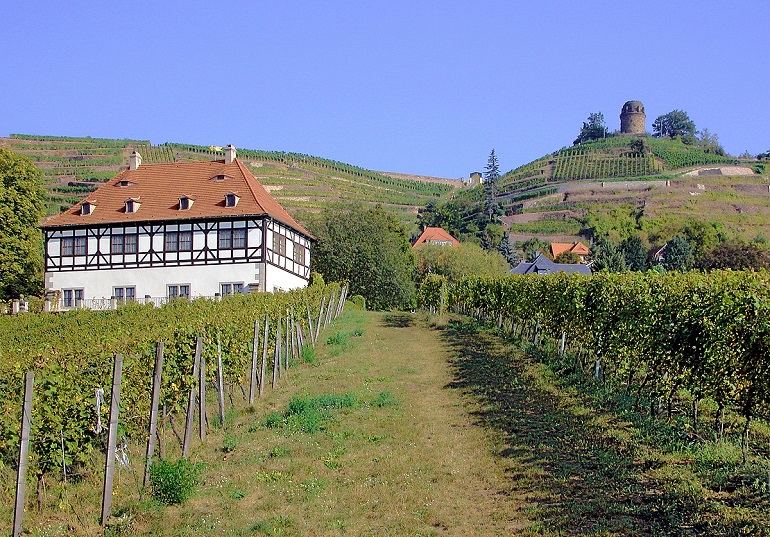
- The Spitzhaustreppe, a long baroque stairway above the Hoflößnitz vineyards, rewards a climb with sweeping views over the Elbe valley.
- Radebeul’s modern shape reflects a 20th-century merger of older villages such as Kötzschenbroda, Serkowitz, and Oberlößnitz into a single town.
- Known as an affluent garden suburb, Radebeul blends villa districts, vineyards and cultural institutions with quick access to Dresden’s urban amenities.
History
Radebeul's history stretches back to the 14th century, when the village was first mentioned in historical records in 1349. Originally a modest settlement in the Elbe valley, the area gradually developed through the absorption of neighbouring villages, with Radebeul incorporating Serkowitz in 1905. The settlement officially became a town on 1st April 1924, marking a significant milestone in its administrative development. Meanwhile, the neighbouring village of Kötzschenbroda had been expanding its own boundaries, taking over Lindenau in 1920 and acquiring Naundorf, Zitzschewig, and Niederlößnitz by 1924, when it too achieved town status.
The modern formation of Radebeul occurred through a series of municipal consolidations during the 1930s. In 1934, Wahnsdorf and Oberlößnitz joined the original Radebeul, and on 1st January 1935, the towns of Kötzschenbroda and Radebeul were united under the single name of Radebeul. This unification was partly influenced by political considerations of the time, as the Slavic-rooted name "Kötzschenbroda" was deemed too "ungermanic" by the authorities. The town's administrative status continued to evolve through the 20th century: it became part of the Dresden district in 1947, was designated as a major town within the rural district in 1995, and when the rural district of Dresden was dissolved, Radebeul was incorporated into the district of Meißen.
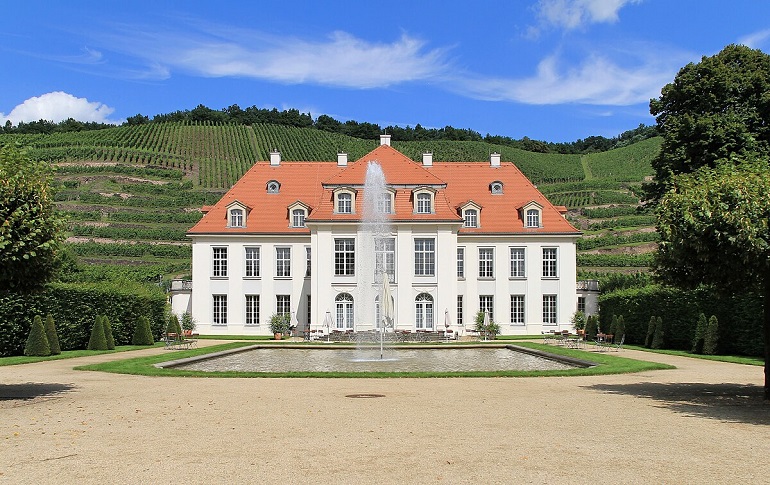
Radebeul's significance extends beyond its administrative development, with the town earning recognition as one of Saxony's most important cultural and economic centres. The area has a distinguished 400-year-old winemaking tradition that has shaped both its landscape and identity, making it the heart of the Saxon Wine Route. The region's viticultural heritage dates back over 850 years, with the establishment of significant wine estates including the baroque Schloss Wackerbarth complex, built between 1727 and 1730 by August Christoph Count of Wackerbarth, a close confidant of Augustus the Strong. The town also holds historical significance for Saxon sparkling wine production, as in 1836, three wine estate owners founded the first mousseux production facility in Saxony, bringing French champagne-making expertise from Reims to establish what became the Bussard cellars. Today, Radebeul is sometimes referred to as the "Nice of Saxony" for its pleasant landscape and mild climate, and has achieved the distinction of being the wealthiest town in Eastern Germany.
Main Attractions
Schloss Wackerbarth
Schloss Wackerbarth stands as the premier wine estate along the Saxon Wine Route, celebrated as Europe’s first ‘experience winery’. The estate features a resplendent 18th-century baroque palace, set amidst meticulously landscaped gardens and steep, terraced vineyards overlooking the Elbe Valley. Its history as Saxony’s oldest producer of sparkling wine dates back centuries, and today’s visitors can embark on guided tours through modern production facilities and historic cellars, learning about the winemaking process from grape to glass. Wine tastings are an essential part of the experience, with opportunities to sample award-winning Saxon Sekt and local varietals. Beyond viticulture, Schloss Wackerbarth is a vibrant cultural venue, hosting classical concerts—including those for the Dresden Music Festival—culinary workshops, and a lively programme of seasonal festivals that showcase the region’s famed joie de vivre.
Altkötzschenbroda Village Green
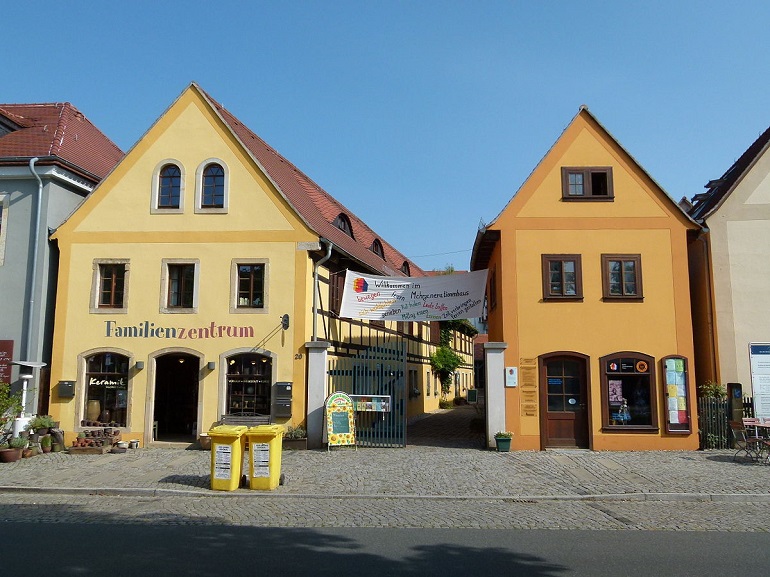
The heart of Radebeul’s Old Town, Altkötzschenbroda’s village green is a charming and beautifully preserved historical centre, first documented in the 13th century. The area is lined by cobbled lanes, colourful old cottages, independent boutiques, art galleries, and inviting cafés, making it a delightful place to explore at leisure. The square itself is anchored by the Friedenskirche, or Peace Church, which played a significant role in Saxony’s history as the site of a truce during the Thirty Years’ War. Following extensive restoration in the 1990s, the village green has become the town’s social and cultural hub, hosting regular markets, lively festivals, and a much-loved Christmas market. This venue encapsulates the town’s rural heritage while offering a convivial setting for enjoying local wines, regional cuisine, and community events.
Saxon Wine Route and Vineyard Trails
Radebeul forms a prominent part of the 60-kilometre-long Saxon Wine Route, which meanders through Germany’s smallest and most easterly wine region. The landscape is defined by steeply terraced vineyards—many supported by historic dry-stone walls requiring careful manual maintenance. A network of walking and cycling trails criss-crosses the vine-clad slopes, offering panoramic views over the Elbe Valley and connecting numerous family-run wineries and traditional Straußwirtschaften (seasonal wine taverns). These paths provide a hands-on way to experience Saxon viticulture, especially during the autumn grape harvest. Visitors can taste local specialities such as Goldriesling, a rare grape variety almost exclusive to Saxony, while learning about the history and techniques of winemaking in this unique region.
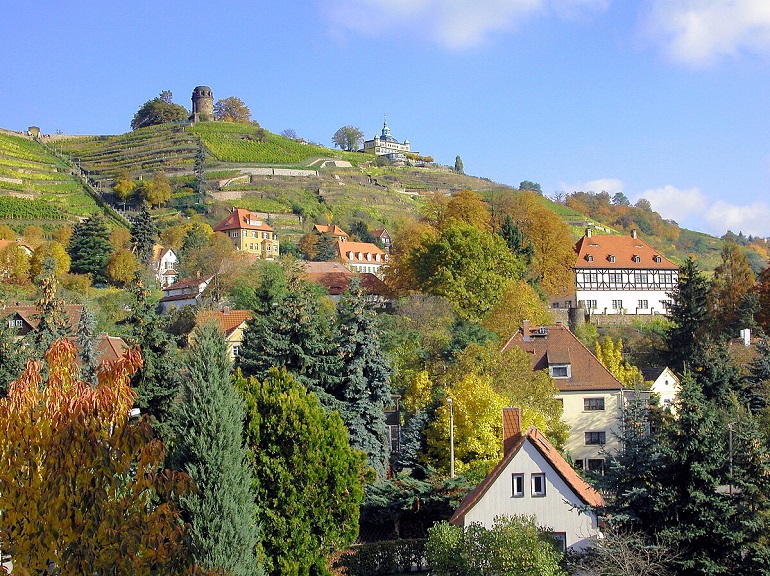
Spitzhaustreppe (Spitzhaus Steps)
The Spitzhaustreppe is a striking baroque staircase and one of Saxony’s most impressive public works of the 18th century. Designed for the Elector Augustus the Strong by the eminent architect Matthäus Daniel Pöppelmann, it was intended to connect the Hoflößnitz winery with the planned pleasure palace above. Completed in 1750, the monumental structure consists of 397 sandstone and granite steps, ascending 76 metres over a distance of 220 metres. Today, those who undertake the climb are rewarded with breathtaking views of the Elbe Valley, as well as access to the Spitzhaus restaurant and its terraces. The staircase is also the site of the annual Sächsischer Mt. Everest Treppenmarathon, a gruelling endurance race that sees participants climbing the steps a hundred times to simulate the ascent of Mount Everest—a uniquely Saxon sporting challenge.
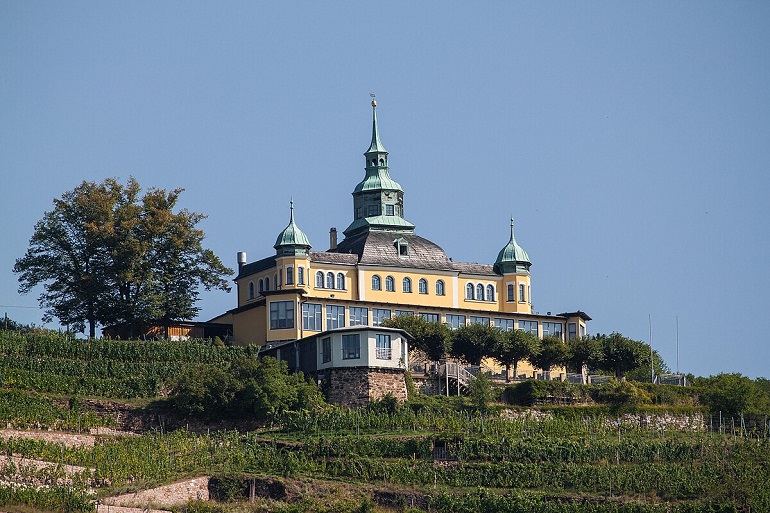
Spitzhaus
The Spitzhaus is one of Radebeul’s most iconic landmarks, an elegant late Renaissance summer residence perched atop the vine-clad slopes overlooking the Elbe Valley. Originally constructed in 1622 on an almost square foundation, its current distinctive look was shaped in the mid-17th century with the addition of a grand, curved tent roof, attributed to master builder Wolf Caspar von Klengel. The house became property of the Saxon Elector Augustus the Strong in 1710 and was renowned for its upper-floor banqueting hall, where courtly entertainments and illustrious guests such as Frederick II of Prussia and Emperor Joseph II enjoyed the sweeping vistas. In the early 20th century, it was transformed into a restaurant and today welcomes visitors with regional cuisine and commanding views stretching towards Dresden. The Spitzhaus is not only prized for its historical architecture and storied past but also for its unrivalled panorama over the Radebeul vineyards and the Elbe river valley.
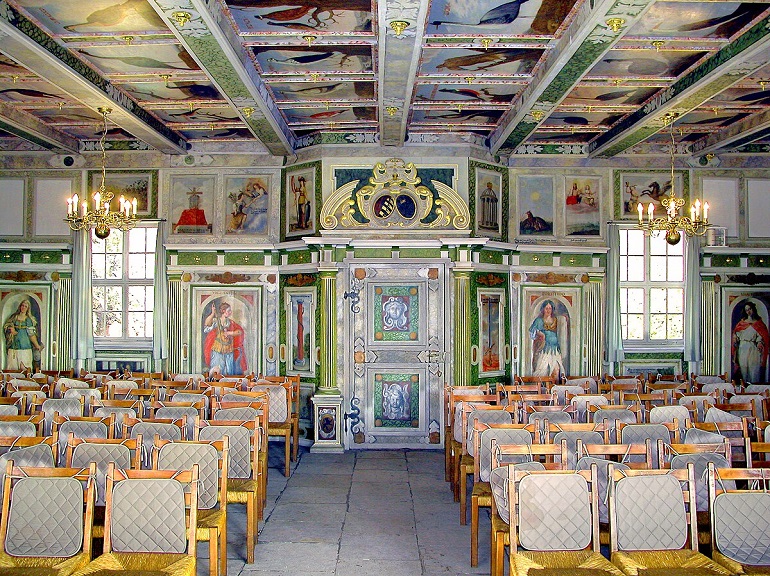
Schloß Hoflößnitz
Schloß Hoflößnitz, nestled amid terraced vineyards at the foot of the Spitzhaus steps, is a central monument to Saxony’s winemaking heritage. For nearly 500 years, it served as the seat of the electors’ courtly vineyards, and now houses the Saxon Winegrowing Museum, which showcases the region’s rich viticultural history. The estate is distinguished by its striking baroque architecture and a splendid banquet hall, famed for lavish ceiling frescoes depicting eighty exotic birds painted by Dutch artist Albert Eyckhout. Visitors to Hoflößnitz can explore the historic press house, view maps and equipment used in centuries of Elbe Valley wine production, and plan excursions along the Saxon Wine Route at the dedicated visitor centre. With its combination of living tradition, architectural elegance, and authentic vineyard atmosphere, Schloß Hoflößnitz remains at the very heart of Radebeul’s cultural and culinary identity.
Bismarckturm (Bismarck Tower)
Standing atop one of Radebeul’s vine-covered hills, the Bismarckturm is both a historical monument and a beloved viewpoint. Built in 1907 to honour Otto von Bismarck, the tower’s name and symbols were removed after the Second World War and it was subsequently known as the “Tower of Youth” until its restoration in the 1990s. The tower’s terrace is among the finest vantage points in Radebeul, offering sweeping panoramas across the vineyards, the town, and all the way to Dresden’s skyline. Visitors can climb the tower at weekends during the warmer months, enjoying an even more commanding view. The surrounding area is popular for leisurely walks, picnics, and simply taking in the scenery, particularly during the autumn months when the foliage glows in rich golden hues.
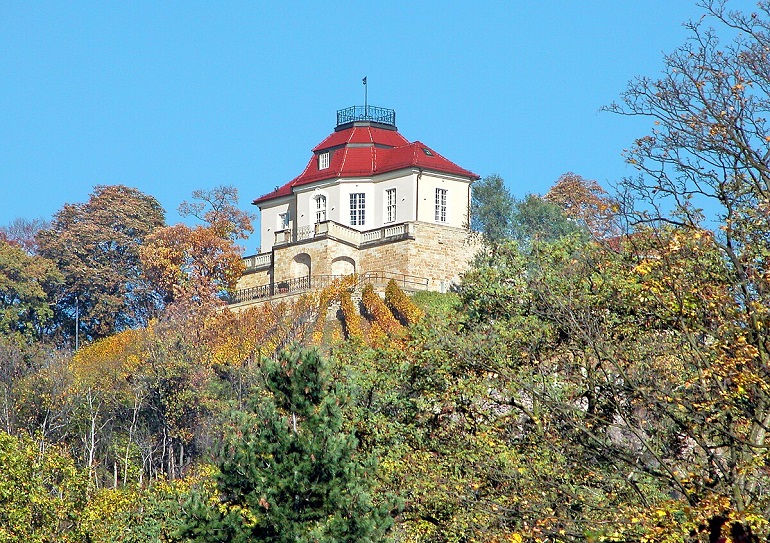
Niederlößnitz Berghaus (Mätressenschlösschen)
The Niederlößnitz Berghaus, also known locally as the Mätressenschlösschen, is a striking and historically significant pavilion perched above the vineyards of Neufriedstein in Radebeul’s Niederlößnitz quarter. Constructed in 1771/1772, its octagonal shape and mansard roof with an observation platform make it one of the town’s most recognisable landmarks. Once a pleasure retreat for the estate owners, its architectural harmony is accentuated by decorative terraces and a formal garden leading from the main house up the hillside. The Berghaus was built in the late baroque style, offering panoramic views over the historic vineyards and the Elbe Valley below. After periods of private and municipal ownership, the building was restored in the late 20th century, and it stands today as an architectural and landscape treasure, representative of the region’s rich viticultural heritage.
Friedensburg
Friedensburg is an elegant villa located in Radebeul’s Niederlößnitz, dating to 1870/1871 and reflecting the area’s era of prosperous villa construction. Designed in the style of a romanticised feudal residence, the villa stands amidst gardens and vineyards, exuding the stately charm that was highly prized by Dresden’s wealthy bourgeoisie at the time. Its graceful architectural details and prominent hilltop situation have established Friedensburg as an enduring part of Radebeul’s prestigious villa landscape. Over time, Friedensburg has served various residential functions and remains under monument protection, embodying the town’s blend of historic grandeur and scenic beauty.
Paulsberg Wine Estate (Weingut Paulsberg)
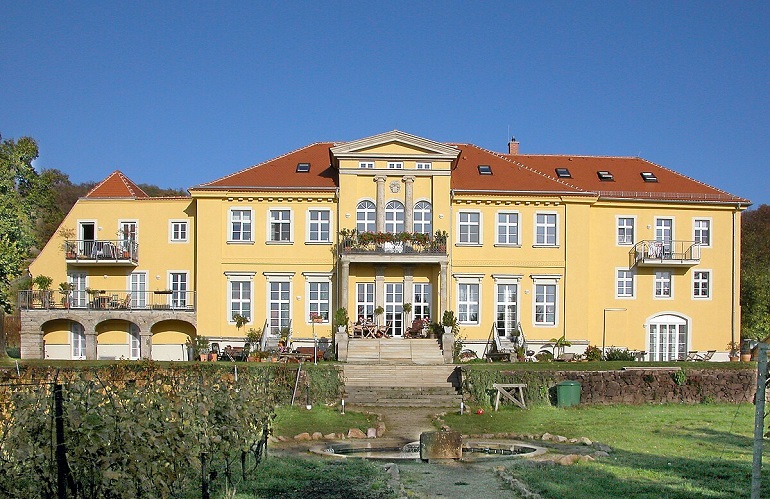
Situated in the historic district of Zitzschewig, the Weingut Paulsberg is one of Radebeul's most significant former wine estates, with a rich history dating back to the 18th century. The centrepiece is a grand classicist manor house, later enhanced by an Art Nouveau extension designed by the celebrated architect Richard Riemerschmid. The estate gained prominence under Johann Martin Fleischmann, a key figure in establishing the Saxon Winegrowing Society in 1801, and was given its current name in 1837 in memory of a former owner’s husband. After the Second World War, it played a crucial role as the headquarters of the state-run winery, producing the region's first post-war Sekt in 1952. While the magnificent buildings have since been converted into a private residential complex, the name Paulsberg endures as a respected vineyard site within the renowned Radebeuler Johannisberg growing area, preserving its legacy in the local wine tradition.
Lößnitzgrundbahn Steam Railway
Affectionately known as the “Lößnitzdackel” (Lößnitz Dachshund), the historic Lößnitzgrundbahn is a narrow-gauge steam railway that has been operating since 1884. The 16.6-kilometre route, which begins in Radebeul, winds through the romantic Lößnitzgrund valley, passing ancient woodlands, quaint villages, and picturesque ponds before reaching the terminus in Radeburg. The journey introduces passengers to the scenic beauty of Saxony’s countryside, with the highlight being the crossing of the Dippelsdorf pond on a 210-metre-long embankment. Restored vintage carriages and an open-air observation carriage provide an evocative travel experience, while themed excursions—such as culinary wine tours and festive holiday rides—add extra charm. The railway remains a beloved attraction for families, transport enthusiasts, and those seeking a nostalgic journey through Saxony’s rural heritage.
Top Museums
Literary and Ethnographic Heritage
Karl May Museum
The Karl May Museum is a major attraction for enthusiasts of German adventure literature. It is housed across two distinctive buildings: Villa Shatterhand, the author’s former residence, and Villa Bärenfett, a log cabin built in the garden.
Villa Shatterhand invites visitors into the world of Karl May, with displays that include his original study, library, and personal mementos. The interior is decorated with oriental furnishings and souvenirs, echoing the exotic settings of his novels. Among its treasures are the famous “Silver Nails Rifle” and “Bear Slayer.”
Villa Bärenfett is notable for its ethnographic collection focused on the cultures of North American Indigenous peoples, a rarity in Europe. It features more than 800 objects from the 18th and 19th centuries, including eagle-feather headdresses, tomahawks, and a large painting of the Battle of the Little Bighorn.
Modern and Experimental Art
Lügenmuseum (Museum of Lies)
For a truly unique experience, the Lügenmuseum (Museum of Lies) challenges visitors to question the boundaries between fiction and reality. Founded by artist Reinhard Zabka, it began as a form of protest art in the former GDR.
Housed in a former inn, the museum is described as a “private work of art,” combining contemporary installation pieces with historical curiosities and a splash of political commentary. Visitors are greeted by a riot of light installations, animatronics, collages, and peculiar objects—including Van Gogh’s ear. The museum’s playful origin story is intertwined with the exhibits, reinforcing the idea that lies can sometimes reveal deeper truths.
Wine and Agricultural Traditions
Hoflößnitz Estate and Saxon Wine Museum (Sächsisches Weinbaumuseum)
The Hoflößnitz estate is the historic heart of Saxon viticulture and home to Saxony’s only wine museum. The museum preserves and presents the region’s wine-making heritage from its beginnings to the present day.
The centrepiece is the Electoral “Pleasure and Mountain House,” built around 1650 for Elector Johann Georg I. Its lavishly decorated banqueting hall is adorned with 80 paintings of Brazilian birds, and the elector’s private apartments are also open to visitors. The estate is also notable for its commitment to organic wine production.
Regional Art and Exhibition Spaces
Stadtgalerie Radebeul (City Gallery)
Located on the historic village green of Altkötzschenbroda, the Stadtgalerie Radebeul is the town’s municipal art gallery. Since 1997, it has occupied a former three-sided courtyard.
Its exhibition space hosts changing displays of painting, graphic art, sculpture, photography, and design, with a focus on regional artists and the wider Dresden cultural scene. The gallery also organises talks, guided tours, and readings, making it a lively hub for local art enthusiasts.
Art Galleries
Radebeul is also home to smaller, independent art venues such as the Kunstscheune Altnaundorf and Galerie mit Weitblick. These galleries feature works by local artists and provide an intimate setting for appreciating contemporary painting, sculpture, and other media.
Local History and Special Interest Museums
Naundorfer Heimatstube
This small local museum is dedicated to the history of the Naundorf district of Radebeul. Housed in a former carpenter’s workshop, it displays everyday objects, old tools, and a notable collection of antique toys. The site also includes a craft shop and a small café.
Minibahnclub Dresden e.V.
Model railway enthusiasts will appreciate this venue, which serves as both an association and a museum for miniature trains. It offers a focused experience for hobbyists and families alike.
Local Cuisine
Radebeul’s food culture is shaped by the Elbe’s vineyard slopes and convivial wine taverns, where vintners pour regional whites alongside hearty snacks; look out for the rare, aromatic Goldriesling, the blush-coloured rotling Schieler, and elegant bottle-fermented Schloss Wackerbarth Sekt. In traditional Weinstuben, a classic Winzervesper—rustic bread with cured meats, cheeses and pickles—sets the tone, while Saxon favourites such as Sächsischer Sauerbraten, potato-quark pancakes (Quarkkäulchen) and the beloved Dresden cake Dresdner Eierschecke round off meals; seasonal game, orchard fruit and asparagus reflect the Elbe valley’s produce throughout the year.
Getting There
By train Radebeul lies on Dresden’s S-Bahn line S1 between Dresden and Meißen; frequent services from Dresden Hauptbahnhof and Dresden-Neustadt stop at Radebeul Ost and Radebeul-Kötzschenbroda, with easy onward connections from long-distance trains arriving in Dresden from cities such as Berlin and Leipzig.
By coach or bus Long-distance coaches serve Dresden’s central bus station by the Hauptbahnhof; from there, continue with S-Bahn S1 or Dresden tram 4 towards Radebeul/Weinböhla, while regional VVO buses also link nearby towns like Meißen and Dresden’s suburbs directly to Radebeul.
By car Use the A4 around Dresden and exit at Dresden-Neustadt, then follow the B6 (Meißner Straße) along the Elbe towards Radebeul and Meißen; traffic can be heavy at peak times, and parking is easiest at park-and-ride facilities by Radebeul Ost or Kötzschenbroda stations, or in signed car parks near Altkötzschenbroda.