



| Contents |
|---|
Introduction
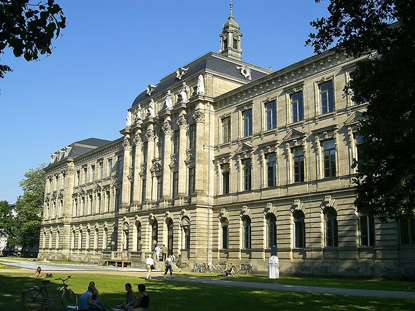
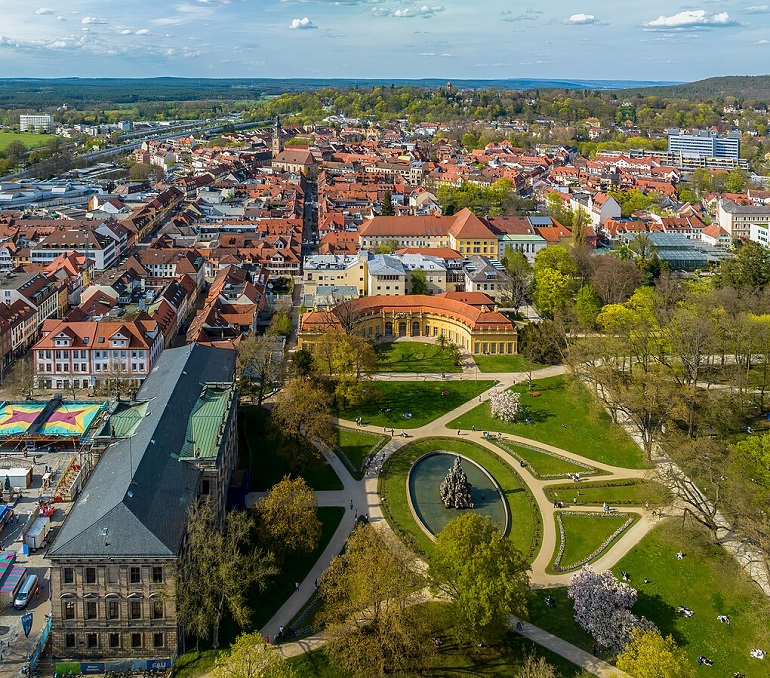
Erlangen (pop. 120,000) is a pleasant little city that grew with the establishment of French Huguenot refugees in the 1680's. Known for its longstanding association with Friedrich-Alexander University, Erlangen is recognised as a centre for scientific research, engineering, and medical innovation. The lofty neoclassical Margravial Schloss is now occupied by the University of Erlangen-Nuremberg. The city features a well-preserved baroque old town, extensive green spaces, and a network of bicycle routes, making it accessible and easy to navigate. Erlangen's annual events, such as the Bergkirchweih beer festival, draw visitors from across the region. The presence of major technology and healthcare firms, along with its academic influence, shape Erlangen as a modern yet historic destination in Franconia.
Interesting Facts about Erlangen
- Erlangen is one of the best-preserved Baroque planned cities in Germany, renowned for its straight streets and elegant squares.
- The city is famous for its historic influx of Huguenot refugees in the 17th century, who fled religious persecution in France and significantly shaped Erlangen’s character, industry, and architecture.
- Erlangen is home to the prestigious Friedrich-Alexander University, which was relocated from Bayreuth in 1743 and now hosts around 20,000 students in the city.
- Each year, the city celebrates the Bergkirchweih, one of Germany’s oldest and most picturesque beer festivals, held since 1755 on the Burgberg hillside.
- Erlangen houses the Margravial Theatre, built in 1718, which is southern Germany’s oldest Baroque theatre still in use today.
- The Botanical Garden of Erlangen, founded in 1747, features around 4,000 plant species from diverse climates and is open to the public free of charge.
- Erlangen is a key site for Siemens, the global technology company, which moved much of its operation to the city after World War II and now employs approximately 20,000 people locally.
- The city’s population is highly international, with around 40% migrants of first, second, and third generation backgrounds, and the largest minority community being from India.
- Erlangen's Old Town was repeatedly destroyed throughout history, including a major fire in 1706, but much of the medieval cellar structure survived beneath the reconstructed streets.
- The city is famed for its bicycle-friendly infrastructure, making cycling a popular and practical mode of transport for its residents.
History
Erlangen's history spans over a millennium, beginning with its foundation in the 8th century. The settlement was first mentioned as a community in the 11th century, though it remained relatively insignificant for centuries. In 1017, Erlangen was transferred from the bishopric of Würzburg to that of Bamberg, before being sold to the King of Bohemia in 1361. The town finally received its charter in 1398 and passed to the Hohenzollern burgraves of Nuremberg in 1402. However, Erlangen's early history was marked by frequent destruction - it was completely devastated during the Hussite Wars in 1431 and suffered repeated attacks during the First and Second Margrave Wars in the 15th and 16th centuries. The town endured further hardship during the Thirty Years' War, when it was virtually burned to the ground.
The most transformative period in Erlangen's history began in 1685 when French King Louis XIV revoked the Edict of Nantes, triggering a massive wave of Huguenot refugees. Margrave Christian Ernst of Brandenburg-Bayreuth seized this opportunity to revitalise his war-ravaged principality and offered the French Protestant refugees the right to settle. Approximately 1,500 Huguenots arrived in several waves starting from 17 May 1686, along with several hundred Waldensians who later moved on in 1688. To accommodate these refugees, the Margrave founded an entirely new planned town called "Christian-Erlang" south of the existing settlement, using baroque principles with straight streets and right angles leading to a central marketplace. Construction began on 14 July 1686 with the laying of the foundation stone for the Huguenot Church. The refugees brought valuable skills, making Erlangen a centre for glove-making, hat-making, and drapery production.
Following a devastating fire in 1706 that destroyed almost the entire old town, Erlangen was rebuilt using the same planned city principles as the new town. In 1812, the old town and Christian-Erlang were officially united to form a single municipality called Erlangen. The city's importance grew significantly when the Friedrich-Alexander University was moved from Bayreuth to Erlangen in 1743, establishing it as an educational centre. After passing through Prussian hands in 1792, Erlangen became part of the Kingdom of Bavaria in 1810. The 19th century brought further development with the opening of the Ludwig Canal, railway connections, and the establishment of a garrison in 1868. Modern Erlangen's prosperity was significantly boosted when Siemens relocated from Berlin after World War II, employing around 20,000 workers and making the city a major centre for medical technology and computer manufacturing.
Main Attractions
Schloss Erlangen
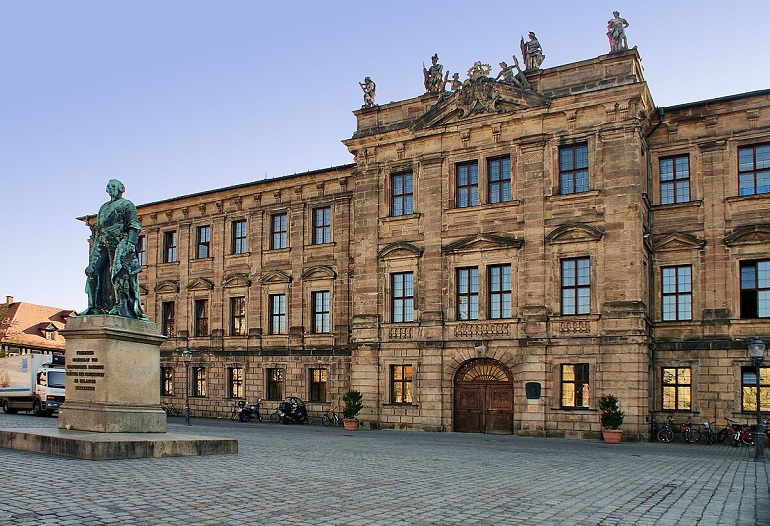
Schloss Erlangen was erected between 1700 and 1704 as a summer residence for George William, Margrave of Brandenburg-Bayreuth. The original Baroque structure, known as Elisabethenburg, incorporated an orangery completed in 1706 and fronted an extensive formal garden that extended beyond the adjacent Schlossgarten. After a series of fires, the building was destroyed in 1814 and subsequently reconstructed from 1821 to 1825 with a simplified roofline in a more restrained Neoclassical style by Friedrich Wilhelm Örtel. Since the early nineteenth century the castle has served the University of Erlangen-Nuremberg, first housing its library and later accommodating administrative offices. The façade and inner courtyards are accessible to the public and local events often take place in its grounds.
Margravial Theatre
Margravial Theatre in Erlangen is recognised as the oldest Baroque theatre in southern Germany, constructed between 1715 and 1719 under the patronage of Margrave Frederick. The design follows the Italian opera-house model with a compact auditorium, horseshoe-shaped seating, and painted ceiling panels. In 1743 the interior was remodelled to modernise the stage machinery and decorative scheme under the direction of court architect Karl Albert Gollwitzer. Restoration works completed in the late twentieth century returned much of the theatre to its eighteenth-century appearance, ensuring that original features such as the proscenium arch and stage mechanics are preserved. The theatre continues to host operatic and dramatic performances as well as guided tours.
Huguenot Church
Huguenot Church Erlangen (Hugenottenkirche) marks the oldest Reformed church building outside France, with its cornerstone laid in 1686 and consecration in 1693. A tall steeple was added between 1732 and 1736 by the local community, completing the church’s Baroque silhouette. The interior reflects the French Reformed tradition with a central pulpit and restrained ornamentation, while the original presbyterial governance structure is commemorated in the adjacent consistorial hall. Positioned on a principal east–west axis through the New Town, the church symbolizes the settlement of Huguenot refugees by Margrave Christian Ernst. It remains an active place of worship and a landmark in the city’s historic centre.
Bergkirchweih
Bergkirchweih is an annual beer festival held in Erlangen during the Whitsun period, typically spanning ten days between late May and early June. Originating in 1755, it takes place on the Kirchenberg and is operated by local breweries using tented pavilions known as Schänken. The event is characterised by traditional Franconian beer served from wooden pumps, a permanent fairground with rides and food stalls, and nightly fireworks displays. Attendance regularly exceeds one million visitors, making it one of Germany’s largest folk festivals by visitor count. While open to the public without formal ticketing, entry to the brewery tents may require reservations or queueing.
Parks & Gardens
Schlossgarten Erlangen
Schlossgarten Erlangen is a seven-and-a-half hectare Baroque garden laid out between 1700 and 1706 behind the Schloss, now part of the university complex. It originally followed a symmetrical design emphasising a central axis with terraces and fountains such as the Huguenot Fountain created by Elias Räntz in 1706 and an equestrian statue of Margrave Christian Ernst. In the nineteenth century the eastern sections were remodelled into an English landscape garden under Johann Christian von Schreber. Since 1849 the grounds have been open to the public and feature ornamental parterres, mature trees, and avenues extending towards the surrounding forest. The garden remains accessible daily and provides formal lawns, water features, and historic sculptures.
Botanical Garden
Botanical Garden Erlangen is maintained by the Friedrich-Alexander-Universität and dates back to its founding in 1747 for academic instruction. Located on the north side of the Schlossgarten, it extends across two hectares and cultivates some 7 000 plant species from diverse climatic regions. The collection is organised into open-air beds and thematic greenhouses, including facilities for tropical, subtropical, and arid-zone flora as well as a medicinal plant section. Adjacent to the river Schwabach lies the Scented Garden, established in 1981, where aromatic and culinary herbs are displayed. There is no admission charge and the garden serves both research purposes and public education.
Aromagarten an der Palmsanlage
Aromagarten an der Palmsanlage is a specialised scented garden situated within the Palmsanlage park near the city centre, created to display aromatic and medicinal plants. Established in 1981, the garden arranges species in thematic beds that illustrate historic and modern uses of herbs and spices. Informational plaques accompany each planting area, detailing botanical characteristics, cultivation requirements, and traditional applications. Winding paths permit visitors to encounter a variety of scented shrubs, perennials, and annuals in a sequence that emphasises seasonal changes. The garden is open during daylight hours and admission is free.
Dechsendorfer Weiher
Dechsendorfer Weiher comprises two connected lakes situated a few kilometres north of Erlangen’s centre, offering recreational opportunities for swimming, boating, and angling. The larger Weiher, approximately 39 hectares, features designated swimming zones, boat rentals, and a campsite on its western shore. Surrounding paths allow for a circuit of the water, with sections adapted for cycling and walking around its perimeter. The smaller southern basin provides a quieter environment for fishing and birdwatching, with benches and picnic areas overlooking the reed-fringed banks. Both lakes are managed by the local municipality and are accessible via public bus routes.
Walderlebniszentrum Tennenlohe
Walderlebniszentrum Tennenlohe is a forest experience centre located on the southern edge of Erlangen, dedicated to environmental education and outdoor recreation. It encompasses 1 200 hectares of deciduous forest with visitor trails, interpretive stations, and a nature play area designed for children. Guided tours and workshops introduce topics such as sustainable forestry, wildlife habitats, and native plant species. The centre includes a training facility for youth groups and schools, as well as picnic spots and a café housed within a timber-framed building. Public parking is available free of charge, and the site is served by regional bus lines.
Leisure Park Wöhrmühle
Leisure Park Wöhrmühle lies on the banks of the Regnitz river to the west of the Old Town and occupies the historic site of a former water mill. The park covers roughly 20 hectares and provides picnic areas, walking paths alongside the river, and children’s play facilities including swings and climbing frames. A footbridge links the two sides of the park, facilitating circular strolls along tree-lined avenues. Birdlife is abundant in the adjacent wetlands, making the park a popular spot for wildlife observation. Amenities include public restrooms and benches at regular intervals along the main pathways.
Top Museums
Stadtmuseum Erlangen (Erlangen City Museum)
Situated in the heart of Erlangen’s Old Town, the Stadtmuseum provides a comprehensive journey through the city’s history. Its exhibitions stretch from archaeological finds revealing the area’s earliest settlements, through the influence of the Huguenots in the 17th and 18th centuries, to the development of Erlangen as an industrial and university city. Of particular note is a hosiery weaver’s chair from 1716, representative of the trades introduced by the Huguenots. The collection showcases everyday items, industrial artefacts, toys, and student memorabilia, painting a vivid picture of Erlangen’s past and transformation into a modern city.
Kunstpalais Erlangen (Erlangen Art Palace)
Housed in the elegant Palais Stutterheim, constructed in 1730, the Kunstpalais occupies two floors and is dedicated to contemporary art and art education. The focus of the Kunstpalais is on major positions of the international art world since 1945, with connections to literature, philosophy, and film. The museum hosts changing exhibitions and maintains the substantial Erlangen Municipal Collection, which boasts over 4,500 pieces, including graphic art, artist’s books, and portfolios reflecting key tendencies in modern art.
Siemens Healthineers MedMuseum
Catering especially to those interested in science and technology, this museum follows the fascinating evolution of medical technology, primarily through developments spearheaded by Siemens. More than 200 exhibits, some dating back to 1890, chronicle milestones such as early X-ray tubes and MRI scanners. The MedMuseum provides an interactive experience, blending historical artefacts with multimedia, illustrating how medical diagnostics and therapy have advanced over the decades.
Erlanger Biermuseum (Beer Museum)
While relatively small, this museum captures Erlangen’s rich brewing heritage. Located in the Steinbach Brewery, it shares the story of beer-making in the city, with a collection of brewing equipment and informative displays about local brewing traditions. The museum space is found on the brewery’s former barley floor, and provides a charming insight into Franconian beer culture.
Heinrich Kirchner Sculpture Garden
Though not a museum in the conventional sense, this outdoor sculpture park on the southern slope of the Burgberg features seventeen substantial bronze pieces by Erlangen-born artist Heinrich Kirchner. Created as ambassadors of peace, hope, and love, these sculptures are harmoniously integrated into the landscape, offering both artistic and contemplative value to visitors as part of the city’s public art scene.
Further University Collections
Friedrich-Alexander-Universität Erlangen-Nürnberg manages an array of collections, covering topics as diverse as anatomy, computer science, and mineralogy. These collections document the history of academic study and scientific progress in Erlangen. While not all are open to the general public, some provide guided tours by arrangement, offsetting the city’s museum landscape with a distinctive academic flavour.
Kunstmuseum Erlangen and Contemporary Art Spaces
Erlangen is also home to further spaces devoted to modern and contemporary visual arts. The Kunstmuseum and the Städtische Galerie frequently host both permanent and temporary exhibitions, highlighting local talents alongside international creatives. These venues, together with numerous public artworks scattered across the city, underscore Erlangen’s enduring commitment to art and cultural dialogue.
Local Cuisine
Travellers can savour regional delights such as Schäuferle (slow-roasted pork shoulder), Sauerbraten (marinated pot roast), and Kartoffelklöße (potato dumplings), often served with tangy red cabbage. The city is renowned for its vibrant beer culture, and sampling freshly brewed local beers from traditional breweries like Steinbach Bräu is a must. During the annual Bergkirchweih beer festival, don’t miss indulging in Bratwurst and the iconic mountain pretzels, which perfectly complement the festival atmosphere. Many local establishments also offer inventive takes on classic dishes using seasonal and regional produce, ensuring every meal in Erlangen is a memorable experience.
Getting There & Around
By train, Erlangen is well connected to major German cities, with frequent trains running from hubs such as Nuremberg, Munich, and Frankfurt. From Nuremberg, the journey is especially quick and convenient, typically taking around 12 to 13 minutes, while direct trains from other cities are also available and provide a comfortable travel experience.
By coach or bus, a range of intercity and international coach services, including FlixBus, stop at Erlangen’s central station. These buses run from cities across Germany and neighbouring countries, with schedules offering both daytime and overnight journeys. There are also local and regional buses connecting Erlangen to the surrounding area, making onward travel simple.
By car, the city is accessible via the A3 and A73 motorways, which link Erlangen to key destinations such as Nuremberg, Würzburg, and Bamberg. Ample parking facilities are available in and around the city centre, from where Erlangen’s attractions can be explored easily on foot or via local public transport.


