



| Contents |
|---|

Introduction
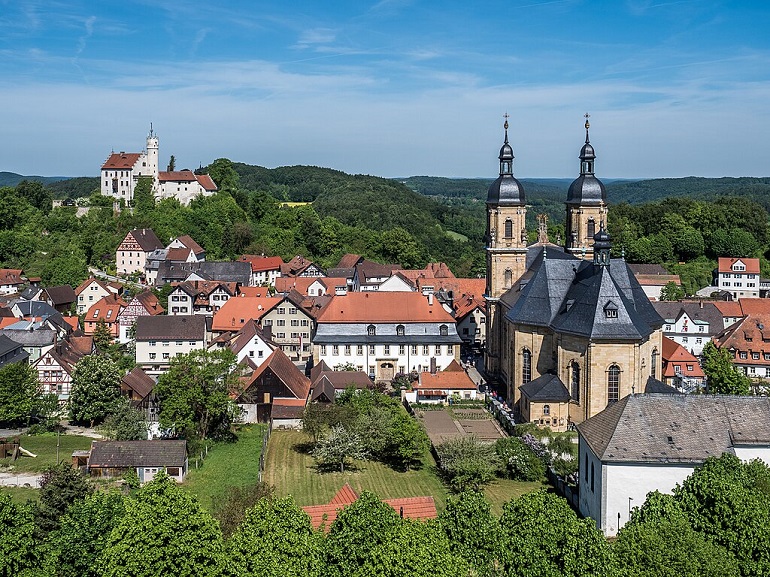
Gößweinstein (pop. 1,350) is a market town located in the scenic Franconian Switzerland nature park, known for its characteristic limestone rock formations and forested hills. The town is notable for its baroque basilica, a prominent pilgrimage site designed by architect Balthasar Neumann, the Gößweinstein Castle, which overlooks the surrounding countryside, and steam locomotive rides on the Franconian Switzerland Steam Railway.
Interesting Facts about Gößweinstein
- Gößweinstein Castle, perched high above the village and the River Wiesent, may have inspired Richard Wagner’s Grail Castle in his opera "Parsifal".
- The castle dates back to at least 1076, with a turbulent history of destruction and rebuilding during regional wars.
- Each spring, the town’s fountains are decorated with colourful Easter egg displays, a tradition known as "Osterbrunnen," unique to the Franconian region.
- Despite its population of just 1,350, Gößweinstein is home to four traditional breweries, reflecting the Bavarian love of beer.
- The Franconian Toy Museum and a local steam railway make Gößweinstein a family-friendly destination with plenty of attractions.
- Gößweinstein offers several scenic lookout points, such as Gernerfels and Bärenstein, providing spectacular views over the surrounding countryside.
- The Pilgrimage Church of the Holy Trinity is a significant pilgrimage site, attracting both walkers covering distances up to 70 miles and tourists arriving by bus.
- In addition to historical and religious landmarks, Gößweinstein also boasts quirky amusements such as mini-golf and a unique billiards-like game called Pit-Pat, popular with both locals and visitors.
History
Gößweinstein's recorded history begins in 1076 when the castle "Goswinesteyn" was first mentioned in historical documents. The settlement takes its name from its founder, Count Gozwin of the Grabfeldgau, likely an ancestor of the later Henneberg noble family, who built this impressive Jura fortress in the late 11th century. Before 1102, the castle fell to the Hochstift Bamberg, probably through donation, beginning centuries of ecclesiastical rule. The bishops appointed burggraves to manage the castle, initially drawn from the noble Schönfeld family, with some members even adopting Gößweinstein as their family name between 1140 and 1174.
The medieval period brought considerable turbulence to Gößweinstein. The castle and surrounding lands were pawned to the Schlüsselberg family before 1243, returning to Bamberg control only after 1308. During the German Peasants' War of 1525, both the castle and town suffered destruction before being rebuilt. The settlement endured another devastating attack during the Second Margrave War in 1553, requiring yet another reconstruction. Throughout these centuries, Gößweinstein served as the seat of a vogtei (bailiff's office) for the bishops of Bamberg from 1348 to 1780. The Hussite Wars may have also damaged the fortress, as archaeological evidence suggests the western courtyard was permanently abandoned during this period.
The town's fortunes improved dramatically under Prince-Bishop Friedrich Carl von Schönborn, who ruled from 1729 to 1746 and elevated Gößweinstein to market town status. This period also saw the construction of the magnificent pilgrimage basilica designed by the renowned baroque architect Balthasar Neumann between 1730 and 1739. During the secularisation of 1803, Gößweinstein passed from ecclesiastical to Bavarian control. The modern municipality was formed through extensive territorial reforms in the 1970s, incorporating numerous surrounding villages including Behringersmühle, Kleingesee, Stadelhofen, and Unterailsfeld in 1972, followed by Leutzdorf in 1974 and Morschreuth with several other settlements from the dissolved municipality of Wichsenstein in 1978.
Main Attractions
Gößweinstein Castle
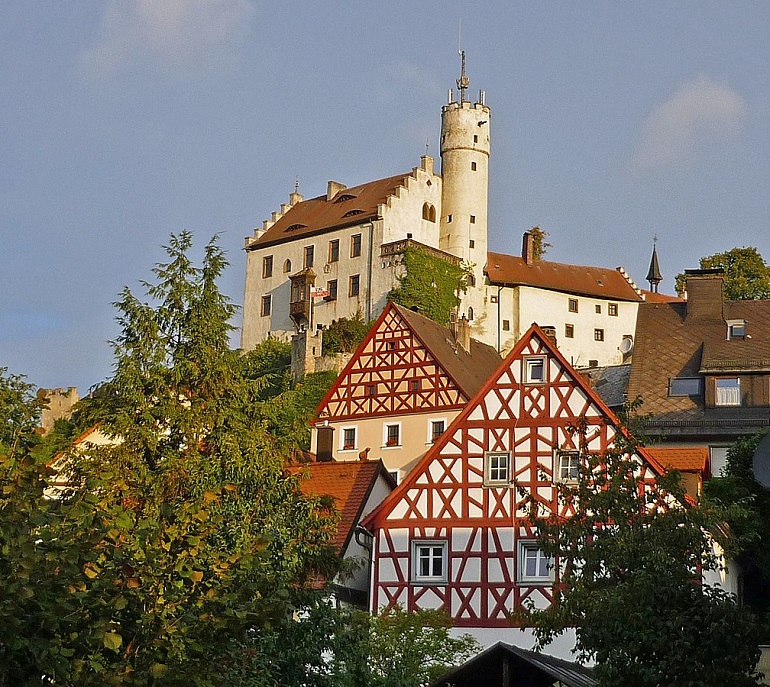
Gößweinstein Castle is a medieval hilltop fortress that overlooks the market town of Gößweinstein and the winding course of the River Wiesent. First documented in 1076, the castle entered Bavarian state ownership following the secularisation of the Bishopric of Bamberg in 1803 and was later acquired by Baron Edgar von Sohlern, who remodelled it in the Neogothic style in 1890. Today, the site includes a collection of restored chambers tracing its evolution from a fortified stronghold to a 19th-century residence, alongside an outdoor beer garden serving local Bavarian brews. An observation terrace offers panoramic vistas across the Franconian Switzerland landscape, making the castle both a cultural landmark and a scenic viewpoint.
Basilika Gößweinstein
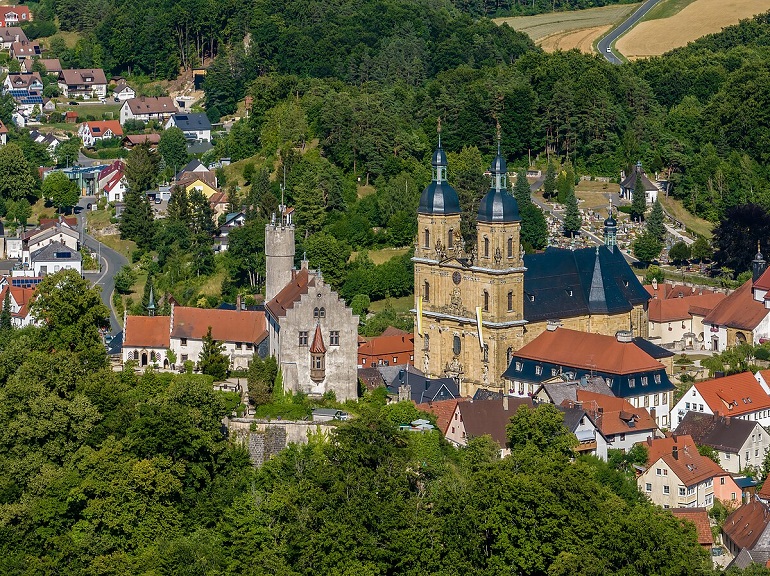
Basilika Gößweinstein is a late Baroque pilgrimage church dedicated to the Holy Trinity, constructed between 1730 and 1739 under the guidance of architect Balthasar Neumann. Recognised as one of the most significant ecclesiastical buildings in Franconia, it was elevated to the status of Basilica minor by Pope Pius XII in 1948 and remains a focal point for annual pilgrimages, drawing an estimated 140 groups each year. The twin towers, elaborate stucco work, sculpted altars and ceiling frescoes exemplify the artistic ambitions of the period, and regular guided tours with organ recitals take place from May through October.
Natural Attractions
Höhenschwimmbad Gößweinstein
Höhenschwimmbad Gößweinstein is a natural outdoor swimming pool situated at the edge of the village on Schützenstraße. Drawing its water from a local spring, the facility is maintained by the municipality to ensure safe bathing conditions and is open free of charge during the summer season. The complex includes a main swimming basin alongside a shallower section for children, and grassy banks provide sunbathing lawns and picnic areas. Changing cabins and sanitary facilities are available on site, making it a practical destination for families and visitors seeking a refreshing respite.
Aussichtspunkt Ludwigshöhe
Aussichtspunkt Ludwigshöhe lies a short walk north of the village centre along a waymarked footpath. Perched on a gentle rise above the forested slopes, this viewpoint affords sweeping panoramas of the Franconian Switzerland countryside, encompassing Gößweinstein’s basilica and castle in the foreground. A modest wooden shelter and benches offer visitors a place to rest, while clearly signed paths make access straightforward. The site is well used by walkers at dawn for its unobstructed eastern outlook.
Walli-Maus-Weg Erlebniswanderung
Walli-Maus-Weg Erlebniswanderung is a themed, family-oriented loop trail beginning on Burgstraße in the village centre. Extending for roughly two kilometres, the path features gentle gradients and a surfaced walkway suitable for all ages, including pushchairs. Along the route, wooden figures represent the Walli Mouse character, with informational boards recounting local folklore and legends. Strategically placed seating areas and small play installations provide interactive rest points for younger walkers.
Höhlenruine Riesenburg
Höhlenruine Riesenburg comprises the remnants of a cave castle hewn into a sandstone outcrop along Forchheimer Straße, a short distance from Gößweinstein. The site includes vestiges of stone walls and vaulted arches under a natural rock overhang that once provided defensive shelter during the medieval period. A riverside footpath alongside the Wiesent leads directly to the ruin, offering scenic views en route. Discreet interpretative panels recount the strategic role of the fortress in historic regional conflicts.
Wegweiser zur Konstantinengrotte
Wegweiser zur Konstantinengrotte is an interpretative signpost located near Behringersmühle that marks the route to the nearby Konstantinengrotte cave system. The weather-resistant installation provides directional pointers and distance information for several local natural attractions. Adjacent paved parking and a gently graded footpath ensure accessibility for visitors with reduced mobility. Informational panels at the base of the sign detail the geological processes responsible for the formation of the surrounding karst landscape.
Esperhöhle
Esperhöhle is a limestone cave accessed via a two-kilometre footpath south of Gößweinstein, forming part of a geological trail designed to illustrate the region’s diverse rock formations. The out-and-back route covers approximately one kilometre each way through mixed deciduous woodland, with the cave entrance opening into a narrow passage that terminates in a modest chamber displaying dripstone features. Visitors are advised to carry personal lighting equipment, as no fixed illumination is provided inside the cave, and dogs are permitted along the path.
Top Museums
Pilgrimage Museum Gößweinstein
The Pilgrimage Museum (Wallfahrtsmuseum) is a unique cultural institution dedicated to Gößweinstein’s remarkable pilgrimage tradition, the majestic baroque basilica, and its exceptional collection of over 100 life-sized, clothed wax votive figures. Housed in an 18th-century sacristan’s residence that forms part of the town’s historic 'Holy District', the museum uses creative displays—including multimedia elements—to trace the evolution of Christian pilgrimage, the significance of the Holy Trinity in Gößweinstein, and the broader context of religious travel across different faiths. Its blend of striking original artefacts and thematic storytelling makes this museum an essential stop for those interested in religious history, local identity, and artistic expressions of faith. While some of the displays focus on a deeply specialised aspect of regional tradition, the presentation remains accessible and engaging, especially for visitors intrigued by the intersection of art, devotion, and community heritage.
Franconian Switzerland Museum
Just a short drive from Gößweinstein, the Franconian Switzerland Museum (Fränkische Schweiz-Museum) in Tüchersfeld offers the most comprehensive overview of the region, housed within the dramatic setting of the historic Judenhof beneath towering limestone cliffs. This expansive museum spans 43 rooms and covers geology, archaeology, folk life, crafts, and the history of both Christian and Jewish communities in Franconian Switzerland. Highlights include the preserved 18th-century synagogue, prehistoric fossils, reconstructed workshops, and a wealth of artefacts from daily life through the ages. The breadth of the collection makes it ideal for visitors wanting to go beyond Gößweinstein itself to understand the full tapestry of local culture and natural history—though its size and the density of information may require more time and energy to fully appreciate. Not all labels are in English, but the displays remain visually informative and illuminating.
Local Cuisine
Local inns and cafés serve up classic specialties such as Schäufele (tender pork shoulder), Weißwurst (delicately flavoured white sausage), and Schweinshaxe (crispy roasted pork knuckle), often accompanied by fluffy Kartoffelknödel (potato dumplings) and tangy sauerkraut. Don’t miss the region’s beloved Obatzda—a creamy cheese spread with Camembert, butter and spices—perfect with a freshly baked Brezen (pretzel) and a glass of local beer. Traditional desserts like apple strudel or the renowned homemade “grannies sheet cake” make for an irresistible finish to any meal, adding a sweet note to the welcoming Franconian hospitality.
Getting There & Around
By train, Gößweinstein is not directly connected to the national rail network, but it is easily accessible by taking a train to nearby towns such as Forchheim, Pegnitz, Bamberg, or Bayreuth. From these stations, travellers can continue their journey by regional bus to Gößweinstein, with connections typically available throughout the day. Regular trains operate from major cities, making this a convenient option for those preferring public transport.
By coach or bus, Gößweinstein can be reached by regional bus services, such as the Trubachtal-Express (bus line 229), which runs from Gräfenberg and other nearby railway stations directly to the heart of Gößweinstein. There are also buses from cities like Bamberg and Bayreuth, and the village's main bus stop is just a short walk from local attractions. Bus timetables can vary by season, so it is advisable to check schedules in advance.
By car, Gößweinstein is easily reached via the A73 motorway or the B470 federal road, situated between Pegnitz and Forchheim. Simply follow the signs for Gößweinstein after leaving the motorway, and you will find ample parking throughout the town. This route offers flexibility and is particularly suitable for visitors planning to explore the surrounding Franconian Switzerland area.


