



| Contents |
|---|
Introduction
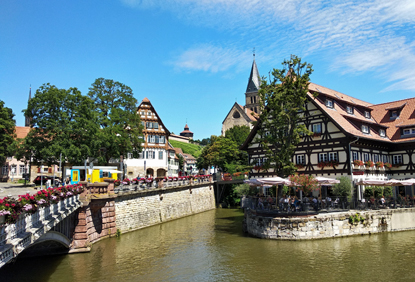
Esslingen am Neckar (pop. 96,000) is a city known for its medieval centre, which contains over 200 well-preserved half-timbered houses, including what is considered to be Germany's oldest complete row of such houses, constructed in the early 14th century. This historic core remained largely undamaged during the Second World War. The main landmarks include the Church of St. Dionysius, which stands on foundations laid in the 8th century, and the Frauenkirche, an important example of late Gothic architecture. The Old Town Hall, first erected in the 15th century, displays a later Renaissance facade and an ornate astronomical clock. Overlooking the town and its surrounding vineyards are the remnants of the Esslingen Castle fortifications, offering views across the Neckar valley. The city also has a long history of wine production and is home to Germany's oldest producer of Sekt, or sparkling wine.
Interesting Facts about Esslingen am Neckar
- Esslingen am Neckar was a free imperial city for centuries until it was annexed by Württemberg in 1802, a status that shaped its autonomy and prosperity through medieval trade.
- First recorded in 777 as “Cella,” the settlement’s name evolved through “Hetsilinga” before becoming Esslingen am Neckar, reflecting early medieval roots along the Neckar River southeast of Stuttgart.
- The Old Town boasts more than 200 half-timbered houses from the 13th to 16th centuries, forming one of the region’s largest ensembles of this iconic architecture.
- Wine has been cultivated on Esslingen’s slopes for over 1,200 years, with vineyards climbing up to the castle walls above the historic centre.
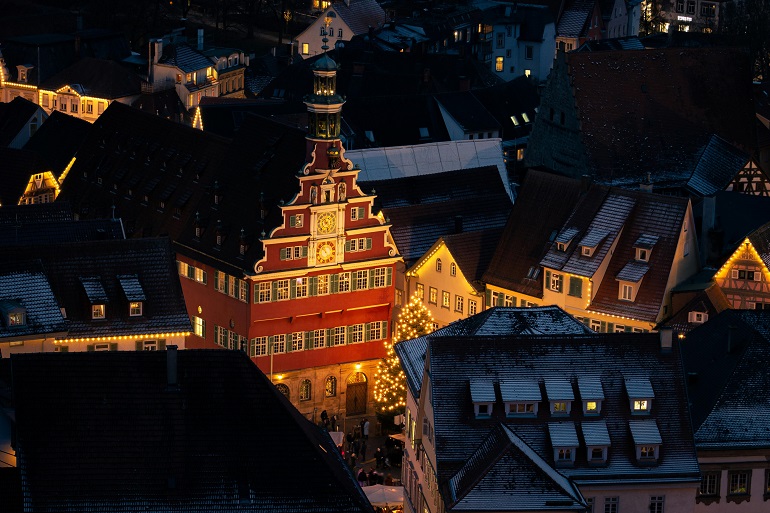
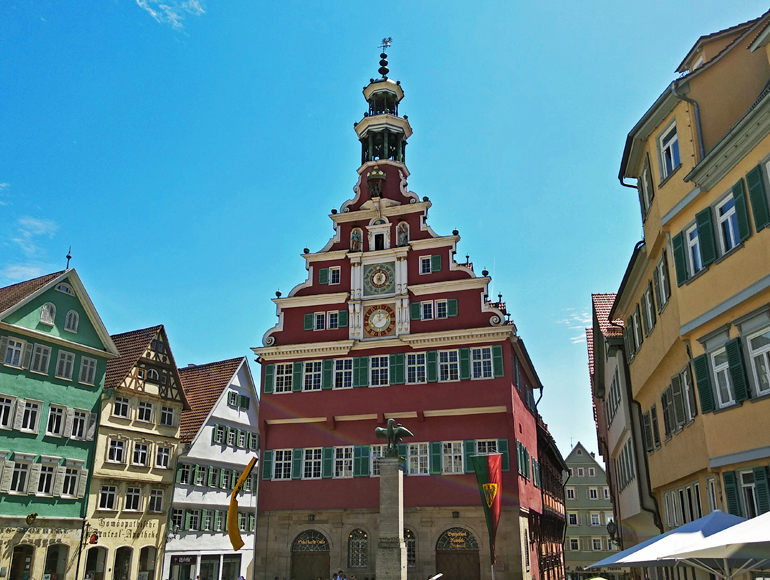
- The Old Town Hall pairs half-timbered construction with a Renaissance façade featuring an astronomical clock and a daily carillon with moving figures.
- The Church of Our Lady (Frauenkirche), built between 1321 and 1516, helped inaugurate the distinctive Swabian Gothic style in the region.
- St. Paul’s (1233–1268) is considered the oldest surviving Dominican church in Germany, marking Esslingen’s medieval religious significance.
- Excavations beneath St. Dionysius reveal foundations dating to the 7th century, offering a window into the town’s early medieval past.
- Canals thread through the old town for roughly 3 km, enhancing the medieval cityscape alongside churches, towers, and the hillside citadel.
- The German Timber-Frame Road passes through Esslingen, underscoring its prominence for historic timber-frame architecture.
- Esslingen’s economy blends tradition and innovation, coupling wine and fruit cultivation with machine building and precision engineering in the Stuttgart tech corridor.
- The Esslinger Burg and its “Dicke Turm” tower overlook the city, connected to vineyards and stairways that link the fortifications to the market squares below.
- Many historic buildings survived the Second World War relatively intact, contributing to the town’s remarkably cohesive medieval character today.
- The town’s name likely derives from an Alemannic patriarch (Azzilo/Hezzilo), with early mentions in 856 and 866 reflecting its early tribal-era lineage.
- Visitors often highlight the seamless mix of liveable old-town ambience—cobbled lanes, canals, and wine taverns—set amid surrounding vineyards ideal for walks.
History
Ancient Origins and Early Settlement
Esslingen am Neckar boasts a remarkably long history stretching back to prehistoric times, with archaeological evidence revealing continuous human settlement since the Neolithic period. Traces of early habitation near the present-day city church date to approximately 1000 B.C., establishing the area as one of the region's earliest inhabited sites. During the 1st century AD, the region became part of the expanding Roman Empire, with Romans constructing villas and establishing a warehouse in the Oberesslingen area. The nearest major Roman settlements and garrisons were located at Cannstatt and Köngen, positioning Esslingen within an important network of Roman administrative centres. The city's distinctive name originates from the Alemannic period, deriving from the tribe of Ezzelinge, meaning "the peoples of Azzilo" or "Hetsilo", with the settlement first documented as Ezlinga in 856 and as Hetsilinga in 866.
Medieval Rise to Prominence
The medieval period marked Esslingen's transformation from a modest settlement into a significant Free Imperial City of considerable influence. The town was first officially mentioned in 777 in the testament of Abbot Fulrad from Saint-Denis near Paris, who bequeathed his "sixth cell upon the river Neckar" to his monastery. This religious connection was strengthened when Fulrad brought the bones of Saint Vitalis to Esslingen, establishing it as an important pilgrimage destination and spurring substantial growth. Around 800, Esslingen achieved market town status, with these rights formally certified in 866. The city received its crucial city rights in 1229 under Emperor Frederick II, coinciding with the construction of the still-extant Neckar bridge. This strategic infrastructure made Esslingen a major trading centre on the vital commercial route connecting Italy, Switzerland, and northern Germany, whilst taxes from bridge tolls and markets, combined with exports of the region's highly regarded wines, fuelled continued prosperity.
Conflicts and Modern Transformation
The period from the 13th to 16th centuries was characterised by persistent conflicts between the Free Imperial City of Esslingen and the neighbouring Counts of Württemberg, later the Duchy of Württemberg. These territorial disputes included dramatic episodes such as the Esslingers' destruction of the Württemberg burial place in Beutelsbach and the burning of the clan's fortress on Witemberg during Emperor Heinrich VII's campaign between 1310-1313. The devastating Thirty Years' War (1618-1648) proved catastrophic for the city, with approximately half the population perishing through famine and epidemics. Esslingen's long-cherished independence finally ended during the Napoleonic era in 1802-1803, when it was incorporated into the Duchy of Württemberg. The 19th century brought industrialisation and transformation into an engineering centre, whilst the city notably gained recognition as the "cradle" of German sports and leisure movements, with local figures founding the German and Swabian Singing Society and contributing to the establishment of the German Gymnastics Association. Despite suffering little damage during the Second World War, post-war reconstruction saw the exemplary restoration of the historic city centre, preserving over 200 half-timbered buildings from the 13th to 16th centuries.
Main Attractions
Old Town (Altstadt)
Esslingen's Old Town is a delight for the senses, with its maze of cobbled lanes, timber-framed houses, bustling squares, and vibrant atmosphere. The preservation of historic architecture spanning twelve centuries lends the area a fairytale quality that survived wartime destruction almost miraculously. Medieval half-timbered houses stand alongside Gothic churches and Baroque palaces, creating an enchanting streetscape where every building tells its own story. Meandering through the crooked cobbled alleys reveals the city's layered history, whilst the weekly markets and the world-famous Medieval Christmas Market bring the streets to life with colour and festivity.
Altes Rathaus (Old Town Hall)
The Altes Rathaus is one of Esslingen's architectural treasures, famed for its ornate Renaissance façade and astronomical clock dating to 1589. Originally built in 1422 as a merchant's hall and tax house, the building underwent a stunning transformation when Heinrich Schickhardt redesigned the north façade in Renaissance style. The famous carillon chimes several times daily, filling the market square with melodic charm. The building showcases a fascinating blend of architectural styles, with the north side displaying late-Renaissance opulence whilst the south side features a mighty half-timbered façade complete with the distinctive "Swabian Man" figure.
Schelztorturm and Wolfstor
Two of Esslingen's impressive medieval gate towers, the Schelztorturm and Wolfstor, are enduring legacies of the city's ancient defensive walls. The 13th-century Schelztorturm stands as a reminder of the formidable fortifications that once protected the prosperous medieval town. The Wolfstor, built in 1266-67, holds the distinction of being one of the oldest surviving gate towers in the region and charms visitors with its distinct stonework and historical significance. Both towers provide atmospheric entry points into the Old Town and serve as tangible connections to Esslingen's medieval past.

Kielmeyer House
The magnificent Kielmeyer House stands as the largest and most beautiful half-timbered building on the market square. Built in 1582 as the winepress of the Hospice of St. Katharine, which occupied the market square from the 13th century until 1811, it represents one of the finest examples of Renaissance timber-frame architecture in the region. Today, the building continues to serve the community with excellent dining establishments and modern holiday apartments on the upper floor, allowing visitors to experience medieval splendour with contemporary comfort.

The Inner Bridge (Innere Brücke)
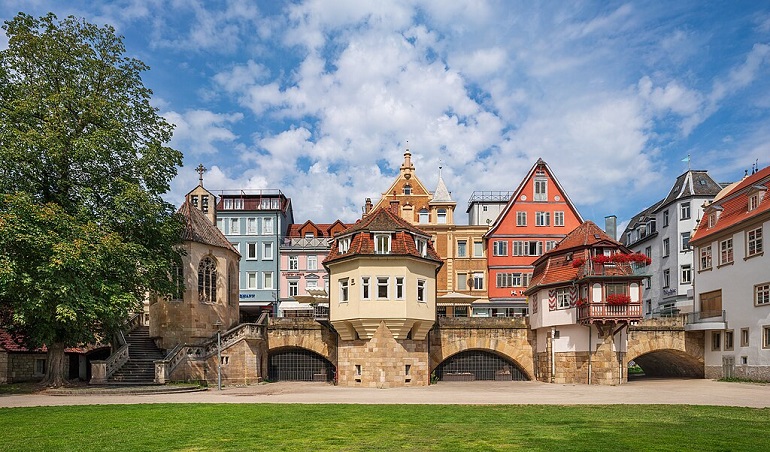
Dating from 1286, the Inner Bridge holds the remarkable distinction of being the second oldest bridge in Germany. This outstanding medieval structure once featured dense building development similar to Florence's Ponte Vecchio or Erfurt's Krämerbrücke, with some bridge houses still standing today. The bridge connected to the vital trade route from Italy via Ulm to the Rhine and on to prosperous Flanders, making it a crucial link in medieval European commerce. Its strategic importance and architectural significance make it one of the most outstanding structures of its time.
Stadtkirche St. Dionys
An imposing presence in the town centre, the Stadtkirche St. Dionys is a striking Gothic-Romanesque church that marks the very spot where Esslingen's history began in 777. This magnificent building is already the third church on this historic site, rebuilt in the 13th century when the town's prosperity allowed citizens to create this proud architectural statement. The church features distinctive twin towers and ancient crypts, with atmospheric interiors that captivate visitors. Beneath the church lie fascinating excavations that reveal the town's earliest foundations, accessible through guided tours that delve into Esslingen's Franconian origins.
Frauenkirche
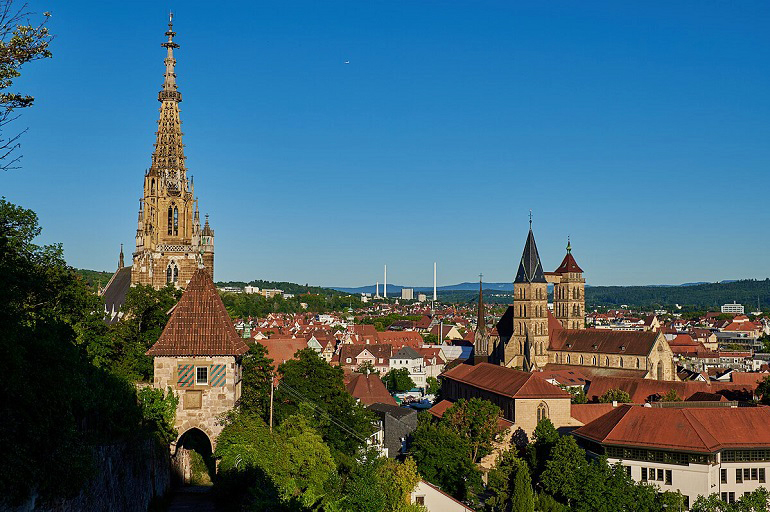
The Frauenkirche exemplifies Gothic architectural mastery, distinguished by its soaring spires and luminous stained-glass windows. Built from 1325 to 1516, it is considered one of the most outstanding examples of Southwest German late Gothic architecture and one of the oldest hall churches in Swabia. The church was constructed by the renowned Beblinger and Enziger brothers and stands at the foot of Esslingen's vineyards, creating a picturesque setting. The ethereal light cast through its ancient windows creates a tranquil ambience that has inspired contemplation for centuries.
Klein Venedig ("Little Venice")
Klein Venedig is a picturesque canal district where the Neckar's branches wind past centuries-old houses and lush gardens. This enchanting area features interlaced waterways and traditional watermills that lend a tranquil, almost romantic character to the neighbourhood. The narrow passageway around the town archives leads down to the Kesselwasen, where mills have operated since 1428 and two historic water wheels continue to turn today. The view across the Rossneckar to the houses on the Inner Bridge creates the charming scene that locals affectionately call their "Little Venice".
Esslingen Castle (Esslinger Burg)
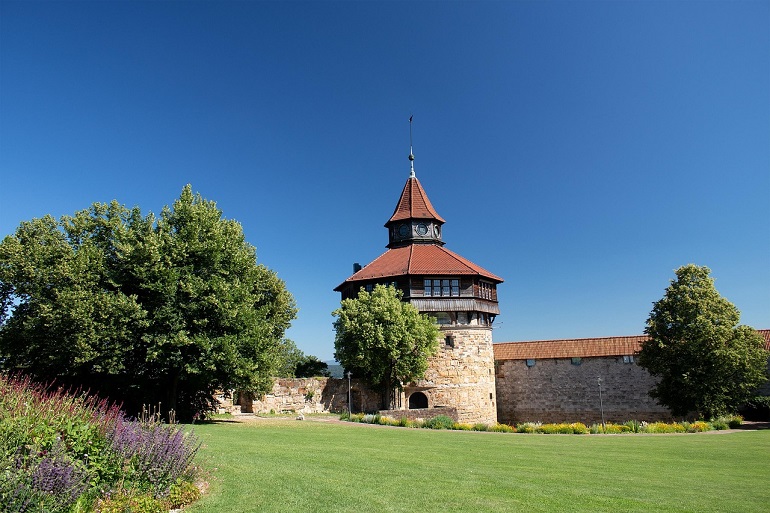
The Esslingen Castle, perched on the hillside above the town, is an enduring symbol of Esslingen's history and offers striking panoramic views of the surrounding area. Originally constructed as part of the town's massive fortifications in the 13th century, its towers, walls, and bastions are remnants of the city's medieval defences. Despite its name, it was never actually a castle in the traditional sense, as no noble family ever resided here—the locals affectionately call it their "castle" nonetheless. Climbing the steep path to reach the castle grounds is rewarded with beautiful castle gardens, restaurants, and breathtaking vistas of the old town's rooftops. The distinctive silhouette features the High Watch Tower, Ropers' Walk, and Big Tower, creating one of Esslingen's most recognisable landmarks.
Kessler Sekt Cellars
For those eager to discover local culinary heritage, the Kessler Sekt Cellars represent a unique highlight as Germany's oldest sparkling wine producer, operating since 1826. The historic cellars offer guided tours and tastings that provide fascinating insight into the traditional art of sparkling wine production beneath atmospheric vaulted ceilings. This attraction celebrates the Baden-Württemberg region's rich viticultural history and offers visitors a delightful way to savour Esslingen's festive spirit whilst learning about centuries-old winemaking traditions.
Top Museums
Historical Museums
City Museum in the Yellow House (Stadtmuseum im Gelben Haus)
The City Museum in the Yellow House serves as Esslingen's primary historical repository, chronicling the city's remarkable journey from its first documentary mention in 777 to the present day. Housed in a distinctive yellow building at Hafenmarkt, this museum presents a comprehensive chronological narrative of Esslingen's transformation from a medieval imperial city to one of Württemberg's most important industrial centres.
The museum's focus extends beyond major historical events to illuminate the everyday life of Esslingen's inhabitants throughout the centuries. Particular attention is given to the city's development as an imperial city with its influential craftsmen and guilds, showcasing how these institutions shaped the community's social and economic fabric. The exhibits feature local artefacts, documents, and photographs that bring the past to life, making it an essential starting point for understanding Esslingen's cultural heritage.
Visitors appreciate the museum's well-organised displays and bilingual information in German and English, making it accessible to international tourists. The museum successfully balances scholarly rigour with engaging presentation, though some visitors note that certain areas could benefit from more interactive elements to enhance the experience for younger guests.
Specialised Museums
J. F. Schreiber Museum
The J. F. Schreiber Museum offers a fascinating glimpse into the world of 19th-century publishing and illustration. Dedicated to the legacy of Jakob Ferdinand Schreiber, who arrived in Esslingen in 1831 with lithographic training and 44 stone printing plates, this museum celebrates one of Germany's most innovative publishing houses.
Spanning over 400 square metres, the museum showcases an extraordinary collection of paper theatres, picture books, cardboard models, and scientific educational materials produced by the Schreiber publishing house. The museum's displays include original design drawings from the publisher's production archive, providing insight into the creative process behind these beloved children's products. Visitors can explore a recreated illustrator's studio and stone printing workshop, offering a window into the working world of around 1900, when the Esslingen publisher was among the leading representatives of its field.
The museum's main attraction is the Wurzelhöhle (Root Cave), dedicated to the Schreiber publishing house's most famous children's book, "Etwas von den Wurzelkindern" (Something About the Root Children) by Sibylle von Olfers. This immersive exhibit allows visitors of all ages to experience the magical world of these diminutive creatures, making it particularly enchanting for families.
Interactive Exhibition Spaces
Museum im Schwörhaus
The Museum im Schwörhaus serves as Esslingen's dynamic exhibition space, hosting annual interactive exhibitions specifically designed for children and families. Located within a medieval building known as the Schwörhaus, this museum typically runs its main exhibitions from early May to early October, featuring engaging hands-on stations where children can play, experiment, and discover new concepts.
The museum's philosophy centres on learning through interaction, with colourful programmes complementing each exhibition. Recent exhibitions have included "Große Gefühle" (Big Feelings), which invites visitors of all ages to explore the world of emotions through ten interactive stations, encouraging participants to embark on "a funny, annoying, disgusting, and beautiful journey" of self-discovery.
Local Heritage Museums
Heimatstube vom Berg
The Heimatstube vom Berg represents a charming example of local heritage preservation, operating as a volunteer-run district museum in the attic of an old schoolhouse in Esslingen-Liebersbronn. This intimate 80-square-metre exhibition space, characterised by its exposed oak beams, offers visitors an authentic glimpse into the life and work of residents from the small communities of Hegensberg, Liebersbronn, Kimmichsweiler, and Oberhof more than a century ago.
The museum operates by appointment only, providing personalised guided tours that bring the exhibits to life through local knowledge and community connections. Run by the volunteer association "Wir vom Berg e.V.," this museum exemplifies grassroots cultural preservation, maintaining connections to local traditions and family histories that might otherwise be lost.
Local Cuisine
Among the must-try dishes, Maultaschen—generously filled pasta pockets likened to ravioli—are a local favourite, often served with potato salad or immersed in broth. Visitors will find Spätzle, a soft egg noodle typically accompanied by rich gravy, and Linsen mit Spätzle und Saitenwürstle—a comforting combination of lentils, noodles and sausage—at many traditional eateries. No visit is complete without sampling a crisp, oven-fresh Swabian Brezel (pretzel), perfect with a generous spread of butter. Pair these delights with a glass of regional wine, locally referred to as a Viertele, to fully savour the culinary soul of Esslingen's historic taverns and restaurants.
Getting There
By train, Esslingen am Neckar is easily accessible from Stuttgart, with the S-Bahn S1 providing direct services from Stuttgart's main station in just 15 minutes. There are approximately 117 trains per day running this route, with the fastest services taking as little as 9 minutes to complete the 10-kilometre journey. Regional trains also stop at Esslingen station, making it well-connected to the wider rail network.
By coach, visitors can reach Esslingen from Stuttgart Airport and the Trade Fair Centre in approximately 30 minutes using bus number 122. All buses terminate at the central bus station, which is within easy walking distance of the Old Town. Various local bus routes also connect Esslingen to surrounding areas and neighbouring towns.
By car, the town is conveniently located just off the A8 motorway at the Esslingen exit, or accessible via the B10 federal road. From Stuttgart Airport or the Trade Fair Centre, drivers can reach Esslingen city centre in approximately 15 minutes. The town features a parking guidance system to help locate available spaces, making it relatively straightforward for visitors arriving by car.