



| Contents |
|---|

Introduction
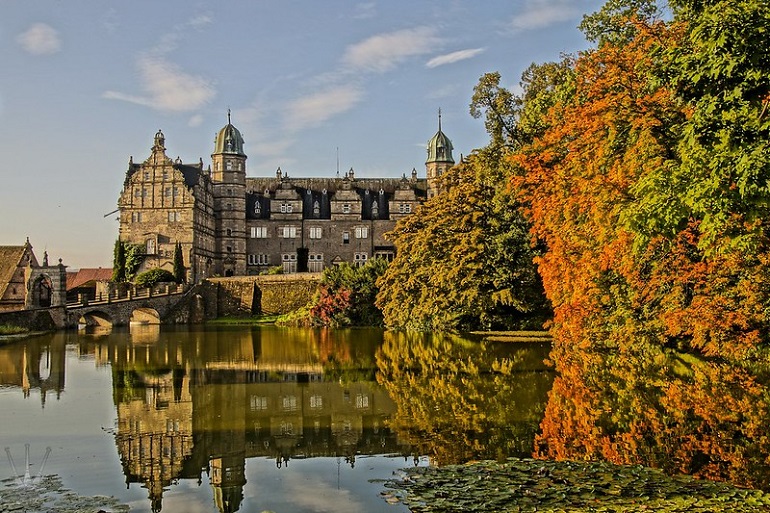
Located between Hamelin and Bad Pyrmont, Schloss Hämelschenburg is a superb Renaissance castle built in Weser sandstone between 1588 and 1612. The characteristic façades are endowed with 24 elaborately decorated gabled dormers. The interior is decorated with the original 17th-century furniture. The castle complex includes a moat, residential wings, a gatehouse, and a church, all set within a scenic park. Still privately owned by descendants of its original builders, Hämelschenburg is accessible to visitors for guided tours, providing insights into its historical interiors and significant art collections.
Interesting Facts about Hämelschenburg Castle
- Hämelschenburg Castle is considered one of the most important examples of Weser Renaissance architecture in Germany.
- The castle was commissioned by Jürgen von Klencke and his wife Anna von Holle and was constructed between 1588 and 1613 on the foundations of a much older fortress.
- It features 24 decorative gabled dormers and is built from the highly prized Weser sandstone.
- Remarkably, members of the von Klencke family have owned and inhabited the castle for over 500 years, and it remains in their possession today.
- The castle survived the plundering of the Thirty Years' War thanks to the bravery of Anna von Holle, who successfully negotiated its protection with invading forces.
- Hämelschenburg still boasts authentic Renaissance interiors filled with antique furniture, paintings, porcelain, glassware, and weaponry spanning five centuries.
- The castle complex includes a church, believed to be the first built in Germany especially for a Protestant congregation in 1563, and a historic watermill.
- Its beautiful Minnegarten, also called the Garden of Courtly Love, is a reconstructed floral retreat inspired by Renaissance traditions.
- Civil weddings can be held in the castle’s ornately decorated Charlottensaal, and visitors can enjoy the estate’s café, beer garden, and walking paths.
- Guided tours of the castle offer a fascinating insight into the 550-year history of the noble family and the region’s architectural and cultural heritage.
History
Hämelschenburg Castle stands as one of Germany's most magnificent examples of Weser Renaissance architecture, representing over 500 years of continuous family ownership by the von Klencke dynasty. The castle's origins trace back to the early 15th century when the Counts of Everstein constructed the first fortress, known as Burg Hemersen, between 1409 and 1414 on this strategic site. However, this original structure faced a tumultuous fate, being destroyed in 1487 and again in 1544, before the current splendid palace began to take shape. The von Klencke family acquired the property in 1437, and their association with the site has endured through the centuries, making it one of the most remarkable examples of sustained aristocratic stewardship in northern Germany.
The present castle was commissioned by Jürgen von Klencke, a former mercenary, and his exceptionally well-educated wife Anna von Holle, niece of the Bishop of Lübeck, with construction commencing in 1588. This ambitious project took 25 years to complete, finishing around 1613, though Jürgen tragically died in 1609 before witnessing his vision fully realised. The castle was designed as a three-winged moated fortress featuring two impressive octagonal towers built in the Italian Renaissance style, with the most striking architectural elements being the 24 elaborately adorned gabled dormers that crown the structure. Built from the highly prized Weser sandstone, the castle showcases the distinctive regional architectural style known as Weser Renaissance. During construction, the family of 14 children lived in a farm building across the street until the northern wing was completed, demonstrating their commitment to this grand undertaking.
Anna von Holle's remarkable diplomatic skills proved crucial during the castle's most perilous period, the Thirty Years' War, when her negotiations with Count Tilly's Catholic League forces secured a protection contract that declared any soldier entering the castle grounds would face execution. This bold strategy succeeded brilliantly, making Hämelschenburg one of the few castles in the region to survive the devastating conflict completely unscathed. The castle underwent significant modifications in the 19th and 20th centuries, including the removal of earth mounds and partial filling of the moat between 1845 and 1850, and the controversial 1970s restoration that stripped away plaster to reveal the original stonework whilst changing the roof colour from red to greyish-black. Today, the castle remains a living monument, still inhabited by the von Klencke family and operated as a working agricultural estate, whilst welcoming visitors to explore its historic rooms filled with Renaissance furniture, Habsburg paintings gifted by Holy Roman Empress Wilhelmine Amalia, and extensive collections of weapons, porcelain, and glassware spanning five centuries.
Description
Architecture and Exterior
The castle presents an impressive three-winged structure built in the distinctive Weser Renaissance style, characterised by its ornate stone facades and elegant proportions. The main building features richly decorated gables with intricate stonework, mullioned windows, and decorative bay windows that create dramatic plays of light and shadow across the facade. The warm sandstone construction gives the castle a golden hue that changes beautifully throughout the day.
The central courtyard provides an excellent vantage point to appreciate the architectural details, including the elaborate doorways with their carved stone surrounds and the distinctive chimneys that punctuate the roofline. The castle's towers offer commanding views over the surrounding Weser valley landscape.
Interior Spaces
State Rooms and Living Quarters
The castle's interior showcases period furnishings and decorative arts spanning several centuries. Visitors can explore opulent state rooms featuring original wall paintings, coffered ceilings, and period furniture that illustrate the refined taste of its former inhabitants. The great hall serves as a centrepiece, with its impressive proportions and historic tapestries.
The Knight's Hall
This ceremonial space contains an exceptional collection of armour and weapons, displayed in authentic period settings. The hall's vaulted ceiling and stone columns create an atmospheric backdrop for the medieval and Renaissance artifacts.
Private Apartments
The residential areas reveal intimate details of castle life, with preserved bedchambers, studies, and sitting rooms furnished with antique pieces. Many rooms retain their original wood panelling and decorative plasterwork.
Gardens and Grounds
The castle's baroque gardens represent one of Northern Germany's most significant landscaping achievements. The formal parterre gardens feature intricate geometric patterns created with boxwood hedging and seasonal plantings. Stone statuary and ornamental urns punctuate the garden rooms, while gravel paths wind between carefully manicured beds.
The woodland areas surrounding the formal gardens offer pleasant walks through mature trees, with occasional clearings providing scenic viewpoints. A series of garden pavilions and decorative structures, including a charming orangery, add architectural interest throughout the grounds.
Special Collections and Exhibitions
The castle houses notable collections of decorative arts, including fine porcelain, silverware, and textiles. Rotating exhibitions in designated gallery spaces showcase various aspects of regional culture and craftsmanship. The library contains rare books and manuscripts, whilst the castle's chapel features beautiful stained glass windows and religious art.
Visitor Experience
Guided tours provide detailed insights into the castle's architectural features and collections, with knowledgeable guides offering commentary in multiple languages. Self-guided exploration is also possible using detailed information materials. The castle hosts regular classical music concerts in its atmospheric halls, taking advantage of the excellent acoustics.
Special events throughout the year include craft demonstrations, historical reenactments, and seasonal celebrations that bring the castle's spaces to life. The on-site restaurant, housed in the castle's former kitchens, serves regional specialities in an authentic historical setting.
Getting There
By train, the nearest railway station to Hämelschenburg Castle is Emmerthal, situated about 4 kilometres from the castle. Regular S-Bahn trains connect Emmerthal to major cities such as Hannover and Paderborn, making this an accessible option for visitors arriving from further afield. From Emmerthal station, travellers can complete the journey to the castle by local bus or taxi.
By bus, the most convenient route is via the line 40 bus from Emmerthal, which travels to Hämelschenburg during weekdays, with fewer services available on Saturdays and none on Sundays and public holidays. Those coming from Hamelin can also use the same bus line, making it straightforward to reach the castle from the town centre.
By car, Hämelschenburg Castle is located between Hameln and Bad Pyrmont, roughly one hour south-west of Hannover. There is ample parking directly at the castle grounds, including facilities for large groups and coaches, ensuring a relaxed arrival for all visitors.
Best Time to Visit
The ideal window to explore Hämelschenburg Castle is between late spring and early autumn—specifically from May through June—when the is delightfully mild and the Renaissance gardens are awash with blooming roses and vibrant greenery. Although the castle is open to guided tours from April until October, May and June offer the sweetest combination of pleasant daytime temperatures, fewer summer crowds and the full splendour of the Minnengarten’s flowers. Visiting during this period ensures comfortable strolls around the moated courtyards, hourly guided tours in English and German, and the chance to linger over coffee and cake in the castle’s charming café garden without the peak-season bustle.


