



| Contents |
|---|

Introduction
An attractive historic town, Gotha (pop. 46,000) was the capital of the Duchy of Saxe-Gotha from 1640, the the co-capital of the Duchy of Saxe-Coburg-Gotha from 1826 to 1918. The main sight is the grand, monumental Schloss Friedenstein, the former ducal palace. Erected between 1643 and 1655, it is Germany's oldest baroque palace and houses the oldest surviving baroque theatre in the world. Gotha also has a well-preserved old town, with notable buildings such as the town hall and St. Margaret’s Church.
Interesting Facts about Gotha
- The city's name first appeared in 775 CE in a document signed by Charlemagne, making it one of the oldest settlements in the region.
- Gotha was the residence of the dukes of Saxe-Gotha and later the combined duchy of Saxe-Coburg and Gotha, whose descendants include the British royal family.
- Friedenstein Castle in Gotha is Germany’s largest early Baroque castle and houses the historic Ekhof Theatre, the oldest preserved Baroque theatre in the world still featuring working 17th-century stage machinery.
- The influential Almanach de Gotha, once the definitive directory of European nobility, was first published here in 1763 and is still associated with the city.
- In 1875, Gotha hosted the congress that created the Socialist Labour Party of Germany, which was the precursor of the SPD, one of the country’s major political parties.
- Gotha was a European centre for woad, a plant used for blue dye, contributing to its historic prosperity and splendid merchant houses around the Hauptmarkt.
- Famous visitors to Friedenstein Castle include Frederick the Great and Napoleon Bonaparte, with a hat said to have been left by Napoleon now displayed in the castle museum.
- The city boasts a vibrant festival culture, with the annual Gothardus Festival celebrating Saint Gothardus—the city’s patron—with concerts, parades, and fireworks.
- Gotha’s Augustinian Monastery and its church are over 700 years old, ranking among the oldest monastic structures in Thuringia.

History
Gotha's history begins with its first documented mention in 775 CE when Charlemagne signed a document referring to the settlement as "Villa Gotaha," meaning "good waters" in Old High German. The earliest settlement was likely located around today's Hersdorfplatz, outside the north-eastern edge of the later city centre. During the 11th century, the powerful Ludowingians acquired the village and established Gotha as a proper city in the late 12th century, making it their second most important stronghold after Eisenach. The city's strategic location at the junction of two crucial long-distance trade routes—the Via Regia from Mainz and Frankfurt to Leipzig and Breslau, and a north-south route from Mühlhausen through the Thuringian Forest to Franconia—generated considerable wealth. Evidence of this prosperity includes the remarkable "Gotha cache of coins," containing nearly 800 Bracteates buried in 1185 in the city centre. By 1180, Gotha was officially recognised as a city, with the area between Brühl and Jüdenstraße becoming the core of urban development, highlighting the early presence of Jewish traders in this thriving commercial centre.
The Reformation period marked a pivotal chapter in Gotha's history, beginning with Johann Langenhan's Protestant preaching in 1522. The appointment of Friedrich Myconius as Protestant preacher at St Mary's Church in August 1524 firmly anchored the Reformation in the city. Myconius not only became Gotha's first Superintendent in 1529 but also shaped the Protestant organisational structure through his innovative approach to church administration. Martin Luther himself visited Gotha several times and preached his first sermon there, marking the start of his ecclesiastical career. The city's commitment to education was demonstrated early when compulsory schooling up to age 12 was introduced in 1642 by Ernest the Pious, Duke of Saxe-Gotha. This educational tradition continued with the founding of the Ernestinum Grammar School in 1524 by Myconius, one of Germany's first humanist grammar schools. The cultural renaissance reached its zenith when Duke Ernest II established Germany's first permanent court theatre with actor Conrad Ekhof in 1775, creating theatre history in the baroque Ekhof Theatre within Friedenstein Palace.
Gotha's influence extended far beyond Germany's borders through its royal connections and political significance. From 1640 to 1825, the city served as the residence of the Dukes of Saxe-Gotha, and from 1826 to 1918, it became the joint residence of the Dukes of Saxe-Coburg-Gotha. The most internationally significant union occurred in 1840 when Prince Albert of Saxe-Coburg-Gotha married Queen Victoria of Great Britain. Their descendants ascended to the British throne, and the ruling dynasty was styled the House of Saxe-Coburg-Gotha from 1901 until it was changed to Windsor in 1917. Gotha also played a crucial role in German political history when, in 1875, the city hosted the congress that united the Eisenach and Lassalle political groups into the Socialist Labour Party of Germany at the Tivoli venue, adopting the famous Gotha Programme that was later sharply critiqued by Karl Marx. The city's commercial innovation is exemplified by Ernst Wilhelm Arnoldi founding Germany's first national fire insurance company there, whilst Joseph Meyer established the Bibliographisches Institut, which published the renowned "Meyers Universallexikon". Today, visitors can explore this rich heritage through Friedenstein Palace, Germany's largest early Baroque castle complex, the historic Augustinian monastery dating back over 700 years, and the ingenious water art system completed in 1895.
Main Attractions
Schloss Friedenstein (Friedenstein Palace)
As one of Germany's earliest and largest baroque palaces, Schloss Friedenstein stands as a dominant architectural landmark in Gotha. Built atop the ruins of Grimmenstein Fortress, the palace was designed both as a residence for Ernst I and as a symbol of peace following the devastations of the Thirty Years' War. The four-winged complex retains original state rooms, a functioning baroque theatre, and baroque chapel, while its plain yet imposing façade contrasts sharply with the elaborate interiors. The castle's extensive layout and preserved architecture make it essential for anyone exploring Gotha's royal heritage and 17th-century design.
History and Construction
Construction of the palace was commissioned by Ernest I, Duke of Saxe-Gotha, and took place between 1643 and 1654, during the final years of the Thirty Years' War. The Duke chose the name Schloss Friedenstein, which translates to "Peace Rock," to signify a desire for peace and to contrast with the site's previous structure, the Grimmenstein fortress, which had been destroyed. The palace was never destroyed and has remained largely unchanged on the exterior since its completion.
Architecture and Design
Friedenstein Palace is a significant example of early Baroque architecture. The vast four-winged structure was designed with a deliberately simple and unadorned façade, a stylistic choice favoured by Protestant rulers of the era to contrast with the more elaborate palaces of Catholic princes. The main north wing is 100 metres long, while the two side wings measure 140 metres each.
While the exterior is austere, the interior state rooms are opulently designed in Baroque, Rococo, and Classicist styles. These rooms feature decorative stucco ceilings, magnificent marquetry floors, and valuable furniture.
What to See
- Ekhof Theatre One of the palace's most significant features is the Ekhof Theatre, built in the 17th century. It is one of the oldest theatres in the world that still possesses its original, functioning wooden stage machinery from 1683, which is still used for performances during the summer Ekhof Festival.
- Museums Friedenstein is home to a diverse range of museums. The Ducal Museum contains an art collection with masterpieces by artists such as Peter Paul Rubens, Caspar David Friedrich, and an extensive collection of sculptures by Jean-Antoine Houdon. The Palace Museum showcases the historic state rooms, while the Museum of Nature displays the ducal natural history collections, and the Gotha Historical Museum covers the development of the town and duchy.
- Gardens The palace is surrounded by extensive grounds, including one of Germany's oldest English landscape gardens and a Baroque orangery.

Schlosspark Gotha (Castle Park)
The Schlosspark Gotha is a historic park that originally served as the landscaped gardens for Schloss Friedenstein. Covering 37 hectares, the park features varied sections including baroque gardens, walled kitchen gardens, and the expansive English Garden—one of the earliest examples of this style on the European continent. The park's pathways, lake, rare trees, Mercury Temple, and formal flower beds offer peaceful spaces for walking, picnicking, and recreation, highlighting the historical transition from utility gardens to landscaped leisure grounds.
Gotha Orangery
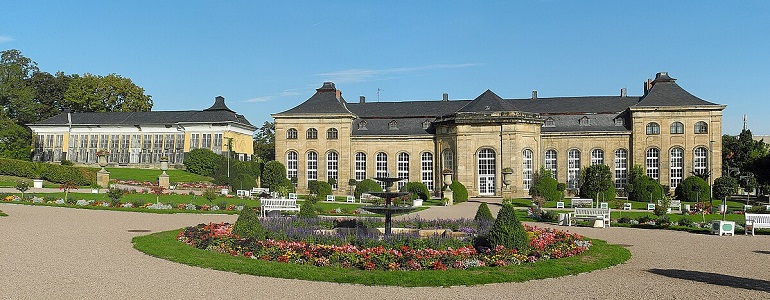
Located to the east of Schloss Friedenstein, the Gotha Orangery forms part of the palace's elaborate baroque gardens. Commissioned in the 18th century, it is one of the largest and most beautiful Baroque orangery complexes in the German-speaking world. Designed to house exotic plants such as citrus trees during cold months, the orangery consists of elegant greenhouses and formal parterre gardens. Today, it also hosts concerts and cultural events, combining horticultural tradition with vibrant community life.
Old Town
Gotha's historic Old Town is a charming district characterised by its well-preserved medieval layout and a mix of Baroque and Renaissance architecture. The area is best explored on foot, allowing visitors to appreciate the picturesque houses, small boutiques, and cosy cafés that line its streets. Key landmarks such as the historic Town Hall, the Augustinian Monastery, and the city's three main market squares are all situated within this compact and atmospheric part of the city. The Old Town frequently hosts markets and events, making it a lively centre of Gotha's cultural life.
Hauptmarkt
The Hauptmarkt, or main market square, serves as the historic and social heart of Gotha. The square is surrounded by beautifully restored historic buildings and is a popular meeting place for both locals and tourists, with numerous cafes, restaurants, and shops. The most prominent structure on the square is the Old Town Hall, which stands in the middle of the space. The square itself provides ample seating and regularly hosts events, functioning as a central point for exploring the city's attractions.
Town Hall
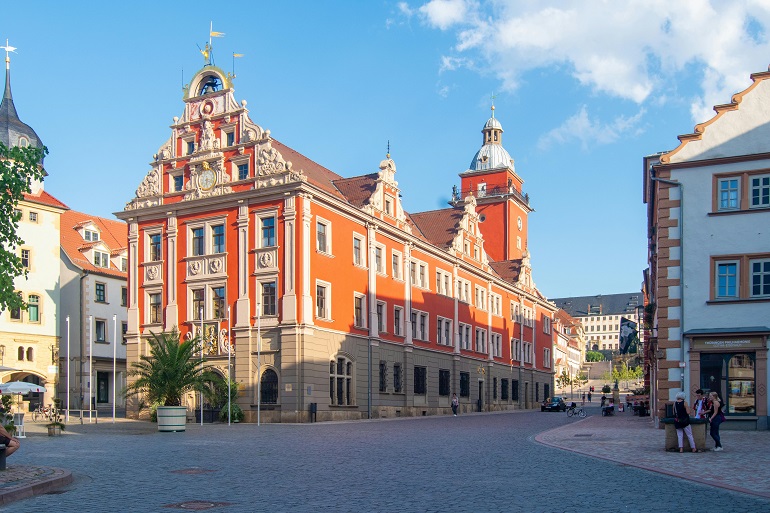
The historic Town Hall is a commanding Renaissance building located in the centre of the Hauptmarkt, which it divides into an upper and lower section. Constructed between 1567 and 1577, the building is notable for its striking red-painted façade. Originally built as a department store, it later served as a temporary residence for Duke Ernst I before being converted into the town hall after a fire in 1665. Today, it functions as the seat of Gotha's Lord Mayor and houses parts of the city's administration. For a small fee, visitors can climb the town hall tower for a panoramic view over the city.
Innungshalle
Located on the lower section of the Hauptmarkt, the Innungshalle (Guild Hall) stands on the historic site of Gotha's medieval town hall. In 1820, the building was acquired by the merchant Ernst-Wilhelm Arnoldi for the grocers' guild. In 1818, Arnoldi had already established the first German commercial school within this building. Today, the Innungshalle contributes to the historic character of the main market square.
Schellenbrunnen
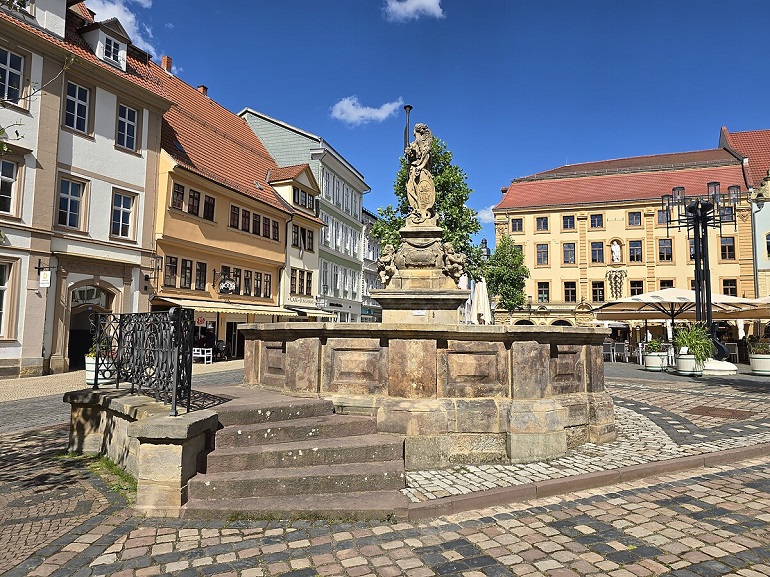
The Schellenbrunnen is one of the notable fountains situated in Gotha's Hauptmarkt. Located on the lower part of the main market square, this historic fountain contributes to the square's historic ambience. The name of the fountain translates to "Bell Fountain". It stands as one of several water features in the city, which historically played a role in the local water supply system.
Augustinian Monastery
The Augustinian Monastery is one of the oldest monastic sites in Thuringia, with a history stretching back over 750 years. Originally founded as a convent by Cistercian nuns in 1216, it was taken over by Augustinian monks by 1258. The monastery retains significant historical features, including a Gothic cloister dating to 1366. The interior of the church was remodelled in the Baroque style between 1676 and 1680 under Duke Frederick I of Saxe-Gotha-Altenburg. The monastery is also noted for its connection to Martin Luther, who stayed there as a district vicar. Today, the site serves as a meeting centre for the Protestant city church community.
Parks
Mönch Park Gotha
Mönch Park offers a central green space ideal for families and visitors seeking relaxation or recreation within Gotha. The park features walking trails, children's playgrounds, slides, swings, and open fields suitable for picnics. It is designed to be accessible for visitors of all ages and abilities, with amenities that also accommodate pets. The park's gently landscaped area and welcoming facilities make it a popular destination for leisure and community gatherings.
Gotha Zoo
Gotha Zoo, located on the outskirts of the city, is a small but well-maintained zoological park. It is home to a range of domestic and exotic animals, alongside playgrounds and picnic areas. The zoo is particularly suitable for families with children, providing educational value and opportunities for interactive learning in a relaxed setting. Free parking and accessible facilities further add to its convenience for all visitors.
Bürgerturm (Civic Tower)
The Bürgerturm is a modern observation tower on the Galberg hill, built in 2009 as a community initiative. At 34.75 metres tall, the steel structure offers three observation platforms, providing sweeping panoramic views over Gotha, the Thuringian Forest, and, in clear weather, as far as the Brocken mountain. The tower is freely accessible year-round except during extreme weather. Its location is reached via a pleasant walk from the city centre, making it a destination for both history enthusiasts and nature lovers.
Top Museums
Ducal Museum Gotha (Herzogliches Museum)
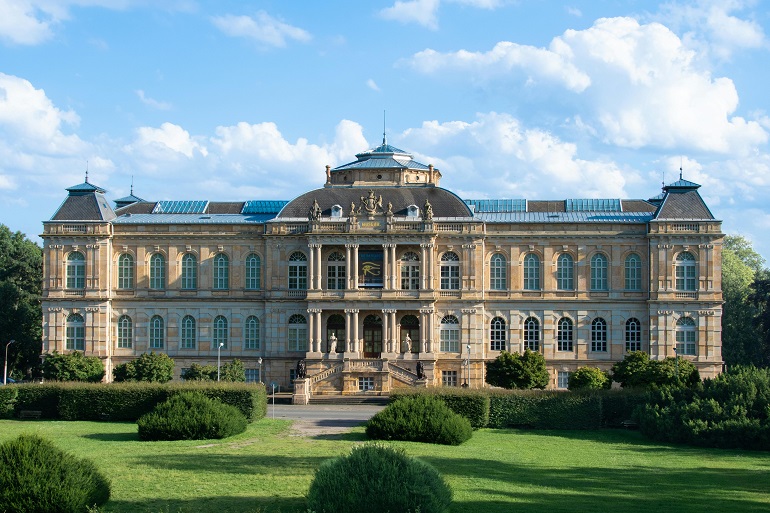
The Ducal Museum Gotha is often celebrated as the “Thuringian Louvre”, and stands as an architectural gem in Neo-Renaissance style, dating from the late 19th century. It houses the former art collections of the Dukes of Saxe-Gotha, a truly eclectic and internationally significant assortment that spans from ancient Egypt to modern times. Inside, you’ll find Egyptian mummies, Greco-Roman antiquities, 18th-century cork models, and treasures from East Asia.
The collection features masterpieces by greats such as Peter Paul Rubens, Jan van Goyen, Caspar David Friedrich, and Lucas Cranach the Elder. The enigmatic painting “Gothaer Liebespaar” (‘Gotha lovers’) is a particular highlight. Sculpture enthusiasts will appreciate works by Jean-Antoine Houdon—Gotha houses the world’s largest collection of his work outside France—as well as Conrad Meit and Adriaen de Vries. The museum also offers remarkable ceramics, including Italian maiolica, Meissen porcelain, and Böttger stoneware. The combination of light-filled galleries and ornate detailing makes a visit an aesthetic pleasure for all ages.
Museum der Natur Gotha (Museum of Nature Gotha)
The Museum of Nature, located within Friedenstein Palace, presents one of Germany’s oldest and most distinguished natural history collections. Some of its geological, palaeontological, and zoological displays can be traced as far back as the 17th century, initiated by the collecting interests of the Gotha dukes.
The flagship permanent exhibition, “Animals in the Tower”, invites exploration of animal life both native and exotic. From rainforest species through to those from Antarctica, the displays are highly engaging—taxidermied specimens can often be touched or heard, making the exhibits especially captivating for children and families. Of particular note are the prehistoric fossils: the museum holds rare sandstone slabs imprinted with the remains and footprints of early reptiles, including the “Tambach Lovers”, some of the world’s oldest such finds. The museum strives for both scientific integrity and accessibility, making it an enjoyable destination for visitors of all backgrounds and ages.
Historical Museum of Gotha (Museum für Regionalgeschichte und Volkskunde)
This museum brings the region’s history to life, concentrating on the daily experiences of Gotha’s citizenry across the ages. Its displays offer a window into social life, trades, and traditions, forming a complement to the grandeur of ducal art and architecture found elsewhere in the city. Here, you will trace the evolution of Gotha from its early settlement through to its status as an influential ducal seat. Expect to encounter historical objects, folklore artefacts, and thematic exhibitions that reflect the town’s role in regional and national history.
KunstForum Gotha
The KunstForum Gotha is a relatively recent addition, providing a platform for modern and contemporary art at the heart of the old town. Since 2014, its 400-square-metre exhibition space has been dedicated to presenting rotating shows of painting, photography, sculpture, and installations by both regional and national artists. The venue places great emphasis on interaction, offering events and programmes that bridge artists and the public in an intimate, thoughtfully restored setting. Those interested in contemporary artistic trends will find this an essential stop in Gotha.
Lucas-Cranach-Haus
Named after the celebrated Renaissance painter Lucas Cranach the Elder, this two-storey Baroque house on the Hauptmarkt has direct historical ties to the artist’s family. Cranach’s wife was born here, and he later bequeathed the property to his son-in-law. The building was given its current name in 1872, marking Cranach’s 400th birthday. Today, the house stands as a historic monument with some preserved features from the original, such as the basement and portal, and contains also a pump station for the city’s picturesque fountains. While not a museum in the classical sense, it’s an iconic site for those fascinated by the city’s artistic ancestry.
Local Cuisine
The city’s restaurants showcase classics such as the renowned Thuringian bratwurst—smoky, savoury sausages often enjoyed with mustard and freshly baked bread—as well as hearty cuts like Thuringian beef featured in traditional roasts or as a delicate tartare. Local menus frequently present dishes starring salmon trout from nearby fish farms, perfectly complementing vegetable sides flavoured with local herbs. For those with a sweet tooth, don’t miss the Thuringian prophet cake, a delightful dessert pairing apples with a light vanilla foam. Whether in a historic tavern or a more contemporary eatery, Gotha’s culinary scene is rooted in local produce and time-honoured Thuringian recipes, ensuring every meal is both authentic and memorable.
Getting There & Around
By train, Gotha is easily accessible with regular regional and high-speed rail connections, including direct services from major cities such as Erfurt, Leipzig, and Eisenach, operated by Deutsche Bahn and FlixTrain. The main Gotha station is located in the city centre and provides a convenient gateway for visitors arriving from across Germany and beyond.
By coach or bus, several companies, such as FlixBus and regional providers, operate frequent services to Gotha from surrounding cities and towns, with arrivals and departures from the centrally situated bus station near Gotha Hauptbahnhof. This option is ideal for those seeking a straightforward and comfortable ride across the scenic Thuringian countryside.
By car, Gotha benefits from excellent road links, sitting close to the A4 motorway (Dresden–Frankfurt) and well connected by federal roads B7 and B247. Visitors arriving by car will find ample parking around the historic old town, with recommended facilities at the Ducal Museum, Friedenstein Palace, and the city car park in Gartenstraße.


