



| Contents |
|---|

Introduction
Nestled atop a hill in the charming town of Augustusburg, the magnificent Jagdschloss Augustusburg stands as one of Saxony's most spectacular Renaissance treasures. Built between 1568 and 1572 as a hunting retreat for Elector Augustus of Saxony, this imposing four-winged palace exemplifies the grandeur and architectural sophistication of 16th-century German court culture. With its distinctive red-tiled roofs, elegant arcaded courtyards, and commanding views across the surrounding countryside, the hunting lodge represents a masterful blend of Italian Renaissance influences and German craftsmanship. Today, this remarkably well-preserved palace complex houses an extraordinary collection of museums, including displays of vintage motorcycles, hunting equipment, and period furnishings, whilst its ornate state rooms and chapel showcase exquisite Renaissance art and decoration. Whether you're drawn by its rich history, stunning architecture, or unique museum collections, Augustusburg offers visitors an unforgettable glimpse into the opulent world of Saxon nobility.
Interesting Facts about Augustusburg Hunting Lodge
- The Augustusburg Hunting Lodge was built remarkably quickly between 1568 and 1572 on the Schellenberg hill, 516 metres above sea level on the northern edge of the Ore Mountains in Saxony.
- Commissioned by Elector Augustus of Saxony after his victory in the Grumbach Feud, the lodge was intended to project prestige and political dominance as much as to host hunts.
- The site previously held a medieval fortification of the von Schellenberg family, documented from the early 13th century and later transferred to the House of Wettin.
- Although long attributed to Hieronymus Lotter, current research credits the lodge’s overall design to court architect Hans Irmscher under Elector Augustus’s close supervision.
- Architecturally, the complex is a strictly symmetrical Renaissance ensemble whose Italianate straight-flight staircases reflect contemporary influences beyond traditional Saxon palace forms.
- Set about 12 kilometres east of Chemnitz and 21 kilometres southwest of Freiberg, the castle is a prominent landmark visible from afar across the Zschopau valley.
- Often called the “Crown of the Ore Mountains”, the castle’s commanding hilltop presence has defined the skyline for more than four centuries.
- Since 1922, Augustusburg has functioned as a museum complex, including exhibitions on hunting and ornithology, arms collections, and a renowned motorcycle museum that earned it the moniker “Bikers’ Castle”.
- The lodge forms part of Saxony’s historic hunting culture, with displays tracing the evolution of hunting weaponry from the 17th to the 20th century.

History
The Augustusburg Hunting Lodge stands as one of Saxony's most remarkable Renaissance palaces, built between 1568 and 1572 on a hill called the Schellenberg in the Ore Mountains. Elector Augustus of Saxony commissioned this prestigious hunting palace not merely as a venue for his sporting pursuits, but as a powerful statement of his political supremacy in Central Germany. The construction commemorated his decisive victory in the Grumbach Brawl (Grumbachsche Händel), where Augustus successfully enforced the imperial ban against his Ernestine rivals, John Frederick the Middle and the outlawed knight Wilhelm von Grumbach. This triumph secured the Albertine elector's dominance over the competing Ernestine line and earned him additional territories including the Ämter of Weida, Ziegenrück and Arnshaugk. The site itself held historical significance, as it replaced an older castle belonging to the von Schellenberg family that had been built around 1210-30 and was severely damaged by fire and lightning between 1528 and 1547.
The architectural design of Augustusburg represents a fascinating departure from traditional Saxon palace construction, with scholars now believing that Elector Augustus himself may have been involved in the overall design conception. While the project was long attributed to master builder Hieronymus Lotter, mayor of Leipzig, current understanding suggests he served primarily as chief architect responsible for executing an already completed design. Lotter's influence is evident in the Italian-style staircases with straight flights rather than the customary spiral staircases, whilst details of the north portal and chapel are attributed to Erhardt van der Meer, Lotter's senior clerk of works. The first clerk of works during construction was Paul Widemann until his death in 1568. The castle's innovative design featured four corner towers and a rational ground plan that bore similarities to France's Château de Chambord, though Augustus deliberately chose square corner buildings and ground plans over Chambord's spiral staircases and round towers. Augustus drew inspiration from the extensive collection of architectural documents and template books in his library, creating a structure that differed markedly from other Saxon palaces.
Despite its grandeur and strategic importance, the hunting lodge served primarily as a temporary residence for the electors of Saxony, being inhabited for only brief periods during hunting seasons. The castle's prominent position at 516 metres above sea level made it visible from great distances, serving as a local landmark that could be seen approximately 12 kilometres east of Chemnitz and 21 kilometres southwest of Freiberg. From the early 20th century onwards, the lodge took on new roles beyond its original hunting purpose. The thriving economy of the Electorate of Saxony under Moritz and Augustus provided the necessary financing for such an ambitious construction project, reflecting the region's prosperity during this period. Today, the castle houses Europe's largest motorcycle museum, attracting enthusiasts from across the continent and transforming this Renaissance hunting palace into a modern tourist destination.
Description
Setting and arrival
Set high above the surrounding countryside, the lodge reveals itself gradually through the trees, its pale façades catching the light as the path crests the hill. A broad forecourt frames the entrance, with low walls and neat gravel giving a sense of ceremony before stepping inside.
Architecture and layout
The building presents a harmonious, symmetrical composition, with clean lines, high roofs and crisp stonework that read beautifully against the sky. Arched portals, evenly spaced windows and restrained decorative flourishes create a dignified rhythm, while sheltered loggias offer vantage points over the valleys below.

The grand staircase
Just beyond the threshold, the grand staircase sets the tone: sweeping flights curve upward beneath high ceilings, the handrail polished smooth by centuries of passage. Subtle natural light filters from above, animating the stone treads and casting soft shadows along the walls.
Salons and chambers
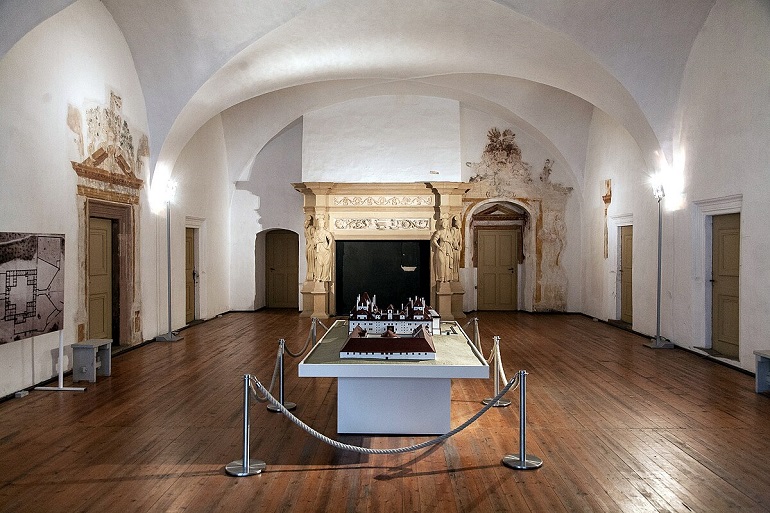
A sequence of salons unfolds at the upper levels, each with a distinct character shaped by colour, proportion and decorative craft. Plasterwork scrolls, painted panels and inlaid floors are balanced rather than ostentatious, allowing furniture groupings and textile accents to define intimate corners for conversation and contemplation.
Banquet hall
The principal hall carries a brighter, celebratory mood, with tall windows, mirrored niches and measured stucco ornament accentuating its length. Suspended lanterns and wall sconces create a warm glow in the late afternoon, when the surfaces pick up subtle reflections from the polished tables and picture frames.
Hunting parlour
More intimate in scale, the hunting parlour is set apart by carved wood panelling, leather seating and thoughtfully arranged display cabinets. Here, the dialogue between craftsmanship and utility comes to the fore—delicate metalwork, engraved details and tactile materials invite close viewing without feeling like a museum vitrine.

Porcelain cabinet
The porcelain cabinet contrasts richly coloured walls with shelves of fine ceramics, the arrangement curated for visual cadence as much as for content. Crisp silhouettes, gilded rims and floral motifs read clearly against deep tones, rewarding slow circuits of the room at different distances.
Archery gallery
Long and lightly vaulted, the archery gallery has a measured hush that suits demonstrations and small exhibitions. Period bows, crossbows and related kit are presented with space around them, so their forms and mechanisms can be appreciated in profile or in the round.
Corridors and light
Throughout the interior, generous windows and well-placed transoms create an interplay of brightness and shade that changes from morning to evening. Wide corridors double as viewing points, framing layers of landscape—wooded slopes, clustered villages and, on clear days, a sweep of distant hills.
Textures and details
Close at hand, the building rewards attention to detail: the cool touch of stone newel posts, the grain of aged timber doors, the faint sheen on wrought-iron latches. Even small elements—keyholes, hinges, escutcheons—contribute to a coherent material language that binds the rooms together.
Gardens and terraces
Outside, terraced gardens descend in trim geometry, with clipped hedging and beds that read as patterned tapestries from the balustrades above. Straight paths give way to softer curves at the edge of the woodland, where ferns, mossy stones and birdsong shift the mood from formal to pastoral.
Woodland walks
A network of trails threads the surrounding forest, shaded by beech and pine and punctuated with simple stone benches. Occasional clearings reveal long views back to the lodge, its roofline rising above the canopy like a landmark for orientation.
Views and vantage points
Balconies and corner platforms are positioned for panoramic views, each offering a slightly different composition of valley, ridge and sky. At sunset, the façades take on warmer tones while the landscape falls into layered blues, making even a short pause feel uncommonly restorative.
Café and loggia
The café occupies a sunlit edge of the complex, with indoor tables flowing onto a loggia that captures the breeze. Simple regional fare—broths, pastries and seasonal cakes—pairs well with the setting, encouraging unhurried breaks between galleries or before a walk.
Shop and crafts
A compact shop focuses on well-made, locally rooted items: carved wooden ornaments, small ceramic pieces, textiles and stationery. Quality takes precedence over quantity, so displays feel curated rather than crowded, making it easy to find a thoughtful memento.
Exhibitions and demonstrations
Across the year, rotating displays bring focus to specific strands of craftsmanship and field sports, from bow-making techniques to the care of working animals. Demonstrations on the meadow below enliven the grounds without disturbing the calm of the interiors.
Wayfinding and flow
Clear signage and a sensible, looped route allow visitors to wander at their own pace without missing key rooms. Seating is placed at useful intervals, and attendants are present yet discreet, maintaining a balance between guidance and freedom.
Accessibility and amenities
Entrances, lifts where available and occasional ramps make much of the complex navigable to those with reduced mobility. Cloak areas, well-kept conveniences and drinking-water points are distributed logically, supporting a relaxed visit of two to three hours.
Photography and quiet corners
Photography is generally accommodated with consideration for others, and several alcoves and window bays provide calm spaces to pause without blocking circulation. Early or late in the day, the quieter ambience lends itself to sketching, reading and reflective viewing.
Overall character
What distinguishes Augustusburg Hunting Lodge is the equilibrium between cultivated design and sylvan charm. The architecture elevates the landscape and the landscape softens the architecture, creating a place that feels both composed and profoundly restorative.
Getting There
By train Take a regional train on the Zschopautalbahn to Erdmannsdorf-Augustusburg station, then ride the Augustusburg Cable Railway (Drahtseilbahn) up to Augustusburg for the final ascent to the hilltop lodge
By coach or bus Regional buses 703, 704 and 705 link Chemnitz, Flöha and Frankenberg with Augustusburg, with stops such as “Zum Schlossberg” convenient for the walk up to the castle
By car From the A4 or A72, approach via Chemnitz to Erdmannsdorf, or leave the A4 at Frankenberg and continue via Flöha, then follow the signs up to Augustusburg.
Best Time to Visit
The best time to visit Augustusburg Hunting Lodge in Saxony is during the warmer months from spring through autumn, as the castle is typically open from March to November and closed during the winter months of December, January, and February. The optimal visiting period falls between May and September when the weather is most favourable for exploring both the impressive Renaissance castle and its extensive grounds, including the woodlands and gardens. During the summer months, the palace often operates with extended opening hours to accommodate the increased number of visitors, whilst the pleasant weather allows for comfortable strolling through the castle's beautiful terraced gardens and enjoying the magnificent views over the Zschopau valley from its commanding hilltop position 516 metres above sea level.