| Contents |
|---|

Introduction
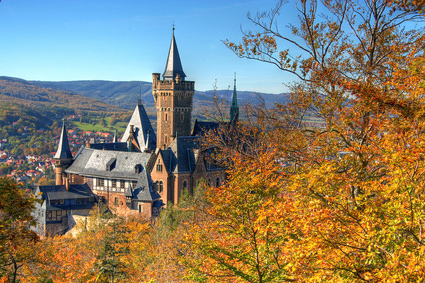
Founded in the year 1000 as mining settlement deep in the Harz mountains, Stolberg (pop. 1,300) became the seat of a county in 1210, then of the Principality of Stolberg-Wernigerode. The pocket-sized town is dominated by the grand Renaissance castle. The town is known for its cohesive ensemble of half-timbered houses.
Interesting Facts about Stolberg
- Stolberg is a medieval half-timbered town romantically tucked into four narrow valleys in the southern Harz, at roughly 300–350m above sea level.
- The townscape comprises more than 380 half-timbered houses spanning four centuries, giving Stolberg a strikingly cohesive historic character.
- Stolberg is on the German Half-Timbered Houses Route, highlighting its architectural significance and preservation.
- It is the birthplace of the radical Reformation leader Thomas Müntzer, a key figure in early 16th-century religious and social upheavals.
- Countess Juliana of Stolberg, ancestress of the Dutch royal family, has her ancestral roots here, linking the town to European dynastic history.
- Stolberg Castle, the former residence of the counts and princes of Stolberg (1201–1945), crowns the town and now serves as a museum.
- The “Old Mint” museum houses a fully preserved 16th-century coin workshop that is unique in Europe and can still be demonstrated on guided tours.
- The Joseph’s Cross on the Auerberg is the world’s largest iron double cross and offers panoramic views from the Kyffhäuser to the Brocken.
- Stolberg has held the honorary title “Historic European City” since 1993, reflecting its longstanding cultural and urban heritage.
- Well-marked circular trails around Stolberg deliver recurring vantage points over the town and its castle-dotted skyline.

History
Stolberg was established as a mining settlement around the year 1000, though evidence of mining activities in the area dates back to 794. The town's name derives from the German words "Stollen" (mining gallery) and "Berg" (hill), reflecting its fundamental connection to the extraction of iron, copper, silver, tin, and gold. Stolberg received town status before 1300 and first appeared in historical documents in 1170. From 1201, the settlement became inextricably linked with the noble House of Stolberg, when it served as the residence and family seat of the counts of Stolberg. The imposing Stolberg Castle, with its oldest round tower dating to around 1200, dominated the town from its hilltop position and shaped both its skyline and its destiny for centuries to come.
The 16th century marked both triumph and turmoil for Stolberg. The town became renowned for its minting industry, which reached its zenith during this period, whilst mining operations continued to provide the foundation of the local economy. However, the German Peasants' War of 1525 brought significant upheaval to the settlement. The town's own son, the radical preacher Thomas Müntzer, led the peasant rebellion, and on 2 May 1525, rebellious peasants invaded Stolberg, forcing Count Botho of Stolberg to accept their demands known as the 24 Stolberg Articles. These concessions were swiftly revoked following the peasants' defeat, but not before Martin Luther himself had visited the town on 21 April 1525 to preach against the rebellion from the pulpit of St. Martin's Church. In 1548, Stolberg became the seat of Stolberg-Stolberg, and the castle underwent extensive Renaissance renovations between 1539 and 1547. The town also holds the distinction of being the birthplace of Juliana zu Stolberg und Wernigerode in 1506, who would become the ancestress of the Dutch royal family through her son William of Orange.
The subsequent centuries witnessed significant political transitions that would reshape Stolberg's governance and identity. Mining ceased in the 17th century, marking the end of an era that had defined the town for over 600 years. In 1738, the counts of Stolberg were compelled to recognise the suzerainty of the Electorate of Saxony, and following the Congress of Vienna in 1815, the town was awarded to the Kingdom of Prussia and subsequently administered by the Prussian Province of Saxony. The castle continued to serve as the residence of the Stolberg family until their dispossession in 1945, after which it became a rest home for the teachers' union in East Germany from 1951. By the 19th and 20th centuries, Stolberg had transformed from a mining community into a tourist destination, officially becoming a health resort in 1946. The town's remarkable collection of over 380 half-timbered houses spanning four centuries has earned it recognition as a Historic European City since 1993, cementing its status as one of the best-preserved medieval settlements in Germany.
Main Attractions
Stolberg Castle (Schloss Stolberg)
Stolberg Castle stands on a spur above the old town and served as the residence of the counts and princes of Stolberg from 1201 to 1945, making it the town’s defining landmark and a key site on the Orange Route across Germany and the Netherlands. The complex has medieval origins and later expansions, and its elevated position provides commanding views over the half-timbered townscape and the surrounding beech forests of the southern Harz. Access involves a short uphill walk from the centre, with the castle now restored and publicly accessible as a heritage site that anchors Stolberg’s historic urban ensemble.

Market Square & Town Hall
The market square is the civic focal point framed by characteristic timbered façades, with the historic town hall presenting a representative example of regional half-timbered architecture within the preserved streetscape. Its position within the old town grid provides direct visual axes to Stolberg Castle and connects to key streets leading toward the town gates and historic quarters. The square regularly functions as a starting point for exploring Stolberg’s built heritage, with short approaches to other landmarks including the Seigerturm, Rittertor, and St. Martini Church.

Historic Half-Timbered Old Town
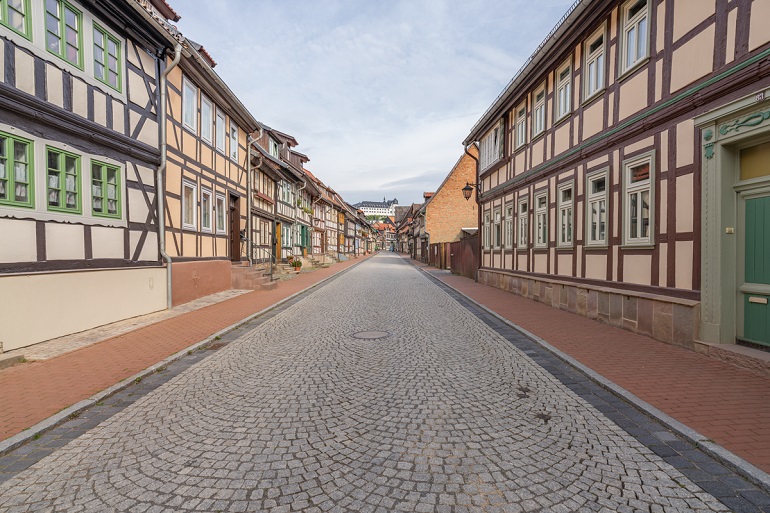
Stolberg’s old town forms a cohesive ensemble of almost 380–400 half-timbered houses across four narrow valleys, with buildings spanning over four to six centuries and streetscapes in late Gothic and Renaissance styles. The compact centre lies at about 300–350m above sea level and is part of the German Half-Timbered Houses Route, reflecting the town’s outstanding preservation and recognition since 1993 as a “Historic European City”. Notable urban features include the market square and views toward the castle from lanes such as Rittergasse, illustrating the intact relationship between the medieval fabric and the hilltop residence.
St. Martini Town Church (Stadtkirche St. Martini)
St. Martini is the principal parish church of Stolberg, situated within the historic centre and contributing a prominent ecclesiastical silhouette amid the timbered urban fabric. The church reflects the town’s long religious and civic history in the Harz, with its setting and architecture integrated into key walking routes between the market square and the ascent to the castle. As a functioning parish site, it remains part of the cultural landscape while offering insight into local craftsmanship and building traditions evident throughout Stolberg’s monuments.
City Gates and Towers: Rittertor and Seigerturm
Remnants of Stolberg’s historic defences include the Rittertor and the Seigerturm, which mark former controlled entrances and watchpoints tied to the town’s medieval street network. These structures illustrate the scale and organisation of Stolberg’s historical fortifications and their role in regulating access through the valley settlement. They can be incorporated into a short heritage walk linking the gates, the market area, and the ascent to Stolberg Castle, providing layered views of the town’s defensive and residential architecture.

Josephskreuz (Auerberg)
The Josephskreuz on the 580m-high Auerberg is the world’s largest iron double cross at 38m tall, reached by roughly 200 steps to an observation platform that offers extensive views from the Kyffhäuser to the Brocken on clear days. The current iron lattice structure dates to the 19th century and was comprehensively restored in 2004; it is a popular hiking destination accessible via routes such as the Alte Auerbergstraße, Alte Poststraße, the Lutherweg, or a shorter approach via the “Straße der Lieder” from the Forsthaus Auerberg car park. Facilities on the Josephshöhe include a small refreshment spot and a playground area, with the site also hosting seasonal events.
Auerberg Hiking Routes (including “Straße der Lieder”)
Multiple signed trails connect Stolberg with the Auerberg ridge and the Josephskreuz, including heritage routes such as the Alte Auerbergstraße and Alte Poststraße and themed paths like the “Straße der Lieder,” which features 14 song stations along a 15–20 minute approach from the Forsthaus Auerberg. These routes offer varied gradients and viewpoints over the South Harz, integrating cultural history with landscape features and making the ascent accessible for different levels of walkers. Waymarking ties into wider regional networks including the Lutherweg, enabling onward connections across the Harz foothills.
Top Museums
Alte Münze Museum (Old Mint Museum)
The Alte Münze Museum is the city's main museum. It is housed within one of the town's most magnificent and oldest half-timbered buildings. Dating from 1534–1535, this impressive structure was originally built by master minter Kilian Keßler and represents a remarkable example of Renaissance architecture.
The museum's permanent exhibition begins on the ground floor with a fascinating collection of historical mint tools, carefully explained for both casual visitors and serious numismatists. A highlight is the display of German coins spanning from the high Middle Ages to the present day, effectively illustrating both local and national history.
The second floor is devoted to local mining and minting traditions, showcasing an impressive collection of large commemorative coins created for collectors and display purposes. These centuries-old pieces function as miniature works of art, depicting local rulers with remarkable attention to detail.
The third floor presents comprehensive information about Stolberg's local history. The final room houses a notable collection of medals and coins dedicated to Thomas Müntzer, the local figure associated with the farmers' revolt, portrayed as a complex idealist seeking justice.
The museum maintains a traditional approach without modern electronic gadgetry, offering a focused and authentic educational experience across its three storeys.
Museum Kleines Bürgerhaus (Small Burgher House Museum)
The Museum Kleines Bürgerhaus offers a window into the domestic life and culture of Stolberg's middle-class residents. Period rooms and objects convey the rhythms of everyday life, craftsmanship, and social customs that shaped the town’s historical identity.
Local Cuisine
Nestled in the Harz, Stolberg offers a hearty mountain kitchen shaped by forests, game and time-honoured butchery, with the local icon being the Stolberger Lerchen—a seasoned pork sausage traditionally served with kale in cosy inns around the market square. Expect menus rich in regional game, freshwater fish and robust German classics in wood-beamed dining rooms such as Gasthaus Kupfer, which showcases home-style dishes alongside seasonal specialties. Broader Harz traditions add character to the table—from dumplings and rustic lard breads to an array of game preparations—reflecting a cuisine that marries earthy savoury notes with occasional sweet flourishes. For a taste of certified regional craft, the Typisch Harz label highlights genuine local products and kitchens committed to quality and provenance, a helpful marker when exploring Stolberg and nearby Harz towns. Beyond savoury plates, Stolberg’s confectionery heritage endures at Friwi, a long-standing bakery renowned for factory-fresh biscuits, waffles and gingerbread, many bearing the regional seal—an inviting stop for a sweet finish after a day in the half-timbered lanes.
Getting There
By train Stolberg has its own station with regional links via Berga-Kelbra to the Halle–Kassel line, so typical rail journeys route through Halle(Saale) Hbf and Berga-Kelbra before the short hop to Stolberg, with services from major hubs such as Berlin and Munich commonly following this pattern.
By coach or bus Regional buses connect Stolberg with nearby towns in the Harz, including direct services from Quedlinburg Bahnhof several times a day, and broader Harz public transport is well integrated for visitors through networks highlighted by local tourism, making bus connections practical once in the region.
By car Approaching from either direction on the A38 (Göttingen–Leipzig/Halle), follow signs for the B85 toward Stolberg, then continue via the L236/L237 to reach the historic centre, a straightforward drive that threads through the southern Harz.
| Travel destinations in Saxony-Anhalt | ||||||||||||||
|---|---|---|---|---|---|---|---|---|---|---|---|---|---|---|
|
|
|
|
| ||||||||||
|
|
|
|
| ||||||||||
|
|
|
| |||||||||||