



| Contents |
|---|

Introduction
Nestled gracefully along the banks of the River Elbe in Dresden, Pillnitz Palace stands as one of Saxony's most enchanting baroque treasures, captivating visitors with its unique blend of European elegance and exotic Oriental influences. This magnificent summer residence of the Saxon electors and kings showcases an extraordinary architectural ensemble comprising three stunning palaces - the Riverside Palace, the Upper Palace, and the New Palace - all harmoniously arranged around meticulously landscaped baroque and English gardens that stretch towards the water's edge. The palace complex, with its distinctive Chinese-inspired elements and ornate facades, offers a fascinating glimpse into 18th and 19th-century royal life, whilst its extensive parklands provide a serene retreat filled with rare botanical specimens, including the famous 230-year-old camellia that blooms spectacularly each spring in its own protective glasshouse. Whether you're drawn by the opulent interior rooms displaying period furnishings and decorative arts, the romantic garden pavilions and sculptures, or simply the peaceful riverside setting that inspired countless royal gatherings, Pillnitz Palace promises an unforgettable journey through Saxon history and horticultural splendour.
Interesting Facts about Pillnitz Palace
- Pillnitz Palace on the Elbe east of Dresden was the Baroque summer residence of Saxony’s rulers and the backdrop to the 1791 Declaration of Pillnitz during the French Revolution.
- The complex is formed by the Riverside Palace and Upper Palace in late Baroque with striking Chinoiserie, linked later by a Neoclassical New Palace that frames formal gardens and a large park.
- Augustus the Strong transformed an earlier château into an “oriental” fête palace between 1720 and 1725, commissioning Pöppelmann and Longuelune to add river stairs for gondolas direct from Dresden.
- A catastrophic fire in 1818 destroyed the Renaissance core and Venus Temple, prompting the construction of the New Palace completed in the 1820s–1830s in austere classicism.
- Pillnitz’s park blends an English landscape garden and Chinese elements from the 18th century, reflecting Saxony’s enthusiasm for exotic styles and botanical collecting.
- The site houses the Dresden State Art Collections’ museums today, with interiors such as the Catholic chapel and historic court kitchen open seasonally to visitors.
- A giant camellia planted in 1801 survives in the grounds, about 9 metres high and 11 metres across, and is among Europe’s oldest camellias, protected in winter by a mobile glasshouse.
- Legend links the Pillnitz Camellia to 18th-century transfers of rare plants from Asia via Kew and continental courts, and it famously survived a 1905 freeze after a greenhouse fire.
- The Palmenhaus, once Germany’s largest cast-iron greenhouse, still nurtures exotic flora from the southern hemisphere and anchors Pillnitz’s identity as a botanical showplace.
- Visitors can still read the palace’s “river festival” design in the ceremonial water stairs and terraces that stage the architecture against the Elbe and vineyards beyond.

History
Pillnitz Palace has its origins in a modest residential fortress first mentioned in 1335 as a nobility seat and manor. The site was enlarged during the 16th and 17th centuries to become a four-winged building before the Wettin dynasty acquired it in 1694 when Elector John George IV of Saxony purchased the property in exchange for Lichtenwalde. He initially presented it as a gift to his mistress, Magdalena Sibylla of Neidschutz, though both died shortly afterwards. The property passed to John George's brother, Augustus II the Strong, who in 1706 granted the facilities to one of his numerous mistresses, Anna Constantia of Brockdorff (later Countess of Cosel). However, Augustus rescinded the gift after she fled to Berlin in 1715, and subsequently ordered the château to be converted into an oriental summer palace for riverside festivities.
The transformation of Pillnitz into the baroque pleasure palace we know today began around 1720 under Augustus the Strong's ambitious vision. Between 1720 and 1725, government architect Matthäus Daniel Pöppelmann oversaw the construction of the elaborate baroque palaces, replacing the original buildings with an exotic architectural ensemble inspired by Chinese imperial palaces, Venetian designs, and the work of Andrea Palladio. The Riverside Palace (Wasserpalais) was constructed first in 1720-21 on the river bank, featuring water stairs completed in 1725 by French architect Zacharias Longuelune that formed a gondola dock for Augustus's stately boats arriving from Dresden. The almost identical Hillside Palace (Bergpalais) was completed in 1723-24, with both palaces designed in the fashionable Chinoiserie style of the period. Pöppelmann also built the octagonal Venus Temple and the Vineyard Church during this period, creating a harmonious complex that blended baroque grandeur with oriental influences.
The palace's role as a royal summer residence was firmly established under Elector Frederick Augustus I of Saxony, a great-grandson of Augustus the Strong, who made Pillnitz his regular retreat from 1765. During his tenure, the grounds were enhanced with an English garden featuring an English pavilion, a Chinese garden with its own pavilion, and an artificial Gothic Revival ruin built in 1785 on a nearby hilltop. The valley behind the palace, known as Friedrichsgrund, was landscaped around 1780 with walking paths and decorative stone bridges. A devastating fire on 1st May 1818 destroyed the original Renaissance palace and Venus Temple, prompting Frederick Augustus to commission architect Christian Friedrich Schuricht to design the Neoclassical New Palace, which was completed in 1826 and formed the third side of the pleasure garden. The palace complex continued to evolve throughout the 19th century with the construction of Germany's largest cast-iron greenhouse at the time—the Palm House—built between 1859 and 1861, covering 660 square metres and stretching 93.7 metres in length. The Wettin dynasty used Pillnitz as their summer residence until 1918, after which it became a state museum.
Description
Overview
Pillnitz Palace stands as a splendid testament to refined European taste and the gentle embrace of nature, nestled along a particularly scenic bend of the River Elbe. From the moment the palace comes into view, its unique blend of Baroque architecture and exotic Chinoiserie elements sets it apart, creating a sense of both stately grandeur and playful charm. The approach is marked by wide, tree-lined avenues and meticulously tended lawns, hinting at the elegance to come.
The Palace Complex
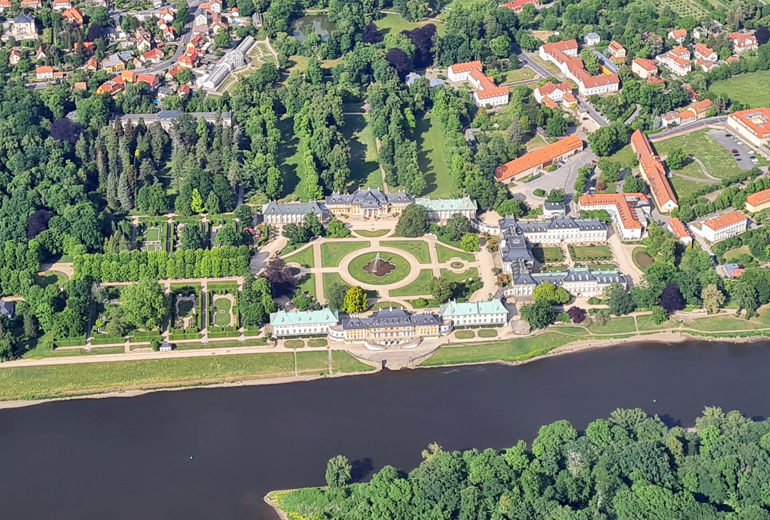
The palace complex is composed of three principal buildings: the Riverside Palace, the Upper Palace, and the New Palace. Each structure faces gracefully onto a central courtyard, while their interconnected forms are arranged to optimise vistas and the interplay of light. The Riverside Palace, closest to the water’s edge, is adorned with intricate façade decorations and tall, arched windows designed to soak up the sunlight and offer uninterrupted views across the sparkling Elbe. Here, one often hears birdsong mingled with the faint sounds of passing riverboats, adding to the tranquil atmosphere.
Riverside Palace (Wasserpalais)
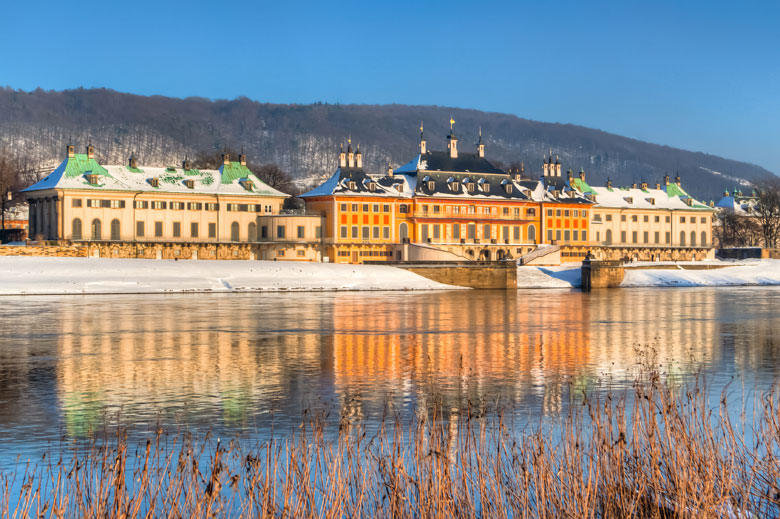
The Riverside Palace, or Wasserpalais, stands as the most iconic of the three main buildings, positioned directly on the banks of the River Elbe. Its graceful, curved form and elegant façade make it a masterpiece of German Baroque architecture infused with the whimsical charm of Chinoiserie.
Architecture and Exterior: The palace presents a long, symmetrical front to the river, anchored by a prominent central pavilion and flanked by two-tiered side wings. Its most striking feature is the sweeping double staircase that descends from the main hall directly to a landing stage on the river, designed to allow guests arriving by boat to make a grand entrance. The building's soft yellow stucco is accented with delicate white trim and decorative reliefs. The roofline is particularly notable; it curves gently upwards in a pagoda-like style, adorned with elegant cornices and crowned with distinctive blue-grey tiles that evoke an oriental aesthetic. Large, arched windows and French doors dominate both levels, ensuring the interiors are flooded with natural light and offering panoramic views of the water.
Function and Interior: Historically, the Riverside Palace was the primary venue for courtly festivities and lavish entertainments hosted by Augustus the Strong. Its main floor is dominated by a grand central festival hall that served as a magnificent ballroom and reception area. Today, this building houses the Museum of Decorative Arts (Kunstgewerbemuseum), showcasing an exquisite collection of furniture, textiles, porcelain, and glassware from the 17th to the 20th centuries. The rooms are arranged to reflect different stylistic periods, from opulent Baroque cabinets to refined Neoclassical salons.
Upper Palace (Bergpalais)
Positioned directly opposite the Riverside Palace across the formal courtyard, the Upper Palace, or Bergpalais, serves as its architectural counterpart and mirror image. While sharing the same fundamental design, it possesses its own distinct character.
Architecture and Exterior: The Upper Palace perfectly reflects the dimensions and style of the Riverside Palace, creating a sense of harmonious symmetry within the complex. It features the same curved, pagoda-style roof, yellow façade, and elegant proportions. However, instead of opening onto the river, its main façade faces the courtyard and the formal gardens beyond. Its grand entrance is reached via a wide, ceremonial ramp rather than a riverside staircase, designed for arrivals by carriage. This orientation gives it a more grounded, stately presence, connecting the formal courtyard with the lush parkland that extends up the hillside.
Function and Interior: Like its counterpart, the Upper Palace was also used for courtly life, providing additional suites and function rooms for the Saxon electors. It now forms part of the Museum of Decorative Arts, with its exhibitions often focusing on contemporary design and special thematic displays that contrast with the historical collections in the Riverside Palace. Walking from one palace to the other across the grand courtyard allows visitors to appreciate the masterful Baroque planning that defines the entire ensemble.

New Palace (Neues Palais)
Connecting the Riverside and Upper Palaces on the eastern side of the courtyard is the New Palace, or Neues Palais. Built later, it represents a stylistic transition from the exuberant Baroque to the more restrained and classical forms of Neoclassicism.
Architecture and Exterior: Constructed between 1818 and 1826, the New Palace has a more severe, linear design than the other two buildings. Its long, colonnaded façade features clean lines, a triangular pediment, and a less ornate roofline. The building's white and grey colour scheme provides a cool, elegant contrast to the warm yellows of the Baroque palaces. Its most significant feature is the large central block containing the domed festival hall and chapel, which creates a monumental link between the two older structures and formally encloses the courtyard.
Function and Interior: The New Palace was built to provide modern living quarters for the royal court and to house new functional spaces. Its most impressive interior is the magnificent domed festival hall, a masterpiece of Neoclassical design that serves as a stunning venue for concerts and events. The palace also contains the former Royal Kitchen, which has been preserved and is now a museum offering a fascinating glimpse into the culinary operations of a royal household. Alongside it is the Palace Chapel, a serene Catholic chapel with beautiful ceiling frescoes and an atmosphere of quiet contemplation, which is still used for services and weddings today.

Highlights of the Estate
An unmissable highlight is the Chinese Pavilion, set deep within the gardens, a riot of lacquered reds, blues and golds, its roof rising in an elegant sweep. Inside and out, the pavilion is decorated with gilded dragons, painted fans and ornate lanterns, lending it a fantastical air. Not far away stands the camellia house, a glass-walled sanctuary that shelters a centuries-old camellia—one of the oldest in Europe—which bursts into bloom each spring, filling the space with an ethereal palette of pink and white.
Inside the Palace: An Array of Remarkable Rooms
Within the Riverside Palace, a series of sumptuous reception rooms greet visitors with a flourish of decorative artistry and refined taste. The grand Entrance Hall, paved in marble and lit by towering windows, sets an airy tone. From here, guests might proceed to the lavish Banqueting Hall, where crystal chandeliers hang from elaborately stuccoed ceilings and gilt-framed mirrors amplify the natural light. The hall’s walls are adorned with scenes from classical mythology and are flanked by towering double doors, each opening into further suites of rooms.
A highlight is the Chinese Room, a dazzling salon where European craftsmanship meets exotic inspiration. Here, silk wallpaper delicately patterned with birds, peonies, and scenes of Chinese life covers the walls. Lacquered wooden panels, gold leaf accents and a collection of oriental porcelain vases lend the space an atmosphere of delicate sophistication and enchantment.
Moving onward, the Porcelain Room showcases a remarkable collection of Meissen and Asian porcelain; its glass-fronted cabinets glisten with intricately painted tea sets, figurines, and decorative vessels. The Music Room is equally evocative, featuring a rosewood pianoforte, period instruments and painted panels depicting serenading musicians and garden scenes, fostering a spirit of convivial gathering.
Within the New Palace, the Long Gallery impresses with its splendid vaulting, rows of arched windows, and a polished wooden floor that seems to stretch forever. Portraits of Saxon royalty gaze down from the walls, framed by gilded stucco and finished in subtle shades of blue and grey. The Royal Apartments consist of several surprisingly intimate rooms: drawing rooms with damask-covered walls, private studies furnished with delicate inlaid desks and Biedermeier chairs, and well-appointed bedrooms complete with canopied beds and exquisitely embroidered textiles.
One should not overlook the Chapel, serene and beautifully proportioned, where sunlight filters through stained-glass windows and the soft strains of organ music often linger. The Library, tucked discreetly at the palace’s edge, houses shelves lined with leather-bound volumes and rare manuscripts; it is a haven for quiet contemplation and scholarly pursuit.
Gardens and Grounds: A Living Tapestry
Encircling Pillnitz Palace is an expanse of gardens that reflect both formal European design and the playful incorporation of exotic motifs. The French Garden closest to the palace is geometrically precise: low box hedges outline intricate parterres, each filled with seasonal floral displays, and paved pathways radiate outwards, bordered by manicured lawns and ornamental planters.
Moving eastward, the English Park provides a freer, more naturalistic landscape. Here, sweeping meadows, gently curving walks, and specimen trees—oaks, beeches, chestnuts—create a romantic setting reminiscent of a picturesque painting. Scattered benches beneath the boughs afford uninterrupted views of the distant vineyards and wooded hills that characterise the country estate.

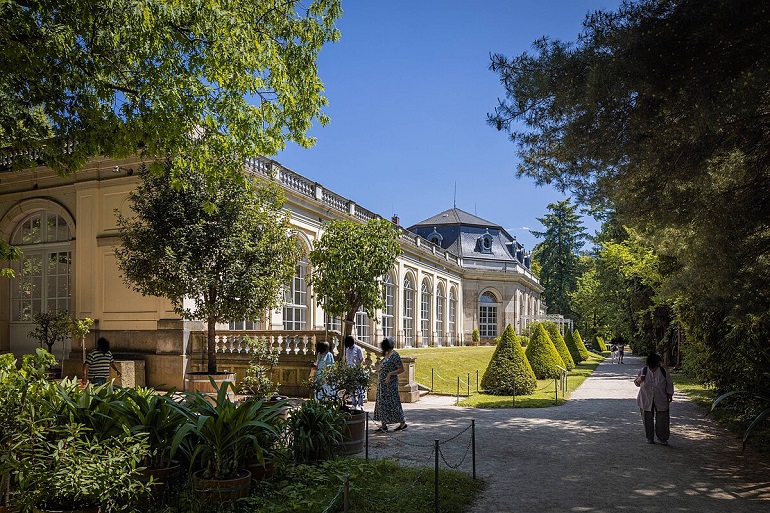
Of special note is the Orangery, a grand structure with a long façade of south-facing windows. In summer months, the courtyard is alive with rows of citrus trees—lemon, orange, and pomegranate—set in painted tubs and filling the air with their subtle perfume. When chillier days approach, these precious plants are wheeled back indoors, ensuring their survival through the winter.
Nestled deeper within the grounds, the Camellia House shelters a legendary camellia tree, over two centuries old, within a glass pavilion ingeniously designed to slide on rails, protecting the plant as seasons change. Each spring, its enormous branches are smothered in delicate pink and white flowers—a spectacle that draws garden aficionados from near and far.
The palace park is peppered with ornamental features: fountains adorned with leaping dolphins and water nymphs, sculpted figures of mythological gods, and rococo garden pavilions ideal for rest or reflection. In high summer, the Rose Garden bursts into full bloom, presenting a vibrant mosaic of colour and fragrance.
The Chinese Pavilion—perhaps the gardens’ most romantic folly—stands surrounded by clusters of bamboo and gingko trees. Its pagoda roof is edged with upturned eaves and gilded details, while within, painted medallions and lacquered benches offer an inviting respite. Lanterns are hung festively whenever special events or evening concerts take place, bathing the area in a warm, otherworldly glow.
Elsewhere, winding paths connect the palace buildings to hidden corners: shaded arbours wrapped in wisteria, secluded ponds with darting dragonflies, and flower-filled borders that change with the seasons. Along the river, a broad embankment lined with ancient linden trees encourages leisurely walks, as pleasure boats drift by on the Elbe and the air is laced with a constant, gentle breeze.
Throughout the estate, the interplay of designed beauty and natural splendour delivers a sense of harmony. From grand halls that once hosted courtly celebrations to tranquil garden rooms fragrant with blossom and the soft sounds of nature, Pillnitz Palace creates an immersive world where art, architecture, and horticulture blend seamlessly. Whether exploring the sumptuous interiors or wandering through verdant parkland, visitors encounter an atmosphere of graceful abundance and quiet delight at every step.
Getting There
By train Arrive at Dresden Hauptbahnhof or Dresden-Neustadt on regional or long-distance services, then switch to local DVB transport: either take tram 2 to Kleinzschachwitz and cross the Elbe by the Pillnitz ferry for a short riverside walk to the palace, or take bus 63 directly to the stop “Pillnitz, Schloss”.
By coach or bus Long-distance coaches arrive at Dresden’s central bus station (ZOB) by the Hauptbahnhof; from there, use DVB services—tram 2 to Kleinzschachwitz plus the ferry, or bus 63 to “Pillnitz, Schloss”—both well signposted and frequent.
By car From Dresden city centre, follow the B172 towards Pirna, then the signposts for Pillnitz via Pillnitzer Landstraße; from the A17, exit at Dresden-Prohlis or Heidenau and continue to Pillnitz; parking is available in designated car parks signed “Schloss Pillnitz”, with a short walk to the palace grounds.
Best Time to Visit
The best time to visit Pillnitz Palace is during spring and early summer, particularly from May through September, when the weather is mild and pleasant for exploring the extensive gardens and baroque architecture. Spring proves especially rewarding as the palace gardens burst into full bloom with vibrant flowers, including the famous 230-year-old camellia which produces up to 35,000 flowers between mid-February and April. Visitors can enjoy the spectacular cherry blossoms and spring bloomers such as crocuses and snowdrops, whilst the warm summer months offer lush greenery and outdoor events in the park. The shoulder months of May and September provide the optimal balance of beautiful weather, blooming gardens, and fewer crowds, making them ideal for a more tranquil visit to this magnificent former summer residence of the Saxon royals.