| Germany Guide |
|---|
|
| | Top National Parks |
|---|
|
| | German States |
|---|
|
| | Europe Guide |
|---|
|
|
|
|
 Dresden at night. Dresden at night.
Introduction

Saxony (Sachsen in German) is the most populous and second smallest state in the former East Germany. With a land area of 18,415 km² (7,110 sq mi) and 4.15 million inhabitants, it is only slightly larger than Kuwait or the US state of Connecticut (though more populous than either).
The area has been known historically as Upper Saxony. The traditional dialects spoken are Erzgebirgisch in the southwest, Upper Saxon between Dresden, Leipzig and Zwickau, and Silesian in the east, around Bautzen and Görlitz.
Particularly rich in castles and palaces, Saxony is one of Germany's most beautiful regions, both for architecture and natural landscapes. Leipzig is one of the capitals of classical music, the former working place of Bach, Schuman, Mendelssohn, Wagner, Mahler and von Weber. Dresden, with its unrivaled baroque and rococo historic centre, may well be the most beautiful city in all Germany.
In 2004, the Dresden Elbe Valley was designated a World Heritage Site. This included the city of Dresden, the Dresden Funicular Railway, the Schwebebahn Dresden, the suburb of Blasewitz, Übigau Palace, Albrechtsberg Palace and Pillnitz Palace. In 2006, the city of Dresden planned to build the Waldschlösschen Bridge across the valley. The UNESCO Committee opposed the project, claiming that it would have a serious impact on the integrity of local landscape. Construction started in late 2007, and the UNESCO decided to delist the area in 2009.
Famous people from Saxony include (chronologically): the mathematician and philosopher Gottfried Wilhelm Leibniz, the composer Robert Schumann, and the composer Richard Wagner.
History of Saxony
In the late Antiquity, the region was settled by Germanic tribes, then from the 6th century, by Slavic people, notably the Sorbs. The modern state of Saxony laid entirely outside the borders of Charlemagne's empire, and was only Germanised in the 10th century.
Integrated to the Marca Geronis ("March of Gero", which expanded from Saxony to Mecklenburg) in the 920s, the territory was divided upon Gero's death in 965, and the southern part became the Margraviate of Meissen, also known as the Thuringian March. In 1423, it merged with the Duchy of Saxe-Wittenberg to form the Electorate of Saxony.
Elevated to the rank of Kingdom of Saxony by Napoleon in 1806, it would remain a powerful semi-independent state until the dissolution of the German Empire in 1918. The kingdom was subsequently rebranded as the Free State of Saxony.
Clickable Tourist Map of Saxony
Note that dots, castle icons and national parks are not clickable on the mobile version. Please use the desktop version for optimal navigation. Blank map of Saxony by Grundkarte TUBS, Relief by Alexrk2. Tourist locations by Maciamo. CC BY-SA 3.0.
|
Attractions
Attractions are listed geographically, from west to east (left to right) and north to south (top to bottom).
West
| Leipzig |
|---|

 Leipzig (pop. 608,000), the largest city in Saxony, is a vibrant city with a rich history, a thriving arts scene, and a reputation for innovation and resilience. Founded at the crossroads of the Via Regia and Via Imperii trade routes, it has been a centre of commerce since the Middle Ages. Its landmarks include St. Nicholas Church, central to the peaceful demonstrations that led to German reunification, and the Old Town Hall, a masterpiece of Renaissance architecture. Leipzig is synonymous with Bach, who served as the Kapellmeister (music director) from 1723 until his death in 1750. His legacy is celebrated at the Bach Museum and the annual Bach Festival. In addition to being called the City of Music, Leipzig is also nicknamed the City of Books due to its long-standing tradition of publishing and book fairs. The Leipzig Book Fair, held annually, is one of the largest in Europe. Leipzig is affectionately called "Klein Paris" (Little Paris) due to its vibrant cultural scene, a term popularized by Goethe during his time as a student. The city is also known for its coffee culture. Leipzig boasts one of Europe's oldest coffeehouses, Zum Arabischen Coffe Baum (The Arabian Coffee Tree), dating back to 1711. |
| Lichtenwalde Palace |
|---|

Lichtenwalde Palace is an impressive Baroque-style palace set against a backdrop of picturesque parkland. It was commissioned in 1687 by the Count of the Wittgenstein as a country residence. The interior is known for its richly adorned rooms, including gilded moldings, frescoed ceilings, and beautifully designed furniture. Some of the most impressive rooms include the ballroom, which is decorated with stucco ceilings and crystal chandeliers, and the staircase hall, which has a grand staircase adorned with ornate banisters. he palace is surrounded by a stunning Baroque garden with symmetrical paths, flowerbeds, and a central axis leading from the palace to a beautiful pond. The palace now houses a museum, which includes collections of paintings, furnishings, and decorative arts from the Baroque era and later periods. |
| Chemnitz |
|---|

 Once known as an industrial powerhouse, Chemnitz has emerged as a hub for modern architecture, art, and innovation while still cherishing its cultural and historical roots. Chemnitz is part of the Erzgebirge/Krušnohoří Mining Region, a UNESCO World Heritage Site that highlights the city’s industrial and mining history. Chemnitz became an industrial and economic hub during the 19th century, earning it the nickname “Manchester of Saxony” due to its booming textile and machinery industries. Opposite the Old Town Hall is the Karl Marx Monument, a massive 7-meter-tall bronze bust created in 1971. It serves as a reminder of the city’s history during the GDR (East Germany) era when it was renamed Karl-Marx-Stadt (1953–1990). |
| Jagdschloss Augustusburg |
|---|

The Augustusburg Hunting Lodge was built between 1568 and 1572 by Elector Augustus of Saxony, who commissioned the construction to serve as a royal hunting lodge. Designed by the renowned architect Giovanni Maria Nosseni, the lodge is a perfect example of Renaissance architecture in Saxony, with a focus on symmetry, grandiosity, and decorative detail. The interior of the lodge contains beautifully decorated rooms that reflect the royal and aristocratic style of the period. It includes wood-paneled rooms, frescoed ceilings, and luxurious furnishings. |
| Scharfenstein Castle |
|---|

Originating as 13th-century fortress, Scharfenstein Castle underwent multiple renovations and alterations over time, especially during the Renaissance and Baroque periods. The castle museum is dedicated to the history of Scharfenstein and the Ore Mountain region. |
| Zwickau |
|---|

Known as the birthplace of Robert Schumann and the cradle of German automobile manufacturing, Zwickau combines culture, history, and innovation. Robert Schumann's birthplace is now a museum and the city holds an annual festival in his honour. Zwickau is also the birthplace of Audi, one of Germany's premier car manufacturers. August Horch, a pioneer of automobile engineering, founded his company here in 1904. The world-class August Horch Museum chronicles the history of automobile production in Zwickau, with a focus on Horch, Audi, and Trabant vehicles. |
| Annaberg-Buchholz (※) |
|---|

Annaberg-Buchholz is a historic town located in the Ore Mountains (Erzgebirge). It has a rich mining history and is known for its well-preserved architecture, beautiful surroundings, and strong ties to the region's traditions. It was particularly known for its silver mining after the precious metal was discovered in the 15th century. The historic town center of Annaberg-Buchholz is home to a beautiful market square, surrounded by well-preserved Renaissance and Baroque-style buildings. One of the main attractions is the Erzgebirgsmuseum (Ore Mountain Museum), which showcases exhibits about the mining techniques, tools, and life of miners throughout history. It also features exhibits on local crafts, including the famous wooden toys and Christmas decorations for which the region is known. The surrounding Ore Mountains are known for their hiking trails, ski resorts, and nature parks. |
| Schloss Wildeck |
|---|

Originally built as a medieval fortress in the 12th century, Wildeck Castle was transformed many times over the centuries and acquired its Renaissance style in the 16th century. It now houses a motorcycle museum, a public one library as well as a wedding room. A baroque garden laid out around the castle in 2009 complements the complex. |
Central (Elbe Valley)
| Meissen |
|---|

 Meissen is world-famous for being the first place in Europe to produce porcelain, a craft previously exclusive to China. The porcelain factory, established in 1710, is one of the oldest in the world. The iconic Blue Crossed Swords mark is a symbol of quality and luxury. Visitors can tour the factory and museum to see how porcelain is crafted, from shaping and glazing to hand-painting delicate designs. Perched above the Elbe River, the 15th-century Albrechtsburg Castle, which played a key role in Saxony's history and was used as the original location for the porcelain manufactory. Adjacent to the castle, Meissen Cathedral is a masterpiece of Gothic architecture, dating back to the 13th century. The cathedral regularly hosts classical music concerts, taking advantage of its excellent acoustics. Meissen lies in the heart of the Saxon Wine Region, one of Germany’s smallest but oldest wine-growing regions. The region specializes in white wines like Müller-Thurgau, Riesling, and the local specialty Goldriesling. |
| Schloss Moritzburg |
|---|

Originally built in 1542 as a hunting lodge for Duke Moritz of Saxony, Moritzburg Castle was later transformed into a grand Baroque residence by Augustus the Strong (1670–1733), Elector of Saxony and King of Poland, in the early 18th century. The castle is situated on a man-made island in a large pond (Schlossteich), which reflects the castle's golden façade, creating a stunning visual effect. The surrounding landscape includes gardens, tree-lined avenues, and a large hunting area known as the Wildgehege Moritzburg, where visitors can see deer and other animals. The interiors of Moritzburg Castle feature richly decorated rooms with tapestries, ornate furniture, and elaborate stucco ceilings. |
| Radebeul |
|---|

Radebeul lies at the heart of the Saxon Wine Country along the Sächsische Weinstraße (Saxon Wine Route), which stretches from Pirna to Diesbar-Seußlitz. Wine production in Radebeul dates back over 850 years, with its terraced vineyards creating a stunning landscape. Radebeul is the longtime home of Karl May, one of Germany’s most famous adventure novelists, known for his tales of the American Wild West. Housed in May's former villa, Villa Shatterhand, the museum showcases his life, literary works, and fascination with Native American culture. Highlights include artifacts, manuscripts, and May's personal belongings. |
| Dresden (※) |
|---|

 Dresden is often called the "Florence on the Elbe" due to its stunning Baroque architecture and rich artistic heritage. Despite suffering devastating destruction during World War II, Dresden has risen from the ashes to reclaim its position as one of Europe’s most beautiful and culturally vibrant cities. Dresden was the royal residence of the Electors and Kings of Saxony, especially during the 17th and 18th centuries when it flourished as a cultural and political center. Dresden State Art Collections houses one of the oldest and most prestigious art collections in Europe. In addition to its historical and artistic appeal, Dresden has a thriving modern cultural scene, with contemporary art galleries, live music venues, and a growing tech industry. The Neustadt district is particularly known for its bohemian vibe, street art, and trendy cafes. The Dresden Striezelmarkt is one of the oldest Christmas markets in the world, dating back to 1434. |
| Schloss Albrechtsberg (※) |
|---|

 Albrechtsberg Palace is a beautiful neoclassical palace, set amid lush gardens. It was designed by the architect Giovanni Maria Nosseni and was built between 1850 and 1854 for Prince Albrecht of Saxony, a member of the ruling royal family. The design was inspired by the villas of northern Italy, incorporating elements of the Renaissance and Baroque periods. The palace is surrounded by a beautiful park, which is designed in a romantic style. The gardens are arranged with tree-lined paths, terraces, and lush green spaces, offering a tranquil and scenic environment. |
| Schloss Pillnitz (※) |
|---|

 Located just outside Dresden, Schloss Pillnitz was constructed in the early 18th century as a royal summer residence for Augustus II the Strong, the Elector of Saxony, King of Poland and Grand Duke of Lithuania. The palace's mix of Baroque and Chinese architectural styles makes it a unique attraction. The complex consists of three main buildings: the Upper Palace (Oberes Schloss), the Lower Palace (Unteres Schloss), and the Pillnitz Pavilion. The pavilion incorporates Chinese architectural elements, such as pagoda-like roofs, intricate wooden carvings, and oriental motifs. The palace is surrounded by formal Baroque gardens, naturalistic English-style parkland, as well as a Terrace Garden overlooking the Elbe River. |
| Weesenstein Castle |
|---|

Weesenstein Castle is a historic hilltop castle located in the picturesque Müglitztal Valley. Its construction likely began in 1240 and was initially a simple fortress. Over the centuries, it was expanded and modified, evolving into a grand noble residence. The castle's architectural style is a blend of various eras, with Renaissance, Baroque, and Gothic influences, creating a unique combination of design elements. Weesenstein Castle served as a royal residence for several noble families, including the Schönburg family and the Von Carlowitz family. |
Central (Saxon Switzerland)
| Saxon Switzerland National Park |
|---|

 Saxon Switzerland National Park is one of the most breathtaking natural landscapes in Germany, located at the confines of the state of Saxony and the Czech Republic. Known for its dramatic sandstone rock formations, deep valleys, lush forests, and picturesque villages, the park is a haven for outdoor enthusiasts, nature lovers, and adventure seekers. The park is famous for its Elbe Sandstone Mountains, a unique range of jagged, towering sandstone cliffs that rise dramatically above the Elbe River. These formations are the result of millions of years of erosion, creating an otherworldly landscape of spires, pinnacles, and deep ravines. |
|
Bastei |
|---|

One of the most iconic landmarks in the region, Bastei is a stunning rock formation offering panoramic views of the Elbe Valley. A series of bridges connect the peaks of the Bastei, providing visitors with incredible photo opportunities. |
| Königstein Fortress |
|---|
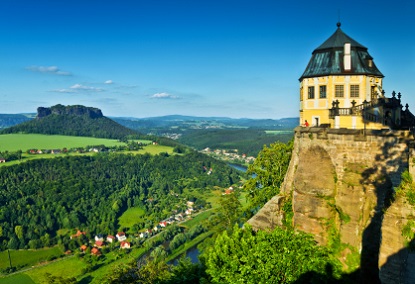
Situated atop a hill, the Königstein Fortress is one of the largest and most impressive hilltop castles in Europe. The fortress has a history dating back to the 13th century and offers panoramic views of the surrounding Saxon Switzerland National Park. |
| Bad Schandau |
|---|

 Bad Schandau is a spa town nestled at the foot of the Elbe Sandstone Mountains. The town serves as the primary gateway to Saxon Switzerland National Park, offering direct access to the dramatic sandstone rock formations and hiking trails |
East
| Muskau Park (※) |
|---|

Located on the border between Germany and Poland, Muskau Park is one of the most famous and beautiful landscape parks in Europe, known for its harmonious blend of nature, artificial landscaping, and historic design. The park was designed in the early 19th century by the influential Prince Hermann von Pückler-Muskau, a German aristocrat, traveller and landscape architect. He began designing Muskau Park in the early 1800s, with the aim of creating a romantic landscape that would reflect the natural beauty of the region while incorporating elements of artificial landscaping, such as scenic vistas, man-made lakes, and strategically placed groves of trees. Muskau Park is a fine example of the English garden style, which was a popular movement in Europe during the late 18th and early 19th centuries. This style emphasized a naturalistic design, creating landscapes that appeared untamed and wild, even though they were carefully planned. Prince Pückler's innovative ideas were highly influential in the development of European gardens and inspired many other famous parks, including Sanssouci in Potsdam and Schönbrunn in Vienna. Uniquely, the park spans two countries, with parts of the park located in both Germany and Poland. The German side (Bad Muskau) and the Polish side (Łęknica) are connected by bridges, making the park a symbol of international cooperation and cultural exchange. |
| Bautzen |
|---|

Known as the "City of Towers" for its skyline dotted with medieval spires, Bautzen is also a cultural hub for the Sorbian minority, a Slavic ethnic group with a distinct language and traditions. Bautzen's old town is a picturesque maze of cobblestone streets, colorful facades, and medieval buildings, including charming townhouses and market squares. It's mots famous tower is the Reichenturm, a leaning tower that rivals Pisa, tilted due to shifting foundations. The town was a key site during the Napoleonic Wars, where French forces led by Napoleon defeated a coalition of Russian and Prussian armies in 1813. |
| Görlitz |
|---|

Görlitz, situated on the easternmost edge of Germany, along the Lusatian Neisse River, is a stunning city steeped in history, culture, and architectural beauty. Known as "Germany's Best-Preserved City" or the "Pearl of Silesia", it boasts over 4,000 preserved historic buildings spanning various architectural styles. Görlitz is also famous for its cinematic charm, frequently serving as a backdrop for Hollywood films. Görlitz is often called “Germany’s Largest Open-Air Museum” because of its incredibly well-preserved architecture, encompassing styles as diverse as Gothic, Renaissance, Baroque and Art Nouveau. |
| Zittau |
|---|

Zittau is located in the southeastern corner of Germany in the state of Saxony, nestled at the meeting point of Germany, Poland, and the Czech Republic. A key member of the Lusatian League during the Middle Ages, the city flourished as a center for textiles, brewing, and commerce from the 14th century onward. The historic center features beautifully preserved Renaissance, Baroque, and Art Nouveau buildings. Highlights include the Town Hall, a magnificent Neo-Renaissance structure, and the Salt House, a former storage facility for salt and grain. Zittau is the gateway to Saxony’s smallest mountain range, the Zittau Mountains. The Zittau Narrow-Gauge Railway is a historic steam train that runs from Zittau to the mountain towns of Oybin and Jonsdorf. It offers scenic rides through the lush countryside and is a must-do for train enthusiasts and families. |
|



 : Local interest
 : Moderately interesting
 : Outstanding place
 : Must-see in the country
 : Top cities in Europe