



| Contents |
|---|
Introduction
Located on the Danube, straddling the border with Bavaria, Ulm (pop. 129,000) is know for being the birthplace of Albert Einstein, and for its cathedral, Ulm Minster, which boasts the tallest steeple in the world (161 m / 530 ft).Founded around 850 CE, the former Free Imperial City combines a rich medieval heritage with modern industry and science, hosting the University of Ulm and the Ulm University of Applied Sciences. The city also features a well-preserved Old Town (Altstadt) with the historic Fishermen's and Tanners' Quarter, characterised by its half-timbered houses, cobblestone streets, and picturesque footbridges. Ulm's fortifications are also a significant historical feature, with much of the 19th-century federal fortress still intact.
Interesting Facts about Ulm
- Ulm Minster boasts the tallest church steeple in the world, rising 161.53 metres high, with 768 steps to the top.
- Albert Einstein was born in Ulm in 1879, although his family moved away when he was an infant.
- Ulm was a Free Imperial City during the Middle Ages, governing itself independently within the Holy Roman Empire.
- The charming Fischerviertel (Fishermen’s Quarter) is known for its half-timbered houses, cobblestone lanes, and the famously crooked house, now used as a hotel.
- Ulm’s old city wall, partially dating from the 14th century, still stands along the river and features the notable Metzgerturm, or Butcher’s Tower.
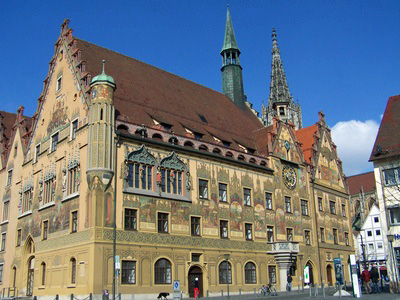
- The colourful Town Hall (Rathaus), built in 1370, features Renaissance murals and an astronomical clock from 1520.
- Every July, Ulm celebrates Schwörmontag (Oath Monday), a unique local holiday involving a mayoral oath and a civic festival with a parade on the Danube.
- The historic Wiblingen Abbey, with its magnificent Rococo library, was incorporated into Ulm in 1927.
- The world’s oldest known animal sculpture, the prehistoric “Lion-man,” can be seen at the Museum Ulm.
- Ulm sits at the confluence of the rivers Danube, Iller and Blau, and on clear days, you can see the Alps from the city’s hills.
- Ulm merchants once shipped goods down the Danube on special flat-bottomed boats called “Ulmer Schachtel,” selling the boats for wood at the journey’s end.
- Ulm is twinned with Neu-Ulm, its Bavarian “sister city,” located directly across the Danube.
- After heavy bombing in World War II, Ulm rebuilt with a striking mix of restored historic buildings and cutting-edge modern architecture.
- The University of Ulm, founded in 1967, is renowned for science and medicine, with strong roots in the city’s medical traditions.
History
Ulm, nestled on the banks of the Danube, is a city with a history stretching back thousands of years. The earliest settlement traces found in the region date back to the Neolithic period, around 5,000 BCE. However, Ulm is first mentioned in written records in 854 CE, when King Louis the German signed a document there. Over the centuries, Ulm developed as a royal domain and gained importance under the Carolingians, who regularly held court in the area. By 1027, Ulm had become a town and, in 1155, it rose to the distinguished status of a Free Imperial City within the Holy Roman Empire, serving as a vital hub at the crossroads of European trade routes.
During the Middle Ages, Ulm flourished as a centre for traders and craftsmen, particularly renowned for its linen and textile industries. The city’s prosperity peaked in the 15th century, supporting the construction of significant Gothic buildings, most notably the Ulm Minster, which boasts the world’s tallest church spire. Ulm’s wealth and influence also allowed it a role in regional politics, often leading Swabian city alliances. In 1530, Ulm embraced the Protestant Reformation, aligning itself with the new religion sweeping across parts of Germany. The following centuries, however, saw periods of decline brought about by religious conflicts, shifts in trade routes, and devastation from the Thirty Years’ War and the plague.
Ulm’s fortunes shifted with major European conflicts. It lost its independence in 1802, becoming part of Bavaria, and was then ceded to Württemberg in 1810. Notably, in 1805, Napoleon’s forces secured a decisive victory at the Battle of Ulm, capturing a large Austrian army. The 19th century witnessed Ulm becoming a fortress city, and the completion of the Ulm Minster in 1891 rekindled civic pride. The city faced immense destruction during the Second World War, but it rebuilt and developed into an important industrial and economic centre. Today, Ulm is not only famous for its medieval heritage and architecture but is also known as the birthplace of Albert Einstein and a thriving university city.
Main Attractions
Ulm Minster (Ulmer Münster)
The Ulm Minster is a principal landmark of Gothic church architecture, primarily known for possessing the tallest church spire in the world, which stands at 161.5 metres. Construction began in the 14th century and was completed in 1890. Visitors can ascend the 768 steps of the main steeple to reach a viewing platform that offers panoramic views over Ulm, the Danube River, and, on clear days, the Alpine mountain range. The interior contains notable features such as 15th-century choir stalls and stained-glass windows.

Fishermen’s and Tanners’ Quarter (Fischerviertel)
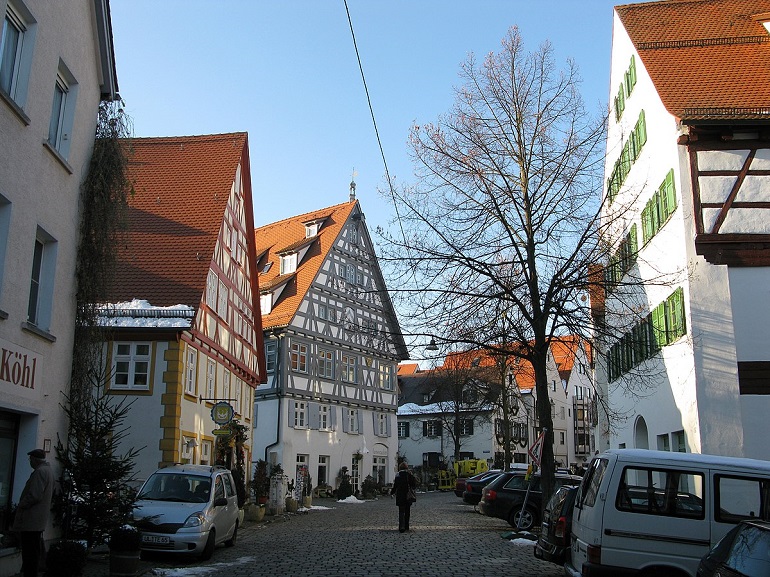
Situated at the confluence of the rivers Blau and Danube, the Fishermen’s and Tanners’ Quarter is Ulm's most significant historic district. It is characterised by its narrow, cobbled alleyways, footbridges, and well-preserved medieval, half-timbered houses that once belonged to craftsmen. The area is now home to a variety of restaurants, independent shops, and galleries. A key building here is the Schiefes Haus (The Crooked House), a 14th-century structure that visibly leans over the river and now functions as a hotel.
Ulm Town Hall (Rathaus)
The Ulm Town Hall is a historically significant building in the city centre, with its oldest parts dating back to 1370. Originally built as a merchants' house, its façade is notable for its extensive and colourful early Renaissance frescoes from 1540, which depict virtues, commandments, and allegories. A prominent feature is the ornate astronomical clock, a 16th-century reconstruction of an earlier timepiece. In front of the building stands the Fischkastenbrunnen (Fish Tank Fountain), a late Gothic fountain from 1482 where fishermen once kept their catch fresh.

Old City Walls (Stadtmauer)
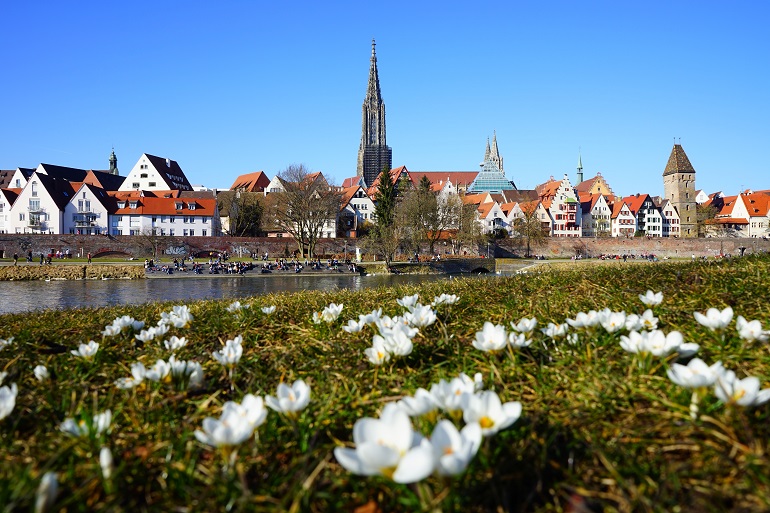
Stretching along the northern bank of the Danube, the well-preserved Old City Walls date from the 15th century and were part of Ulm's extensive fortifications. Today, the top of the wall serves as a popular public promenade for walking and cycling, providing excellent views across the river to the district of Neu-Ulm and back towards the city's skyline. The most recognisable feature of the wall is the Metzgerturm (Butchers' Tower), a leaning 14th-century gatehouse that tilts noticeably due to its foundation on marshy ground.
The Danube Promenade
The Danube Promenade offers a scenic route along the riverbank, connecting the Old City Walls with green spaces like Friedrichsau Park. It is a modern, landscaped area designed for leisure, with dedicated paths for pedestrians and cyclists. The promenade features wide wooden steps leading down to the water, providing ample public seating for resting and observing the river. From here, there are direct views of the historic city skyline, including the Minster and the Old City Walls.
Ulm Synagogue
The Ulm Synagogue, located at Weinhof, is a modern place of worship and community centre for the local Jewish population. Opened in 2012, its striking, cube-like structure stands on the site of the original synagogue, which was destroyed during the November Pogroms of 1938. The building's design features a prominent Star of David pattern perforated into its limestone façade. It serves not only as a religious centre but also as a symbol of remembrance and the revitalisation of Jewish life in the city.
Top Museums
Museum Ulm
Situated on the Market Square, Museum Ulm presents Ulm’s art, archaeology and urban history under one roof. Its archaeological displays range from Ice Age carvings—including the famed Lion-Man statuette—to Neolithic burials and a rare Neanderthal bone fragment. In the art galleries, Late Gothic masterpieces by Ulm School sculptors such as Michel Erhart sit alongside 20th- and 21st-century works by Paul Klee, Franz Marc and Roy Lichtenstein. A striking permanent installation is the Kurt Fried Collection of post-1945 European and American art, featuring works by Mark Rothko, Yves Klein and Gerhard Richter.
Kunsthalle Weishaupt
This privately endowed venue showcases a rotating programme of modern and contemporary art drawn from Siegfried Weishaupt’s collection of over 400 paintings and sculptures. Housed in a sleek glass pavilion opposite City Hall, Kunsthalle Weishaupt highlights artists of the 1950s to 1970s—including members of the ZERO group—and frequently collaborates with the city of Ulm and Museum Ulm for special exhibitions.
Museum Brot und Kunst (Museum of Bread and Art)
Housed in a Renaissance storehouse (Salzstadel), this unique “knowledge museum” explores the cultural, technological and social history of grain, bread and global food systems. Half the exhibition space is devoted to artworks interpreting bread as symbol, metaphor and material; the other half presents technological innovations, religious symbolism and contemporary debates on nutrition and sustainability. The museum’s mission emphasises the intersection of art and everyday nourishment.
Donauschwäbisches Zentralmuseum (Danube Swabian Central Museum)
The only German museum dedicated to the Danube Swabians, Ulm’s DZM offers two permanent exhibitions. “Danube Swabians: Migration and Encounter” traces ethnic German settlement along the middle Danube from the 17th century through displacement and resettlement after World War II. “Danube: River Stories” presents 22 narratives of life on Europe’s great waterway—from fishing traditions to environmental concerns—underscoring the river’s role as a conduit of culture and history.
Naturmuseum Ulm
Located near the Danube, Naturmuseum Ulm (formerly the Natural History Education Centre) is a hands-on natural history museum. Its collections span palaeontology (local fossils), mineralogy and regional flora and fauna. Interactive displays engage families and school groups, with highlights including fossilised remains from the Swabian Jura and well-curated insect and bird exhibits that illustrate Ulm’s ecosystem.
Wiblingen Abbey Museum
The former Benedictine monastery at Wiblingen houses an abbey museum in the former guest rooms, charting monastic life from the Middle Ages to secularisation. The adjacent Baroque library—often hailed as one of Europe’s finest Rococo interiors—is decorated with pastel columns, ceiling frescoes by Franz Martin Kuen and sculptural allegories of virtue and learning. Guided tours illuminate the abbey’s evolution from 11th-century foundation to 19th-century military barracks and modern university facility.
HfG-Archiv Ulm (Ulm School of Design Archive)
Succession to the legendary Bauhaus, the Ulm School of Design (HfG) influenced design theory and industrial practice in the mid-20th century. The HfG-Archiv Ulm preserves curricula, prototypes and documents illustrating the school’s pioneering pedagogy in visual communication and material culture. Rotating exhibitions delve into HfG’s legacy—from furniture design to experimental film—highlighting its role in shaping post-war design.
Edwin Scharff Museum
Dedicated to 20th-century sculpture and visual art, the Edwin Scharff Museum occupies a town centre villa. Its collection centres on ceramic works by Edwin Scharff (1887–1955) alongside contemporary installations and children’s art workshops. Special exhibitions explore regional artists and thematic intersections of art, design and pedagogy.
Local Cuisine
A highlight of Ulm's cuisine is Maultaschen, large pasta parcels typically filled with minced meat, spinach, and onions, often referred to as "Swabian ravioli." The city also takes pride in Spätzle, soft egg noodles usually served as a side dish to savoury meat stews. Another local favourite is Zwiebelrostbraten, a succulent roast beef dish topped with fried onions and accompanied by gravy. Be sure to try Schäufele, a delicious, slow-cooked pork shoulder, and Linsen mit Saitenwürstle, a wholesome combination of lentils and locally made sausages. Traditional bakeries in Ulm also tempt visitors with Dampfnudeln, sweet steamed dumplings that complete any meal in this charming riverside city.
Shopping
Ulm’s principal retail artery is Hirsch- / Bahnhofsstraße, a pedestrianised thoroughfare lined with department stores, international brands and independent boutiques. In the old town around Minster, narrow lanes feature owner-run specialist shops, while the adjacent Fishermen’s Quarter offers crafts, galleries and second-hand bookshops. For covered shopping, Blautalcenter on Blaubeurer Straße hosts around 100 outlets, including fashion, dining and leisure facilities. Most shops are open Monday to Saturday from approximately 09:00 to 20:00, with grocery stores extending hours and all shops closed on Sundays. Regular farmers’ markets on Münsterplatz take place on Wednesdays and Saturdays from 06:00 to 13:00, offering fresh regional produce and artisanal goods.
Nature in and around Ulm
Ulm and its surroundings offer a variety of natural attractions. Within the city, the riverside paths along the Danube provide tranquil walking routes with views of the skyline, while the expansive <>Friedrichsau park on the north bank features woodland trails, meadows and small lakes. The Botanical Garden of Ulm University showcases regional flora in open-air and greenhouse settings. A short drive west brings you to the Blautopf in Blaubeuren, a karst spring renowned for its intense blue colour and 21 metre depth. Beyond that, the rolling hills and limestone escarpments of the Swabian Alb offer extensive hiking and cycling opportunities, and several artificial lakes such as Pfuhler See and Waldsee Senden invite visitors to swim and picnic in a natural setting.
Friedrichsau Park
Established in the early 19th century, Friedrichsau Park is Ulm’s largest and oldest public park. It provides an expansive green space for recreation and relaxation, divided into two sections by the Danube. The park contains a mix of landscaped areas, including themed gardens and arboretums, alongside more natural woodland trails. Its facilities cater to a wide audience, with playgrounds for children, sports fields, beer gardens, and a small animal park (Tiergarten Ulm), making it a central point for outdoor activity.
Glacis Park
Glacis Park is a public green space located just outside the historic city centre, built on the grounds of former 17th-century fortifications. After the fortress was dismantled, the area was converted into a park in the 19th century. It is now characterised by open lawns, mature trees, and walking paths that follow the contours of the old earthworks. The park contains playgrounds, water features, and several historical markers that relate to Ulm’s past as a federal fortress city.
Getting There & Around
By train, Ulm is easily accessible from major German cities, with frequent high-speed and regional train services connecting Ulm Hauptbahnhof to Munich, Stuttgart, and Frankfurt, as well as to other international destinations. The central station is only about a ten-minute walk from the city’s famous cathedral, making rail travel both convenient and comfortable.
By coach or bus, direct services such as FlixBus and BlaBlaCar Bus link Ulm with other major cities including Munich and Stuttgart, with journey times from Munich typically ranging from 1.5 to 2 hours. Most coach services arrive at Ulm’s Eberhard-Finckh-Straße, which is well connected to the local transport network.
By car, Ulm sits at the intersection of the A7 and A8 motorways, providing straightforward access from all directions. Travellers arriving from Munich, Stuttgart, or Frankfurt can follow Autobahn routes to Ulm, with well-signposted exits leading to the city centre and ample parking options available nearby.
Best Time to Visit
The optimal time for a trip to Ulm is during the summer months of June to August. During this period, the weather is pleasantly warm, ideal for exploring the city's historic streets, climbing the Ulm Minster for panoramic views, and enjoying the riverside beer gardens along the Danube. This is also the season for lively festivals and outdoor events, including the famous Nabada water parade on Schwörmontag (Oath Monday) in July. However, for those who prefer to avoid the peak season crowds, the shoulder seasons of late spring (May) and early autumn (September and October) offer a wonderful alternative, with mild temperatures and fewer visitors. Alternatively, a visit during the Advent season provides a magical experience, with the city's Christmas market set against the stunning backdrop of the Minster, offering festive cheer and traditional crafts.


