



| Contents |
|---|

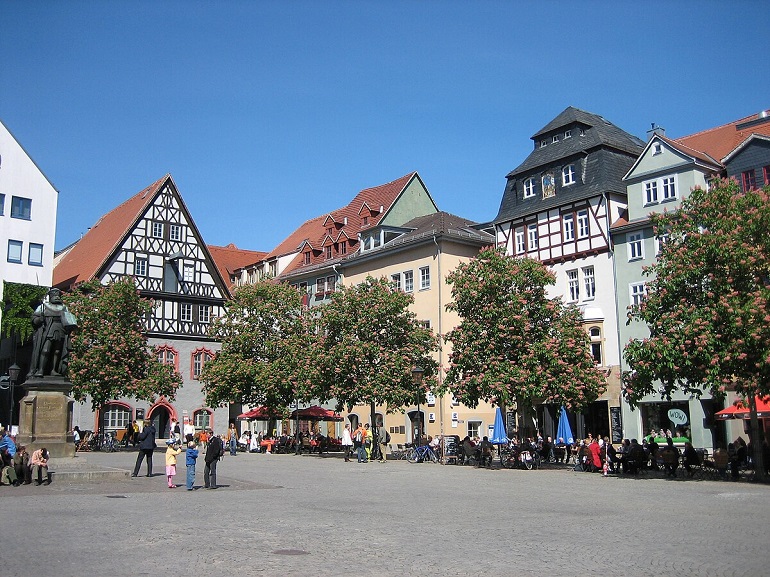
Market square, Jena.
Introduction
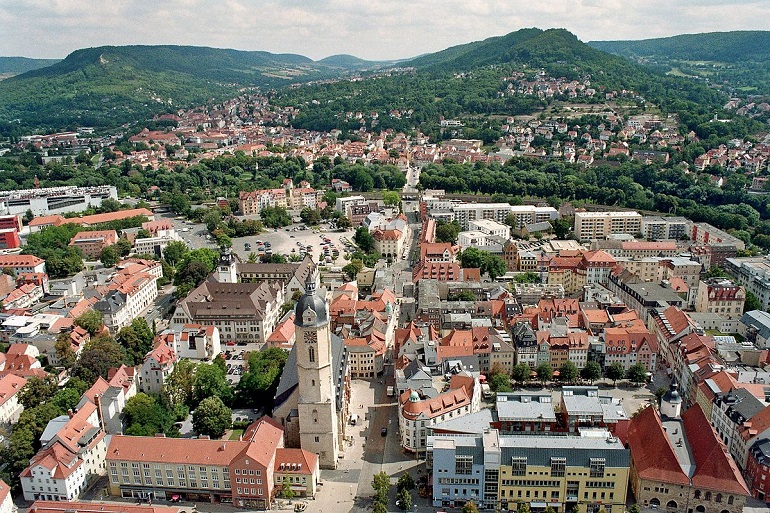
Situated along the Saale River, Jena (pop. 100,000) is Thuringia's second largest city. It is known for its strong academic heritage as the home of Friedrich Schiller University, founded in 1558, and for its historical significance in scientific research and optics, with companies like Carl Zeiss and Schott AG originating there.
Defaced by GDR city planning, Jena is rather unexceptional from a touristic point of view, apart from a handful of specialised museums linked to the local history (optical instruments, glass, phylogeny) and a Goethe Memorial.
Interesting Facts about Jena
- The city is renowned as the “City of Light” due to its pioneering role in the European optical industry, led by companies like Carl Zeiss and Schott.
- Jena is home to the Friedrich Schiller University, founded in 1558, making it one of Germany’s oldest and most significant universities.
- About a quarter of Jena’s population are students, giving the city a distinctly youthful and vibrant atmosphere.
- The world’s oldest working planetarium, the Zeiss Planetarium, opened in Jena in 1926.
- Jena played a major role in the German student and liberal movement, with the colours of the German national flag originating from the Jena Students' League.
- Famous intellectuals such as Goethe, Schiller, and Hegel lived and worked in Jena, contributing to its cultural legacy.
- Jena’s skyline is dominated by the JenTower, a unique cylindrical high-rise built during the GDR era and now a city landmark.
- The city’s medieval heritage is still visible in its historic town hall, old city walls, and towers such as Johannistor and Pulverturm.
- Jena’s market square features a moving clock figure called 'Schnapphans', a local curiosity and part of the city’s so-called ‘Seven Wonders’.
- The Saale river valley and surrounding limestone hills provide Jena with abundant green spaces and scenic hiking paths.
- Jena hosts the annual 'Kulturarena', a renowned open-air summer festival with music and performances from across the world.
- The city boasts the second oldest botanical garden in Germany, established in 1580.
- At the end of the 18th century, Jena thrived as a focal point of German Romanticism and early philosophical thought.
- Jena is sometimes called Germany’s “City of Glass” because of its significant glass and optics industries.
History
Medieval Origins and Early Development
Jena's history stretches back over 840 years, with the city first mentioned in 1182, though some sources suggest earlier references to "Jani" in the 9th century. The settlement emerged at a strategically important crossing point on the River Saale, which historically served as the boundary between Germanic regions in the west and Slavic territories in the east. The early rulers were the Lords of Lobdeburg, who established their castle near present-day Lobeda, approximately 6 kilometres south of the city centre. In the 13th century, these nobles founded two settlements in the valley: Jena on the west bank and Lobeda on the east bank. Around 1230, Jena received official town rights and developed a regular city grid between what are now Fürstengraben, Löbdergraben, Teichgraben, and Leutragraben. The medieval town was centred around wine production, taking advantage of the warm, sunny hillsides of the Saale valley, and featured the essential elements of a medieval city including a marketplace, main church, town hall, council, and protective city walls. Two monasteries - the Dominicans (1286) and the Cistercians (1301) - completed Jena's medieval character. The political landscape changed dramatically in 1331 when the weakened Lords of Lobdeburg sold the town to the ambitious Wettin dynasty.
University Foundation and Early Modern Growth
The Protestant Reformation arrived in Jena in 1523, with Martin Luther himself visiting to reorganise clerical relations, making the city an early centre of his doctrine. A pivotal moment in Jena's development came in 1558 when Ernestine Elector John Frederick the Magnanimous founded the university, having lost his previous university in Wittenberg following the Schmalkaldic War. This institution, later named Friedrich-Schiller University, was initially established as an academy in 1548 and elevated to full university status in 1577. The university quickly became a crucial source of income for the city, particularly as wine-growing declined during the Little Ice Age in the 17th century. The same century witnessed a boom in the printing industry, making Jena the second-largest printing centre in Germany after Leipzig, driven by the Lutheran emphasis on books and literacy. During this period, students created the famous list of "Seven Wonders of Jena," supposedly as a test of local knowledge to verify genuine former students. The university flourished remarkably under Duke Charles Augustus from 1787 to 1806, when it boasted an extraordinary faculty including philosophers Johann Fichte, Georg Wilhelm Friedrich Hegel, and Friedrich von Schelling, as well as writers August von Schlegel and Friedrich Schiller. The institution maintained a reputation for liberal acceptance of new ideas, with notable figures such as evolutionist Ernst Haeckel teaching there in the mid-19th century, and even Karl Marx receiving his doctorate in absentia in 1841.
Industrial Revolution and Modern Transformation
The 19th century brought dramatic change to Jena, beginning with Napoleon's decisive victory over the Prussian army at the Battle of Jena-Auerstedt on 14 October 1806. The subsequent French occupation sparked strong resistance, particularly among students, many of whom later fought in the Lützow Free Corps in 1813. The real transformation began with Jena's relatively late connection to the railway system - the Saal Railway opened in 1874, linking Halle and Leipzig to Nuremberg, whilst the Weimar-Gera railway (1876) connected the city westward to Frankfurt and Erfurt, and eastward to Dresden and Gera. This railway access triggered an industrial boom that fundamentally changed the city's character from a small academic town to a major industrial centre. The pioneers of Jena's industrial revolution were Carl Zeiss and Ernst Abbe (Carl Zeiss AG) along with Otto Schott (Schott AG), who established the city's reputation for optical instruments, precision machinery, and laboratory glassware - industries that gave rise to the term "Jena glass". These industrialists also functioned as social reformers, implementing progressive working conditions and contributing to local prosperity. Following Zeiss's death in 1889, his company passed to the Carl-Zeiss-Stiftung, which channelled substantial profits into social benefits and university research projects, creating a model for other German corporations. By the early 20th century, Jena had become the largest industrial centre in Germany, with the population soaring from around 8,000 in 1870 to 71,000 by the outbreak of World War II. The city's growth continued through the establishment of an electricity generator in 1898 and an electrified tramway in the early 1900s, whilst in 1901 the tram system began operation and the university received a new main building constructed between 1906 and 1908 on the former castle site.
Main Attractions
Market Square (Marktplatz)
Market Square (Marktplatz) serves as the historic heart of Jena, featuring the prominent Hanfried Monument, which commemorates Johann Friedrich I, the founder of the city's university in 1558. The square is surrounded by a collection of Gothic and Renaissance buildings, with notable examples including merchant houses dating from the 14th to 16th centuries. The Old Town Hall, constructed in the 14th century, is particularly noted for its astronomical clock, which displays not only the time but also lunar phases and zodiac signs. The square's cobblestone surface has been preserved, maintaining its medieval character whilst accommodating modern use. The area remains lively throughout the year, hosting weekly markets on Tuesdays and Saturdays where local farmers sell fresh produce, flowers, and regional specialities. During December, the square transforms into a Christmas market, and it regularly serves as a venue for city festivals, political gatherings, and cultural events.
Johannistor and Haus auf der Mauer
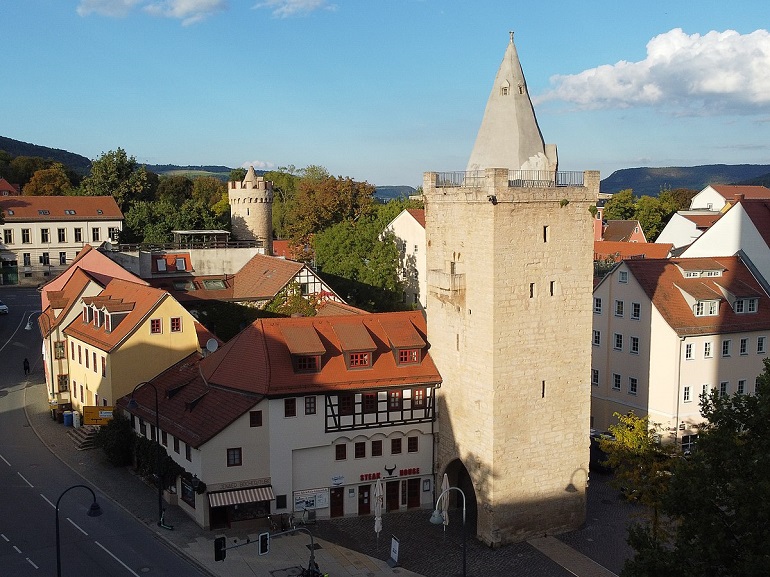
Johannistor and Haus auf der Mauer represent the best-preserved examples of Jena's medieval defensive architecture, offering tangible connections to the city's fortified past. The Johannistor, dating from the 14th century, stands as the last surviving city gate from what was once a comprehensive system of walls and towers that protected medieval Jena. The gate's Gothic design includes defensive features such as murder holes and slots for a portcullis, illustrating medieval military engineering. Adjacent to it, the Haus auf der Mauer presents a unique architectural phenomenon—a residential building constructed directly upon the former city wall, demonstrating how urban spaces evolved as defensive needs diminished. This house, now serving as a cultural venue and event space, hosts community gatherings, small concerts, and educational programmes about medieval urban life. Both structures are easily accessible from the city centre via pedestrian routes, and guided tours are available that explain their historical significance, architectural features, and role in Jena's development. The surrounding area includes remnants of the medieval street layout, with narrow lanes and traditional building styles that complement these historic monuments.
St. Michael's Church
St. Michael's Church is one of Jena's most significant Gothic structures, with construction beginning in the late 14th century and completed in the 15th century. The church stands as a testament to medieval craftsmanship, with its imposing tower reaching 68 metres in height and serving as a landmark visible from across the city. Most notably, it houses the original bronze grave plate of Martin Luther, weighing approximately 1.5 tonnes and created in 1548, making it a rare artefact as the version displayed in Wittenberg's Castle Church is merely a replica. The interior features remarkable Gothic elements including ribbed vaulting, carved wooden altarpieces, and tall stained-glass windows that cast colourful patterns across the nave. The church's acoustics are particularly renowned, making it a popular venue for classical concerts and organ recitals throughout the year. Regular Protestant services continue to be held, and the building also serves educational purposes, offering guided tours that explain both its religious significance and architectural features. The surrounding churchyard contains graves dating back several centuries, providing insight into Jena's social history.

Jena Botanical Garden (Botanischer Garten)
Jena Botanical Garden (Botanischer Garten) holds the distinguished position of being Germany's second oldest botanical garden, established in 1586 by the university for medicinal plant research. Spanning 4.5 hectares in the heart of the city, it contains over 10,000 plant species from various climatic regions around the world, carefully maintained in both outdoor gardens and expansive greenhouse complexes. The garden is affiliated with Friedrich Schiller University and continues to serve important research and educational functions, particularly in the fields of botany, ecology, and plant conservation. Historical significance extends beyond its age, as it played a crucial role in Johann Wolfgang von Goethe's scientific studies during his frequent visits to Jena between 1794 and 1832. The systematic arrangement includes themed sections such as Alpine plants, medicinal herbs, tropical species, and endangered European flora. The Victorian-era greenhouses, renovated in recent decades, house exotic plants including orchids, cacti, and tropical rainforest species that cannot survive in the Central European climate. Educational programmes for schools and universities are regularly conducted, and the garden maintains seed exchange relationships with botanical institutions worldwide.
Friedrich Schiller University's main campus
Friedrich Schiller University's main campus occupies a central position in Jena, with its historical buildings and modern facilities creating an integral part of the city's character. Established in 1558 as one of Germany's oldest universities, it has played a continuous and central role in Jena's intellectual and cultural development for over four centuries. The campus encompasses numerous architectural styles, from Renaissance and Baroque university buildings to contemporary research facilities, reflecting the institution's evolution through different historical periods. Notable historical figures associated with the university include philosophers Johann Gottlieb Fichte and Georg Wilhelm Friedrich Hegel, poet Friedrich Schiller (after whom the university is named), and scientist Ernst Abbe. The university's presence contributes significantly to Jena's vibrant atmosphere, with approximately 18,000 students creating a youthful energy throughout the city. Public lectures, cultural events, and academic conferences are regularly held in university facilities, many of which are open to interested residents and visitors. The campus includes historic lecture halls, modern libraries, research laboratories, and student facilities that collectively form a living educational environment in the city centre.
Goethe-Gallery
Goethe-Gallery is a modern shopping and entertainment complex located strategically south of JenTower, representing contemporary commercial development within Jena's city centre. The mall provides a comprehensive mix of retail outlets, dining establishments, and entertainment facilities spread across multiple levels, serving both residents and visitors to the area. Its architectural design incorporates glass and steel elements that complement rather than compete with the surrounding historic cityscape. The shopping centre houses approximately 60 shops ranging from international retail chains to local specialty stores, alongside restaurants offering various cuisines from traditional German fare to international options. Entertainment facilities include a modern cinema complex showing current films in both German and original languages with subtitles. The mall's central location and pedestrian-friendly connections make it a convenient stopping point for visitors exploring other city centre attractions. Underground parking facilities accommodate vehicles, whilst public transport links provide easy access from various parts of the city and surrounding region. The complex also serves as a venue for seasonal events, exhibitions, and community activities.
JenTower
JenTower, locally nicknamed the "Keksrolle" or "Cookie Roll" due to its distinctive cylindrical shape, dominates the Jena skyline at 160 metres in height. Completed in 1972, it has held the distinction of being the tallest building in eastern Germany for over five decades and remains an iconic symbol of the city's modern development during the GDR period. The tower serves multiple functions, housing offices, residential flats, and commercial spaces across its 30 floors. The observation deck on the 27th floor provides panoramic views extending over the Saale Valley, the surrounding Thuringian countryside, and on clear days, visibility reaches the Harz Mountains to the north. Access to the viewing platform requires a lift journey that takes approximately 45 seconds, and the experience includes informational displays about Jena's geography and history. The tower also features a restaurant on the upper levels, offering regional Thuringian cuisine alongside the spectacular views, making it popular for both casual dining and special occasions. The building's concrete facade has undergone several renovations to maintain its structural integrity and aesthetic appeal.
Napoleonstein
Napoleonstein, situated in the district of Cospeda approximately 4 kilometres southwest of the city centre, is a commemorative monument positioned on a plateau overlooking Jena. It marks the strategic location of the decisive Battle of Jena fought on 14 October 1806, during which Napoleon's Grande Armée defeated the Prussian forces, fundamentally altering the political landscape of Central Europe. The stone monument itself, erected in the 19th century, stands as a simple yet significant reminder of this pivotal moment in European history. The site offers extensive walking and hiking opportunities, with well-marked trails leading through mixed forests and open meadows that provide scenic routes for outdoor enthusiasts. From the plateau, visitors enjoy commanding views across the Saale Valley, encompassing not only Jena's urban landscape but also the rolling hills of the Thuringian countryside. Information panels provide historical context about the battle and its consequences. The area is particularly popular during autumn when the surrounding deciduous forests display vibrant colours, and during clear winter days when snow-covered landscapes create striking photographic opportunities.
Jenzig Mountain
Jenzig Mountain, rising to 385 metres northeast of Jena, serves as the city's most popular hiking destination and natural landmark. This limestone mountain offers multiple access routes, including well-maintained walking paths for hikers of various fitness levels and a winding road for those preferring vehicular access. The distinctive geological formation results from millions of years of sedimentary limestone deposits, creating steep cliffs and unique rock formations that are popular among both geologists and rock climbers. The summit provides excellent panoramic views encompassing not only Jena and the meandering Saale River but also extending across the broader Thuringian landscape to distant mountain ranges. Jenzig House, the mountain-top restaurant and guesthouse, has served hikers and visitors for decades, offering traditional regional cuisine and refreshments in a rustic alpine setting. The facility provides both indoor and outdoor seating areas, allowing visitors to enjoy meals whilst taking in the scenic views. Well-marked hiking trails connect Jenzig to other regional walking routes, making it part of a broader network of recreational paths. During winter months, the mountain occasionally receives snow, creating different seasonal recreational opportunities and photographic subjects.
Top Museums
Science and Technology Museums
Deutsches Optisches Museum (Optical Museum Jena)
The Deutsches Optisches Museum stands as a unique institution in Germany, being the only exhibition of its kind in the country. This science and technology museum houses an extensive collection showcasing optical instruments spanning eight centuries. The museum provides a comprehensive overview of the evolution of optical equipment, offering fascinating insights into the history and many applications of optical technology that have shaped modern science. The collection demonstrates how Jena became the centre of optical innovation and industry.
Zeiss Planetarium
The Zeiss Planetarium holds the distinction of being the world's oldest free-standing projector planetarium that remains in operation, having first opened in 1926. This remarkable institution takes visitors on voyages of discovery through diverse astronomical subject areas. The planetarium features presentations on the fantastic world of galaxies, stars and planets, alongside regular special events and projections of celestial activity in the current night sky. It serves as both an educational facility and a testament to Jena's pioneering role in optical technology.
Schott Museum of Glass
The Schott Museum of Glass complements Jena's optical heritage by showcasing the development of glass technology, celebrating the legacy of Otto Schott alongside Carl Zeiss and Ernst Abbe.
Natural History and Science
Phyletisches Museum
Founded by the renowned zoologist Ernst Haeckel, the Phyletisches Museum represents a globally unique institution that transcends the boundaries of a traditional natural history museum. From its inception, this museum has been dedicated to illustrating the development of life, with its main focus on phylogeny and evolutionary theory. The museum celebrates the fascinating intersection of art and nature, embodying Haeckel's vision of scientific education.
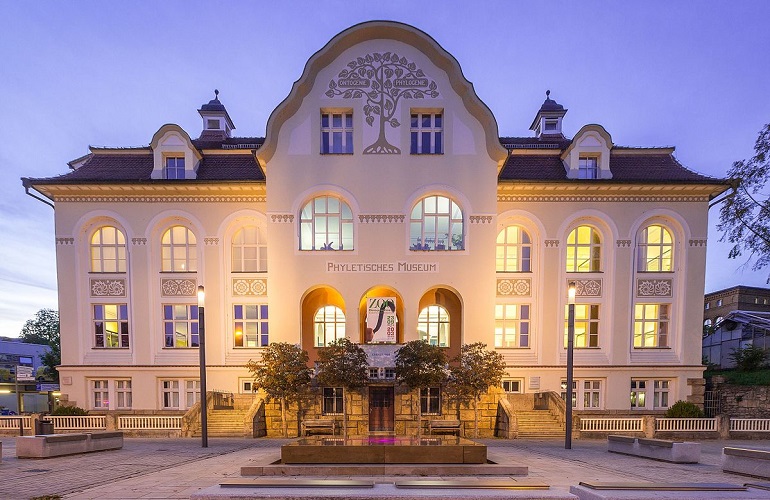
Housed in an Art Nouveau building that itself serves as a cultural monument, the museum's façade is adorned with two important terms that Haeckel coined in Jena: "Ontogenie" (ontogeny) and "Phylogenie" (phylogeny). The institution accommodates extensive zoological and palaeontological collections comprising more than 500,000 specimens, with some dating back to the 18th century. Remarkably, some of the most important specimens originate from the period when Goethe himself curated the anatomical-zoological collections.
Ernst-Haeckel-Haus
The Ernst-Haeckel-Haus serves as both a museum and memorial to one of Germany's most influential scientists. Located in Haeckel's former residence, this institution is part of Friedrich-Schiller-University Jena and pays tribute to Haeckel's significant contributions to zoology and his influence on Darwinism. The museum provides intimate insights into the life and work of this renowned zoologist, philosopher, and pioneering supporter of evolutionary theory.
Historical and Cultural Museums
Stadtmuseum Jena (City Museum)
The Stadtmuseum Jena, also known as Göhre, occupies a late Gothic building on the market square and serves as the primary repository of the city's history. Inaugurated in 1901, this comprehensive museum traces Jena's development from prehistoric times to around 1850 across four levels.
The museum places particular emphasis on the University of Jena's history, founded in 1558, which was transformed into a "School of Athens" by renowned philosophers such as Reinhold, Fichte, Schelling, and Hegel between the late 18th and early 19th centuries. The collection includes documents, objects, and artefacts that testify to the city's development, alongside artistic works depicting views and landscapes of Jena and detailed scale models.
A significant portion of the museum focuses on Jena's period of maximum splendour when it served as an important centre, including exhibits featuring finds from the historic Battle of 1806, where Prussian forces fought against Napoleon. The museum regularly organises temporary exhibitions that delve deeper into the city's history and popular traditions.
Jena Art Collection
The Jena Art Collection combines with the City Museum to present modern art alongside historical exhibits. This collection showcases contemporary artistic works whilst complementing the historical narrative of the city's development.
Romantikerhaus Jena
The Romantikerhaus Jena holds the unique distinction of being the only museum in Jena under municipal sponsorship that exclusively commemorates the city's cultural flowering around 1800. Part of the Municipal Museums Jena, this institution is dedicated to researching, preserving, and disseminating knowledge about Jena Early Romanticism. The museum examines the significance of this pivotal period for modern art and culture, questioning and exploring its lasting influence on contemporary creative expression.
Schiller's Garden House
Schiller's Garden House represents one of only two preserved residences of Friedrich Schiller, the renowned German poet, philosopher, physician, historian, and playwright. This historically significant site served as Schiller's family residence during the summers from 1797 to 1799. The period was remarkably productive for Schiller, during which he penned some of his most important literary works. The house provides visitors with intimate insights into the domestic life and creative environment of one of Germany's greatest literary figures.
Specialised Collections
Oriental Coin Cabinet Jena
The Oriental Coin Cabinet Jena represents a more specialised museum focusing on numismatic collections with an emphasis on Eastern coinage and monetary history.
Local Cuisine
Visitors to Jena can savour hearty dishes such as Thüringer Rostbratwurst, a flavourful grilled sausage often enjoyed with mustard and crusty bread, and Thüringer Klöße, potato dumplings that perfectly complement rich meat dishes. Local menus frequently feature Sauerbraten, a marinated beef roast, as well as sweet treats like Blechkuchen, a tray-baked cake popular in the region. Many cosy inns and modern eateries serve these specialities alongside locally brewed Thuringian beers, offering a true taste of the area’s culinary heritage.
Getting There & Around
By train, Jena is well-connected to Germany's extensive rail network, with two main stations: Jena Paradies for north-south journeys and Jena West for east-west routes. You can reach Jena directly on high-speed ICE trains from cities such as Berlin or Munich, or via regional trains from destinations like Erfurt, Leipzig, and Nuremberg. The city's central location makes it an accessible stop on many intercity routes, and connections from major airports such as Frankfurt and Berlin are readily available.
By coach or bus, Jena is served by various long-distance bus companies, including FlixBus. Coaches typically arrive at the central bus station (Paradies), and the service network links Jena with both domestic and international cities. The bus station is centrally located, making onward travel within the city straightforward.
By car, Jena can be reached via Germany’s motorway system. The city has convenient access from the A4 motorway (connecting Dresden–Frankfurt), with exits at Jena-Zentrum and Jena-Göschwitz. The A9 motorway (Berlin–Munich) intersects the A4 not far from Jena at the Hermsdorfer Kreuz junction, offering flexible north-south connections. Public parking and residential permits are available for visitors travelling by car.


