| Germany Guide |
|---|
|
| | Top National Parks |
|---|
|
| | German States |
|---|
|
| | Europe Guide |
|---|
|
|
|
|
Lower Saxony, Hamburg & Bremen Travel Guide
 Illuminated Statue of Roland in Bremen. Illuminated Statue of Roland in Bremen.
Introduction

The modern state of Lower Saxony (Niedersachsen in German) was formed out of the historic Kingdom of Hanover, Grand Duchy of Oldenburg, Duchy of Brunswick and Principality of Schaumburg-Lippe. It is second largest and fourth most populous of the sixteen states of Germany. It is also the least densely populated state in West Germany.
The city states of Hamburg and Bremen, in contrast, are the two smallest states. Bremen is by far the least populous, with only 547,000 inhabitants, a bit more than Luxembourg. Hamburg, Germany's second biggest city after Berlin, has 1.8 million people. Hamburg and Bremen are respectively the two richest German Länder in terms of GDP per capita.
Altogether, Lower Saxony, Hamburg and Bremen have a population of 10,260,000 (similar to Belgium or the Czech Republic) and a land area of 48,700,000 km² (comparable to Slovakia).
Famous people from Lower Saxony include (chronologically): the astronomer William Herschel, the poet Karl Wilhelm Friedrich Schlegel, the mathematician Carl Friedrich Gauss, the chemist Robert Bunsen, the inventor and industrialist Werner von Siemens, the caricaturist and painter Wilhelm Busch, the entrepreneur Dr. August Oetker, and the model and actress Diane Kruger.
Famous people from Hamburg include: the composer Felix Mendelssohn, the composer Johannes Brahms, the physicist Heinrich Hertz, the Nobel Prize-winning physicist Gustav Ludwig Hertz, the physicist and inventor Manfred von Ardenne, Chancellor Helmut Schmidt, the fashion designer Karl Lagerfeld, and Chancellor Angela Merkel.
History of Lower Saxony
The region of modern Lower Saxony takes its name from the Saxons, a confederation of Germanic tribes who inhabited the area between the Rhine and Elbe rivers from at least the 3rd century onwards. These tribes lived on the North Sea coast and gradually expanded westward and southward, eventually occupying territories that roughly correspond to present-day Lower Saxony and Westphalia. The Saxons were notable amongst Germanic confederations for their lack of a unified monarchy, instead being governed by regional chieftains who selected temporary leaders during times of war. From 772 to 804, the Saxons, led by their legendary chieftain Widukind, waged fierce resistance against the Frankish emperor Charlemagne during the Saxon Wars. Despite skilled guerrilla tactics and strong local support, the Saxons ultimately succumbed to Frankish military might, particularly after the infamous Massacre of Verden in 782, when Charlemagne ordered the execution of 4,500 Saxon prisoners. Widukind's eventual baptism in 785, with Charlemagne serving as his godfather, marked the end of Saxon independence and their forced conversion to Christianity. Saxony was thereafter incorporated into the Carolingian Empire as a single duchy and became a constituent part of the Holy Roman Empire.
During the medieval period, the region experienced its greatest prominence under Henry the Lion, Duke of Saxony from 1142 to 1180 and simultaneously Duke of Bavaria from 1156. Henry was one of the most powerful German princes of his era, whose territories at their height stretched from the North Sea coast to the Alps. He founded numerous important cities including Munich in 1157, Lübeck in 1159, and developed Brunswick, Stade, Kassel, Hildesheim, Lüneburg and Schwerin. In Brunswick, his capital, Henry commissioned the Brunswick Lion in 1166, a bronze statue that became the first large detached sculpture north of the Alps since antiquity and served as a symbol of his ducal authority. However, Henry's refusal to support Emperor Frederick Barbarossa's invasion of Lombardy in 1174 proved fatal to his ambitions. The Emperor subsequently tried Henry in absentia for insubordination, stripped him of his lands, and sent him into exile. Following Henry's fall, the Duchy of Saxony was divided into numerous smaller principalities whose rulers squabbled constantly over territory and succession for the ensuing centuries.
After Napoleon's defeat in 1814, the Congress of Vienna created the Kingdom of Hanover from the former Electorate of Brunswick-Lüneburg, elevating it to the fourth-largest state in the German Confederation. The kingdom was ruled by the House of Hanover and existed in personal union with Great Britain from 1714 to 1837, during which time the monarch resided in London whilst a viceroy administered Hanoverian affairs. This personal union ended in 1837 when Queen Victoria inherited the British throne, as Hanoverian semi-Salic law prevented female succession whilst male heirs lived, causing the crown to pass to her uncle Ernest Augustus. The independent Kingdom of Hanover lasted only until 1866, when it was annexed by Prussia following the Austro-Prussian War, despite Hanoverian expectations of victory at the Battle of Langensalza. It was around this period that the term "Lower Saxony" began to describe this region of Germany. The modern state of Lower Saxony was finally established on 1 November 1946 by British Military Government Ordinance No. 55, merging the State of Hanover (formerly the Prussian Province of Hanover) with the Free States of Brunswick, Oldenburg and Schaumburg-Lippe. The newly formed state faced immense challenges, including integrating hundreds of thousands of refugees from former German territories in Silesia and East Prussia that had been annexed by Poland and the Soviet Union, with Lower Saxony assuming sponsorship of Silesian refugees on 3 October 1950.
|
Clickable Tourist Map of Lower Saxony, Hamburg & Bremen
Note that dots, castle icons and national parks are not clickable on the mobile version. Please use the desktop version for optimal navigation.
Blank map of Lower Saxony by Grundkarte TUBS, Relief by Alexrk2. Tourist locations by Maciamo. CC BY-SA 3.0.
Attractions
Attractions are listed geographically, from west to east (left to right) and north to south (top to bottom).
West
|
Wadden Sea National Park ※ |
|---|
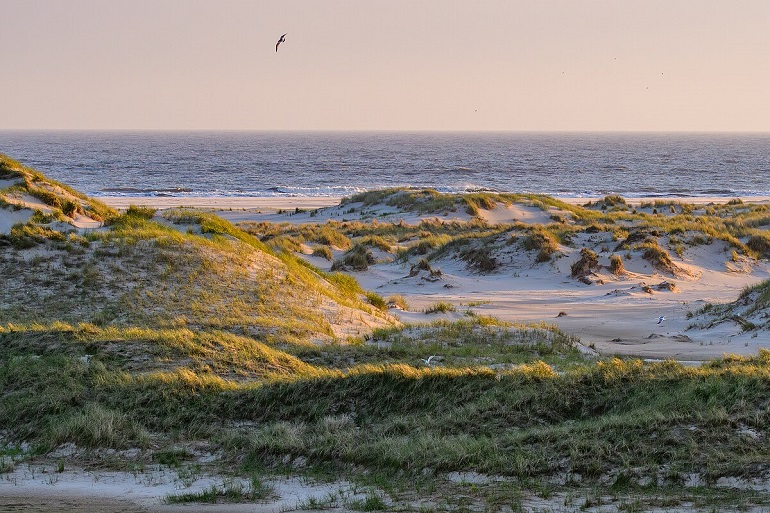
 Stretching from Denmark to the Netherlands, Wadden Sea is Germany's largest national park. It is divided in five administrative sections, including three in Germany: Lower Saxony, Hamburg and Schleswig-Holstein—forming part of the larger Wadden Sea, a UNESCO World Heritage Site recognised as the world’s largest unbroken system of intertidal sand and mudflats. They cover respectively 2,777 km², 137 km² and 4,410 km² of salt marshes, mudflats, beaches, dunes and estuaries. They are ideal for birdwatching, walking and swimming. The German sections protect extensive tidal flats, channels, salt marshes, beaches and dunes, with Schleswig-Holstein’s park covering about 441,500ha, and Lower Saxony’s about 345,800ha, alongside the smaller Hamburg unit in the Elbe estuary. This highly dynamic landscape is shaped by tidal processes and supports rich biodiversity, serving as a critical hub on the East Atlantic Flyway where millions of migratory birds rest and feed annually. Visitors encounter a predominantly marine national park where habitats flood and emerge with the tides, offering opportunities for birdwatching on salt marsh roosts at high tide and views across expansive mudflats at low tide, all managed under strict conservation frameworks that prioritise undisturbed natural processes. |
| Bremerhaven |
|---|

 Located at the mouth of the River Weser, Bremerhaven (pop. 119,000) is Bremen's seaport. It is Europe's fourth largest container port. The viewing platform is a perfect place to watch the hustle-bustle of ships being loaded and the impressive industrial machinery that goes with it. Established in the 19th century as a harbour, it is known for maritime heritage centred on the Hafenwelten district, including the German Emigration Center, the German Maritime Museum and the Climate House Bremerhaven 8° East. The modern container terminal reflects its ongoing role in shipping and logistics, while the historic fishing harbour (Schaufenster Fischereihafen) features seafood restaurants and maritime industry sites. The National German Maritime Museum has an impressive collection of 500 model ships. |
| Bremen (※) |
|---|

Bremen, the capital of the German state of the Free Hanseatic City of Bremen, is a vibrant city steeped in history and culture. Located on the River Weser in northern Germany, Bremen boasts a rich Hanseatic heritage and a blend of tradition and modernity. The city's compact centre is home to numerous UNESCO World Heritage sites, including the magnificent Town Hall and the Roland statue in the historic Market Square. |
| Oldenburg |
|---|

 Situated 50 km west of Bremen, Oldenburg (pop. 176,000) is the historical seat of the eponymous duchy. The House of Oldenburg gradually ascended the thrones of Schleswig-Holstein, Scandinavia, Russia, Greece and the United Kingdom, making it one of Europe's most influential Royal Houses. Unfortunately the city doesn't have much to show for it, apart from its charming late Renaissance ducal palace, housing the interesting State Museum. |
| Osnabrück |
|---|

 Founded by Charlemagne, Osnabrück (pop. 167,000) is situated on the River Hase between the Wiehen Hills and the northern edge of the Teutoburg Forest. A member of the Hanseatic League during the Middle Ages, the city became the seat of the Prince-Bishopric in the Renaissance until being absorbed by Hanover in 1803. It is inside Osnabrück's Renaissance Town Hall that the Peace of Westphalia was signed, ending the Thirty Years' War (1618-1648), the worst war that Germany experienced before the 20th century. The traditional crow-stepped gable architecture of Osnabrück is reminiscent of the nearby Low Countries. The 17th-century yellow-painted Palace of the Prince-Bishops now houses the administration of Osnabrück University. |
| Bückeburg Palace |
|---|

 Bückeburg Palace stands as a magnificent testament to over 700 years of noble history. This Renaissance palace has been in the possession of the family of the Counts of Holstein-Schaumburg, later the Princes of Schaumburg-Lippe, for more than seven centuries and continues to serve as their ancestral seat today. Surrounded by extensive gardens and parks covering more than 80 hectares, the palace complex includes not only the main building with its historic state rooms but also the largest private mausoleum in the world and a Royal Riding School with a tradition dating back 400 years. |
Central
| Hamburg (※) |
|---|

Hamburg, Germany's second-largest city, is a vibrant port metropolis known as the "Gateway to the World". Situated on the Elbe River, it boasts more bridges than Venice, Amsterdam and Paris combined, with over 2,500 spanning its numerous canals and waterways. Key sights include the Speicherstadt warehouse district, Elbphilharmonie concert hall, St Michael’s Church, the International Maritime Museum, Miniatur Wunderland, and the Reeperbahn in St Pauli. Green spaces such as Planten un Blomen and access to the Elbe beaches offer outdoor respite, while museums and galleries, including the Hamburger Kunsthalle, provide a broad cultural programme. |
| Celle |
|---|

Celle (pop. 70,000) is situated on the banks of the River Aller at the southern edge of the Lüneburg Heath. The town is renowned for its remarkably preserved Old Town featuring around 450-500 half-timbered houses dating from the 16th to 18th centuries. Celle's most prominent landmark is its ducal palace, which dates back to 1292 and combines Renaissance and Baroque architectural styles. From 1378 to 1705, Celle served as the official residence of the dukes of Brunswick-Lüneburg. |
| Hanover |
|---|

Hanover (pop. 530,000) is the capital of Lower Saxony. Despite extensive damage during World War II, Hanover has risen to become a thriving metropolis, renowned for its world-class exhibition grounds and international trade fairs. The compact centre combines post-war urban planning with surviving historic areas around the Old Town, while landmarks include the early 20th-century Neues Rathaus with its domed viewpoint and models of the city, the Gothic Marktkirche, and the reconstructed half-timbered facades near the Leine River. |
| Hildesheim (※) |
|---|

Hildesheim (pop. 101,500) is at the same time one of North Germany's oldest and newest cities. Pictures of the superb traditional timber-framed buildings on its market square hints at a well preserved historical centre. Yet Hildesheim was razed to the ground in 1945, and the market square was the only part of town reconstructed to its former glory, and not until the 1980's. So all the old building are in fact fairly new - though few visitors seem to care, as they are truly charming. Sadly the rest of town is pretty much undescript and soulless, apart from a few outstanding medieval stone churches scattered in the western and southern part of the city, including Hildesheim Cathedral (Mariendom), St. Michael's Church, St. Andrew's Church and St. Godehard Church. |
| Hamelin (Hameln) |
|---|

 A major stop on the Fairy-Tale Road, Hamelin (pop. 56,000) is forever associated with the medieval story of Pied Piper of Hamelin. Popularised by the the Brothers Grimm, Goethe and Robert Browning in the 19th century, the legend tells how in the 13th century a piper hired for his rat-catching skills lured all the town's rodent into the Weser River with his magic pipe. When the town folk refused to pay for his services, Pied Piper led all the local children to drown in the river too. |
|
Hämelschenburg Palace |
|---|

Located between Hamelin and Bad Pyrmont, Schloss Hämelschenburg is a superb Renaissance castle built in Weser sandstone between 1588 and 1612. The characteristic façades are endowed with 24 elaborately decorated gabled dormers. The interior is decorated with the original 17th-century furniture. The castle complex includes a moat, residential wings, a gatehouse, and a church, all set within a scenic park. Still privately owned by descendants of its original builders, Hämelschenburg is accessible to visitors for guided tours, providing insights into its historical interiors and significant art collections. |
| Göttingen |
|---|
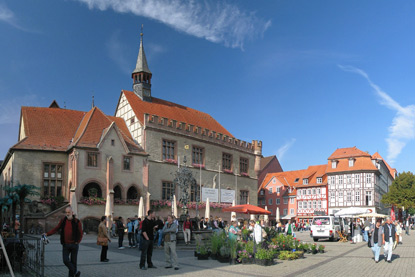
Göttingen (pop. 124,500) is a city that revolves around its university, a sort of German Cambridge or Oxford. Founded in 1734 by George II, King of Great Britain and Elector of Hanover, the University of Göttingen quickly became one of the most prestigious universities in Germany, spawning some 45 Nobel laureates. The town itself is encircled by former ramparts and features a largely preserved medieval layout with numerous half-timbered houses competing for the visitor's attention with neoclassical university buildings and medieval churches. But Göttingen's historical centre suffered from WWII like other German cities and it has lost its architectural homogeneity and authenticity. |
Other attractions
Fairy-Tale Road
Bad Karlshafen
Bodenwerder
East
| Lüneburg |
|---|

Lüneburg (pop. 77,500) is a former Hanseatic city that grew rich on salt mining, beer brewing and trade in the Middle Ages. Today it is a quiet and handsome historic town with stepped gable and timber-framed façades. Its leaning buildings, dislocated by centuries of mining, give the place a unique charm. The compact old town features stepped-gable façades and timber-framed houses, with several buildings showing a characteristic lean due to ground subsidence from centuries of underground salt extraction. |
| Wolfsburg |
|---|

Aptly nicknamed "Golfsburg", Wolfsburg (pop. 130,000) is home to the global headquarters of Volkswagen and the world's largest car factory. The city actually grew around the first VW factory, established in 1938, and originally went by the clumsy appellation of Stadt des KdF-Wagens bei Fallersleben. It was renamed Wolfsburg in 1945 after the local castle. Needless to say that everything here revolves around the automobile industry. The main sight is the Autostadt, a large automotive-themed park with pavilions, museums and delivery centres sprawling on 25 ha (61 acres). |
| Braunschweig |
|---|

Braunschweig (pop. 252,000), known in English as Brunswick, is Lower Saxony’s second-largest city. It is a pleasant, if a bit hotchpotch, historic city that played an important role in medieval Germany. The former Hanseatic city is shaped by the legacy of Henry the Lion, whose 12th-century influence endures at Dankwarderode Castle and St Blasii Cathedral. The compact core is encircled by the Oker river, with pedestrian-friendly streets linking key sights, museums such as the Herzog Anton Ulrich Museum, and the historic Magniviertel quarter of timber-framed houses. The ducal palace, entirely rebuilt and rehabilitated as a shopping centre in 2007, is the largest neoclassical palace in Germany. |
| Wolfenbüttel |
|---|

Located 12 km south of Braunschweig, Wolfenbüttel (pop. 53,000) is a relaxed historical town filled with half-timbered houses. It is one of the best preserved hsitorical towns in the northern half of Germany along with nearby Goslar and Quedlinburg. With origins dating back to the 10th century and first officially documented in 1118, this picturesque town combines rich history, stunning architecture and a vibrant cultural scene. For some 400 years until 1754, Wolfenbüttel served as the residence of the Dukes of Braunschweig and Lüneburg, with the impressive baroque Schloss Wolfenbüttel standing as testament to this period. The town is particularly renowned for the Herzog August Bibliothek (Duke August Library), founded in 1572 and housing over 900,000 books including rare manuscripts. |
| Goslar ※ |
|---|

Goslar (pop. 50,000), a thousand-year-old town nestled on the northern edge of the Harz Mountains in Germany, is a UNESCO World Heritage Site renowned for its rich history and well-preserved medieval architecture. Founded in the 10th century, this former imperial city boasts an impressive array of cultural treasures, including approximately 1,500 half-timbered houses dating from the 15th to 19th centuries, the Romanesque Imperial Palace, and the historic Rammelsberg Mine. The old town, largely surrounded by former defensive structures and green spaces, reflects the economic importance of mining in the region, with its layout and buildings showcasing the mutual balance of technical, social, and economic developments over a millennium of historical mining. |
|
Harz National Park |
|---|

Harz National Park, established in 2006 as the first national park in Germany to span two federal states, offers visitors a legendary mountain wilderness with diverse ecological systems. The park features the impressive Brocken peak (1,142m), unique microclimates that create distinct vegetation zones, and a comprehensive network of well-maintained trails for hiking, biking and cross-country skiing. History enthusiasts will appreciate the area's rich mining heritage, which has shaped the landscape for centuries and led to parts of the region being declared UNESCO World Heritage. The park provides excellent visitor facilities, including several National Park Visitor Centres with interactive exhibitions on natural history and cultural topics, where rangers offer guided tours through the forest wilderness. Beyond nature, visitors can experience thrilling attractions such as Germany's longest swing bridge over the Rappbodetalsperre and a kilometre-long Mega Zipline, making Harz a perfect destination for both nature lovers and adventure seekers. |
Other attractions
Harz Mountains
 Bad Harzburg Bad Harzburg
Braunlage
Clausthal-Zellerfeld
Hahnenklee
St. Andreasberg
|


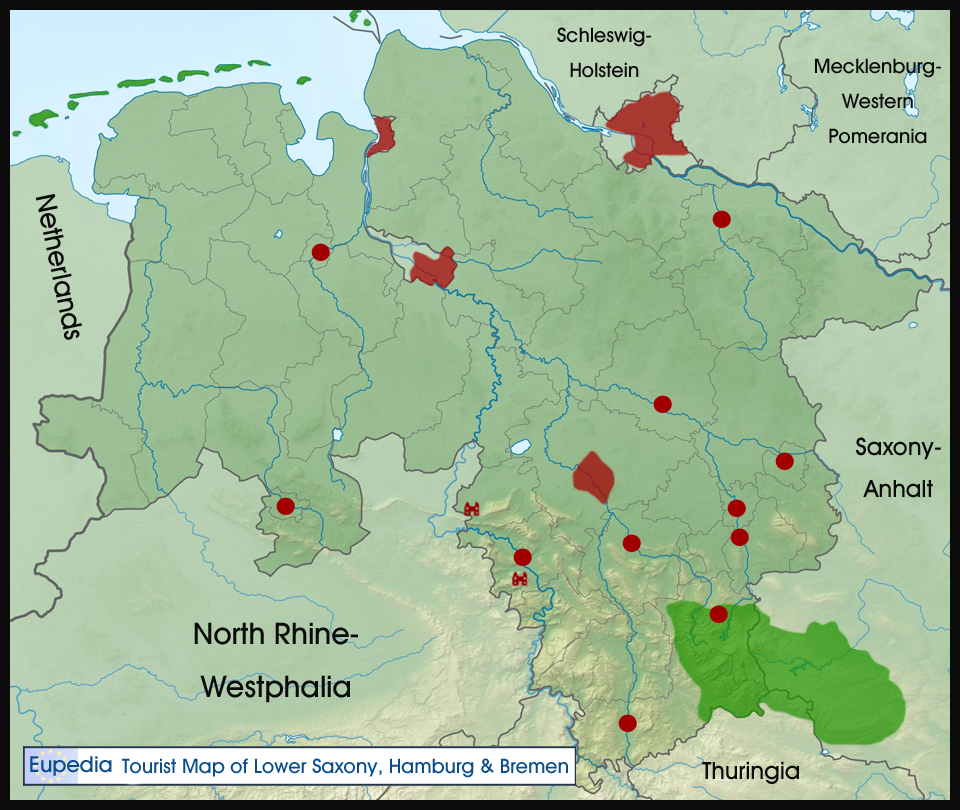
 : Local interest
 : Moderately interesting
 : Outstanding place
 : Must-see in the country
 : Top cities in Europe