| Germany Guide |
|---|
|
| | Top National Parks |
|---|
|
| | German States |
|---|
|
| | Europe Guide |
|---|
|
|
|
|
Mecklenburg-Western Pomerania Travel Guide
 Harbour of Waren, on Lake Müritz. Harbour of Waren, on Lake Müritz.
Introduction

Mecklenburg-Western Pomerania (Mecklenburg-Vorpommern in German, also used in English) is the least densely populated state in Germany, with a mere 73 inhabitants per km² (three times less than the national average). With only 1,642,000 people, it is less populous than the city of Hamburg. Mecklenburg-Vorpommern is also the poorest German state measured by gross regional product per capita at purchasing power parity.
Three of Germany's fourteen national parks are in Mecklenburg-Vorpommern, in addition to several hundred nature conservation areas. The Baltic Sea and the numerous lakes contribute to making Mecklenburg-Vorpommern the number-one tourist destination within Germany, especially popular with Berliners. The state also boast two of Europe's oldest universities (Rostock and Greifswald, both founded in the 15th century), and two cities listed as UNESCO World Heritage Sites (Stralsund and Wismar). Yet, the most beautiful of all is undeniably Schwerin, the state capital.
Famous people from Mecklenburg-Western Pomerania include (chronologically): the field marshal Gebhard Leberecht von Blücher, Chancellor Otto von Bismarck, the archeologist Heinrich Schliemann, and the Nobel Prize biochemist and pioneer geneticist Albrecht Kossel.
Chancellor Angela Merkel's constituency is the central northern part of the state of Mecklenburg-Vorpommern.
History of Mecklenburg-Western Pomerania
The region comprising modern Mecklenburg-Western Pomerania has been shaped by successive waves of settlement and political transformation stretching back millennia. Germanic tribes inhabited the area by around 500 CE, but they were displaced by West Slavic peoples during the Migration Period, with the Obotrites settling in Mecklenburg and the Veleti, Liuticians, and Rani establishing themselves in Pomerania between the sixth and eighth centuries. Vikings and Slavs established important trading posts along the Baltic coast, including Reric, Ralswiek, and Menzlin. In the early 12th century, Polish Duke Bolesław III Wrymouth gained suzerainty over Hither Pomerania and initiated Christianisation efforts, most successfully accomplished by Otto of Bamberg during his mission of 1124-25. The late 12th century brought decisive change when Henry the Lion conquered both Mecklenburg and Hither Pomerania, briefly incorporating them into the Duchy of Saxony and bringing them into the Holy Roman Empire in the 1180s. A Mecklenburg dynasty was established in 1160 following Saxon efforts to Christianise and Germanise the region, and in 1348 the region's dukes became princes of the Holy Roman Empire. This period also marked the beginning of the Ostsiedlung process, as German settlers introduced German law, custom, and Low German language, gradually assimilating the Slavic Rani, Lutician, and Pomeranian tribes into a new German Pomeranian culture.
The medieval and early modern periods witnessed both prosperity and fragmentation across the region. Numerous cities in Mecklenburg and Pomerania flourished during the Middle Ages through participation in the Hanseatic League, with Wismar, Rostock, Stralsund, Greifswald, Anklam, and Demmin becoming important trading centres in the 14th and 15th centuries. From approximately 1700 until 1934, Mecklenburg was divided into two duchies—Mecklenburg-Schwerin and Mecklenburg-Strelitz—following the Treaty of Hamburg in 1701, which resolved succession disputes and established the principle of primogeniture. Meanwhile, Pomerania experienced dramatic territorial changes: whilst Polish dukes ruled until 1637, much of Pomerania subsequently came under Brandenburg-Prussian control. Sweden acquired Western Pomerania through the Peace of Westphalia in 1648, holding Wismar and its surrounding territory from 1648 to 1803, and parts of Western Pomerania (including the islands of Rügen, Usedom, and Wolin) from 1648 until 1815. The Great Northern War brought further territorial reorganisation, with Prussia acquiring parts of Swedish Pomerania south of the Peene River and the islands of Wolin and Usedom through the Treaty of Stockholm in 1720. The Nazi regime united the two Mecklenburg duchies into a single state in 1934.
The 20th century brought profound upheaval and eventual reunification of the region. Following the Second World War, most of Pomerania was transferred to Poland, whilst Western Pomerania and Mecklenburg were merged by Soviet occupation authorities in 1945 to create a new administrative entity. The region became part of Soviet-dominated East Germany, where it was divided into the districts (Bezirke) of Rostock, Schwerin, and Neubrandenburg under the centralised system established in 1952. These districts experienced collectivised farming and economic decline under communist rule, particularly after French occupation in 1806 had already disrupted trade with England and Baltic Sea fishing. The contemporary state of Mecklenburg-Western Pomerania was reconstituted just before German reunification, with the five East German states (including Mecklenburg-Western Pomerania) being formally reconstituted on 23 August 1990. On 3 October 1990, East Germany officially acceded to the Federal Republic of Germany, and the newly reformed state of Mecklenburg-Western Pomerania joined the unified Germany as one of the five new Länder, marking the culmination of centuries of territorial divisions and transformations.
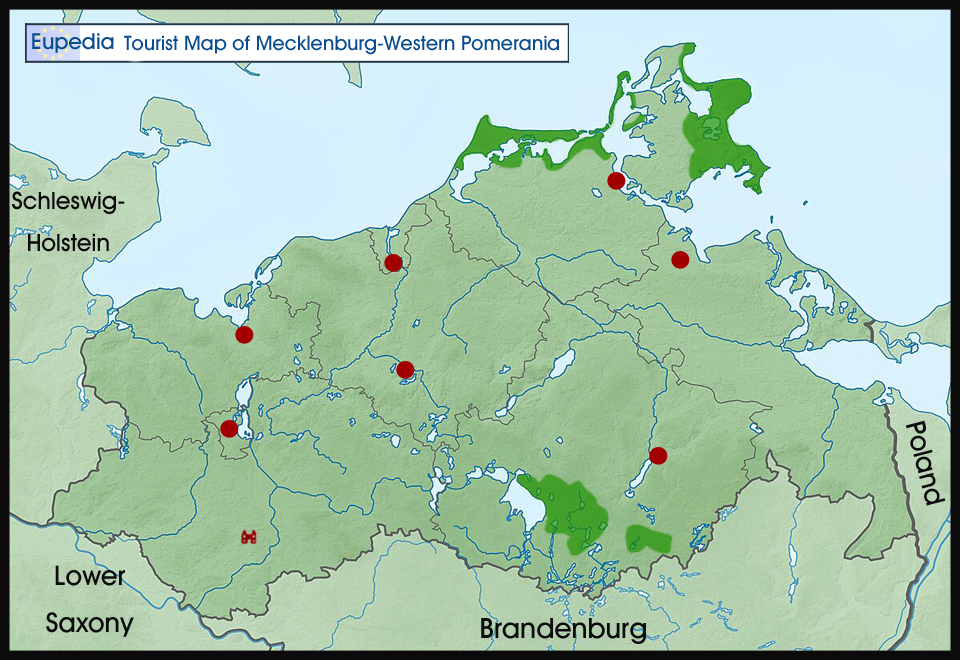
Clickable Tourist Map of Mecklenburg-Western Pomerania
Note that dots, castle icons and national parks are not clickable on the mobile version. Please use the desktop version for optimal navigation.
Blank map of Mecklenburg-Western Pomerania by Grundkarte TUBS, Relief by Alexrk2. Tourist locations by Maciamo. CC BY-SA 3.0.
Attractions
Attractions are listed geographically, from west to east (left to right) and north to south (top to bottom).
Mecklenburg
| Wismar ※ |
|---|

 Strategically sited on a promontory on the Bay of Wismar, facing Poel Island, Wismar (pop. 44,000) started life in the 13th century as a Hanseatic town. In 1648, at the closing of the Thirty Years' War, it became Swedish and remained it until 1903. The city's architectural character is defined by its distinctive Brick Gothic style, showcased by the three great churches of St. George, St. Nicholas, and the remaining tower of St. Mary's. The vast market square, one of Germany's largest, and the historic old harbour further testify to its past importance as a trading centre. Wismar's Brick Gothic historic centre is now protected by the UNESCO as a World Heritage Site. |
| Schwerin ※ |
|---|
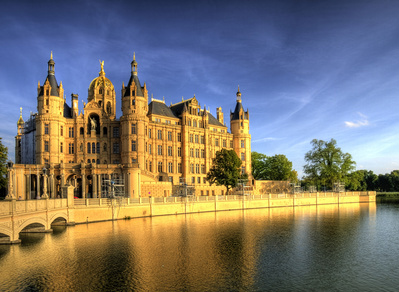
 Schwerin (pop. 97,000), the capital of Mecklenburg-Vorpommern, is the state's oldest city, first mentioned in 1018 and granted city rights in 1160. Known as the "Venice of the North", this charming city is built around seven lakes, with Schweriner See being the largest at 63 square kilometres. The city's iconic landmark is the fairy-tale Schwerin Castle, situated on an island in Lake Schwerin, which served as the residence of the Dukes of Mecklenburg for centuries and now houses the state parliament. Since 2024, the castle and surrounding residential buildings have been designated as a UNESCO World Heritage Site. |
| Ludwigslust Palace |
|---|

 Ludwigslust Palace stands at the heart of the town of Ludwigslust in Mecklenburg-Vorpommern, roughly 40 km south of Schwerin. Originally erected a modest hunting lodge by Prince Christian Ludwig in 1724 near the hamlet of Klenow, it gained its name—meaning “Ludwig’s joy”—when he became duke in 1747. In 1765, Duke Friedrich II elevated Ludwigslust to the ducal capital, prompting a grand reconstruction between 1772 and 1776 under architect Johann Joachim Busch. The late Baroque château, built on an E-shaped plan of brick clad in local sandstone, features a Corinthian-columned central block contrasting with Ionic wings, and its interiors combine Neoclassical reception rooms with elaborate ornamentation—including the two-storey Golden Hall adorned with stucco and innovative papier-mâché decoration. |
Other attractions
 Grabow
Parchim
| Rostock |
|---|

Rostock is the largest city in Mecklenburg-Western Pomerania, despite having a population of only 210,000 inhabitants. Once an active trading port of the Hanseatic League, it became a major shipbuilding and shipping centre in the industrial era, and as such was a prime target for Allied bombings in WWII. The University of Rostock, founded in 1419, is the third oldest in Germany and the oldest in continental northern Europe. At the estuary of the river Warnow, the district of Warnemünde is one of East Germany's most popular seaside resorts. |
| Güstrow |
|---|

Güstrow (pop. 30,000) is an agreeable Brick Gothic town mostly known for its Renaissance castle (built in 1589), which was the home of expressionist sculptor Ernst Barlach for 28 years. This earned the town the moniker of "Barlachstadt" since 2006. The Brick Gothic cathedral was constructed between 1226 and 1335. Inside is the most famous work of Ernst Barlach, the so-called Schwebende Engel ("Hovering Angel"), created in 1926 as a tribute to the victims of World War I. The white town hall was rebuilt around 1800 in the neoclassical style. |
| Neubrandenburg |
|---|

 Located on the shores of Lake Tollensesee, Neubrandenburg (pop. 64,000) has a rich medieval heritage of red-brick Gothic gabled architecture. One of its major attraction is its well-preserved circular medieval town wall, with its four Brick Gothic town gates. This defensive structure is punctuated by four original town gates, which have given Neubrandenburg its nickname, the "Stadt der vier Tore" (City of the Four Gates). |
| Müritz National Park |
|---|

 Müritz National Park is the country's largest terrestrial national park, covering an area of 322 square kilometres of forests, marshland and lakes (over 100 of them) in southeast Mecklenburg, between Berlin and Rostock. The landscape is defined by more than 130 lakes, ancient beech forests, and expansive wetlands. A section of the park's beech forests is recognised as a UNESCO World Heritage Site, forming part of the Primeval Beech Forests of the Carpathians and Other Regions of Europe. Lake Müritz, at the centre of the park, is the largest inland lake entirely within Germany (117 km²). The main fauna includes red deer, cranes, white-tailed eagles, ospreys, great bitterns, black storks, redshanks, greenshanks, teals, and reed warblers. The gateway town to the park is Waren. |
Western Pomerania
| Western Pomerania Lagoon Area |
|---|

The Western Pomerania Lagoon Area National Park ( Nationalpark Vorpommersche Boddenlandschaft in German) is Germany's largest coastal reserve, spanning 786 square kilometres. It consists of several peninsulas and islands in the Darss-Zingst Bodden Chain on the Baltic Sea. The park encompasses the Darß-Zingst peninsula, the island of Hiddensee, and the western coast of Rügen, but its defining feature is the Darß-Zingst Bodden Chain—a series of large, shallow, brackish lagoons. This unique aquatic landscape provides a vital habitat and serves as one of Europe's most important resting areas for migratory birds. It is particularly renowned for the tens of thousands of cranes that gather here in the spring and autumn. |
| Stralsund ※ |
|---|

Stralsund (pop. 59,000) is a historic city enjoying a unique location on an inlet of the Baltic Sea separating the island of Rügen from the mainland. It the late Middle Ages Stralsund was the second most powerful port of Hanseatic League after Lübeck. It The old town is almost completely surrounded by water and is recognised as a UNESCO World Heritage Site for its significant Brick Gothic architecture. In addition to its historical centre, Stralsund is home to the German Oceanographic Museum and its popular aquarium, the Ozeaneum, which focuses on the marine life of the North and Baltic Seas. |
| Jasmund National Park |
|---|

 Jasmund National Park is located on the Jasmund peninsula on the island of Rügen, Germany's largest island. It is the country's smallest national park, covering an area of 3,003 hectares (30 km²). It is famous for its 118-metre-high chalk cliffs, the so called Königsstuhl ("King's chair"), the largest of their kind in Germany. Inland from the coast, the park contains extensive, ancient beech forests, which are part of the transnational UNESCO World Heritage Site known as the Ancient and Primeval Beech Forests of the Carpathians and Other Regions of Europe. A network of hiking trails provides access to the cliffs and the woodlands. |
| Greifswald |
|---|

Located on the Baltic Sea coast between the islands of Rügen and Usedom, Greifswald (pop. 59,000) is a charming university town and historic Hanseatic port that was spared destruction in WWII. Established in 1456, the University of Greifswald is the fourth oldest in Germany, and one in four of the town's residents is a student. The town's history is marked by its membership in the Hanseatic League and a long period of Swedish rule, legacies visible in the extensive Brick Gothic architecture of its historic old town. |
|


 : Local interest
 : Moderately interesting
 : Outstanding place
 : Must-see in the country
 : Top cities in Europe