| Contents |
|---|
Introduction
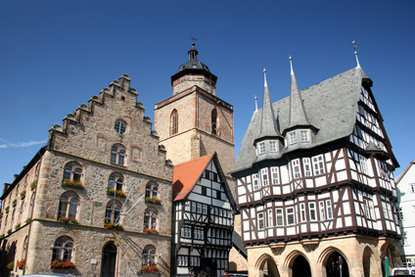
Halfway between Marburg and Fulda, Alsfeld (pop. 16,000) is a charming small town with a 16th-century town hall and an exceptionally well-preserved medieval town centre, which features over 400 half-timbered buildings dating from the 13th to 17th centuries. The oldest timber-framed house dates from 1350, making it one of the oldest in the country. The town's picturesque market square, dominated by the Gothic town hall built in 1512-1516, serves as the heart of the old quarter and has earned Alsfeld recognition as part of the German Timber-Frame Road tourist route. The town is perhaps most famously associated with the Brothers Grimm fairy tales, as it claims to be the inspiration for Little Red Riding Hood's village, adding a cultural dimension to its appeal as a destination for history and literature enthusiasts.
Interesting Facts about Alsfeld
- Alsfeld is renowned for its beautifully preserved medieval old town, featuring hundreds of charming half-timbered houses.
- The town was first officially mentioned in the year 1069 and has roots stretching back to the Carolingian era.
- Alsfeld lies on the German Timber-Frame Road, a tourist route famous for its picturesque wooden architecture.
- The striking town hall, built between 1512 and 1516, is one of the finest examples of Renaissance timber-frame architecture in Germany.
- Alsfeld's fairy-tale connections include an annual festival and a Fairy Tale House, as the Brothers Grimm were inspired by local traditions.
- The name “Alsfeld” is linked to a local legend about a margrave losing his hat to the wind on a nearby hill, supposedly leading to the phrase “Als fällt mir der Hut” (“My hat keeps falling off”).
- During the 16th and 17th centuries, Alsfeld flourished due to its prosperous cloth industry and its location on important trade routes.
- Unlike many other German towns, Alsfeld's historic centre survived World War II with little damage, preserving its unique medieval character.
- The Walpurgiskirche (St. Walpurga's Church) and the Minnigerode Haus are among several significant historic buildings in the town.
- Alsfeld was selected by the European Council as an exemplary model city for building preservation, recognising its architectural heritage.

History
Medieval Origins and Early Development
Alsfeld's history stretches back to the early medieval period, with the town first mentioned in an official document in 1069. Archaeological excavations in the Walpurgiskirche have revealed that a Romanesque church existed here as early as the 9th and 10th centuries, indicating that the settlement was likely founded during Carolingian times. Originally called "Adelesfelt", the town was established in the 8th-9th century as the seat of the Carolingian Court. Between 1180 and 1190, the Counts of Thuringia built a castle along the historic trading route known as the Kurze Hessen, which proved instrumental in Alsfeld's development. The town received its city charter remarkably early, being documented as a town by 1222. Since 1247 Alsfeld has been part of Hesse, and in 1254 the town joined the Rheinischer Städtebund, a coalition of Rhineland cities. For a time, Alsfeld served as the residence of Landgrave Hermann II of Hesse, who built himself a castle here around 1395.
Golden Age and Prosperity
The 16th century marked Alsfeld's golden age, during which the town flourished as a prosperous trading centre on the "Street through the short Hesse". This period witnessed remarkable architectural achievements, with citizens' creativity resulting in the construction of unique buildings including the town hall (1512-1516), the wine house (1538), and the wedding house (1564-1571). The wealth generated by trade and handicrafts during this era is evidenced by the numerous half-timbered buildings that still grace the market place today, making it singularly attractive and earning Alsfeld recognition as the jewel in the crown of upper Hessian cities. The guilds played a crucial role in local governance through the "Korebrief" constitution, demonstrating the town's sophisticated civic organisation. At its peak, Alsfeld's population reached approximately 2,500-3,000 inhabitants.
Decline and Recovery
Ironically, Alsfeld's advantageous geographical position, which had been the source of its prosperity, also led to its decline during the devastating Thirty Years' War (1618-1648). The conflict brought catastrophic consequences to the town: plunder in 1622, starvation in 1626, plague in 1635, multiple occupations in 1640 and 1643-1646, and the destruction of 226 residential buildings and 80 cottages by 1646. By war's end in 1648, only 1,120 people remained in the city, primarily women and children. Recovery was slow, and it wasn't until 1832 that Alsfeld experienced renewed growth when it became a district capital. The 19th century brought gradual modernisation with railway construction in 1870 and industrial development transforming the traditional smallholding system. During this period, the town supported a vibrant Jewish community that built a large synagogue in 1908. However, the Nazi era brought tragedy when the synagogue was burned during Kristallnacht in 1938, and by 1942 Alsfeld had expelled its last Jewish citizens. Fortunately, the town was spared from Allied bombing during World War II and surrendered peacefully to U.S. forces on 30th March 1945.
Main Attractions
Marktplatz (Market Square)
Alsfeld’s Marktplatz is the historical and architectural heart of the town, surrounded by a collection of exceptionally well-preserved medieval half-timbered buildings. The square features the iconic Alsfeld Town Hall (Rathaus), which displays intricate timber framing and dates to the early 16th century. The Marktplatz has long served as a centre for civic life, hosting markets, events, and gatherings, and provides an excellent starting point for exploring the Old Town.
Hochzeitshaus (Wedding House)
Constructed between 1564 and 1571, the Hochzeitshaus is one of the few stone Renaissance buildings in Alsfeld. Initially built as a municipal hall for festivities and dances, it has also served various administrative, commercial, and social purposes over the centuries. The three-storey structure is notable for its Renaissance gables and a prominent corner oriel. The Hochzeitshaus is part of a significant architectural ensemble on the Marktplatz, alongside the Town Hall and Weinhaus.
Weinhaus (Wine House)
Dating back to 1538–1539, the Weinhaus is a prominent Renaissance building on the Marktplatz. Historically, it served as the location for wine trading and as a meeting space for local officials and guilds. The Weinhaus’s iron pillory remains visible on the corner of the building, referencing its former punitive role in civic justice. This building is architecturally harmonious with the neighbouring Town Hall and Hochzeitshaus and is a key element of Alsfeld’s historic townscape.
Leonhardsturm (Leonard’s Tower)
Leonhardsturm, constructed in 1386, is the only surviving tower of Alsfeld’s former medieval town wall. Standing 27 metres high and located at the southern edge of the Old Town, the round tower was originally accessible only from the wall and featured a dungeon in its base. Restored in 1986, locals affectionately refer to it as the “Storchennest” (stork’s nest), reflecting local legends about storks nesting at its summit.
Schwälmer Brunnen (Schwalm Fountain)
The Schwälmer Brunnen, installed in 1958, is an ornamental fountain celebrating the connection between Alsfeld and the Schwalm region. The statue depicts a figure in traditional Schwalm costume, complete with the famous red cap that inspired the Brothers Grimm’s fairy tale of Little Red Riding Hood. It serves as a symbol of the region’s cultural heritage and links Alsfeld to German folklore.
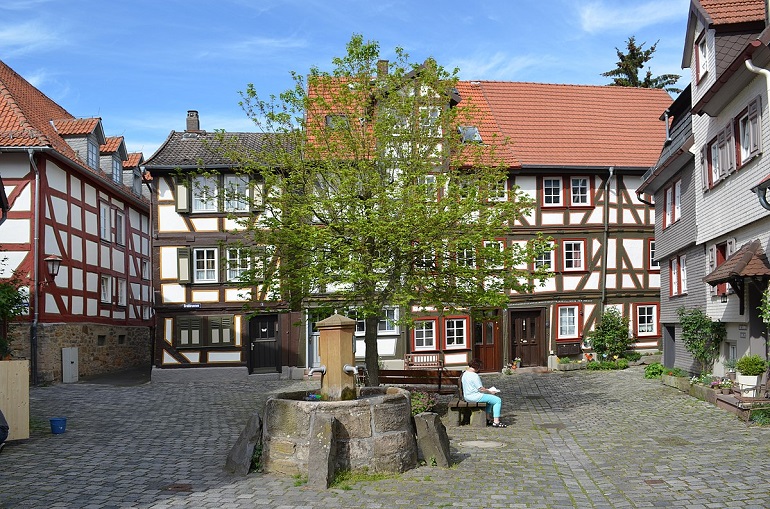
Grabbrunnen (Well Square)
Grabbrunnen, a small square in Alsfeld’s Old Town, features a historical well that was once used in the town’s cloth dyeing process, highlighting Alsfeld's former prominence in textile production. The well is associated with local folklore, particularly the legend that storks would collect newborns from the well to deliver them to families, a story commemorated in the well's modern design.
Around Alsfeld
Burg Herzberg
Located approximately 16km east of Alsfeld, Burg Herzberg is a large hilltop castle, considered the largest in Hesse. Built in the Middle Ages, the castle is notable both for its well-preserved structure and its cultural significance, regularly hosting concerts and festivals. The site offers panoramic views of the Vogelsberg region and provides visitors with insights into feudal history and the local landscape.
Top Museums
Stadtmuseum Alsfeld
The Stadtmuseum Alsfeld is a cornerstone for anyone eager to understand Alsfeld’s historical and cultural development. Located in beautifully restored half-timbered buildings in the heart of the old town, this museum presents the story of Alsfeld from its medieval origins through to modern times. Highlights include displays on local craftsmanship, romantic half-timbered architecture, regional industries such as tobacco and hat-making, and exhibits of traditional costumes and artisan furniture. The museum is noteworthy for its community-driven ethos, its rotating temporary exhibitions, and its immersion in local heritage. With its layered approach complemented by special exhibitions in the Neurathhaus and a significant archival collection, the Stadtmuseum is an ideal destination for visitors fascinated by regional history, social transformation, and the enduring spirit of a Hessian town.
Märchenhaus Alsfeld
The Märchenhaus Alsfeld, or Fairytale House, is a museum devoted to the magical world of the Brothers Grimm and local folklore. Set within a picturesque 17th-century timbered house, the Märchenhaus brings iconic tales such as Little Red Riding Hood, Snow White, and Hansel and Gretel to life through costumed displays, interactive dioramas, themed rooms, and live storytelling sessions. The museum is a key stop on Germany's Fairy Tale Route and is especially suited for families and fairy tale enthusiasts. Its hands-on approach, celebration of imagination, and focus on the relationship between local traditions and the famous Grimm stories distinguish it as a genuinely enchanting and immersive cultural experience.
Local Cuisine
Alsfeld’s local cuisine reflects the hearty traditions of Hesse, with a strong focus on wholesome, regional ingredients. Among the must-try dishes are the beloved Schnitzel, often served with potatoes in every imaginable form at restaurants such as Kartoffelsack, and the classic Spätzle, a soft egg noodle that pairs beautifully with cheese or mushroom sauce. Rustic inns and cosy cafés in Alsfeld frequently offer specialties featuring regional sausages, such as Ahle Wurst, and locally brewed Alsfelder beer is the ideal accompaniment to any meal. The town’s welcoming eateries provide a delicious taste of traditional German food, making Alsfeld a true culinary highlight for visitors.
Getting There & Around
By train, Alsfeld is conveniently accessible via regular rail connections from major German cities like Frankfurt, with the Alsfeld railway station situated close to the town centre. Services run frequently, offering an efficient and comfortable journey for visitors arriving from across the region.
By bus, several companies operate routes to Alsfeld from locations such as Frankfurt, Kassel, and other nearby towns. Buses typically arrive at Alsfeld’s main bus station and are a practical option for those preferring public transport or travelling from within Hesse.
By car, reaching Alsfeld is straightforward, as the town is well-linked by major roads. The A5 motorway provides direct access from Frankfurt, making driving a flexible choice that also allows you to explore the picturesque surrounding countryside at your own pace.