| Contents |
|---|
Introduction
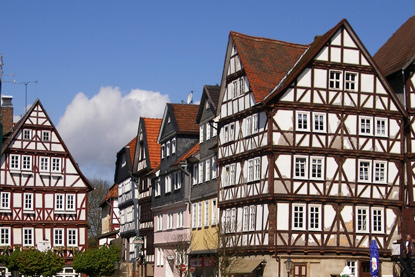
Homberg an der Efze (pop. 14,000) is a small castle town with plenty of traditional timber-framed houses dating from the 15th to the 18th centuries.
In 1526, Philip the Magnanimous converted the Landgraviate of Hesse to Protestantism while attending a synod in Homberg's St. Mary's Church, which earned it the nickname of "Reformation Church of Hesse".
Interesting Facts about Homberg an der Efze
- Homberg an der Efze is famed for its stunning ensemble of centuries-old half-timbered houses and its picturesque market square.
- The town is overlooked by the historic Hohenburg castle, whose well is Germany's third deepest at 150m.
- Homberg played a crucial role in the Protestant Reformation—Philip the Magnanimous introduced Protestantism to Hesse here at the Synod of 1526, earning its church the title “Reformation Church of Hesse”.
- The town boasts the ancient “Kirchhoflinde,” a churchyard lime tree over 700 years old, located beside St. Mary’s Church.
- Homberg was first mentioned as a town in 1231 and celebrated its 775th anniversary in 2006.
- Its cityscape features remnants of a medieval wall and defensive towers, reflecting its rich history in wool, cloth and salt trading.
- Homberg’s unique town centre includes the “Fünffenster House,” with no more than five windows per floor, a clever adaptation to a historical window tax.
- The “Krone” inn, dating from 1721, and the “Löwenhaus” from 1617 are two of Homberg's most impressive timber-frame buildings.
- The lovely landscape around Homberg is defined by volcanic hills and the Efze river, making it a gateway to various scenic hikes and fairy-tale routes.
- Each year, Homberg hosts lively cultural festivals, including night markets, a wine festival and family day, drawing visitors from across the region.
History
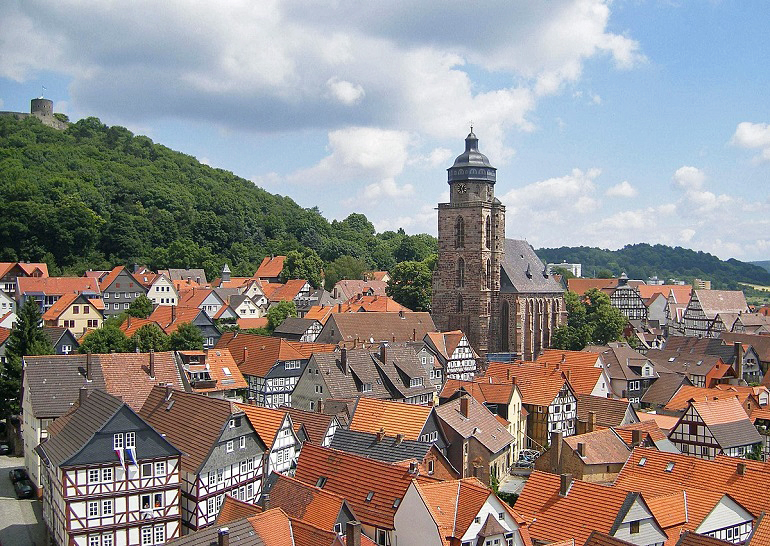
Homberg an der Efze was founded by the Hessian-Thuringian Landgraves in the early 13th century. The town received its first documentary mention as a town in 1231, taking its name from the Hohenburg castle that crowns the basalt hill above the settlement. The strategic location proved vital, as Homberg developed at the intersection of two historic trade routes - the Long Hesse road from Frankfurt to Leipzig and the road connecting Fritzlar to Hersfeld. The settlement was actually a double town from its earliest days, consisting of the Altstadt (Old Town) mentioned in 1231 and Die Freiheit (The Freedom), which was founded in 1356 as an independent town with its own mayor and administration. These two communities remained separate until their unification in 1536, when they were connected by the still-standing New Gate.
The town's golden age came during the late medieval period when it flourished as a prosperous wool trading and cloth-making centre. Guild charters for shoemakers and tanners from 1345, coopers and wheelwrights from 1404, and linen weavers from 1428 demonstrate the importance of organised crafts in Homberg's economy. This prosperity funded ambitious building projects, including the cornerstone laying for St. Marien Church in 1340. However, Homberg's most significant historical moment occurred on 20-22 October 1526, when Landgrave Philip the Magnanimous convened the Homberg Synod in St. Marien Church, marking the introduction of Protestantism to Hesse. This pivotal event earned Homberg the official designation "Reformationsstadt Hessens" (Reformation Town of Hesse) in 2014. The town also served as the venue for several Hessian state assemblies between 1508 and 1536 due to its excellent accessibility.
Homberg's later history was marked by repeated destruction and rebuilding, most notably during the Thirty Years' War when Imperial forces devastated both the castle and town in 1636 and 1640, leaving only a few houses standing. The 150-metre deep castle well, Germany's third deepest, was reconstructed by Landgrave Moritz between 1605 and 1613 at the enormous cost of 25,000 guilders. In 1809, the town became the starting point for the Dörnberg Uprising against King Jérôme Bonaparte under Colonel Wilhelm von Dörnberg's leadership. Throughout the 19th and 20th centuries, Homberg evolved administratively, serving as the seat of a Prussian district administration from 1867, losing this status in 1932 when merged with Fritzlar district, and finally becoming the district seat of the new Schwalm-Eder district in 1974. The town's official name changed from "Homberg, Bezirk Kassel" to simply "Homberg" in 1974, and finally to "Homberg (Efze)" in 1977.
Main Attractions
The Historic Old Town (Altstadt)
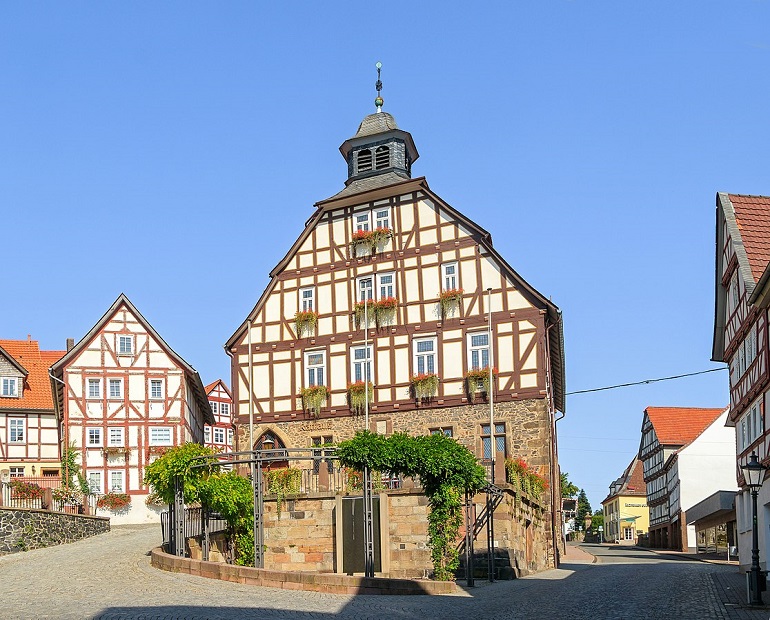
The Historic Old Town (Altstadt) is defined by its cohesive collection of half-timbered houses, with the majority constructed between the 16th and 19th centuries following a major fire in 1636. The market square (Marktplatz) remains the town's centrepiece, surrounded by architecturally significant buildings such as the half-timbered Town Hall (Rathaus), the historic Engel-Apotheke (Angel Pharmacy), and the Krone hotel, all of which illustrate the town's past prosperity as a trading hub after receiving market rights in 1231. Remnants of the medieval town fortifications are still visible, including sections of the old wall and defensive towers like the Pulverturm (Powder Tower), which can be explored on foot. The network of narrow, cobbled streets and alleys is well-preserved, providing a clear insight into the traditional building practices and urban layout of North Hesse. Walking through this area allows for direct observation of the regional half-timbering style, characterised by its ornate carvings and structural forms.
St. Mary’s Church (St. Marienkirche)
St. Mary’s Church (St. Marienkirche), a large Gothic hall church, is located at the foot of the castle hill and stands as a principal symbol of the town. Construction began in the first half of the 14th century, and the building is regarded as a primary example of the Hessian-Westphalian Gothic architectural style. The church holds immense religious and historical importance as the location of the Homberg Synod in October 1526. Convened by Landgrave Philip I of Hesse, this assembly featured debates that led to the formal adoption of the Protestant Reformation throughout the Landgraviate of Hesse. Inside, the church contains several notable artistic works, including a stone relief of Christ healing the sick and a carved Madonna statue. Its 57-metre-high tower is a defining feature of the town's skyline. The church continues to function as an active place of worship and a monument to the Reformation.
Homberg's City Walls
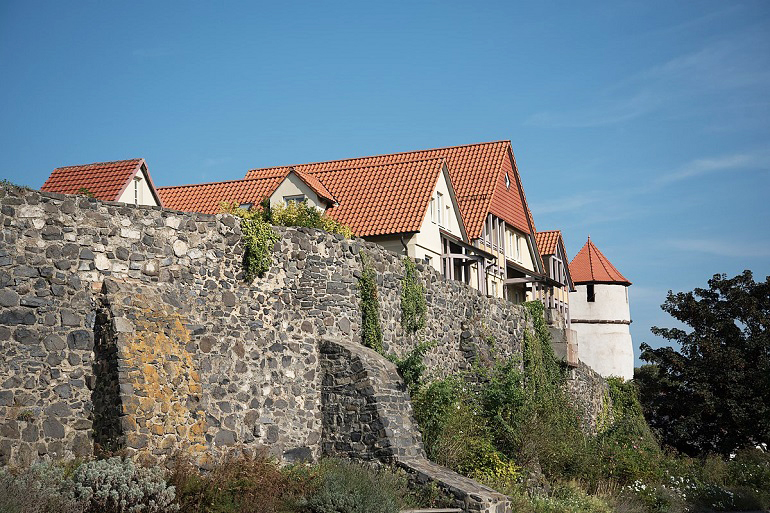
Homberg's medieval town wall is a significant and largely preserved feature of its historical fortifications. Originally, the defensive system stretched for approximately 1,200 metres, with walls standing between 6 and 8 metres high and having an average thickness of 2 metres. The fortifications were punctuated by seven towers, of which the Pulverturm (Powder Tower) is the only one that remains fully intact today. Other remnants include visible sections of the wall and the foundations of former towers, such as the base of the Bächtenturm, upon which the Dörnbergtempel summer house now stands. These defences, which included main gates like the Westheimer Tor, Obertor, and Holzhäuser Tor, were essential to the town's security during the Middle Ages. A major rehabilitation project was completed in June 2024 to secure and reinforce a 100-metre section of the wall, involving extensive masonry repairs, the installation of foundation piles, and the complete replacement of one heavily deteriorated area.
Hohenburg Castle Ruins
Hohenburg Castle Ruins stand on a prominent basalt cone overlooking the town and are considered among the most significant landmarks of Homberg an der Efze. The origins of this medieval fortress date back to the late 12th century, with its first documented mention occurring in 1231. Today, visitors can explore extensive remains, including substantial sections of the original ring walls, various defensive towers, and the foundations of former residential and administrative buildings. The castle is particularly noted for possessing one of Germany's deepest brick-lined castle wells, reaching a depth of 150 metres. After suffering extensive damage and being deliberately slighted by Imperial troops during the Thirty Years' War in 1636, the castle was never rebuilt and has remained a ruin since. The accessible keep can be climbed, offering panoramic views across the Efze valley and the historic old town below. The grounds are frequently used for cultural events, including medieval markets and open-air theatre productions, serving as a venue for experiencing regional history.
The “Little Brother and Little Sister” Fountain (Brüderchen-und-Schwesterchen-Brunnen)
The “Little Brother and Little Sister” Fountain (Brüderchen-und-Schwesterchen-Brunnen) is a distinctive bronze sculpture situated on the market square, celebrating one of the well-known fairy tales collected by the Brothers Grimm. Created by the sculptor Ubbo Enninga and installed in 2008, the fountain serves as a key landmark and photo opportunity, reflecting Homberg’s position on the German Fairy Tale Route, a themed tourist trail that connects towns associated with the lives and stories of the Grimms. The fountain depicts a pivotal scene from the tale, in which the sister places her golden garter around the neck of her brother, who has been transformed into a roe deer after drinking from an enchanted stream. The artwork provides a tangible link to the region's rich storytelling traditions and acts as a popular meeting point in the historic centre of the old town, directly in front of the town hall.
Around Homberg
Wildpark Knüll
Wildpark Knüll is a substantial wildlife park situated in the woodlands of the Knüll hills near Homberg an der Efze. Established in 1968 and covering an area of approximately 50 hectares, the park provides an opportunity to observe over 40 species of European fauna in large, naturalistic enclosures designed to reflect their native habitats. Among the 450 animals are populations of grey wolves, brown bears, red deer, wild boar, lynx, and various bird species. A particular feature is a shared habitat for bears and wolves, which allows visitors to see these two species coexisting. The park includes themed pathways, such as a barefoot path, and multiple educational stations that provide information on local wildlife and conservation. For younger visitors, there is a petting zoo and an adventure playground. The affiliated Nature Centre (Naturzentrum) offers exhibitions and environmental education programmes, making the park a centre for learning about the region’s ecosystems.
Top Museums
Haus der Geschichte Homberg (Efze)
This museum, set in a beautifully restored 350-year-old former pharmacy on the market square, uniquely combines two separate institutions under one roof: the Haus der Reformation and the Hohenburg Museum. Engaging exhibitions explore significant local and regional history, especially focusing on the Reformation and the development of Homberg. Its interactive displays, such as the opportunity to try your hand at historic book printing, and artefacts offer a hands-on experience that appeals to both adults and children alike.
Haus der Reformation
Located on the ground floor of the Haus der Geschichte, this section of the museum vividly presents the importance of Homberg during the Protestant Reformation. It features interactive exhibits on book printing, explanations of local church history, and creative activities, making church history accessible and engaging even for younger visitors.
HohenburgMuseum
Situated within the Haus der Geschichte, this museum immerses visitors in the turbulent story of the Hohenburg castle — the nucleus of the town. Highlights include detailed models of the castle, objects recovered from the deep castle well, and compelling documentation around its dramatic destruction during the Thirty Years' War. The museum excels at bringing to life stories of medieval life, sieges, and local legends, such as the famous tale of the 'White Lady.'
Kyffhäuser Museum
As Germany’s only Kyffhäuser Museum, this site specialises in the military and civic history of the region. Its unique collection, curated by the local camaraderie association, includes an array of regalia, uniforms, flags, and documents spanning from past military centuries into the present, offering a specialised perspective on both Homberg’s and Germany’s broader heritage.
Local Cuisine
Local restaurants proudly serve Ahle Wurscht (a distinctive red sausage), Weckewerk (a hearty dish), and Tafelspitz (a classic boiled beef preparation), alongside the region's beloved schnitzel. The town's cosy cafés offer freshly made Saatenbrot from local bakers and homemade Kuchen (cakes), whilst restaurants like Home Berg focus on fresh, regional ingredients prepared without additives to create modern interpretations of traditional North Hessian recipes. The Cittaslow designation of Homberg emphasises slow food principles, with local producers offering quality meats, artisanal breads, and seasonal specialities that reflect the unhurried pace of life in this historic hilltop town.
Getting There & Around
By train, Homberg an der Efze can be reached by taking regional trains to either Wabern or Treysa stations, both of which are nearby, followed by a short bus ride into the town centre. Regular connections are available from larger hubs such as Frankfurt or Kassel, and onward travel with local buses is straightforward from these stations.
By coach or bus, Homberg an der Efze is served by a network of regional buses within the North Hesse Transport Network. Key stops in town include Kasseler Straße and Busbahnhof, and several lines link Homberg to nearby cities and villages, making it accessible from various points in the region.
By car, the town is easily reached via the German motorway network. It lies near the A7 and A49 motorways; simply follow the signs for Homberg (Efze) and continue along local roads for a short drive into the picturesque centre. Car travel offers flexibility and allows you to enjoy the scenic Hessian countryside at your own pace.