



| Contents |
|---|

Introduction
Situated on the banks of the River Weser near Höxter, the Princely Abbey of Corvey is a former Benedictine monastery founded in 822 by order of Emperor Louis the Pious, the son of Charlemagne. The Abbey quickly became one of the most important monastic centers in Carolingian and Medieval Germany, attracting scholars, pilgrims, and political leaders from across Europe. It became a vital center of learning, particularly in the fields of theology, music, and Latin literature. During the Carolingian Renaissance, a period of cultural and intellectual revival, Corvey played an important role in preserving ancient texts and knowledge.
The abbey blends Romanesque and early Gothic elements, but it also retains a number of features from its Carolingian beginnings. The Princely Abbey of Corvey was designated as a UNESCO World Heritage site in 2014 due to its outstanding cultural and architectural significance. The site is particularly notable for its Carolingian westwork, a rare and well-preserved example of early medieval architecture.
Over time, the Abbey became an imperial abbey, and the abbots were elevated to the rank of prince (prince-abbots), meaning they held both religious and political power. The prince-abbots of Corvey were granted secular authority over the surrounding lands until it was secularised in 1803 after the Napoleonic conquest.
Today, the Princely Abbey of Corvey is managed as a museum and cultural center, offering visitors a chance to explore the church, cloister, and monastic buildings. The Abbey also hosts cultural events, such as concerts, lectures, and art exhibitions. Admission is free.
Interesting Facts about the Abbey of Corvey
- The Princely Abbey of Corvey was founded in 822 by order of Charlemagne and is one of the most important monasteries in medieval Germany.
- Its imposing Carolingian Westwerk, built between 873 and 885, is the only surviving example of its kind from the Carolingian period.
- The abbey was a major centre for Christian mission, sending forth numerous missionaries who evangelised Northern Europe, including Ansgar, the "Apostle of Scandinavia".
- By 833, Corvey had become the first place east of the Rhine granted the right to mint its own coins.
- The remains of Saint Vitus, gifted to Corvey in 836, made it an important pilgrimage site during the Middle Ages.
- The abbey's library was renowned for its collection, preserving works such as books 1–6 of Tacitus' Annals, discovered there in 1508.
- Corvey became a princely abbey (Reichsabtei), meaning its abbot was directly answerable to the emperor in secular matters.
- The original monastic community was dissolved and the abbey secularised in 1803, after which the site became part of various German states and was eventually converted into a palace.
- The abbey's school was celebrated for its scholarly output, producing notable figures such as the 10th-century historian Widukind of Corvey.
- Corvey is now a UNESCO World Heritage Site and houses one of Germany's largest private libraries, the Princely Library, with 74,000 volumes.

History
Following Charlemagne's conquest of Saxon territory in the Saxon Wars, his son Emperor Louis the Pious announced the creation of an abbey east of the River Weser at a synod in Paderborn in 815. Originally established near Neuhaus im Solling at a place called Hethis, the monks from the Benedictine abbey of Corbie in Picardy moved to the current location near Villa Huxori in 822, where they founded Nova Corbeia (the "new Corbie"). The first abbot was Adalard of Corbie, a cousin of Charlemagne, whilst Ansgar, who later became the "Apostle of Scandinavia," founded the prestigious abbey school in 823. The abbey gained exceptional status when it became independent in 826, dedicated to Saint Stephen, and was granted the remarkable privilege of coinage within the Franconian realm in 833—making it the first place east of the Rhine to receive such rights.
Corvey's golden age flourished through its strategic position where the east-west Hellweg route crossed the Weser, establishing it as a vital spiritual, cultural, and economic centre. The abbey's prestige soared when it received the remains of Saint Vitus from the abbey of St Denis near Paris in 836, making the saint the patron of the Saxons and transforming Corvey into a major pilgrimage destination. The first stone church was consecrated in 844, followed by the construction of the magnificent Westwerk between 873-885—the only surviving Carolingian structure that remains today. The monastery became renowned for its exceptional school, producing celebrated scholars including the 10th-century Saxon historian Widukind of Corvey, author of Res gestae Saxonicae. From its cloisters emerged streams of missionaries who evangelised Northern Europe, whilst its library, established with works from Corbie and augmented by local scriptoriums, became one of the finest in medieval Europe. Royal visits were frequent, with historians estimating that the imperial entourage visited Corvey at least 110 times before 1073.
The abbey's fortunes declined dramatically following a devastating attack in 1265 when the neighbouring town of Höxter, envious of Corvey's prosperity and Weser bridge, allied with the Bishop of Paderborn to destroy the town of Corvey and damage the abbey. Though the abbey survived the Reformation as a Catholic principality bordered by Protestant territories, it suffered further devastation during the Thirty Years' War when imperial troops sacked the buildings in 1634, leaving only the Westwerk standing. Reconstruction began after 1665 under Christoph Bernhard von Galen, Bishop of Münster, who replaced the Carolingian church with a Gothic building whilst preserving the ancient Westwerk. The substantial Baroque buildings visible today were erected under his successors between 1678-1722. In 1792, Corvey ceased to be a Benedictine abbey and was elevated to a prince-bishopric by Pope Pius VI, though this ecclesiastical state was short-lived—it was secularised in 1803 under Napoleonic administration and passed through various hands before becoming a Prussian possession in 1815. In 1820, it was awarded to Victor Amadeus, Landgrave of Hesse-Rotenburg, and in 1834 passed to the House of Hohenlohe, whose descendants still own Schloss Corvey today.
Description
Towering sentinel of the Weser Valley, the Abbey of Corvey unfolds as a tapestry of architectural splendour and serene ambience. From a distance, its mighty west—an imposing, multi-storied façade with twin towers and broad arches—commands the eye, its weathered sandstone glowing warm in the late afternoon sun. Approaching under the gentle curve of the River Weser, visitors encounter a harmonious ensemble: the austere dignity of Carolingian design giving way to the refined elegance of later Baroque additions.

On entering, the vaulted westwork vestibule impresses with nine cross-vaulted bays, supported by robust columns with intricately carved Corinthian capitals. Above, a gallery encircles the central chamber, offering a vantage point onto traces of original painted plaster and mythological friezes that whisper of antiquity repurposed for sacred space. Light filters through mullioned windows, dancing across stone walls and lending an air of contemplative calm.
Beyond lies the Baroque abbey church of St Stephanus and Vitus, where high-vaulted ceilings rise above a sumptuous interior. Gilded altarpieces and pastel-toned cherubic carvings punctuate otherwise muted walls. Johann Georg Rudolphi’s dramatic murals impart a theatrical quality, while the Paderborn-crafted organ loft presides as a centrepiece of both visual and acoustic majesty.
Stepping into the cloister, one is enveloped by a rhythm of interlaced arcades and shadowed walkways. The former monk’s refectory garden spills forth with heritage roses and heirloom vegetables, their scents mingling with the cool stone underfoot. Here, the hush invites slow wandering, reflection and the occasional glimpse of swallows weaving through the arches.
The Imperial Hall and prince-abbots’ apartments stand as chambers of princely hospitality. Sumptuously panelled and furnished in late 18th-century Biedermeier style, these salons once hosted emperors; today they offer an intimate window into refined domesticity. Towering bookcases in the Princely Library stretch across fifteen rooms, housing some 75,000 volumes—this private collection remains one of Germany’s grandest, its silent stacks imparting a sense of scholarly gravitas.
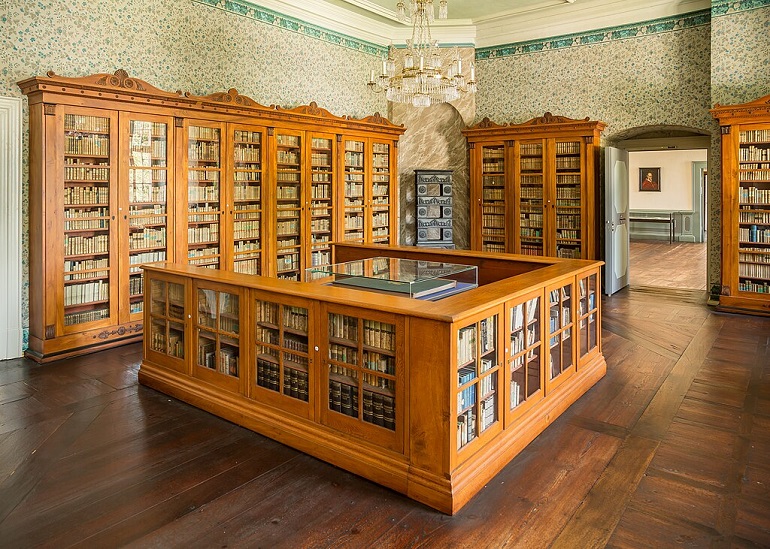
All around, subtle contrasts abound. Stark monastic quarters speak of disciplined routine; adjoining richly decorated state rooms evoke courtly splendour. Banners in Corvey’s red and gold flutter from ramparts, hinting at a living heritage still cared for by its custodians. Elsewhere, a converted wine house and welcoming café invite pausing over local vintages and pastries, while seasonal concerts echo through corridors, marrying music and masonry in an experience as alive today as in centuries past.
Whether exploring vaulted crypts, lingering over illuminated manuscripts, or simply strolling riverside paths, visitors leave Corvey imbued with its quiet theatricality—a place where the austere and the ornate coexist, and where every stone seems to hum with cultural resonance.
Getting There
By train, the most convenient approach is to take a Deutsche Bahn service to Höxter-Rathaus station, which is well connected to major cities. From there, you can either board a local bus heading for the “Corvey” stop, take a taxi, or enjoy a pleasant 2km walk along the Weser river to reach the abbey.
By bus or coach, regional and local buses operate routes to Höxter, often stopping at the central station. From Höxter, you can catch a connecting bus which stops directly at Corvey, making it quite straightforward for those preferring public transport.
By car, set your navigation system to “Corvey, Höxter”. The approach is clearly signposted and the abbey is easily accessible via regional roads. Parking is available near the site, ensuring a smooth arrival by vehicle.
Best Time to Visit
The ideal season to explore the Princely Abbey of Corvey is from late spring through early autumn, roughly May to September, opening hours run daily from 10:00 to 18:00 with public guided tours at 15:00 (and additional 11:00 tours on weekends and holidays). During these months you’ll enjoy pleasantly mild temperatures for wandering the baroque cloisters and Carolingian westwork, while vibrant events such as the Corveyer Sommerkonzerte in May, June and July and the Corvey Garden Festival in early August add cultural flair. Photographers seeking the most evocative light should plan visits for late afternoons, when the basilica façade glows in the setting sun. For a quieter experience, aim for mid-May or late September, when visitor numbers dip but the abbey’s rich history and serene riverside setting remain in full splendour.
| Travel destinations in North Rhine-Westphalia | ||||||||||||||
|---|---|---|---|---|---|---|---|---|---|---|---|---|---|---|
|
|
|
|
| ||||||||||
|
|
|
|
| ||||||||||
|
| |||||||||||||


