



| Contents |
|---|
Introduction
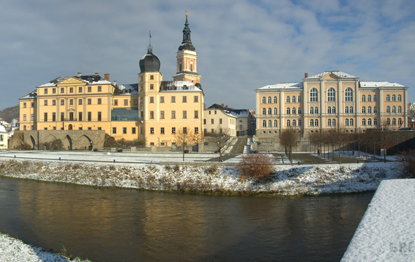
Greiz (pop. 20,500), the former seat of the Principality of Reuss-Greiz until 1918, is located approximately 100km east of Erfurt on the White Elster river. Noteworthy for its historical architecture, Greiz features the Upper Castle (Oberes Schloss), Lower Castle (Unteres Schloss), and the Summer Palace, as well as an extensive central park designed in the English garden style.
Interesting Facts about Greiz
- The town is famed for its two castles, the Upper Castle and Lower Castle, unique paired residences that once mirrored a divided rulership and even led to the town having two parks and two sets of civic institutions.
- Fürstlich Greizer Park in the centre is laid out as an English landscape garden and includes the Summer Palace, now home to art collections and the SATIRICUM caricature archive.
- The White Elster river runs through Greiz, shaping its valley setting and views from surrounding hills and lookouts such as the Weißes Kreuz.
- Greiz’s old town features notable Jugendstil (Art Nouveau) ensembles along streets like Thomasstraße and Burgstraße.
- The settlement name has Slavic roots (originally “Grouts,” meaning a fortified place or gord), with the first written mention dating to 1209.
- Greiz suffered devastating fires that destroyed the town in 1494 and almost entirely again in 1802, after which it was rebuilt.
- An 18th-century innovation footnote: in 1765 Melchior Bauer presented a theoretical concept for aeroplane construction in Greiz.
- The Summer Palace hosts a triennial of caricatures and comic art, giving Greiz cultural resonance beyond Thuringia.
- Astronaut Ulf Merbold, the first West German in space (1983), was born in Greiz in 1941.

History
The settlement's origins can be traced back to its Slavic roots, with the original name "Grouts" meaning "gord" in the local Slavic tongue. First documented in 1209, Greiz's strategic location at the confluence of the White Elster River and its tributary Göltzsch proved instrumental in its rapid development as a thriving commercial centre. From the 12th century, the town was governed by advocati (Vögte), but in 1236 it came under the possession of Gera before being recognised as a town in the 13th century.
The House of Reuss fundamentally shaped Greiz's destiny, transforming it into the capital of the Principality of Reuss-Greiz until 1918. This ruling German dynasty, whose male members were all named Heinrich, commissioned two magnificent castles that remain the town's crown jewels: the "Oberes Schloss" (Upper Castle) and the "Unteres Schloss" (Lower Castle), both designed by renowned architects and considered architecturally unique. However, Greiz's journey was not without tribulation - the town was completely destroyed by fire in 1494 and suffered near-total destruction again in 1802. Despite these devastating setbacks, the resilient citizens repeatedly rebuilt their community, developing it into a prosperous centre for textile manufacturing, paper production, brewing, and liqueur manufacture.
The town's more recent history reflects the broader German experience of the 20th century. During the Nazi era, between 1934 and 1943, 809 people were forcibly sterilised at the district hospital in Wichmannstraße, whilst the local care facilities submitted 122 vulnerable residents to the sinister Aktion T4 euthanasia programme. World War II brought forced labourers from Nazi-occupied territories to work in nearby Sorgwald, with at least 102 losing their lives - commemorated today by a memorial in the Old Cemetery. In a remarkable act of defiance, officer Kurt von Westernhagen refused orders to blow up the town's bridge in April 1945, for which he was shot by the Gestapo - an act now honoured with a local monument. Remarkably, Greiz escaped significant wartime damage, though three of its five bridges were destroyed. Today, this former principality capital, with its population of approximately 20,400, continues to celebrate its distinguished heritage as the birthplace of notable figures including astronaut Ulf Merbold and the inventor of Playmobil figures, Hans Beck.
Main Attractions
Oberes Schloss (Upper Castle)
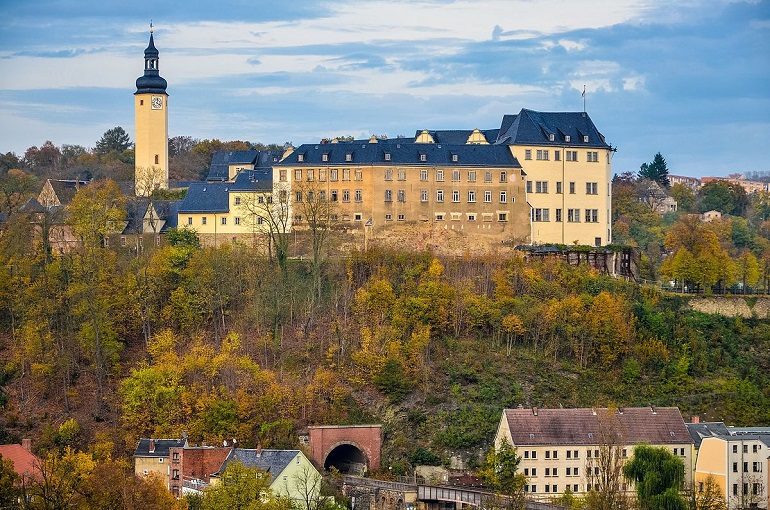
The Upper Castle stands on a rocky spur above the town and is the oldest of Greiz's princely residences, originating as a medieval hilltop fortress and later adapted into a palace by the House of Reuss. Its elevated position provides wide views over the White Elster valley and the historic centre, with footpaths leading up through the Schlossberg area from the town below. The ensemble illustrates the former residence status of Greiz alongside the Lower Castle and the Summer Palace, reflecting successive phases of princely building in the Vogtland.
Unteres Schloss (Lower Castle)
The Lower Castle occupies a central position by Burgplatz in the old town and formed, together with the Upper Castle and Summer Palace, the core of the Reuss residence landscape in Greiz. The complex presents later-period princely architecture at street level and serves as a focal point for orientation when exploring the Altstadt, with surrounding squares and streets linking to shops and civic buildings. Its proximity to the tourist information office makes it a practical starting point for walking routes through the historic centre and towards the park.

Fürstlich Greizer Park (Princely Greiz Park)
Princely Greiz Park is a landscaped park of about 45 hectares laid out along the meadows of the White Elster below the Schlossberg, transitioning from earlier baroque elements to an English-style design in the 19th century under Carl Eduard Petzold. Features include a formal flower garden by the Summer Palace, a historic pinetum with rare conifers, the Seufzerallee of winter lime trees, and an approximately 8-hectare lake with island plantings and planned sightlines back to the Upper Castle. Paths extend through open meadows and wooded sections, offering varied circular walks and vantage points across the parkland.
Sommerpalais and Garden
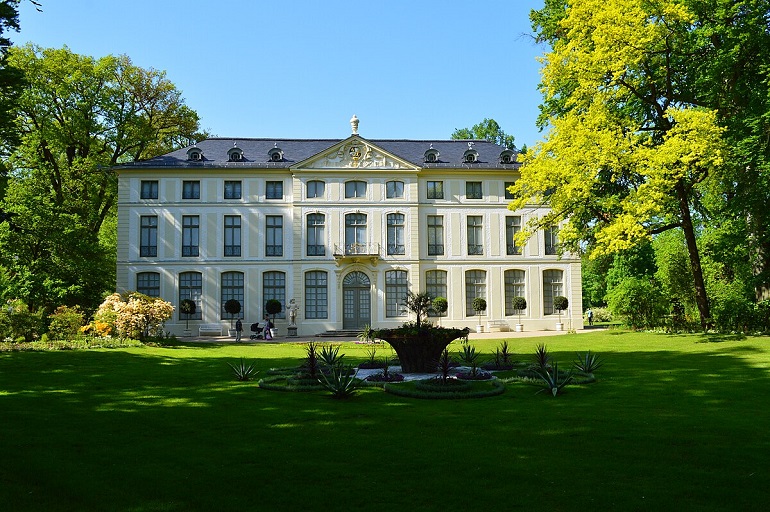
The Summer Palace, constructed between 1769 and 1779 for the Reuss elder line, represents early classicism in Thuringia and forms the architectural centrepiece of the park's southern sector. Its garden frontage includes period ornamental beds and axial views into the wider landscape design, with the building's south gable carrying the historic "Maison de belle retraite" inscription reflecting its residential function until 1918. The adjacent garden hall and terraces integrate with promenades that connect to the park's pinetum, Seufzerallee and lake areas for coherent route planning.
Altstadt Greiz (Historic Old Town)
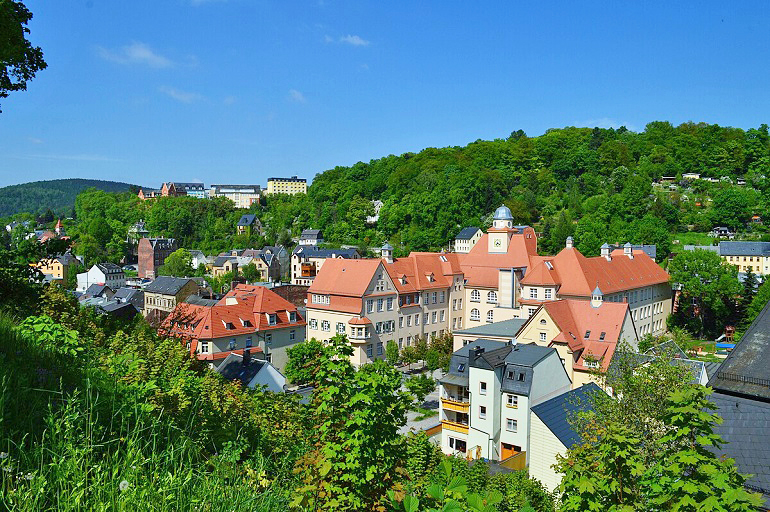
Greiz's historic centre contains nearly 60 listed buildings within a compact urban fabric shaped by its residence history and industrial-era development along the White Elster. Streets around the Lower Castle lead to ensembles with Jugendstil elements and traditional townhouses, while bridges and embankments provide access across the river to park entrances and hillside paths. The area functions as a convenient base for exploring the castles and park on foot, with wayfinding aided by prominent views to the Upper Castle from multiple street axes.
Gasparinentempel (Gasparini Temple)
The Gasparini Temple stands on the former Alexandrinenhöhe and dates to around 1822, forming a small classical garden structure integrated into the hillside landscape across the valley from the Upper Castle. At roughly 65m above the old town level, it offers a clear view westwards to the Schlossberg and over rooflines of the historic centre. The site can be reached on linked footpaths from the valley floor and is often combined with other ridge points to structure a half-day walking circuit.
White Elster riverside and bridges
The White Elster runs through the centre of Greiz and shapes both the park meadows and the alignment of the old town, with embankment paths and crossings enabling short scenic walks between urban and green areas. Riverside sections near the Seufzerallee provide shaded promenades, while bridges connect directly to entrances for the park and to ascent routes towards the main viewpoints. The river corridor also aligns with regional cycling infrastructure, connecting Greiz to longer-distance Elster routes through the Vogtland.
Around Greiz
Weißes Kreuz (White Cross) viewpoint at Hirschstein
The Weißes Kreuz, also known as the Sophienkreuz on the Hirschstein, is a hilltop viewpoint above the Princely Park offering clear sightlines towards the Upper Castle and over the Elster valley. It is accessible via marked paths from the town and park, serving as a short ascent destination that links into longer ridge and hillside trails around Greiz. The location is frequently recommended as a local lookout for orienting walks and assessing route options across the surrounding hills.
Pulverturm on the Roth
The Powder Tower on the Roth is a further elevated vantage point and historical tower site on the opposite side of the valley from the Weißes Kreuz, rewarding a climb with a panoramic view of the townscape and castle silhouette. Approaches combine urban sections with woodland paths, allowing the tower to be included in loop hikes that connect multiple outlooks above the Elster. Its position complements the Hirschstein viewpoint to give alternative perspectives on the park-castle ensemble and the course of the river.
Greiz-Werdau Forest/Waldhaus area and Animal Enclosures
South of the town, the Greiz-Werdau forest and the Waldhaus area offer shaded walking paths with large animal enclosures functioning as a local animal sanctuary suitable for family excursions. The woodland trails provide low-gradient options away from the urban core and can be combined with a visit to the former Princely Mausoleum at Waldhaus to add a short cultural stop to a nature walk. Signposted paths and open clearings allow flexible loop planning depending on time and fitness.
Hiking and cycling routes around Greiz
Greiz serves as a gateway to Vogtland trails including stages of the 228km Vogtland Panoramaweg, the 72km Elsterperlenweg, and a roughly 70km Greiz circular route, all split into manageable segments that pass key viewpoints and the park-castle ensemble. Cyclists can access the Elsterradweg along the river, which incorporates both flat river sections and hilly stretches typical of the region's terrain. Route planning can integrate town-based starts with ridge lookouts such as the Weißes Kreuz and Roth to balance effort with views over the Elster valley.
Top Museums
Oberes Schloss (Upper Castle)
The museum within the Upper Castle opened its doors to visitors in 2010, offering permanent and special exhibitions in a truly royal atmosphere. It showcases architectural discoveries spanning from the Romanesque period through to Art Nouveau, providing visitors with a comprehensive journey through architectural evolution. As part of the unique dual-castle system in Greiz, the Upper Castle represents the fascinating division of the Reuss Older Line succession, which resulted in the town having two of everything - two castles, two parks, two royal stables, and even two mayors.
Unteres Schloss (Lower Castle)
This residential castle houses museums that demonstrate the remarkable architectural cohesion of Greiz's royal collection, featuring structural elements from the 12th to the 19th centuries. Like the Upper Castle, the Lower Castle provides visitors with permanent and special exhibitions within rooms that once served royalty, creating an immersive historical experience that brings the principality's past to life.
DDR Spielzeugmuseum Greiz (GDR Toy Museum)
The GDR Toy Museum offers a fascinating glimpse into childhood and material culture during the German Democratic Republic era. This specialised museum preserves and displays toys from East Germany, providing insight into daily life, manufacturing, and children's experiences during this significant period in German history.
Local Cuisine
Greiz offers a hearty Thuringian table where grill smoke and Sunday roasts set the tone: expect the region’s signature Thüringer Rostbratwurst sizzling from street stalls, plates crowned with pillowy Thüringer Klöße, and charcoal-grilled Rostbrätel marinated with mustard and onions, all best enjoyed with tangy sauerkraut and a local beer or Saale-Unstrut wine; cafés around the park serve generous slabs of homemade cake, while long-standing restaurants lean into seasonal game, mushrooms, and time-honoured recipes that foreground regional produce and cosy, no-fuss hospitality.
Getting There
By train Greiz is connected by regional rail on the Gera Süd–Weischlitz line, with services typically running at two-hourly intervals between Gera and Greiz and onward towards Plauen, while Regional-Express trains link Greiz with Erfurt via Gera, giving frequent onward connections across Thuringia and beyond.
By coach or bus For local and regional travel, buses link Greiz with nearby hubs such as Gera and Zeulenroda, with direct services operating several times daily, making bus a practical option for reaching the town from neighbouring communities without rail stops.
By car Greiz sits close to the Thuringia–Saxony border and can be reached via regional roads from Gera and Plauen, with standard route planners providing turn-by-turn directions and real-time traffic for straightforward access into the town centre and its car parks.


