| Contents |
|---|

Introduction
Bad Homburg vor der Höhe, commonly known as Bad Homburg (pop. 54,000), is a spa town which gained international recognition in the 19th century as a fashionable spa destination, attracting European nobility and earning the title "Bad" (meaning spa or bath) in 1912. First popular with the Russian aristocracy in the mid 19th century, Kaiser Wilhelm II made it an Imperial summer residence in 1888, where his uncle, the future King Edward VII of England, was a frequent guest. The Blanc brothers opened the local casino in 1842, which was a tremendous success. They were later invited to manage the then money-losing Casino of Monte Carlo, and turned it in the famous institution it has become. In 1894, Tsar Nicholas II of Russia married Princess Alexandra of Hesse, daughter of Louis IV, Grand Duke of Hesse. To celebrate their union, an Eastern Orthodox church was erected in Bad Homburg. The first stone was laid in the Russian Imperial couple's presence on 16 October 1896, and the church was consecrated three years later.
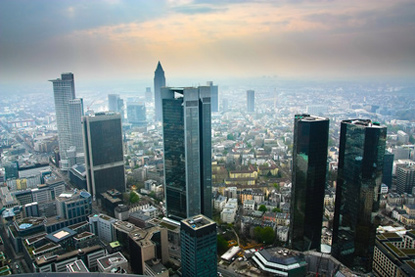
The Bad Homburger Golf Club, inaugurated in 1899, is Germany's oldest golf club. Bad Homburg's proximity from Frankfurt has made it a favourite commuter town for white-collar workers, and it is now one of the wealthiest suburbs of Frankfurt.
Interesting Facts about Bad Homburg
- Bad Homburg, at the foot of the Taunus mountains, became internationally famous as a spa town in the 19th century.
- The town is renowned for its luxurious Kurpark, a historic spa park established with funds from its first casino, opened in 1841 by the Blanc brothers.
- The "Homburg hat," a stylish felt hat, was popularised by Edward VII of the United Kingdom, who frequented the town for health cures.
- Bad Homburg is home to Germany’s oldest golf club, established in 1912, with parts of the historic course still visible today.
- Kaiser Wilhelm II chose Bad Homburg Palace as his imperial summer residence in 1888, earning the town the nickname "Kaiserstadt" (Emperor’s City).
- The imposing White Tower, a remnant of the medieval "Hohenburg" castle, is now the town’s landmark.
- Princess Elizabeth of the United Kingdom, known as "Eliza," married into the local landgravial family and helped advance the town’s spa culture in the early 19th century.
- Not far from the centre stands the Russian Chapel, built with support from the Russian imperial family in 1896.
- King Chulalongkorn of Siam (Thailand) gifted a garden pavilion to the town in gratitude for a successful cure, which was erected in 1914.
- After 1918, Bad Homburg evolved into one of the wealthiest towns in Germany, with its economy based on spas and high-tech industries.
History
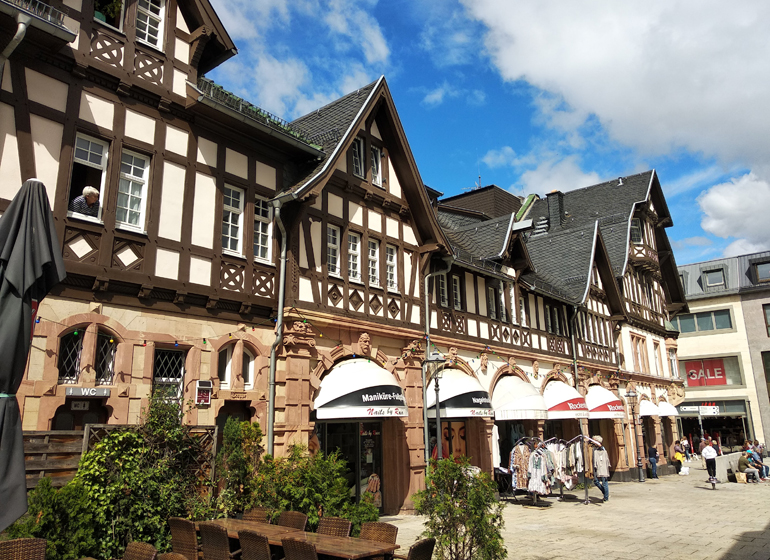
Bad Homburg's recorded history dates back to 1180 when the first written mention of Homburg Castle appears, though local tradition suggests earlier origins in 782 with the Villa Tidenheim mentioned in the Lorsch codex. The town's name derives from the Hohenberg Castle, with the suffix "vor der Höhe" first recorded in 1399, whilst the prestigious designation "Bad" was officially conferred in 1912, recognising its status as a spa town. The settlement acquired market rights around 1330, developing into the seat of the independent landgraviate of Hesse-Homburg from 1622 to 1866, when it became Prussian territory following the Austro-Prussian War.
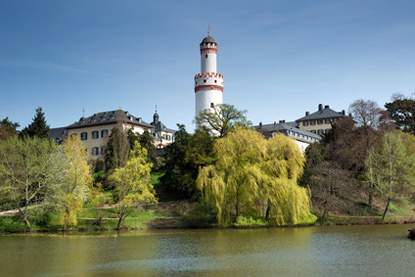
The transformation into a renowned spa destination began in 1834 when the Blanc brothers rediscovered the Elisabeth mineral spring and other springs known to the Romans. This led to the establishment of the first casino in 1841, which attracted wealthy Europeans and funded the development of luxury hotels, the Kurpark, and spa facilities. The town's golden age arrived in the late 19th century when Kaiser Wilhelm II made Bad Homburg his summer residence from 1888, earning it the nickname "Kaiserstadt" (Emperor's City). Distinguished visitors included Edward, Prince of Wales (later Edward VII), who popularised the soft-felt Homburg hat during his 32 visits from 1882 onwards, Russian Czars Alexander I and Nicholas I, and literary figures such as William Makepeace Thackeray, Robert Louis Stevenson, Fyodor Dostoevsky, and Oscar Wilde.
The architectural legacy reflects this rich history, with Bad Homburg Palace combining the medieval White Tower, a remnant of the original Hohenberg Castle, with an early Baroque palace built between 1679-1686 by Landgrave Frederick II. The palace features the only authentically furnished private rooms of the Hohenzollern rulers preserved in Germany, whilst the palace park showcases a unique landscape garden extending 360 hectares along a north-western axis. The town made sporting history in 1912 by opening Germany's first golf course, and during World War I, it served as an important rehabilitation centre for wounded veterans. After 1918, Bad Homburg evolved from an aristocratic playground into a prosperous residential town, maintaining its spa heritage whilst developing into a modern centre for high-technology firms and the knowledge economy.
Main Attractions
Kurpark Bad Homburg
The Kurpark is a sprawling 44-hectare historic spa park laid out in the 19th century, recognised for its extensive lawns, ancient and exotic trees, ornamental gardens, and the Brunnenallee lined with healing mineral springs. The park includes tennis courts, a golf course, playgrounds, the Sala-Thai pavilion, and notable monuments, making it a central spot for recreation and relaxation in the town's heart. Its accessibility, diversity of activities, and abundance of historical features differentiate it from smaller local parks.
Bad Homburg Castle and Schlosspark
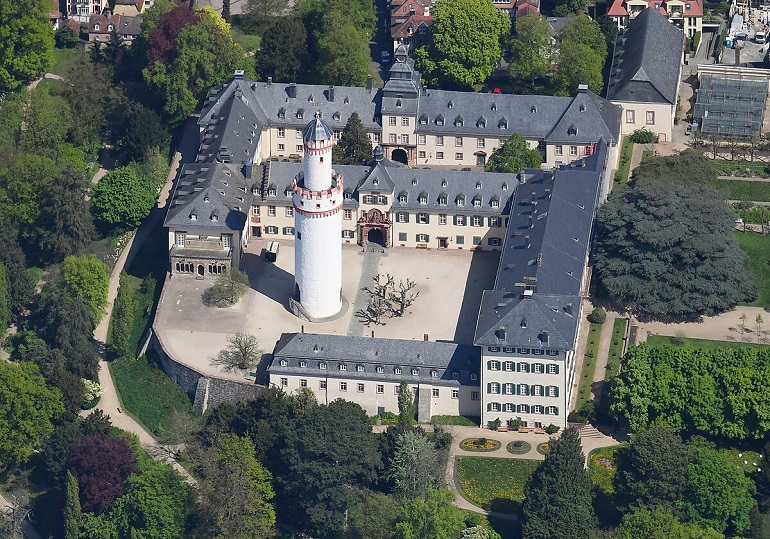
Bad Homburg Castle was originally constructed in the 12th century and rebuilt as a Baroque palace in the late 17th century. It served as the residence of the Landgraves of Hesse-Homburg before becoming the summer home of Prussian kings and German emperors. The complex features the distinctive White Tower, dating from the 14th century, which remains a prominent landmark. The surrounding Schlosspark, developed over several centuries, combines Baroque formal elements with landscaped parkland and includes notable features such as an orangery, English-style gardens, and rare botanical specimens like a Lebanese cedar planted in 1820. Today, the castle operates as a museum and the park is open year-round, providing insight into the daily life of past German nobility as well as a varied example of historical garden design.
Weißer Turm (White Tower)
The Weißer Turm is a prominent 48-metre whitewashed medieval keep and the sole surviving structure from the former Burg Hohenberg, now a defining landmark of Bad Homburg. Visitors who climb its 174 steps are rewarded with expansive views over the town, the Taunus hills, and the surrounding countryside, and its historical importance as the castle’s original defensive tower sets it apart from other local towers and viewpoints.
Herzbergturm
Located atop the nearly 600-metre Herzberg hill, the Herzbergturm is a 24.5-metre observation tower inspired by Roman Limes watchtowers and offers panoramic views of the Taunus range, the Spessart, Odenwald, and Vogelsberg. Accessed via hiking trails, the tower is popular with walkers and nature enthusiasts, and features a nearby mountain inn for refreshments, distinguishing it as a scenic yet active destination.
Jubiläumspark
Established in 1913 to commemorate the 25th jubilee of Kaiser Wilhelm II, Jubiläumspark is adjacent to the Kurpark and is favoured by families for its spacious lawns, mature trees, and well-equipped playgrounds. With opportunities for picnics, play, and relaxation, it is particularly appealing to visitors with children and offers a more intimate green space compared to the larger Kurpark.
Gustavsgarten
Gustavsgarten is a carefully maintained park featuring quiet walking paths, mature plantings, and accessible facilities. While smaller than Kurpark, it provides a tranquil alternative for strolls or dog walking, and its well-kept environment is appreciated by those seeking a peaceful outdoor experience.
Kleiner Tannenwald
This compact landscaped park offers woodland walks, open lawns, and shaded areas, suitable for leisurely visits, dog walking, and family activities. Its style, reflective of historic English parks, gives it unique local charm and sets it apart from the other larger municipal parks.
Brunnenallee
The Brunnenallee is a historic promenade within the Kurpark, lined since the mid-19th century with healing springs, stately chestnut trees, and decorative landscaping. It remains notable for its ensemble of spa-era buildings, ornamental gardens, and biotope-protected tree avenues, offering an evocative glimpse of Bad Homburg's spa heritage in a concentrated area.
Top Museums
Saalburg Roman Fort and Museum
The Saalburg is the most completely reconstructed Roman fort in Germany and forms part of a UNESCO World Heritage site. Beyond its imposing walls and gates, the museum houses extensive archaeological collections and informative exhibitions illuminating Roman military, social, and daily life on the empire's frontier. Events, living history programmes, and reconstructions make the ancient world remarkably vivid. This site is especially compelling for anyone interested in archaeology or ancient history, though the experience is immersive and accessible enough for families and casual visitors alike.
Museum in the Gothic House
Housed in a 19th-century neo-Gothic hunting lodge, this museum explores the history of Bad Homburg, the local landgraviate, and its development as a spa town. Particularly notable is the Hutmuseum, celebrating the town’s legacy in hatmaking, including the famous ‘Homburg’ hat. The museum also features romantic period rooms, art displays, and a sculpture garden. Its elegant setting and intriguing focus on local culture and industry set it apart as a must-visit for those seeking deeper stories behind the town’s genteel façade.
Automuseum Central Garage
Automuseum Central Garage is a sanctuary for automobile enthusiasts, featuring impeccably curated displays of vintage, classic, and youngtimer cars, with a particular strength in Mercedes-Benz. The museum is notable for its changing themed exhibitions and its authentic reconstruction of a mid-century petrol station and workshop, adding a tactile element of nostalgia and technical history. While not vast in scale, the quality and character of the exhibits make it a delight for motoring fans and anyone curious about industrial heritage.
Museum Kirdorf (Kirdorfer Heimatmuseum)
Situated in the heart of the Kirdorf district, Museum Kirdorf offers nuanced, lovingly assembled exhibitions on village life, faith, and community in the formerly Catholic enclave of Kirdorf. The museum excels at rendering the past tangible, with rotating special exhibitions ensuring there’s always something new for return visitors. It’s an excellent choice for those interested in social and local history, particularly as it chronicles the peculiarities and resilience of a community amid changing times.
Gonzenheimer Museum im Kitzenhof
This small local museum specialises in presenting archaeological finds from Bad Homburg-Gonzenheim and exploring the area’s evolution from prehistory through recent centuries. Its displays focus on discoveries made during the 19th and 20th centuries, offering a unique window into the early history of the region. While its opening schedule can be limited, its emphasis on prehistory and local heritage rounds out the historical narrative offered by Bad Homburg’s museums.
Local Cuisine
A must-try in Bad Homburg is the renowned Grüne Soße (green sauce), a fresh herb sauce typically enjoyed with hard-boiled eggs and potatoes, reflecting the specialities of Hesse. In spring, locals eagerly await the arrival of tender asparagus, often featured in generous seasonal dishes. The area is also home to hearty classics such as Handkäse mit Musik—a marinated sour milk cheese with onions best paired with traditional apple cider—and you’ll often find warming stews and meat dishes using seasonal ingredients. For a unique treat, seek out Bad Homburg’s creative adaptations like the house-made Kronenhof Beer or special cheese-based dishes, which offer a genuine taste of local hospitality amid the town’s garden restaurants and historic settings.
Getting There & Around
By train, Bad Homburg is well-connected via the S5 line of the Rhein-Main S-Bahn from Frankfurt Hauptbahnhof, with frequent regional trains taking approximately 16 minutes; the town’s main railway station, just south of the Kurpark, is the primary arrival point for most visitors.
By bus, Bad Homburg is served by numerous city and regional buses running within the Rhein-Main transport network, stopping at the main railway station and central points such as the Kurhaus, making bus travel convenient for reaching various districts in town and for connections from neighbouring areas.
By car, the town lies northeast of the motorway interchange where the A5 meets the A661, allowing straightforward access from Frankfurt and elsewhere in Hesse, with well-signposted routes leading directly into the centre of Bad Homburg.