



| Contents |
|---|
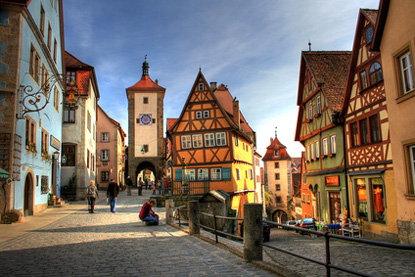
Siebers Gate near the intersection of Plönlein and Kobolzeller Steige.
Introduction
Rothenburg ob der Tauber (pop. 12,000), meaning "Red fortress above the Tauber", is a beautifully preserved medieval town located in Bavaria, Germany. Perched on a plateau overlooking the Tauber River, this walled city is renowned for its well-preserved medieval old town, which attracts tourists from around the world. Founded in the 12th century and becoming a Free Imperial City in 1274, Rothenburg is one of only four towns in Germany that still have completely intact city walls. The town features cobblestone streets, colourful half-timbered houses, and numerous historical attractions including St. James' Church with its altar by Tilman Riemenschneider, the Medieval Crime Museum, and the town hall with its clock tower. Visitors can walk the 1.5-mile medieval wall that encircles the historic centre, offering splendid views of the town's architecture. Rothenburg is also part of the popular Romantic Road, a scenic route through southern Germany.
Interesting Facts about Rothenburg ob der Tauber
- Rothenburg ob der Tauber is one of Germany's best-preserved medieval towns, with intact city walls dating back to the 13th century.
- Legend claims the town was saved during the Thirty Years' War when Mayor Nusch drank over 3 litres of wine in one gulp during a wager with invading forces.
- The picturesque Plönlein square, featuring a yellow half-timbered house and twin towers, is one of Germany's most photographed spots.
- St James's Church houses Tilman Riemenschneider's famous Holy Blood Altar, a masterpiece of late Gothic woodcarving completed in 1505.
- Visitors can walk the entire 2.5km circumference of the medieval town walls, offering panoramic views of colourful rooftops and the Tauber Valley.
- The town's Criminal Museum displays macabre historical punishment devices including shame masks and medieval torture instruments.
- Rothenburg's Schneeballen pastries – fried dough strips shaped like snowballs – have been a local specialty since the 1600s.
- The annual "Meistertrunk" historical play re-enacts the legendary wine-drinking feat that supposedly saved the town from destruction.
- Käthe Wohlfahrt's Christmas Village operates year-round, with five permanent Christmas shops and a dedicated Christmas Museum.
- Rothenburg served as inspiration for the village in Disney's Pinocchio and appears in Harry Potter films as part of Hogwarts' backdrop.
People who have played the video game The Secret of Monkey Island (1990, Special Edition 2009), which incidentally served as the inspiration for the Walt Disney film series Pirates of the Caribbean, will remember the street scene in Melee Town with the clock tower, which is none else than Rothenburg's Siebers Gate and the intersection of Untere Schmiedgasse/Plönlein with Kobolzeller Steige.
History

Rothenburg's history started in 1070, when the Count of Comburg-Rothenburg decided to erect a castle on top of a hill overlooking the River Tauber. The last Count, Heinrich of Comburg-Rothenburg, died heirless in 1116, bequeath the castle and the adjoining Gebsattel village to the Comburg convent. Emperor Henry V had other plans to the future of the county. He stepped in, overruled the will and appointed his nephew Konrad von Hohenstaufen (who'd become King Conrad III of Germany) as the new Count of Comburg-Rothenburg.
In 1170, Rothenburg was granted city rights soon after the completion of Staufer Castle (named after the Hohenstaufen Dynasty). In 1274, Rothenburg was elevated to the rank of Free Imperial City by King Rudolf of Habsburg, which it would keep until the dissolution of the the Holy Roman Empire by Napoleon in 1806.
In the 14th century, Rothenburg grew to a population of 5,500, making it one of the 20 largest cities in the Holy Roman Empire at the time. The Teutonic Knights started the construction of St. James' Church in 1311, which would last until 1484. The Staufer Castle was destroyed by an earthquake in 1356. The St. Blaise Chapel is the only remnant standing to this day. Rothenburg prospered during the late Middle Ages, attracting quantities of pilgrims to the Holy Blood pilgrimage in St. James' Church.

The 17th century marked a sudden decline of the city. the In October 1631, at the height of the Thirty Years' War, the Belgian Catholic Jean t'Serclaes, Count of Tilly, attempted to quarter his army of 40,000 soldiers in Rothenburg, which had converted to (Protestant) Lutheranism. The local citizens refused entry to the Catholic troops, but were soon crushed by a brief siege. Three years later the Black Death wiped out a big chunk of the remaining population, and Rothenburg was left out as an impoverished backwater. The lack of growth and money was ironically a boon for the preservation of the town's architecture, which hasn't changed much since the 1600's.
Artists of the Romantic movement rediscovered Rothenburg in the 1880's. The Nazi seized Rothenburg's Romantic image to their profit, hailing it as "the most German of German towns" and organizing day trips there from all across the Reich. On 31st March 1945, the Americans sent 16 air planes to bomb Rotherburg, sadly destroying 306 houses, 6 public buildings, 9 watchtowers, and over 600 metres of city wall.
Main Attractions
All Rothenburg is a pleasure for the eyes. Visitors shouldn't head for specific sights as they would do in cities like Cologne or Berlin but sample the atmosphere here and there, bathing in the omnipresent visual exuberance.
The town is centred around the Markt (market square), with the Gothic Rathaus (town hall) serving as a rallying point. Climb to 220 steps to the top of its 60-metre-high tower to contemplate the River Tauber meandering across the landscape. Entry is 5 €, a bit steep, even for a climb. Immediately north of the town hall is the Jacobskirche (St. James's Church), renowned for its Holy Blood altarpiece carved between 1500 and 1505 by the famous Würzburg wood carver Tilman Riemenschneider.

Rothenburg's pride is its intact ramparts, circling around the city for 2.5 km. The western section, overlooking the Tauber, is the most impressive. Check the 14th-century double-decker bridge (Doppelbrücke) over the river. The Röderturm, the eastern city gate at the end of Rödergasse, is sometimes open to the public and provides a nice viewpoint.
Top Museums
Medieval Crime Museum (Mittelalterliches Kriminalmuseum)
This museum is one of the most significant legal history museums in Europe, offering an insight into the past 1,000 years of judicial history. Spread across six floors in two buildings, it houses over 50,000 exhibits that showcase the evolution of the German and European judicial system from the High Middle Ages to the 19th century.
Highlights include:
- Instruments of torture and execution
- Tools used for corporal punishment
- Drawings and documents related to criminal proceedings
- Exhibits on civil policy orders, including regulations on clothing, marriage, and baptism
- Displays on various themes such as robbers, commerce, women, children, and animals in legal history
The museum provides a comprehensive look at medieval criminal justice, making it a must-visit for history enthusiasts and those interested in legal systems of the past.
The History Vault (Historiengewölbe mit Staatsverlies)
Located beneath the town hall wing, this museum offers a unique experience centred around Rothenburg's history during the Thirty Years' War. The museum features:
- The former dungeon where the legendary Mayor Heinrich Toppler was once imprisoned
- A collection of original weapons, flags, and uniforms from the era
- An exhibition providing insight into the warfare of the time
Visitors can explore the underground cells and immerse themselves in the town's turbulent past through the historical festival "The Master's Drink".
Käthe Wohlfahrt Christmas Museum
For those who love the holiday season, this museum offers a magical experience year-round. Spanning over 250 square metres, it showcases:
- The history of Christmas
- Various Christmas decorations from the 19th and early 20th centuries
- A permanent exhibition of Christmas-related items
The museum, established in 1981, allows visitors to dive into a world of festive cheer regardless of the season.
Rothenburg Museum (RothenburgMuseum)
Housed in a former Dominican convent, this museum offers a comprehensive look at the town's history. It features:
- Exhibits on medieval craftsmanship
- Displays on the town's rich cultural heritage
- Artworks and artefacts from various periods of Rothenburg's history
The museum provides a wonderful opportunity to view much of the medieval history of the area under a single roof.
Doll and Toy Museum
This charming museum is perfect for those interested in the history of playthings. It showcases:
- A vast collection of dolls from different eras
- Various toys and games from the past
- Exhibits on the evolution of children's entertainment
The museum offers a nostalgic journey through childhood memories and the changing nature of play over time.
Rothenburg ob der Tauber's museums offer a diverse range of experiences, from the sobering realities of medieval justice to the whimsical world of Christmas and toys. Each museum provides unique insights into different aspects of the town's rich history and culture, making them essential stops for any visitor to this medieval gem.
How to get there
Rothenburg ob der Tauber is easily accessible by various modes of transportation. The most convenient way to reach the town is by train, with regular connections from major cities like Munich, Nuremberg, and Frankfurt. The journey from Munich typically takes 3-4 hours with 1-2 transfers, while from Nuremberg it's about 1.5 hours. For those preferring to drive, Rothenburg is located along the A7 and A6 motorways, making it a straightforward 2.5-hour drive from Munich or 1 hour from Nuremberg. Bus services are also available, though less frequent. The town's train station is conveniently located just outside the old city walls, about a 10-minute walk from the center. For visitors staying overnight, many hotels offer parking assistance, as car access within the old town is restricted, especially during nighttime hours.


