



| Contents |
|---|
Introduction
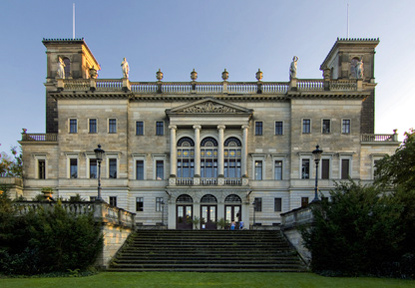
Perched majestically on the slopes above Dresden's Elbe River, Albrechtsberg Palace stands as one of Germany's most enchanting Romantic castles, offering visitors a captivating glimpse into 19th-century royal splendour. Built between 1850 and 1854 for Prince Albert of Prussia, this architectural jewel showcases the finest elements of late Romantic design, with its distinctive towers, ornate facades, and beautifully manicured gardens that cascade down towards the river valley below. The palace's interiors are equally impressive, featuring lavishly decorated rooms that have been meticulously preserved, whilst the surrounding parkland provides breathtaking panoramic views across Dresden's historic cityscape and the meandering Elbe. Today, Albrechtsberg serves not only as a magnificent example of royal residence architecture but also as a cultural venue hosting concerts, exhibitions, and events, making it a must-visit destination for those seeking to experience the grandeur of Saxon nobility whilst enjoying some of the most spectacular vistas in the Dresden region.
Interesting Facts about Albrechtsberg Palace
- Albrechtsberg Palace in Dresden was commissioned by Prince Albrecht of Prussia and built from 1851–1854, with designs by the court architect Adolf Lohse in a Late Classicist style.
- The palace crowns the Elbe hillside in the Loschwitz district as one of the celebrated “Elbe castles,” offering commanding views over the river valley.
- Prince Albrecht established the residence here for himself and his morganatic wife Rosalie von Rauch, reflecting a personal union outside strict royal protocol.
- After passing to their sons, the estate was sold to the City of Dresden in 1925 due to Count Wilhelm of Hohenau’s gambling debts.
- The gardens were opened to the public after 1930 and redesigned as a recreational landscape under Mayor Wilhelm Külz.
- Although Dresden was heavily bombed in 1945, the three Elbe castles, including Albrechtsberg, were largely spared destruction.
- During the Second World War the site saw use by the SA and later served as a children’s home from 1943.
- In 1948 the city was compelled to sell the palace to the Soviet Foreign Trade Ministry, which refurbished it and opened it as the “Intourist” hotel.
- The property returned to municipal ownership in the early 1950s and was used as an East German Pioneers Palace.
- Declared a historic monument in 1977, Albrechtsberg has been progressively restored ever since.
- Since 1991 the palace has hosted a hotel and catering school and today can be hired for events, concerts and congresses.
- Architecturally, the ensemble blends Late Classicist and Neoclassical vocabulary with Italianate influences, characteristic of Lohse’s Schinkel-school lineage.
- The landscaped terraces and parkland were shaped to complement the Elbe slopes, creating a harmonious villa-and-garden composition.
- Notable figures such as Richard Wagner frequented an earlier manor on the site before the present palace was erected.
- Today Albrechtsberg is a prominent cultural venue in Dresden’s riverside palace trio, prized for its state rooms and panorama.

History
The origins of Albrechtsberg Palace trace back to the early 19th century, when around 1803 James Ogilvy, 7th Earl of Findlater, acquired several vineyards in Dresden's Elbe Valley. The Scottish lord constructed a manor house on the site, though he died in 1811 before witnessing its completion. Following Ogilvy's death, Johann Gabriel Krebs purchased the country house and transformed it into a popular restaurant that became Dresden's most favoured day trip destination, welcoming notable guests including architect Gottfried Semper and composer Richard Wagner.
The palace's transformation into a royal residence began in 1853 when Prince Albert of Prussia, younger brother of Prussian King Frederick William IV, faced exile from the Prussian court following his morganatic marriage to Rosalie von Rauch, Countess of Hohenau. Forced to seek a new home abroad, the Prince commissioned his chamberlain's wife, Baroness of Stockhausen, to locate a suitable residence. She acquired the area known as "Findlater's Vineyard," including the existing manor and gardens, for 16,000 Thalers. Prince Albert then engaged Adolf Lohse, a student of renowned architect Karl Friedrich Schinkel and a Prussian court architect, to design the present neoclassical castle. The landscape design was entrusted to Eduard Neide, though court gardener Hermann Sigismund Neumann ultimately executed the plans. Construction commenced in 1850, with the adjacent Villa Stockhausen completed first to serve as temporary accommodation for the Prince and his wife before they moved into the finished palace in 1854.
Following Prince Albert and Rosalie's deaths, their younger son Count Frederick of Hohenau resided in the castle until his death in 1914, after which his elder brother Wilhelm inherited the property. However, Wilhelm was eventually forced to sell the castle and grounds to the City of Dresden in 1925 due to substantial gambling debts. During the Second World War, the palace served various functions, initially used by the SA before becoming a children's home from 1943. Although the building survived Dresden's devastating bombing, it was subsequently occupied by the Red Army, resulting in considerable damage. The castle later operated as an Intourist hotel under Soviet management before being repurchased by East German authorities in 1951. Since 1952, Dresden has maintained ownership, and following German reunification in the early 1990s, the palace was declared a historic monument in 1977 and now functions as a private hotel and catering school.

Description
Albrechtsberg Palace stands as one of Germany’s finest examples of late Neoclassical architecture. This elegant stately home, constructed between 1850 and 1854, represents the architectural vision of Adolf Lohse, a distinguished pupil of Karl Friedrich Schinkel, and was commissioned by Prince Albert of Prussia as a romantic refuge for himself and his beloved second wife, Rosalie von Rauch. Steeped in artistic grandeur yet suffused with an intimate warmth, the palace offers a richly layered sensory experience that unfolds across its interiors, terraces and parkland.
Architectural Excellence
Crafted from local white sandstone, the palace’s exterior exudes a subtle grandeur. A central portico supported by Corinthian columns grants an imposing yet graceful entrance, while gently curved wings embrace the visitor in a measured embrace. Delicate friezes and sculpted garlands adorn the cornices, and balustraded balconies project slender shadows across the façade at different times of day. The careful proportioning of windows and pilasters, combined with the tranquil uniformity of the sandstone, provides a serene counterpoint to Dresden’s exuberant Baroque landmarks, making Albrechtsberg a singular architectural gem.
Interior Grandeur
The Entrance Hall and Foyer
Stepping into the entrance hall, one is greeted by a lofty coffered ceiling painted in dusky terracotta hues and highlighted by gilded rosettes. The parquet flooring, laid in an intricate herringbone pattern, incorporates dark oak and pale maple, creating a warm foundation beneath the foot. Refined Ionic pilasters flank the room, their capitals echoing the exterior’s Corinthian ornamentation, and a graceful sweeping staircase ascends to the upper floor, its balustrade of wrought iron scrollwork crowned with a polished mahogany handrail.
The Crown Hall (Kronensaal)
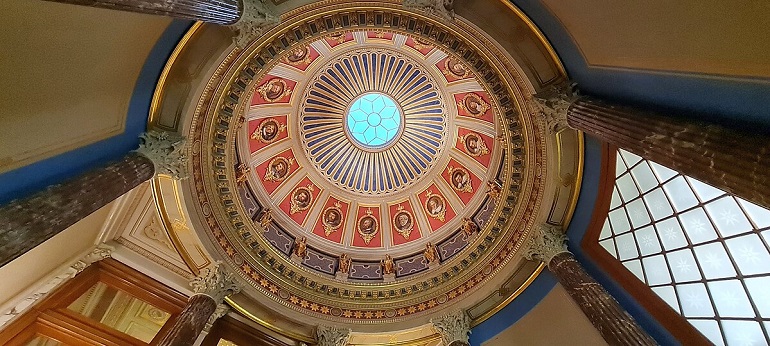
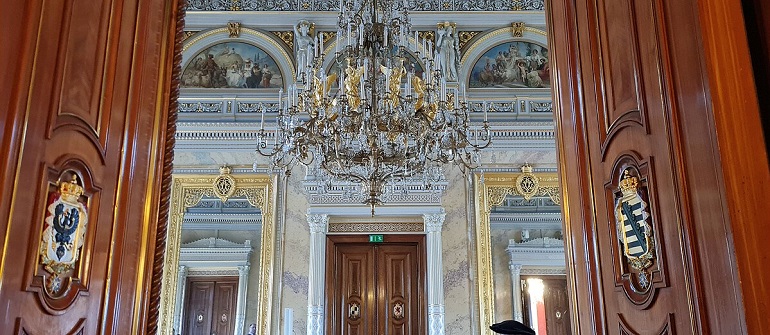
At the heart of the palace lies the Crown Hall, Dresden’s most beautiful ballroom. Spanning almost twenty metres in length, its proportions are astonishingly harmonious, with tall arched windows allowing river breezes to animate the embellished silk curtains. The ceiling presents a masterful interplay of shallow vaults and oval apertures, all framed by bands of delicate stucco foliage. Hand-cut crystal chandeliers descend from the ceiling, their multifaceted prisms scattering light across the marquetry dance floor. Along the side walls, marble columns in verd antique and Pavonazzo create rhythmic intervals, each surmounted by bronze busts of mythological figures.
The Red Salon
Adjacent to the Crown Hall, the Red Salon served as Countess Rosalie’s principal reception room. Here, the walls are cloaked in silk damask of a deep crimson shade, punctuated by gilded interlocking scrollwork. The ceiling’s shallow dome is pierced by a circular skylight, surrounded by a frieze of amorini sculpted in stucco, bearing torches and garlands. Beneath, an ornate cheminee crafted from Silesian marble stands guard, its mantel carved with classical masks and crowned by a gilt mirror framed with laurel wreaths.
The Blue Salon
Formerly the countess’s private living room, the Blue Salon evokes an air of refined calm. Its walls are clad in indigo-blue silk brocade overlaid with silver leaf arabesques, catching the light from a row of tall windows. The ceiling canvases depict Apollo and the nine Muses in soft pastel tones, their ethereal forms set against a cerulean sky. A slender parquet drift subtly into this tranquil space, lending itself to small gatherings and private concerts.
The Turkish Bath
Designed by Carl von Diebitsch, the palace’s Turkish Bath offers an exotic interlude. Reminiscent of Moorish pavilions, the room centres on a hexagonal marble basin, its water once warmed for therapeutic rituals. The walls shimmer with zellij-style tiles in crimson, cobalt and gold, while slender Moorish columns support scalloped arches and a richly painted stucco dome. Brass lanterns suspended on chains cast flickering patterns, creating an atmosphere of hushed luxury.
The Garden Hall
With its French windows opening onto the South Terrace, the Garden Hall blends indoor and outdoor realms. The room’s palette is restrained: dove-grey walls with gilt corner scrolls, pale sandstone columns framing muralled lunettes that depict Prince Albert’s travels. The murals—of Cairo’s minarets, Constantinople’s domes and Naples’ azure bays—are rendered in soft watercolours that evoke distant lands. Low velvet ottomans and slender wrought-iron tables make this room ideal for informal teas and quiet conversation.

Magnificent Grounds and Terraces
The South Terrace
From the Garden Hall, broad stone steps lead to the South Terrace, a sunlit expanse planted with Mediterranean potted citrus and oleander. Elegant balustrades afford sweeping vistas of the Elbe Valley below, with Dresden’s spired skyline punctuating the horizon. The terrace’s terracotta tiling, laid in an interlocking diamond pattern, adds warmth underfoot, while wrought-iron benches invite visitors to linger.

The East Terrace
Accessible via the Grand Staircase, the East Terrace overlooks the palace park and its gently sloping lawns. From here, one gazes across classical statues strategically placed among flowering borders of lavender, roses and peonies. In spring, cherry and magnolia blossoms punctuate the greenery with bursts of colour; in autumn, copper Beech leaves carpet the gravel paths.
The Park
Designed by Eduard Neide and executed by court gardener Hermann Neumann, the six-hectare park is a masterclass in 19th-century landscape design. Serpentine pathways wind past ornamental ponds, a cascading waterfall and grottos clad in local quartzite. A small vineyard terrace, once part of the historic Findlater estate, recalls the region’s viticultural heritage. Hidden alcoves provide secluded seating amid stands of linden and chestnut, while open lawns offer ample space for outdoor concerts or summer promenades.

Present-Day Elegance and Ambience
Albrechtsberg Palace today retains its aristocratic splendour while embracing contemporary cultural life. The Crown Hall’s exceptional acoustics draw both chamber ensembles and solo recitalists, and the intimate salons host exhibitions, readings and bespoke dinners. The Turkish Bath occasionally serves as a dramatic backdrop for exclusive receptions, its lantern-lit ambience lending an air of mystique. Throughout the palace, gentle illumination from wall sconces and crystal pendants ensures each room feels both grand and welcoming, preserving the romantic ideals of its original patrons while providing a refined setting for modern gatherings.
Elegantly restored and immaculately maintained, Albrechtsberg Palace invites visitors to step into a world where architectural harmony, sumptuous decoration and landscaped beauty unite. Whether savouring a concert in the Crown Hall, admiring the Oriental splendour of the Turkish Bath or strolling through the planting schemes of its rolling park, one leaves with a profound appreciation of the refined tastes and creative vision that shaped this Neoclassical masterpiece.
Getting There
By train Travel by rail to Dresden (Hauptbahnhof or Dresden-Neustadt) in Saxony, then connect on Dresden’s tram network to line 11 towards Bühlau; alight at “Elbschlösser” on Bautzner Straße and follow the signposted footpaths through the park for a short walk to Albrechtsberg Palace.
By coach or bus Long-distance coaches arrive at Dresden’s central bus station (ZOB) beside the main railway station; from there, take tram 11 towards Bühlau to “Elbschlösser”; if you are already in the city, local DVB buses and trams link to hubs such as Albertplatz or Postplatz for a quick change to line 11 and a brief walk from the stop to the palace.
By car Approach Dresden via the A4 or A17 motorways, then follow signs to the city centre and onwards to Loschwitz/Bühlau along Bautzner Straße (Elbschlösser); parking near the palace grounds and along the road is limited, so consider using a park-and-ride and tram 11 at busy times.
Best Time to Visit
The best time to visit Albrechtsberg Palace is during spring and summer months, particularly from April through June, when the weather is comfortable and the palace's 11-hectare park and gardens are in full bloom. Spring offers the ideal combination of mild temperatures, fewer crowds, and spectacular floral displays that enhance the palace's neoclassical architecture and picturesque setting along the Elbe River. Summer visitors can enjoy longer daylight hours and the opportunity to catch a magical sunset with the castle as a backdrop, though late afternoon visits are recommended to avoid the midday heat. For those seeking a more peaceful experience, weekdays are preferable to weekends as they offer quieter exploration of both the elegant interior rooms and the sprawling parklands, allowing families to fully appreciate the palace's royal grandeur and historical significance without the bustle of peak tourist times.