



| Contents |
|---|

Introduction
Founded in 1621 by Dutch settlers seeking religious freedom, Friedrichstadt (pop. 2650) is a small town located at the confluence of the Eider and Treene rivers. The town's layout was designed by its original inhabitants, resulting in a grid of streets intersected by canals, which are known locally as Grachten. Its architecture is defined by the distinctive Dutch Renaissance style, with many original gabled houses still lining the waterways. This unique heritage has earned Friedrichstadt the nickname 'Little Amsterdam'. The compact old town, now recognised as a cultural monument of the state, reflects 17th-century Dutch Brick Renaissance architecture and features a network of waterways and bridges within an area of roughly 4 km². Today, Friedrichstadt retains bilingual and regional heritage references, with historical names in Low German, Danish, North Frisian, and Dutch used alongside German.
Interesting Facts about Friedrichstadt
- Founded in 1621 by Dutch settlers invited by Duke Friedrich III of Holstein-Gottorp, the town was granted religious freedom and even had Dutch as an official language.
- Its grid plan, gabled houses and canals earned it the nickname “Little Amsterdam,” reflecting deliberate Dutch urban design on the Eider and Treene rivers.
- Friedrichstadt became a rare early modern refuge for diverse faiths—Remonstrants, Mennonites, Unitarians, Quakers, Catholics and Jews—leading to its moniker “City of Tolerance”.
- The Mennonite community received exceptional privileges in the 17th century, including freedom from military service and special charters repeatedly confirmed by ruling dukes and kings.
- A grand plan to make Friedrichstadt a Eurasian trade hub—with embassies sent to Russia and Persia in the 1630s—ultimately failed to materialise, curbing the town’s commercial rise.
- Strategically sited where the Eider and Treene meet, the town controlled one of only a few historical crossing points on the Eider River in Schleswig-Holstein.
- Despite ambitions for heavy fortifications, planned town walls were never realised, and warfare in 1850 destroyed more than a third of its buildings.
- Today’s canal cruises and waterside festivals celebrate the Dutch-influenced “Grachten,” underscoring the town’s enduring maritime character from Easter to October.
- Friedrichstadt retains multiple language heritages in its names—German, Low German, Danish, North Frisian and Dutch—signalling its borderland and multicultural past.
- With around 2,500 residents and an area just over four square kilometres, it preserves a small-town scale that highlights its 17th-century urban fabric.

History
Foundation and Early Dutch Settlement
Friedrichstadt was founded in 1621 by Duke Friedrich III of Holstein-Gottorp, who envisioned creating a thriving commercial centre in the marshlands where the River Treene joins the Eider. The Duke specifically invited Dutch religious refugees, particularly Remonstrants fleeing Calvinist persecution in the Netherlands, to establish this new settlement. These skilled traders and craftsmen were granted remarkable privileges, including freedom of religion, the right to use Dutch as an official language, and exemption from military service. The town was strategically planned to take advantage of Dutch expertise in land reclamation and drainage, essential skills for developing the swampy lowlands of this region. By naming the settlement after himself, the Duke ensured his legacy whilst creating what would become known as the "City of Tolerance".
Religious Diversity and Trade Ambitions
The settlement quickly became a unique haven for religious minorities in 17th-century Europe, attracting not only Remonstrants and Mennonites but also Catholics, Jews, Quakers, and Unitarians. The Mennonites received their formal charter on 13 February 1623, granting them extensive rights that were unparalleled elsewhere in Germany. Duke Friedrich III harboured ambitious plans to establish Friedrichstadt as a major European trading terminus, even sending diplomatic missions to Tsar Michael I of Russia and Shah Safi of Persia between 1633 and 1637 to create alternative trade routes that would bypass Africa. Though these grand commercial schemes ultimately proved fruitless, the town's commitment to religious tolerance remained steadfast, with all churches deliberately located on side streets rather than the main market square to ensure no faith appeared more prominent than another.
Architectural Legacy and Cultural Heritage
The Dutch influence on Friedrichstadt's character remains unmistakably evident today through its distinctive architecture and urban planning. The market square is lined with characteristic Dutch townhouses featuring stepped gables, many of which were ingeniously designed with forward-tilting facades to facilitate the use of pulleys for moving goods to upper-floor storage areas. The world's only Remonstrant church outside the Netherlands still stands in the town, whilst the Jewish community, which grew to over 400 members by the 19th century, built their synagogue in 1847. Despite suffering damage during the Three Years' War (1848-1851) when the original buildings were destroyed, Friedrichstadt maintained its unique Dutch character through careful reconstruction. This remarkable town, built during the destructive Thirty Years' War, continues to serve as a living testament to the successful integration of diverse religious communities and the enduring legacy of Dutch urban planning in northern Germany.
Main Attractions
Marktplatz (Market Square)
The Marktplatz serves as the heart of Friedrichstadt's historic old town and represents the central gathering place for both locals and visitors. This historic landmark maintains its original function as a market square, hosting a weekly market every Friday from 8:00 to 13:00, where vendors sell regional produce including fruit, vegetables, meat, fish, cheese, bread, baked goods, flowers, plants, handcrafts and souvenirs. The square is surrounded by characteristic Dutch-style stepped gabled houses that reflect the town's unique heritage as a Dutch settlement founded in 1621. The Marktplatz provides wheelchair accessible entrances and parking facilities, making it suitable for all visitors.

Canal System and Bridges
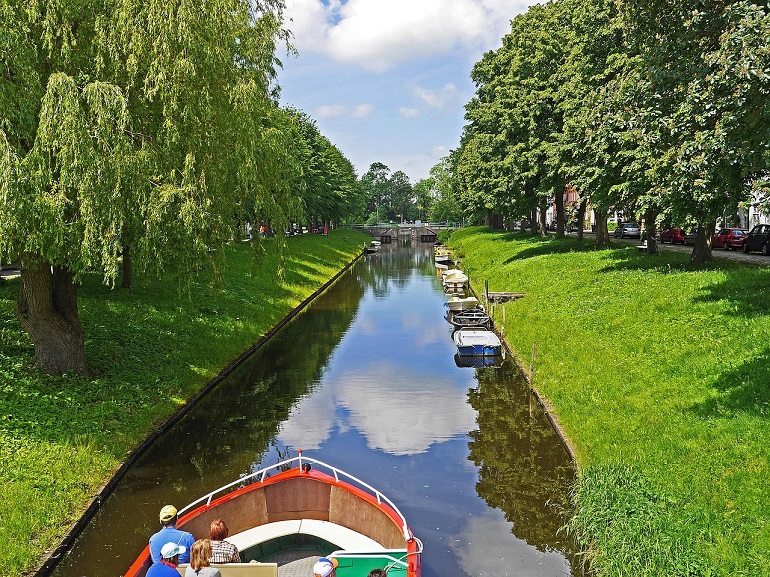
Friedrichstadt's network of narrow canals, known locally as "Grachten," forms the distinctive character of this "Little Amsterdam of the North." These waterways connect the Rivers Eider and Treene and are crossed by numerous small bridges that visitors can walk over or pass under during boat tours. The canal system reflects the Dutch engineering expertise brought by the original settlers and continues to serve both practical and aesthetic purposes. Visitors can explore the canals not only by boat but also by stand-up paddleboard, with equipment rental available from Easter to October at €19 per hour.
Friedrichstädter Grachtenfahrt (Canal Boat Tours)
The canal boat tours operated by the "Prinzenlinie" company offer visitors the opportunity to explore Friedrichstadt from the water, travelling through all the town's canals, both harbours, and sections of the River Treene. These hour-long guided tours operate from Easter to October and provide knowledgeable commentary about the town's 400-year history as a Dutch settlement. The tours include passage under small bridges and past stepped gabled houses, with experienced captains sharing historical anecdotes and humorous stories about the town's development. Adult tickets cost €12.50, with children under 14 years paying €8.50, and the tours typically run on the hour between 10:00 and 16:00, weather and tide permitting. The service requires a minimum of eight adults to operate and accepts advance bookings for groups.
Remonstrantenkirche (Remonstrant Church)
The Remonstrantenkirche represents a unique religious heritage as the only Remonstrant church in the German-speaking world. Originally built in 1624 as the world's oldest Remonstrant church, the current structure dates from 1854 after the original building was destroyed during the Schleswig-Holstein-Danish War in 1850. The church showcases clear, bright simplicity and exceptional acoustics, making it particularly suitable for musical performances. The Remonstrant community, founded in the Netherlands in 1619, rejected Calvinist predestination doctrine and advocated for religious freedom and tolerance. Herzog Friedrich III of Schleswig-Holstein-Gottorf invited them to establish Friedrichstadt as a place where they could practise their faith freely. The church typically remains open during summer daytime hours and can be visited year-round as part of guided city tours, with monthly services usually held on the last Sunday at 10:00.

St. Christophorus-Kirche (St. Christopher's Church)
St. Christophorus-Kirche was constructed between 1643 and 1649, making it one of the few church buildings from the Thirty Years' War period. This simple hall church features a polygonal eastern choir built from small yellow bricks, following Dutch architectural models. The massive western tower received its distinctive baroque crown during the 1760s, whilst the church's external appearance has remained largely unchanged since its construction. The church contains a bell from 1634 in its bell tower, and the interior furnishings date back to the construction period, though they underwent significant modification in 1763. The altar painting was created in 1675 by Jürgen Ovens, a pupil of Rembrandt. The Schleswig-Holstein Music Festival utilises this venue for concerts, particularly appreciating the unusually clear acoustics that enhance performances by small musical ensembles.
Katholische Kirche St. Knud (St. Knud Catholic Church)
The Catholic Church of St. Knud provides an example of the religious diversity that has characterised Friedrichstadt since its founding. Located on Am Fürstenburgwall, this church serves the Catholic community within the historically multi-denominational town and maintains regular opening hours from 9:00 to 17:00 daily. The church offers wheelchair accessible parking facilities and represents the continuing tradition of religious tolerance that Herzog Friedrich III established when founding the settlement.
Kriegerdenkmal (War Memorial)
The Kriegerdenkmal serves as a memorial to soldiers who fell in 1850 before Friedrichstadt during conflicts involving the Schleswig-Holstein Army. This obelisk structure was erected in 1893 on Flachsblumenstraße and provides a place for reflection and remembrance. The memorial represents the town's acknowledgment of its involvement in 19th-century regional conflicts and maintains accessibility for visitors throughout the day.
Windmühle Catharina (Catharina Windmill)
The historic Windmühle Catharina, located along the Eider dyke near Friedrichstadt, serves as a starting point for walking tours to the town. This traditional windmill represents the agricultural heritage of the region and provides access to scenic walks along the Eider dyke. The route from the windmill to Friedrichstadt passes through quiet fields, past thatched houses, and along dykes shared with sheep herds, offering visitors insight into the rural landscape surrounding the Dutch settlement. The windmill can be reached as part of organised walking tours or independent exploration of the surrounding countryside.
Top Museums
Museum "Alte Münze" (Old Mint Museum)
Despite its name, the Museum "Alte Münze" never actually housed a mint. The building's designation stems from the local population's hopeful belief that Friedrichstadt would receive minting rights when it was constructed in 1626 as a storehouse for the noble governor Adolph van Wael. This magnificent Renaissance structure, considered one of the most beautiful buildings in Schleswig-Holstein and northern Germany, has served multiple purposes throughout the centuries, functioning as a church, library, and tourist information centre before becoming the town's municipal museum in 1995 following extensive renovation.
The museum presents a modern and lively exhibition across three levels, exploring the fundamental themes that shaped Friedrichstadt's character: the town's founding, its remarkable religious diversity, and the everyday life of its inhabitants through different historical periods. The displays chronicle how this unique settlement became a haven for religious minorities, including Mennonites, and developed its distinctive Dutch-influenced architecture and culture. Visitors can also glimpse into the Mennonite church, the place of worship for Friedrichstadt's smallest religious community.
Tischlereimuseum (Carpentry Museum)
Located in the heart of Friedrichstadt's old town near the market square, the Tischlereimuseum preserves the authentic workshop of master carpenter Jacob Hansen. Founded in 1876, this remarkable workshop remains in its original condition, offering visitors a rare opportunity to experience an authentic 19th-century craftsman's environment.
The museum complex comprises both the workshop and residential building, connected by an idyllic inner courtyard that exemplifies the traditional integration of living and working spaces within the town. This arrangement provides invaluable insight into how urban craftspeople organised their lives and businesses during the late Victorian era.
The workshop itself is a treasure trove of historical tools and machinery. The ground floor houses the machine room and bench room, featuring numerous fascinating exhibits including an impressive lathe from 1870 and an antique bandsaw. The first floor contains the veneering room and what was once the wood and veneer storage area, now converted into a modern seminar space. Visitors are encouraged to handle the historic tools and experience the working processes first-hand, making this a particularly tactile and engaging museum experience.
Beyond its permanent displays, the Tischlereimuseum hosts various special events throughout the year, including celebrations during the Friedrichstadt Rose Days and the popular Culture Night, when the enchanting rear garden becomes a venue for festivities.
Modellbahn-Zauber (Model Railway Magic)
Housed in Friedrichstadt's historic setting, Modellbahn-Zauber represents Schleswig-Holstein's largest model railway exhibition. This extraordinary attraction transports visitors into a meticulously crafted miniature world built to H0 scale (1:87), where more than 4,500 miniature inhabitants, affectionately called "Mobazaner," populate the landscape.
The technical sophistication of this installation is remarkable. One hundred and one trains operate within a digitally computer-controlled system, with approximately 20 train sets running simultaneously across more than 1.3 kilometres of track. The creators, Sybille and Sönke Röckendorf, continue to develop new scenes annually, ensuring that repeat visitors always discover fresh details.
The magic extends far beyond the trains themselves. Day and night cycles occur every half hour, creating dramatic lighting changes across the landscape. Weather effects add another layer of realism, with thunderstorms complete with lightning and thunder surprising visitors, whilst fireworks and laser shows illuminate the miniature night sky. Fairground scenes come alive with carousels and Ferris wheels, and concert venues bustle with activity.
Interactive elements allow visitors to become part of the experience through 24 push-button switches that trigger various actions throughout the display. The computer-controlled Faller Car System guides miniature vehicles through the streets, whilst technical effects create an ever-changing panorama that captivates visitors of all ages.
For those seeking refreshment, the museum features a unique café housed within an authentic full-sized railway carriage, allowing guests to enjoy coffee and cake whilst surrounded by railway heritage.
Galerie Widderhuus
The Galerie Widderhuus serves as both an art gallery and creative studio, offering a contemporary cultural counterpoint to Friedrichstadt's historical museums. This venue showcases rotating exhibitions and provides space for artistic workshops and performances, contributing to the town's vibrant cultural scene whilst maintaining strong community connections.
Local Cuisine
Visitors to Friedrichstadt can savour hearty regional dishes such as Grünkohl mit Pinkel, a winter speciality of kale served with sausage, or the locally loved Dithmarscher Kohlgerichte, cabbage-based meals celebrating the region’s most famous crop. The town’s waterside setting also makes it an excellent spot for fresh fish and seafood, especially Matjes herring, prepared in the traditional North German style. For something sweet, travellers should not miss Frisian cakes and pastries, often laced with spices and almonds, which pair perfectly with the strong, aromatic Friesentee served with cream and rock sugar — a ritual that embodies the warmth of local hospitality.
Getting There
By train Friedrichstadt is well connected by regional rail services, with direct trains from Husum and Heide, making it the most convenient way to arrive. The town’s small station is only a short walk from the historic centre, allowing easy access for visitors.
By coach or bus Regular bus services link Friedrichstadt with nearby towns such as Husum, Tönning and Heide, providing a reliable alternative for those travelling from areas without direct train connections. Buses stop close to the centre, making onward exploration simple.
By car For those driving, Friedrichstadt is reached via the A23 motorway towards Heide with onward travel along well-marked local roads. Parking is available near the historic centre, making it straightforward to combine a road trip with a visit to the town’s canals and gabled houses.