Introduction
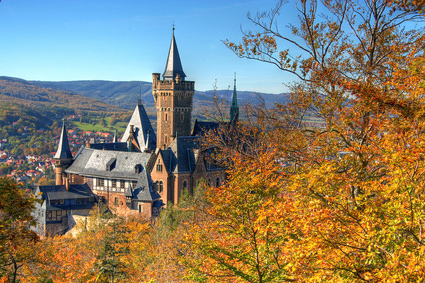
Burg Wettin is is the ancestral home of the House of Wettin, a powerful a dynasty of counts, dukes, prince-electors and kings, who have ascended the thrones of Saxony, Great Britain, Belgium, Poland, Portugal, and Bulgaria, including the current British and Belgian royal families. Originally built in the 11th century, the current castle is a modern reconstruction. Today the site comprises a rebuilt ruin integrated into public buildings and a school, while the castle hill offers visitors panoramic views of the rolling Saale valley and a reminder of the dynasty’s thousand-year legacy.
Interesting Facts about Wettin Castle
- Wettin Castle is the ancestral home of the House of Wettin, a dynasty whose descendants include the current royal families of the United Kingdom and Belgium.
- The castle stands overlooking the Saale river, near the town of Wettin in Saxony-Anhalt, Germany.
- The history of the site dates back to at least the 10th century, with archaeological evidence confirming the existence of a castle there at that time.
- Wettin Castle played a central role as a fortress and administrative centre during the German eastward expansion into Slavic territories.
- The origin of the castle’s name is Old Sorbian, with "vitin" meaning "welcome," indicating its significance as a border gateway.
- The House of Wettin split into two lines in 1485, the Ernestine and Albertine branches, both of which have ruled major European states.
- By the 19th century, parts of the castle served economic purposes, including a brewery and distillery, after it was sold to private owners.
- Today, the castle ruins have been integrated into buildings used for public institutions, rather than remaining a residence.
- The site is considered the symbolic heart of an 800-year-old dynasty that profoundly influenced the history and borders of Central Europe.
- Despite its centuries-old royal connections, the castle itself ceased to play a role as a princely residence after the Wettins relocated their main seats in the late Middle Ages.
History
The castle's origins trace back to Germanic times, with the first documented mention appearing in 961. Originally constructed by local Slavic tribes, the fortress came into the possession of the Wettin family around 1000 CE during the German conquest of Slavic territories. The structure gained its lasting significance when it became the namesake for the House of Wettin, one of the oldest dynasties in Europe. According to historical records, in 982, Dedo I and Frederick, sons of Theodoric I of Wettin, received lands taken from the Wends, including the county of Wettin on the right bank of the Saale.
The House of Wettin's rise to prominence began with their strategic positioning in the Slavic Saxon Eastern March, which led Emperor Henry IV to invest them with the March of Meissen as a fief in 1089. The family's territorial expansion continued throughout the Middle Ages, with significant acquisitions including the landgraviate of Thuringia in 1263 and the Duchy of Saxony in 1423, making them prince-electors of the Holy Roman Empire. The dynasty's wealth stemmed largely from their control of extensive silver and ore deposits, which enabled their territories to flourish economically. A pivotal moment in the family's history occurred in 1485 with the Treaty of Leipzig, which divided the dynasty into two ruling branches: the Ernestine and Albertine lines. This division would prove crucial to European royal genealogy, as the Ernestine branch later gave rise to the House of Saxe-Coburg and Gotha.
The legacy of Wettin Castle extends far beyond its German origins, as descendants of the Wettin dynasty have ascended to thrones across Europe and beyond. The family's influence reached its zenith in the 19th and 20th centuries when Wettin descendants became monarchs of the United Kingdom, Belgium, Portugal, Bulgaria, and Poland-Lithuania. Perhaps most notably, Prince Albert of Saxe-Coburg and Gotha, a Wettin descendant, married Queen Victoria in 1840, making him the ancestor of five successive British sovereigns. Today, the original castle exists as a rebuilt ruin, housing a school and other public institutions, though other Wettin castles from the 15th century still stand in Meissen and along the Elbe River. The Belgian royal family remains the only current ruling dynasty with direct Wettin lineage, maintaining the thousand-year legacy of this remarkable German noble house.
Description
Wettin Castle stands atop a narrow porphyry ridge overlooking the Saale Valley, its long, linear silhouette stretching for some 500 metres above the of Wettin. The ascent follows a gentle undulating path through wooded slopes, emerging onto a series of terraced courtyards and ramparts that once formed distinct lower and upper baileys.
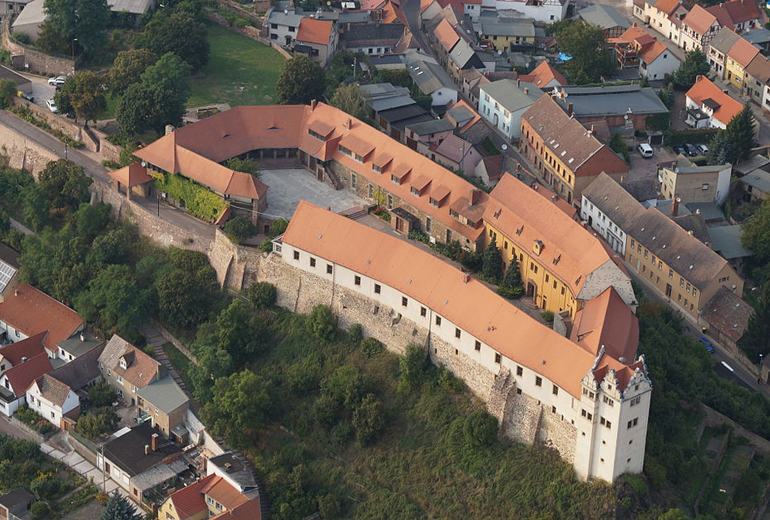
The lower ward is dominated by the richly ornamented Winkelsche Haus, its Rococo-style gables, painted stucco friezes and bright sandstone dressings contrasting with the sombre medieval stonework beyond. Adjoining this, the Meniussche Haus retains an intimate courtyard ringed by half-timbered galleries, while fragments of an imposing 12th-century bergfried—now reduced to its stout, battered foundations—hint at the castle’s former military role. Thick ring-walls, in places two metres wide and laid in rough-hewn limestone, form atmospheric cloisters and vault-like cellars, their cool arches now home to art installations and student studios.
Today the castle marries its ancient fabric with contemporary life, housing a specialist art gymnasium whose lofty studios overlook the valley through tall, arched windows. In the lower courtyard, the Burgcafé occupies a rustic barn-like hall, where painted beams and plank floors provide a warm setting for regional dishes and freshly baked cakes. Beyond the café terrace, wrought-iron railings frame unbroken views of the river meandering between green floodplains and distant hills.
Getting There
By train The most convenient way to reach Wettin Castle by public transport is to take a train to Halle (Saale) and then transfer to a regional train or bus towards Wettin, with final stops such as Löbejün or Nauendorf. The journey may involve changing trains and a short bus ride to Wettin, so planning ahead is advisable.
By coach or bus Regular buses connect nearby cities including Halle and Leipzig with Wettin-Löbejün, typically involving a change at Halle. The journey concludes with a local bus that stops close to the town centre, from which the castle is easily reached on foot.
By car For flexibility, driving is an excellent option. Wettin Castle sits near the Saale river and can be accessed via the A14 or A9 motorways, with clear signposting towards Wettin-Löbejün. On arrival, follow local directions to parking near the castle, a short walk from the entrance.
Best Time to Visit
The ideal time to explore Wettin Castle is from late spring through early autumn, roughly between May and September, when the weather in Saxony-Anhalt at its mildest and the Saale valley is at its most vibrant. During these months daytime temperatures typically hover around 18–25 °C, providing comfortable conditions for wandering the castle’s ancient walls and admiring panoramic river views. Visiting in late spring offers the added delight of flowering meadows and blossoming trees, while early autumn brings a tapestry of golden foliage and fewer day-trippers, allowing for a more tranquil, atmospheric experience. Although summer can be pleasantly warm, occasional showers may occur, so packing a light waterproof layer is advisable. This shoulder-season window strikes the perfect balance between fine weather, scenic beauty and manageable visitor numbers, making it the best period to fully appreciate both the history and landscape of Wettin Castle.




![Wettin Castle (photo by David Meisel [Parexus at de.wikipedia] - CC BY-SA 2.0 Germany license)](https://www.eupedia.com/images/content/wettin-1.jpg)