Germany Guide  |
|---|
|
| | Top German Cities |
|---|
|
| | Top National Parks |
|---|
|
| | Photos |
|---|
|
| | German States |
|---|
|
| | Europe Guide |
|---|
|
| | Travel Tools |
|---|
|
|
|
|
List of German towns with timber-framed houses
There are approximately 2.5 million timber-framed buildings scattered all around Germany. Most of the traditional houses in major German cities were destroyed by the carpet bombings in WWII. Consequently, the greatest part of the traditional half-timbered architecture surviving today is to be found in smaller towns and villages. These are usually top touristic spots, or, on the contrary, well hidden jewels out of the beaten tracks.
|
Esslingen am Neckar |
|---|
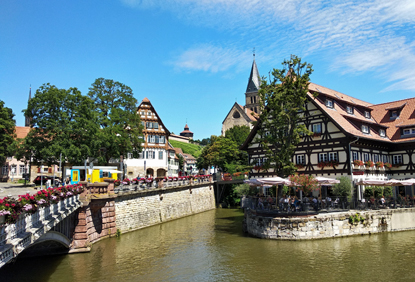
 Esslingen am Neckar (pop. 96,000) is a city known for its medieval centre, which contains over 200 well-preserved half-timbered houses, including what is considered to be Germany's oldest complete row of such houses, constructed in the early 14th century. This historic core remained largely undamaged during the Second World War. The main landmarks include the Church of St. Dionysius, which stands on foundations laid in the 8th century, and the Frauenkirche, an important example of late Gothic architecture. The Old Town Hall, first erected in the 15th century, displays a later Renaissance facade and an ornate astronomical clock. Overlooking the town and its surrounding vineyards are the remnants of the Esslingen Castle fortifications, offering views across the Neckar valley. The city also has a long history of wine production and is home to Germany's oldest producer of Sekt, or sparkling wine. |
|
Meersburg |
|---|

 Meersburg (pop. 6,000) is a town situated on the northern shore of Lake Constance (Bodensee in German). he town is renowned for its two contrasting castles: the medieval Burg Meersburg, believed to date from the 7th century and recognised as Germany's oldest inhabited castle, and the baroque Neues Schloss, built between 1712 and 1760 as a former residence of the prince-bishops of Konstanz. The town is divided into an upper town (Oberstadt) and a lower town (Unterstadt), both pedestrianised areas connected by steep streets and stairways, featuring well-preserved medieval architecture including half-timbered houses and cobblestone streets. Meersburg's hillside location is characterised by terraced vineyards that produce local wines, particularly the regional speciality rosé known as "Weissherbst" and pinot noir varieties. The town serves as a gateway to Lake Constance attractions, with regular ferry services connecting to destinations such as Konstanz and the flower island of Mainau, whilst offering panoramic views across the lake towards the German Alps. |
|
Ravensburg |
|---|
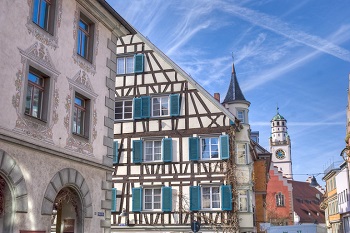
Situated approximately 23 kilometres north of Lake Constance, Ravensburg (pop. 50,000) is renowned for its remarkably well-preserved medieval town centre. First mentioned in historical records in 1088, Ravensburg gained prominence during the Middle Ages as a Free Imperial City and major trading hub, home to the influential "Great Ravensburg Trading Society" which operated trading companies across Europe from around 1380 to 1530. Today, the city is distinguished by its spectacular medieval skyline featuring 17 towers and gates from various historical periods, earning it the nickname "the city of towers and gates". Ravensburg is also internationally recognised as the headquarters of the Ravensburger board game and puzzle company, established here in the late 19th century, which has led to its additional moniker as "the city of games". The historic city centre remains largely intact with its defensive walls, patrician houses, Gothic churches, and medieval trading quarters, making it one of the most attractive and well-preserved medieval cities in southern Germany. |
|
Schwäbisch Hall |
|---|

 Schwäbisch Hall is a town situated in the valley of the River Kocher. Its development was shaped by the production of salt, which brought prosperity and led to its status as a Free Imperial City for five centuries. The town centre is characterised by its medieval and half-timbered buildings, including the large market square, which is dominated by St. Michael's Church and its prominent outdoor staircase. The town also features the Kunsthalle Würth, a gallery for modern and contemporary art, and the Hällisch-Fränkisches Museum, which details regional history. Covered wooden bridges cross the river, connecting the different parts of the old town. |
|
Tübingen |
|---|

Tübingen (pop. 93,000), a charming university town in southwestern Germany, is nestled along the Neckar River in the state of Baden-Württemberg. With a history dating back over 900 years, this picturesque city is renowned for its well-preserved medieval old town, featuring steep steps, narrow lanes, and pointed gabled houses. Home to the prestigious University of Tübingen, founded in 1477, the city boasts a vibrant academic atmosphere with nearly one-third of its 90,000 residents being students. Tübingen offers a blend of cultural attractions, including the imposing Hohentübingen Castle, the Gothic Stiftskirche, and numerous museums showcasing art and archaeology. The town's lively market square, crowned by the 15th-century Town Hall with its ornate astronomical clock, serves as a focal point for local life and events. |
|
Wertheim am Main |
|---|
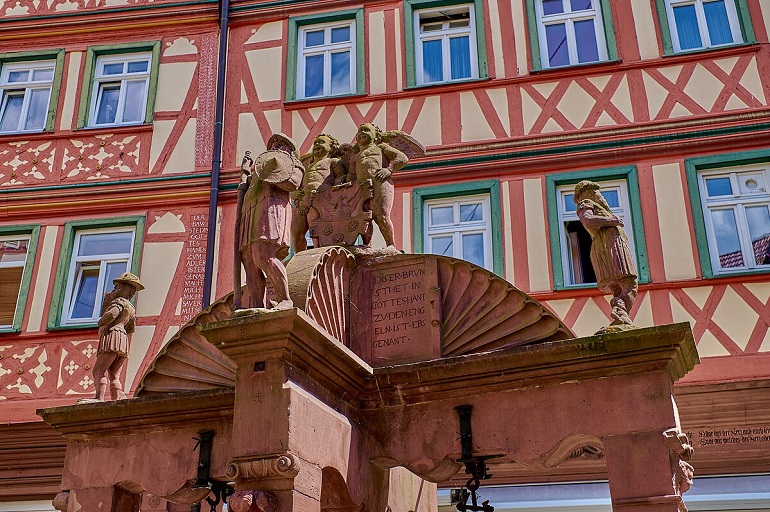
Wertheim am Main (pop. 23,000) is a historic medieval town positioned at the confluence of the Rivers Main and Tauber. The town is characterised by its well-preserved medieval old town (Altstadt), which features a network of narrow streets and numerous half-timbered houses dating from the 16th to 18th centuries, including the notable "Blue House." Overlooking the town from a wooded hillside are the ruins of Wertheim Castle, a stone fortress that dates back to the 12th century. Wertheim is renowned for its glass-making tradition, particularly crystal production, and houses several museums including the Glasmuseum and the Castle Museum. The town also serves as a gateway to the Romantic Road tourist route and offers access to the surrounding Franconian countryside and vineyards. The former Cistercian monastery, Kloster Bronnbach, located nearby, is another significant architectural highlight. |
| Bamberg ※ |
|---|

 Bamberg (pop. 80,000), one of Germany's most beautiful cities, boasts a splendid blend of Romanesque, Gothic, Renaissance and Baroque styles, with the full package of timber-framed houses, stone fortifications and archiepiscopal palaces. The city's remarkably preserved medieval Old Town, a UNESCO World Heritage Site since 1993, features over 1,300 listed buildings and showcases a harmonious blend of Romanesque and Gothic architecture. Built at 262 metres above sea level, this city of 73,300 residents is often called the Franconian Rome due to its religious heritage and hillside setting. |
| Dinkelsbühl |
|---|

Dinkelsbühl, a former Free Imperial City, is a pleasant and colourful historical town situated on the Romantic Road, approximately halfway between Nuremberg and Stuttgart. It is notable for its exceptionally well-preserved medieval old town, which is still encircled by its original 15th-century walls, complete with towers and gateways. The town escaped destruction during both the Thirty Years' War and the Second World War, leaving its architectural heritage intact. Key landmarks include the Gothic St. George's Minster, the historic marketplace (Weinmarkt), and a collection of colourful, half-timbered houses. |
| Nördlingen |
|---|

Nördlingen is a medieval town that is uniquely situated entirely within the Ries impact crater, a depression left by a meteorite some 15 million years ago. It is one of only three towns (along with Rothenburg and Dinkelsbühl) in Germany with a completely intact city wall, which dates back to the 14th century. Visitors can walk the full 2.7-kilometre circuit of these fortifications, offering views of the historic town centre's red-tiled roofs and narrow streets. At the heart of the town is St. Georg's Church, whose 90-metre bell tower, nicknamed the "Daniel", provides a panoramic view that extends to the crater's rim. |
| Nuremberg |
|---|
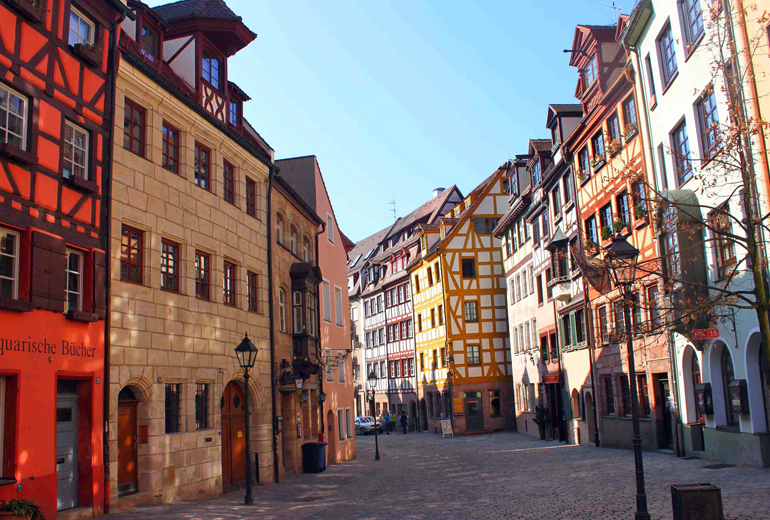
Nuremberg, the second-largest city in Bavaria with 545,000 inhabitants, combines medieval heritage with modern urban life. The city sits on the Pegnitz River and features the Nuremberg Castle, a medieval fortress built around 1140 that dominates the skyline. As the unofficial capital of the Franconia cultural region, Nuremberg forms an urban area with neighboring cities Fürth, Erlangen, and Schwabach, encompassing approximately 3.6 million inhabitants. The city offers 54 different museums, including the Germanic National Museum which houses 1.3 million cultural artifacts. While 90% of the town was destroyed in 1945, many medieval-style areas were carefully rebuilt using the original stones, preserving the city's historical character. |
|
Rothenburg ob der Tauber |
|---|

Rothenburg ob der Tauber (pop. 12,000), meaning "Red fortress above the Tauber", is a beautifully preserved medieval town located in Bavaria, Germany. Perched on a plateau overlooking the Tauber River, this walled city is renowned for its well-preserved medieval old town, which attracts tourists from around the world. Founded in the 12th century and becoming a Free Imperial City in 1274, Rothenburg is one of only four towns in Germany that still have completely intact city walls. The town features cobblestone streets, colourful half-timbered houses, and numerous historical attractions including St. James' Church with its altar by Tilman Riemenschneider, the Medieval Crime Museum, and the town hall with its clock tower. Visitors can walk the 1.5-mile medieval wall that encircles the historic centre, offering splendid views of the town's architecture. Rothenburg is also part of the popular Romantic Road, a scenic route through southern Germany. |
|
Alsfeld |
|---|

Halfway between Marburg and Fulda, Alsfeld (pop. 16,000) is a charming small town with a 16th-century town hall and an exceptionally well-preserved medieval town centre, which features over 400 half-timbered buildings dating from the 13th to 17th centuries. The oldest timber-framed house dates from 1350, making it one of the oldest in the country. The town's picturesque market square, dominated by the Gothic town hall built in 1512-1516, serves as the heart of the old quarter and has earned Alsfeld recognition as part of the German Timber-Frame Road tourist route. The town is perhaps most famously associated with the Brothers Grimm fairy tales, as it claims to be the inspiration for Little Red Riding Hood's village, adding a cultural dimension to its appeal as a destination for history and literature enthusiasts. |
| Friedberg in der Wetterau |
|---|
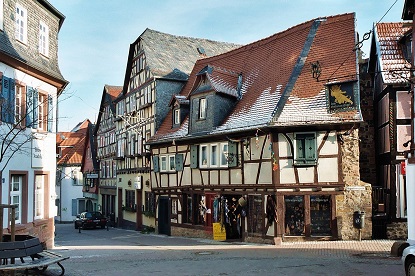
 Located approximately 30 kilometres north of Frankfurt am Main in the fertile Wetterau valley, Friedberg (pop. 31,000) occupies a prominent position on a basalt outcrop along the River Usa just before it joins the Wetter. The town's rich history dates back to Roman times, evidenced by archaeological remains of the ancient Castra Kapersburg, whilst its medieval heritage is preserved in the well-maintained old town featuring traditional half-timbered buildings and remnants of the medieval city walls. Friedberg's most prominent landmark is the imposing former imperial castle complex, which houses both the Adolf-Bartels-Museum and offers panoramic views over the surrounding countryside. |
|
Homberg an der Efze |
|---|

Homberg an der Efze is a small castle town with plenty of traditional timber-framed houses dating from the 15th to the 18th centuries. In 1526, Philip the Magnanimous converted the Landgraviate of Hesse to Protestantism while attending a synod in Homberg's St. Mary's Church, which earned it the nickname of "Reformation Church of Hesse". Overlooking the town are the ruins of Hohenburg Castle, which contains the deepest brick-lined castle well in Germany. Other key structures include the Gothic St. Mary's Church and parts of the old town wall. |
|
Lauterbach |
|---|

Lauterbach (pop. 2,700) is a small town at the foot of the Vogelsberg Mountains. The main attraction is Schloss Eisenbach, a 15th-century castle located 4 km south of the centre. It has belonged to the same family for nearly 600 years. The area features traditional half-timbered houses and offers recreational opportunities like hiking and cycling, particularly in the nearby nature parks. |
|
Limburg an der Lahn |
|---|

Limburg an der Lahn is one of the most famous timber-framed towns in Germany. The characteristic white-and-red buildings date from between the 13th and 18th century and include the oldest free-standing house in Germany. The town's most prominent landmark is Limburg Cathedral, a building of late Romanesque and early Gothic design that sits on a rock overlooking the Lahn river and is distinguished by its seven towers. Visitors can also cross the 14th-century stone Lahn Bridge and visit the Diocesan Museum, which contains the cathedral's treasury and other religious art. The town's layout is suitable for exploring on foot. |
|
Wetzlar |
|---|
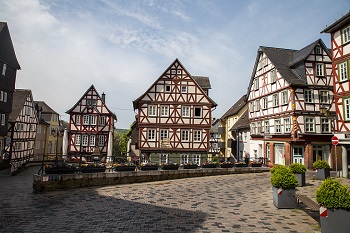
Wetzlar is situated on the River Lahn and is a principal centre of the country's optics industry. The town is also known for its connection to Johann Wolfgang von Goethe, whose work at the former Imperial Chamber Court (Reichskammergericht) here provided the setting for his novel The Sorrows of Young Werther. The well-preserved Old Town (Altstadt) contains half-timbered houses, medieval squares, and the Wetzlar Cathedral, a large church which remains architecturally incomplete and is used by both Catholic and Protestant congregations. Museums in the town cover its optical, legal, and literary heritage. |
| Celle |
|---|
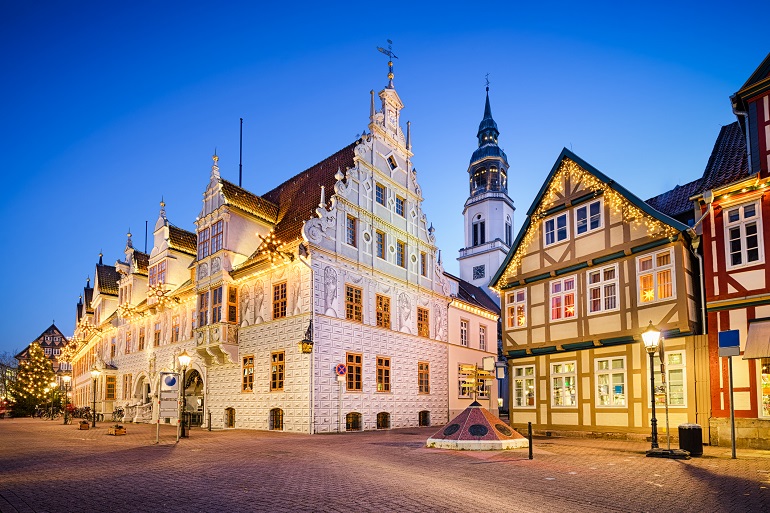
Celle (pop. 70,000) is a historic town situated on the banks of the River Aller at the southern edge of the Lüneburg Heath. The town is renowned for its remarkably preserved Old Town featuring around 450-500 half-timbered houses dating from the 16th to 18th centuries. Celle's most prominent landmark is its ducal palace, which dates back to 1292 and combines Renaissance and Baroque architectural styles. From 1378 to 1705, Celle served as the official residence of the dukes of Brunswick-Lüneburg. Today, the town is known for its cultural offerings, including the Bomann Museum, the Celle Museum of Art (the world's first 24-hour art museum), and the oldest working Baroque theatre in Germany housed within the palace. The town's picturesque setting, rich history, and well-preserved architecture make it a popular destination for both German and international visitors. |
| Goslar ※ |
|---|

Goslar (pop. 50,000), a thousand-year-old town nestled on the northern edge of the Harz Mountains in Germany, is a UNESCO World Heritage Site renowned for its rich history and well-preserved medieval architecture. Founded in the 10th century, this former imperial city boasts an impressive array of cultural treasures, including approximately 1,500 half-timbered houses dating from the 15th to 19th centuries, the Romanesque Imperial Palace, and the historic Rammelsberg Mine. The old town, largely surrounded by former defensive structures and green spaces, reflects the economic importance of mining in the region, with its layout and buildings showcasing the mutual balance of technical, social, and economic developments over a millennium of historical mining. |
| Göttingen |
|---|
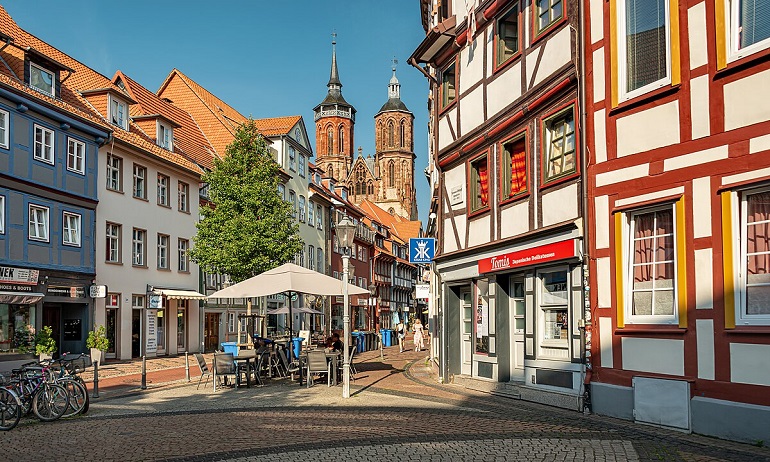
Göttingen (pop. 124,500) is a city that revolves around its university, a sort of German Cambridge or Oxford. Founded in 1734 by George II, King of Great Britain and Elector of Hanover, the University of Göttingen quickly became one of the most prestigious universities in Germany, spawning some 45 Nobel laureates. The town itself is encircled by former ramparts and features a largely preserved medieval layout with numerous half-timbered houses competing for the visitor's attention with neoclassical university buildings and medieval churches. But Göttingen's historical centre suffered from WWII like other German cities and it has lost its architectural homogeneity and authenticity. |
| Hamelin (Hameln) |
|---|

A major stop on the Fairy-Tale Road, Hamelin (Hameln in German ; pop. 56,000) is forever associated with the medieval story of Pied Piper of Hamelin. Popularised by the the Brothers Grimm, Goethe and Robert Browning in the 19th century, the legend tells how in the 13th century a piper hired for his rat-catching skills lured all the town's rodent into the Weser River with his magic pipe. When the town folk refused to pay for his services, Pied Piper led all the local children to drown in the river too. Hamelin's compact Old Town features well-preserved Renaissance and half-timbered buildings such as the Hochzeitshaus (Wedding House) and the Pied Piper’s House, alongside notable churches including St Boniface Minster. |
| Hildesheim (※) |
|---|

Hildesheim (pop. 101,500) is at the same time one of North Germany's oldest and newest cities. Pictures of the superb traditional timber-framed buildings on its market square hints at a well preserved historical centre. Yet Hildesheim was razed to the ground in 1945, and the market square was the only part of town reconstructed to its former glory, and not until the 1980's. So all the old building are in fact fairly new - though few visitors seem to care, as they are truly charming. Sadly the rest of town is pretty much undescript and soulless, apart from a few outstanding medieval stone churches scattered in the western and southern part of the city, including Hildesheim Cathedral (Mariendom), St. Michael's Church, St. Andrew's Church and St. Godehard Church. |
| Wolfenbüttel |
|---|

Located 12 km south of Braunschweig, Wolfenbüttel (pop. 53,000) is a relaxed historical town filled with half-timbered houses. It is one of the best preserved hsitorical towns in the northern half of Germany along with nearby Goslar and Quedlinburg. With origins dating back to the 10th century and first officially documented in 1118, this picturesque town combines rich history, stunning architecture and a vibrant cultural scene. For some 400 years until 1754, Wolfenbüttel served as the residence of the Dukes of Braunschweig and Lüneburg, with the impressive baroque Schloss Wolfenbüttel standing as testament to this period. |
| Bad Münstereifel |
|---|

Bad Münstereifel (pop. 19,000) is a historical spa town in the Eifel mountain range, situated on the river Erft. It is one of the rare towns in the Rhineland region to have kept its medieval ramparts intact. Known for its well-preserved medieval city walls and half-timbered houses, the town offers visitors a glimpse into its centuries-old heritage. It features a compact and walkable old town with notable structures such as the Romanesque St. Chrysanthus and Daria Basilica and several old city gates. |
| Monschau |
|---|

Sitting right across the Belgian border, concealed in a forested valley, Monschau is one of the Rhineland's best kept secrets, a jewel of timber-framed architecture protected by medieval ramparts. The town is situated in a valley along the Rur River, offering scenic walking trails and outdoor activities. Monschau also has a number of museums, including the Red House, which provides insight into local cloth manufacturing. |
|
Bernkastel-Kues |
|---|

Bernkastel-Kues is divided by the Mosel River into two main districts, Bernkastel and Kues, which are linked by a bridge. It is a recognised health resort and serves as the centre of the Middle Mosel wine region, particularly known for its Riesling wines grown on steep vineyards. Key landmarks include the medieval market square in Bernkastel, which features numerous half-timbered houses and a town hall built in 1608. Overlooking the town are the ruins of Landshut Castle. The Kues district is the location of the St. Nikolaus-Hospital, a 15th-century almshouse founded by the philosopher and theologian Nicholas of Cusa, who was born there. The local economy is significantly based on viticulture and tourism, with activities such as wine tasting, river cruises, and hiking available to visitors. |
|
Cochem |
|---|

Set on the banks of the Moselle River and surrounded by vineyards, Cochem is noted for Reichsburg Cochem, a hilltop castle reconstructed in the 19th century, which provides panoramic views over the valley. The historic old town features winding streets, half-timbered houses dating back to the Middle Ages, and a market square with a Gothic town hall and daily chimes. Visitors can explore the riverside promenades, sample local Riesling wines, ride the Cochemer Sesselbahn (chair lift) for views of the area, and enjoy river cruises along the Moselle. Cochem is also close to hiking trails, a historic mustard mill, and a Cold War-era Bundesbank bunker open to tours. Despite its population of just over 5,000, the town serves as a focal point for exploring the Moselle valley and its cultural sites. |
| Neustadt an der Weinstrasse |
|---|
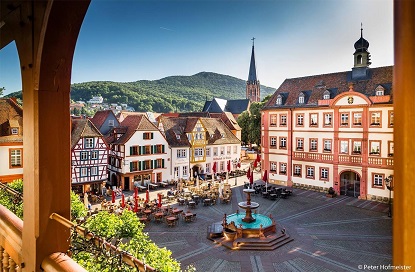
Neustadt an der Weinstrasse is a town situated on the German Wine Route and acting as a primary centre for the region's wine production. The town centre contains a market square with its Gothic collegiate church, alongside streets of well-preserved half-timbered houses. Nearby, Hambach Castle stands on a hill overlooking the town; it was the location of the 1832 Hambach Festival, a key event in the history of German democracy. Positioned on the edge of the Palatinate Forest, the area offers numerous walking and cycling trails, and each autumn the town hosts the German Grape Harvest Festival, which includes the election of the German Wine Queen. |
| Quedlinburg ※ |
|---|

Quedlinburg (pop. 23,000), a UNESCO World Heritage site nestled at the northeastern edge of the Harz Mountains in Germany, boasts over 1,000 years of rich history. The medieval town is renowned for its exceptional collection of 2,069 well-preserved half-timbered houses spanning eight centuries, making it one of Germany's largest area monuments covering nearly 90 hectares. |
| Stolberg |
|---|

Founded in the year 1000 as mining settlement deep in the Harz mountains, Stolberg (pop. 1,300) became the seat of a county in 1210, then of the Principality of Stolberg-Wernigerode. The pocket-sized town is dominated by the grand Renaissance castle. The town is known for its cohesive ensemble of half-timbered houses. |
| Wernigerode |
|---|

Wernigerode (pop. 32,000), known as "the colourful town of the Harz Mountains," is a picturesque destination located on the northern edge of the Harz Mountains in Germany. This charming town is renowned for its well-preserved historic centre featuring lavishly restored half-timbered houses and cobbled streets. |
| Eisenach ※ |
|---|
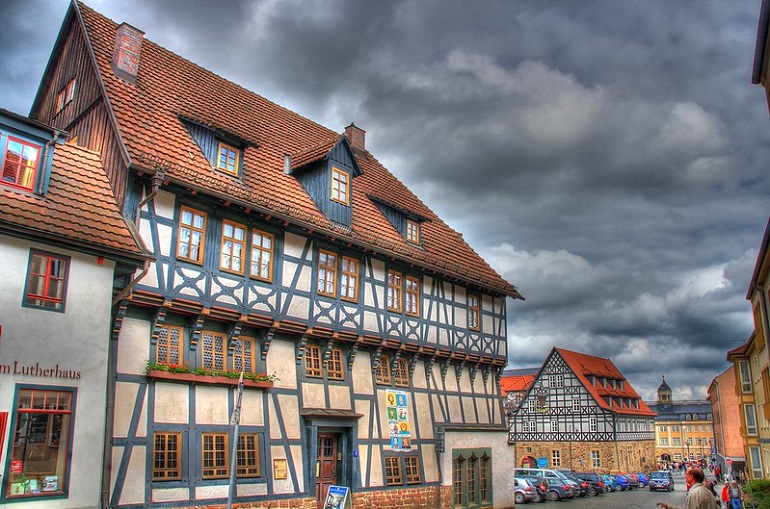
Set in the northern foothills of the Thuringian Forest, the charming Renaissance town of Eisenach (pop. 42,500) is famous for being the birthplace of Johann Sebastian Bach. Martin Luther spent his childhood here too, and spent ten months in hiding at Wartburg Castle, where he translated the New Testament from Greek to German, the first translation into a modern language in over a millennium. Richard Wagner's opera Tannhäuser is based on the famous Minstrels' Contest that took place at Wartburg around 1207. |
| Mühlhausen |
|---|
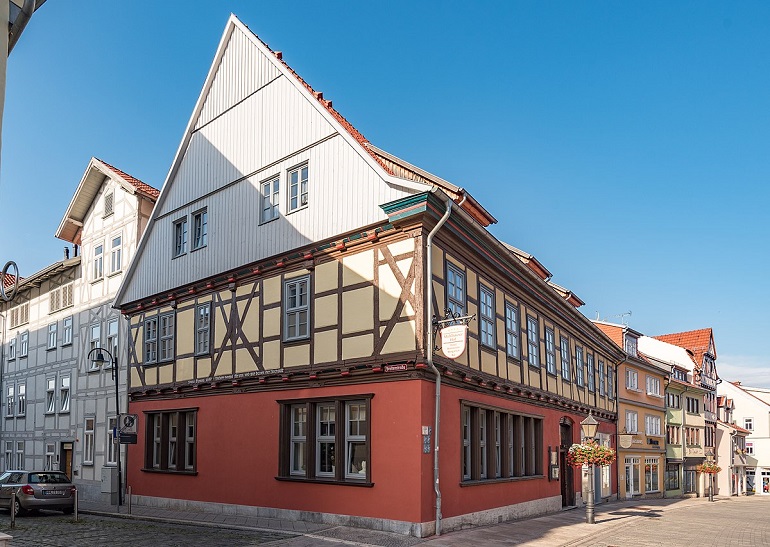
Once a Free Imperial City, Mühlhausen (pop. 36,000) is one of the oldest towns in Thuringia. It is still enclosed with its 3 km long city wall and has a good number of timber-framed houses. The town served as an important centre during the Middle Ages and features more than ten churches within its old town, including the prominent St. Mary’s Church and St. Blaise’s Church. |
German Timber-Frame Road (Deutsche Fachwerkstraße)
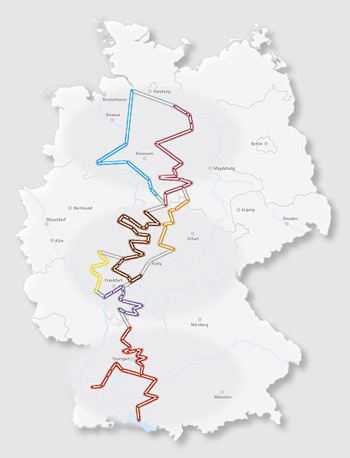
The German Timber-Frame Road is divided into the following seven regional sections, roughly from north to south:
- From the River Elbe to the Weser Uplands (marked blue in the map)
- Stade - Nienburg, Lower Saxony - Bad Essen - Stadthagen - Northeim - Einbeck - Bad Gandersheim - Alfeld
- From the River Elbe plains to the Harz mountains (marked dark red in the map)
- Bleckede - Hitzacker - Dannenberg - Lüchow - Salzwedel - Celle - Königslutter - Wolfenbüttel - Hornburg - Bockenem - Osterwieck - Halberstadt - Wernigerode - Osterode - Duderstadt
- From the Weser Uplands via Northern Hesse to the Vogelsberg Mountains and the Spessart Mountains (marked brown in the map)
- Hannoversch Münden - Eschwege - Hessisch Lichtenau - Spangenberg - Melsungen - Wolfhagen - Bad Arolsen - Korbach - Fritzlar - Homberg (Efze) - Rotenburg an der Fulda - Bad Hersfeld - Schwalmstadt - Alsfeld - Schlitz - Lauterbach - Grünberg - Lich - Butzbach - Büdingen - Gelnhausen - Steinau an der Straße
- From the Harz mountains to the Thuringian Forest (marked orange in the map)
- Stolberg - Bleicherode - Worbis - Mühlhausen - Wanfried - Treffurt - Vacha - Schmalkalden
- From the river Lahn valley to the Rhine District (marked yellow in the map)
- Dillenburg - Herborn - Wetzlar - Braunfels - Hadamar - Limburg - Bad Camberg - Idstein - Eltville
- From the river Rhine to the river Main and the Odenwald mountains (marked purple in the map)
- Trebur - Dreieich - Hanau-Steinheim - Seligenstadt - Babenhausen - Dieburg - Groß-Umstadt - Wertheim - Miltenberg - Walldürn - Erbach - Reichelsheim
- From the river Neckar to the Black Forest and Lake Constance (marked red in the map)
- Mosbach - Eppingen - Besigheim - Bietigheim-Bissingen - Vaihingen an der Enz - Markgröningen - Marbach - Backnang - Waiblingen - Schorndorf - Esslingen - Kirchheim unter Teck - Bad Urach

|




